


How to Build Dedicated Development Team in 2025
Learn how to build a dedicated development team, choose the right roles, compare costs, and manage collaboration for faster, scalable product growth.
6 min read
Loading…
Not all dedicated teams are built the same; choosing the right type can make or break your project’s success.
Written by: Nasif Sid Created on: 24 Sept 20257 min to read

When businesses look for smarter ways to grow, they often turn to types of dedicated team models, from full teams that handle everything to specialized groups focused on design, QA, or research. Each type serves a unique project need.
Well, in the tech world, talent gaps can stall progress. That’s why many companies choose dedicated teams instead of juggling freelancers or rushing in-house hires. These teams work like an extension of your staff, but with more flexibility.
The exciting part? You’re not stuck with a one-size-fits-all option. By picking the right type of dedicated team, you get the skills, speed, and focus your project needs. Let’s find out in this blog!
A dedicated team is a group of professionals hired from an outsourcing partner to work only on your project. They can include developers, designers, testers, and managers, and they act as part of your in-house team.
Here’s how this model compares:
A dedicated team gives you the best of both worlds: the focus of in-house staff with the flexibility and cost savings of outsourcing.
Companies choose different types of dedicated teams because every business has different needs and goals. A startup won’t face the same challenges as a large enterprise, so the type of team they pick depends on where they are and what they want to achieve.
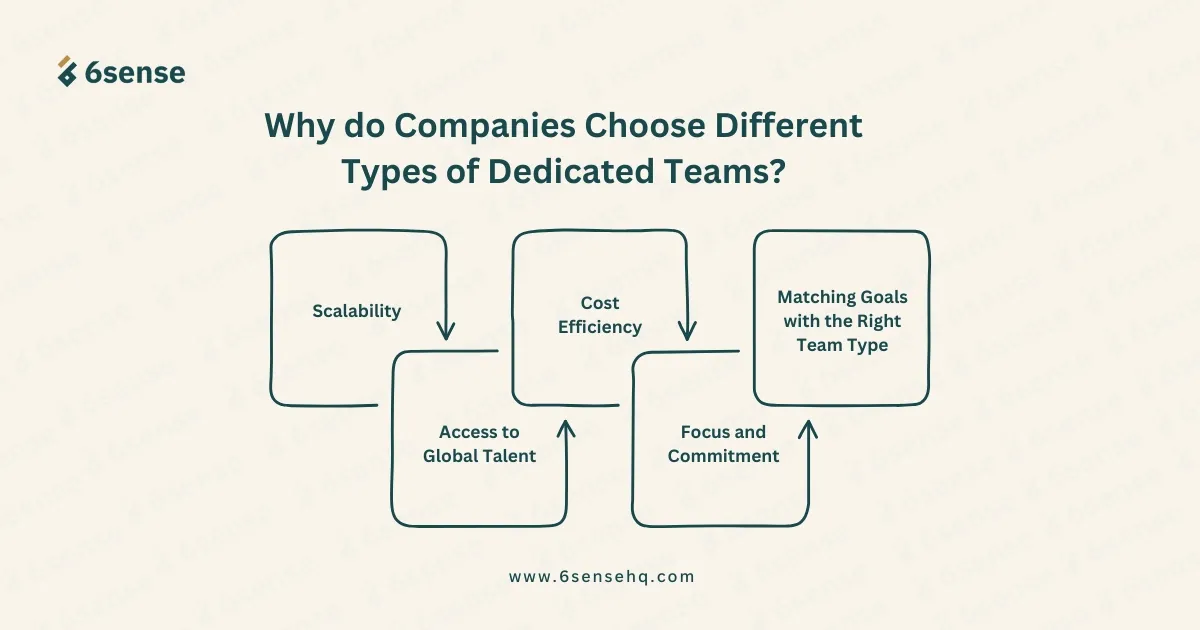
Businesses like the flexibility to scale up or down quickly. A dedicated team makes that possible; you can add more developers during peak work or reduce the team once things slow down. The agility saves time and helps projects move at the right pace.
Hiring locally can take months, but with a dedicated team, you tap into worldwide expertise right away. In fact, according to Statista, the IT outsourcing market is projected to hit $588.38 billion by 2025. It proves that more companies are looking beyond borders to fill skill gaps faster.
Dedicated teams cut out many overhead costs. Companies don’t need to worry about office space, payroll taxes, or employee benefits. Instead, they pay for a ready-to-go team and get predictable costs. This makes it easier to plan budgets while still getting high-quality work.
Unlike freelancers juggling multiple projects, dedicated teams work only on your tasks. The focus means faster progress, fewer mistakes, and better results. Some providers even manage recruitment and operations for you, so you lead direction while they handle the heavy lifting behind the scenes.
Not all teams look the same. Some businesses need a full software development squad to build products from scratch. Others may prefer a small R&D team exploring new ideas, or a support team keeping systems running smoothly. The choice depends on the company’s unique priorities.
Dedicated teams come in different forms, and the best fit depends on your specific project size, complexity, and goals. You can look at them by structure, by function, or by industry focus.
Each type brings unique strengths, so let’s break them down in a simple way.
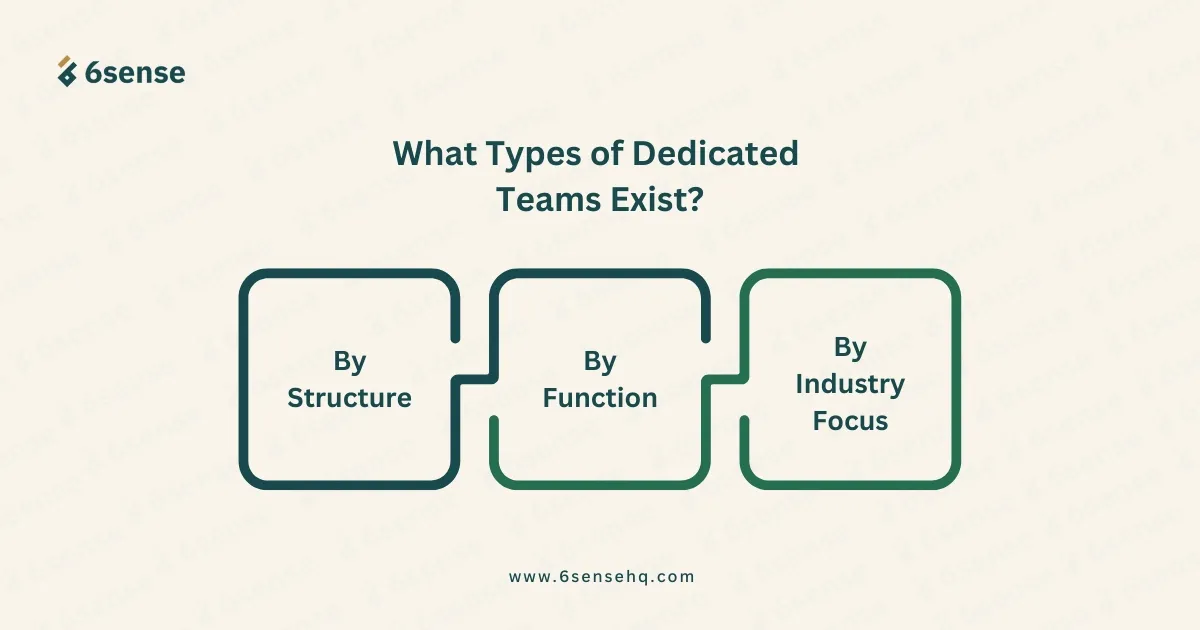
Some companies require a full-team model that encompasses all aspects, including project managers, developers, testers, and designers, working together in a long-term collaboration.
Others may only need an extended team to add missing skills like DevOps or mobile experts. Then there are specialized teams focused on one niche, such as cybersecurity or blockchain, offering targeted expertise for complex challenges.
Understanding these structural differences helps clarify the dedicated team characteristics you should prioritize such as ownership, focus level, collaboration depth, and long-term alignment, before choosing a model.
Teams can also be grouped by what they actually do. Dedicated software development teams handle core coding and product building. QA and testing teams ensure quality through checks and automation. DevOps experts manage infrastructure and cloud operations.
Then, R&D groups explore new ideas, while consulting teams guide digital strategy. Support and maintenance teams focus on keeping systems stable, secure, and updated.
Finally, some teams are tailored to specific industries. Fintech projects need experts in compliance and security. Healthcare teams focus on data privacy and regulations like HIPAA. E-commerce requires scalable platforms and smooth payment systems.
Moreover, Telecom and IoT solutions depend on real-time performance, while blockchain teams specialize in building smart contracts, wallets, or DeFi products. Each industry demands its own know-how.
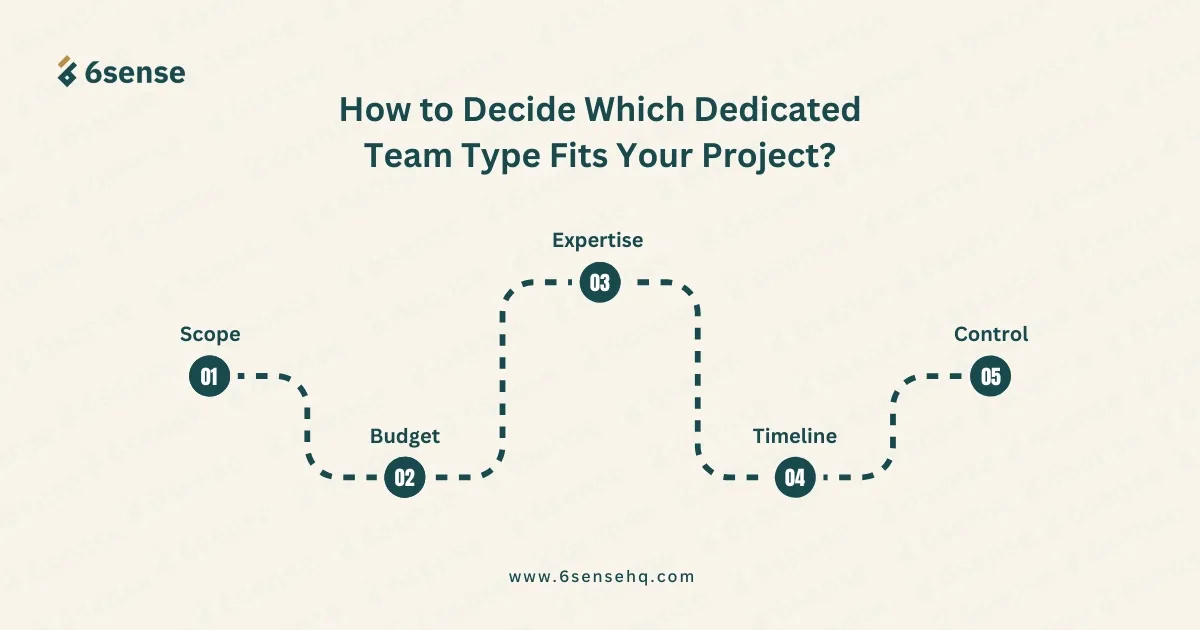
The right dedicated development teams depend on your project’s needs, things like scope, budget, expertise, timeline, and control. Thinking about these factors makes it easier to choose a team model that actually works best for you.
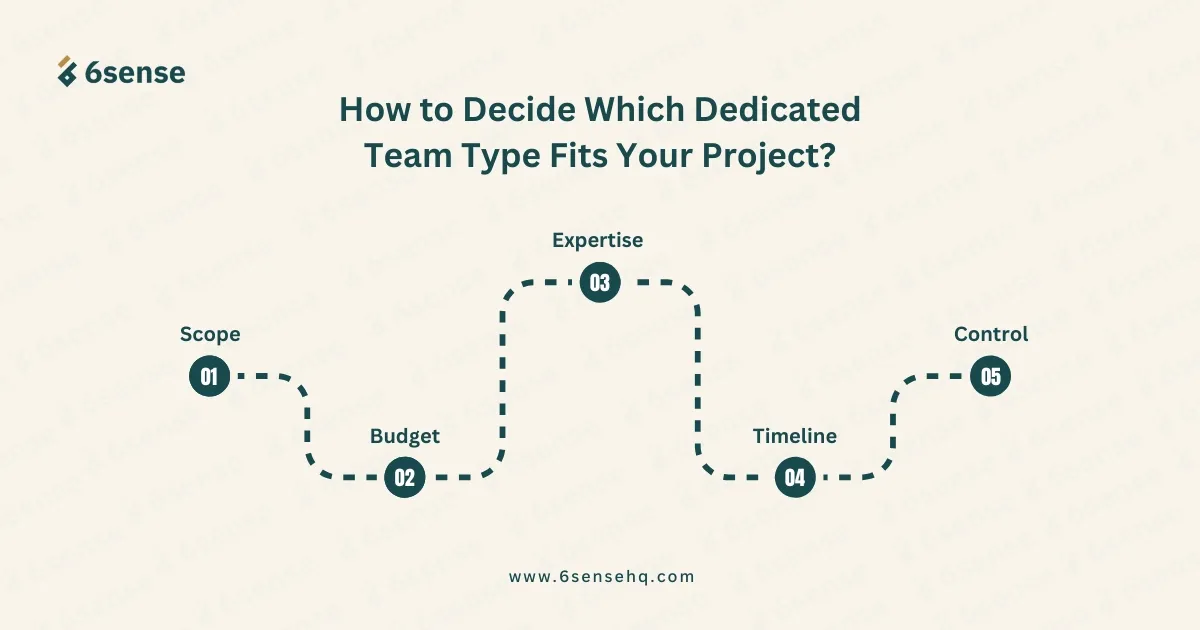
If your project is long-term and keeps evolving, a full team or an extended team is your safest choice. They give stability, flexibility, and enough talent to adapt as your product grows over time.
When money is tight but you still want great results, specialized teams are a smart pick. You get exactly the experts you need for specific tasks without paying for extra roles you don’t require.
If you’re moving into a new space like AI, blockchain, or IoT, you’ll need specialized knowledge. An R&D team or an industry-focused group brings the right experience to handle those tricky technologies and domains.
Need to launch fast? A mixed dedicated team with developers, testers, and a project manager can speed things up. Everyone works together from day one, which shortens delays and helps you hit deadlines more easily.
If you want close oversight, an extended team is better since you direct their work daily. But if you prefer less project management stress, a full-team model lets the vendor handle coordination while you focus on strategy.
Even though dedicated teams are a powerful model, they do come with challenges. Knowing these early helps you prepare better and avoid mistakes that can slow down your project or make things more costly.
Working across time zones and languages can sometimes create delays or misunderstandings. If team members aren’t aligned on goals and processes, simple tasks may take longer, and collaboration can feel frustrating instead of smooth.
Dedicated teams need proper structure. Without clear processes, tools, and regular check-ins, remote coordination becomes messy. It can lead to missed deadlines or confusion about responsibilities, especially in bigger, more complex projects.
Putting all responsibility on an external team can be risky. If you ever want to switch vendors or move work in-house, it may feel overwhelming without the right transition plans or documentation in place.
Dedicated teams take time to set up and integrate, so they’re not the best option for short projects. They work better for long-term needs, ideally 12 months or more, where continuity really pays off.
If your in-house and dedicated teams don’t blend well, silos can form. Poor integration means duplicated work or misaligned goals, which hurts productivity. Building trust and open communication between both sides is key.
The right dedicated team isn’t just about outsourcing; it’s about building a long-term partnership that strengthens your business. By choosing wisely among different types of dedicated team models, whether structural, functional, or industry-specific, you can match skills to your exact goals.
Furthermore, a well-managed team helps you scale efficiently, cut risks, and innovate faster. Remember, the right approach to dedicated teams can be the difference between simply keeping up and leading the market.
So what do you think? If you’re looking for a reliable, dedicated team, partner with 6sense HQ. It delivers talent, strategy, and results customized to your vision.
Learn how to build a dedicated development team, choose the right roles, compare costs, and manage collaboration for faster, scalable product growth.
6 min read

Racing against the clock to ship your MVP? A dedicated development team gives you immediate access to skilled engineers, predictable output, and a streamlined build process. So you can validate your product faster without getting stuck in hiring cycles or management overhead
6 min read

This breakdown of the dedicated development team structure shows exactly who you need, why you need them, and how each role keeps your product moving without friction.
8 min read