


How to Build Dedicated Development Team in 2025
Learn how to build a dedicated development team, choose the right roles, compare costs, and manage collaboration for faster, scalable product growth.
6 min read
Loading…
A dedicated team can be your biggest advantage or your biggest overhead; it all depends on how you use it.
Written by: Nasif Sid Created on: 18 Sept 20256 min to read

When your project needs focus, speed, and the right skills, hiring a dedicated development team can be a smart move. The pros and cons of hiring a dedicated team mostly come down to flexibility, expertise, and control vs. cost and management effort.
This model gives you a remote team of developers, designers, testers, and more, who work only on your project. They operate like your own team, but without the hassle of hiring, training, or setting up office space.
In this blog, I’ll walk you through everything you need to know, what makes this model great, where it falls short, and how to decide if it’s the right fit for your business.
Let’s dive in.
Because it helps them move faster, spend less, and access better talent. The pros and cons of hiring a dedicated team make it a hot choice, and for many companies, the pros are winning.
Here’s what’s driving this shift:
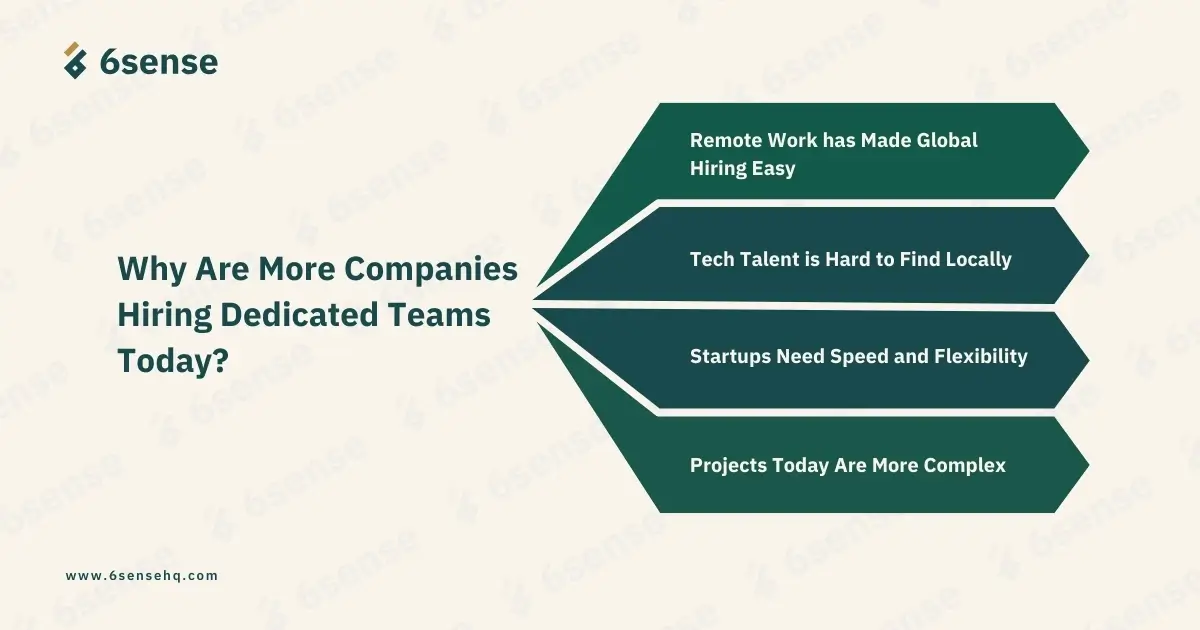
Ever since remote work became the norm, it’s easier than ever to hire talent from around the world. Tools like Zoom, Slack, and Trello make working with a remote team feel just like having them in your office, but without the overhead.
Good developers are in high demand and short supply, especially in competitive markets. With a dedicated team, companies can reach into global talent pools and find the right people faster, skipping the long delays of traditional hiring.
Startups often don’t have the time or money to build full in-house teams. A dedicated team lets them hit the ground running, scale quickly, and avoid the costs of HR, office space, and training. It’s a faster path to MVP or launch.
Modern software needs specialized skills, think AI, DevOps, or blockchain. Instead of training internal teams from scratch, businesses bring in dedicated experts who already know the ropes. That means fewer mistakes and a much faster build.
The dedicated team model gives you full control, flexibility, and deep commitment, but it also requires hands-on project management and can bring cost unpredictability.
Here's a quick view of the main pros and cons:
| Pros | Cons |
| Full project focus | Needs active management |
| Flexible team scaling | Not ideal for short-term work |
| Access to specialized talent | Variable monthly costs |
| Seamless team integration | Possible time zone issues |
| High level of control | Slower initial setup |
| Strong long-term alignment | Risk of team fatigue |
The biggest pros of hiring a dedicated team are control, speed, and flexibility. You get full-time experts focused only on your dedicated project, and you can scale easily without the hassle of hiring in-house.
Here’s why this model works so well:
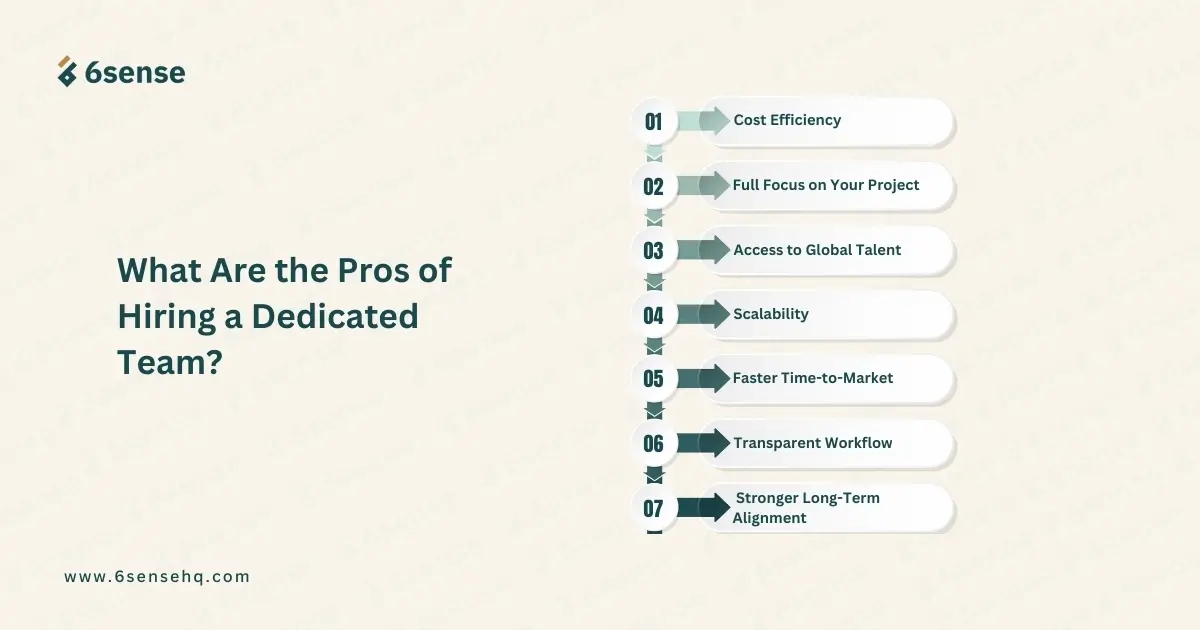
You save money by skipping office rent, hiring fees, and full-time employee benefits. Nearshore or offshore teams often charge much less than local hires, helping you cut costs by up to 60% without sacrificing quality.
Dedicated teams aren’t juggling multiple clients. They work only on your project, which means better attention to detail, fewer delays, and better alignment with your business goals from day one.
Need a blockchain developer? Or someone great at UX? You can hire from a global talent pool, which gives you access to experts you might never find locally, especially for niche or advanced tech skills.
If your project grows, you can quickly add more people. If things slow down, you can reduce the team. This kind of flexibility is hard to achieve with full-time, in-house staff.
Dedicated teams are ready to go, and they often have development processes in place to move fast. You get your product development quicker by avoiding long hiring delays and working in parallel on design, development, and testing.
You stay in the loop at all times. Most teams use tools like Jira, Slack, or Trello to track progress, and they’ll send updates regularly, so you always know what’s happening and what’s next.
For big projects like SaaS platforms or MVPs, a dedicated team becomes part of your journey. They learn your product inside out and stay committed through multiple iterations and releases, just like an internal team.
The biggest cons of hiring a dedicated team are the need for hands-on management and the risk of hidden costs. While the model offers focus and flexibility, it also requires effort to keep communication smooth and budgets on track.
Here are the common challenges of working with a dedicated team:
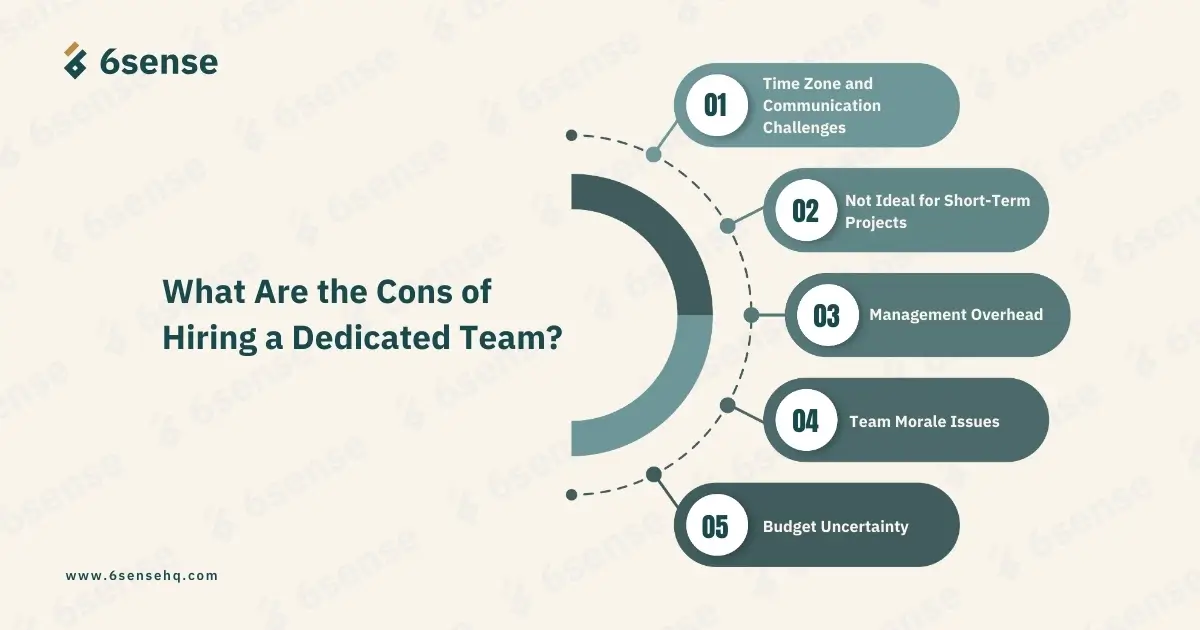
If your team is working in a different time zone, delays can happen. Scheduling meetings or solving urgent issues may take longer, especially without overlap in working hours. Clear communication plans are a must to avoid misunderstandings or project slowdowns.
If you have a small or one-time project with clear goals, hiring a dedicated team may not be worth it. A freelancer or fixed-price contract could save time and money without the need to manage a full team setup.
Dedicated teams need guidance. You or someone on your team must manage workflows, answer questions, and give feedback regularly, in the beginning. Without this, progress can stall or go off track.
If the work gets too repetitive or lacks variety, team members may lose motivation. Unlike in-house staff, it’s harder to spot and fix morale issues in a remote setup, which can hurt performance over time.
While the base cost is predictable, adding new team members, changing scope, or extending timelines can raise your overall budget. Without careful planning, costs may grow more than expected, especially in long-running projects.
If you're working on a long-term, flexible, or complex project, the dedicated team model is likely a great fit. It gives you a team that ticks to the whole checklist and feels like your own. It’s also ideal when you want control, quick scaling, and deep collaboration.
It’s best used when your product will grow over time, your scope isn’t fully defined yet, or you don’t have the right tech skills in-house. You’ll get consistent support and room to pivot as needed.
But if your project is short-term, fixed in scope, or you can’t manage a remote team actively, it might not be worth it. In fact, 70% of companies outsource to cut costs and improve efficiency, according to Deloitte.
Hiring a dedicated development team isn’t just about filling roles; it’s a strategic choice. If you understand the pros and cons of hiring a dedicated team, you’ll know it offers big wins in flexibility, speed, and expertise. But to make it work, you need clarity.
Know your project goals, timeline, and budget. Make sure the team fits your tech needs and company culture. Set up clear tools for communication and decide who on your team will manage the partnership. When done right, this model can feel like an extension of your own team.
Looking to build a focused, flexible team? 6sense can help; we connect you with the right talent for long-term success. Contact us today.
Learn how to build a dedicated development team, choose the right roles, compare costs, and manage collaboration for faster, scalable product growth.
6 min read

Racing against the clock to ship your MVP? A dedicated development team gives you immediate access to skilled engineers, predictable output, and a streamlined build process. So you can validate your product faster without getting stuck in hiring cycles or management overhead
6 min read

This breakdown of the dedicated development team structure shows exactly who you need, why you need them, and how each role keeps your product moving without friction.
8 min read