


How to Build Dedicated Development Team in 2025
Learn how to build a dedicated development team, choose the right roles, compare costs, and manage collaboration for faster, scalable product growth.
6 min read
Loading…
The right dedicated team isn’t just about location; it’s about finding the balance between cost, control, and collaboration.
Written by: Nasif Sid Created on: 19 Sept 20256 min to read

The better choice between offshore vs onshore dedicated team depends on your priorities: go offshore for cost savings and scale, choose onshore for real-time collaboration and local expertise.
If you’re a startup or a growing business, this decision can shape your product's future. Offshore teams help you move fast and save money, but come with time zones and communication challenges. Onshore teams are easier to work with but cost more.
In this blog, we’ll walk you through everything about choosing an onshore vs offshore dedicated team, from pricing and workflow to communication and scalability. This way, you can pick the model that fits your business best.
An offshore dedicated team is a group of software developers based in another country who work full-time on your project. It’s just like an in-house team, but at a much lower cost.
These teams are usually located in countries like Bangladesh, India, Eastern Europe, Southeast Asia, or Latin America. They work remotely but stay fully aligned with your goals, tools, and timelines.
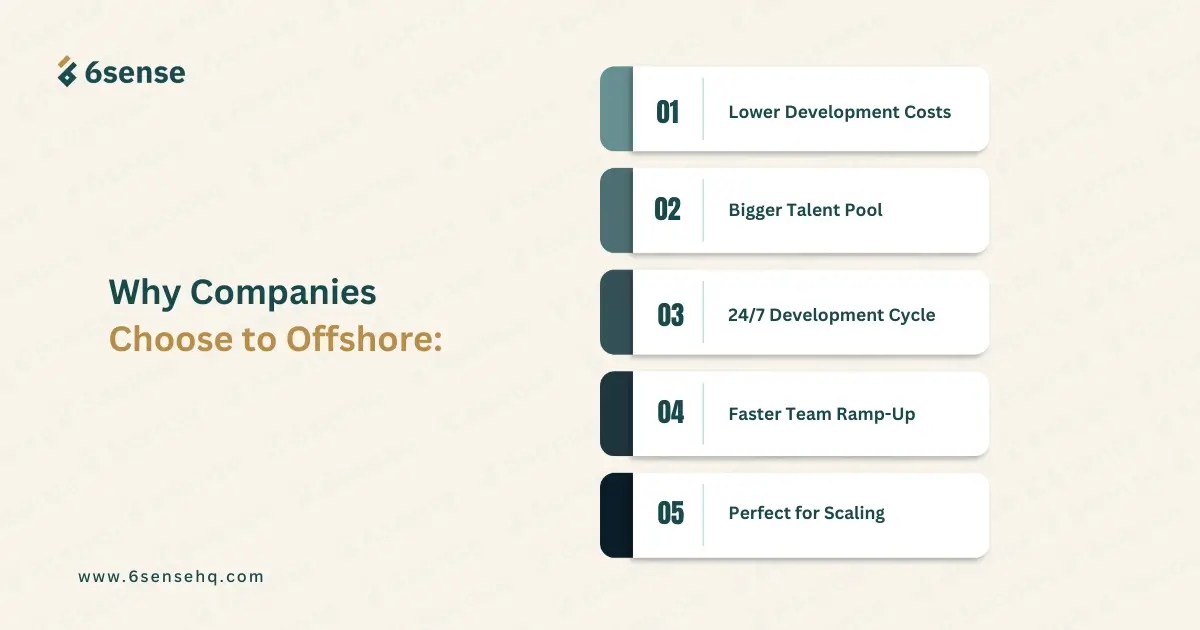
Offshore teams can save you 40-70% compared to hiring locally. Overhead, salaries, and taxes are much lower in offshore regions, which helps startups and growing businesses stretch their budget.
You get access to a global network of developers, including experts in hard-to-find technologies. Plus, offshore hiring helps you find the right skills fast, without being limited by your local job market.
With time zone differences, your offshore team can continue working while your local team is asleep. This leads to faster turnaround and shorter software development cycles, which are particularly helpful when deadlines are tight.
Offshore agencies like 6sense Technologies already have experienced teams ready to go. You don’t have to start from scratch; you can kick off development within days, not weeks.
Moreover, offshoring makes it easy to add more developers as your needs grow. Whether you're building an MVP or maintaining an app, offshore teams give you the flexibility to scale up or down as needed.
An onshore dedicated team is a group of developers based in the same country as your business. They work full-time on your project with easy access to real-time collaboration and local market knowledge.
Furthermore, onshoring is often chosen for projects where fast communication, strong cultural alignment, or legal compliance is essential. These teams typically work in the same time zone as you, making day-to-day coordination smoother.
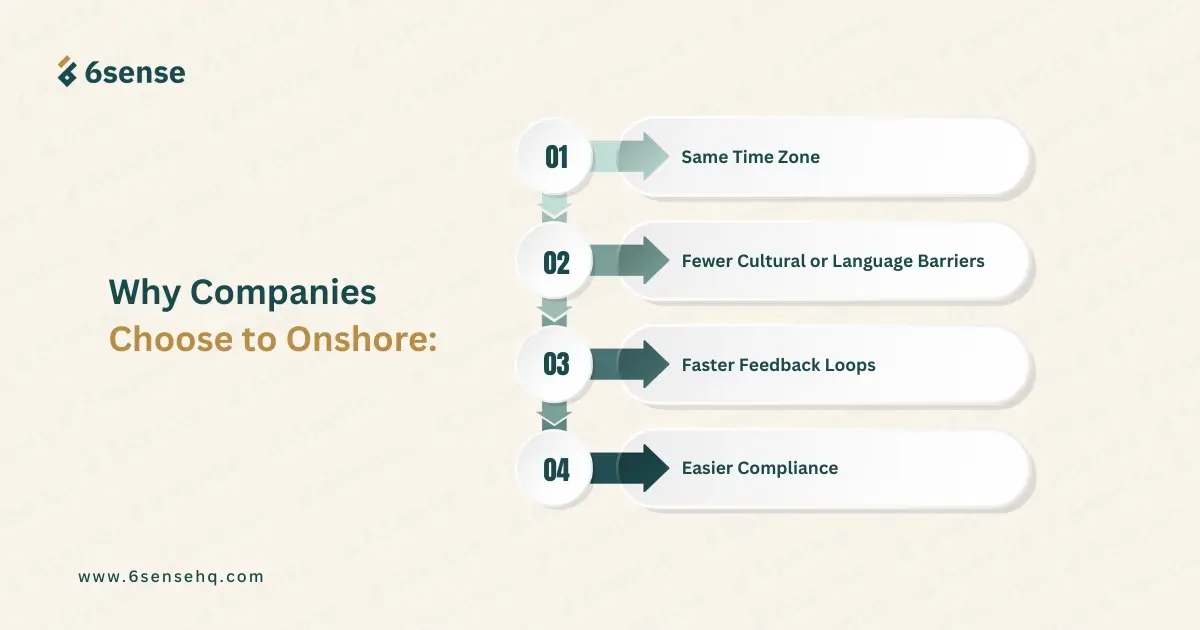
Your team works the same hours as you, so it’s easy to hop on quick calls, fix issues faster, and stay in sync; no need to wait overnight for updates or approvals.
Onshore teams usually speak your language fluently and understand your work style. It helps avoid confusion, speeds up onboarding, and builds trust more quickly across teams.
With no time zone delays, onshore teams can test, improve, and release faster, which is a significant advantage if you're working in agile sprints or launching frequent product updates.
Suppose you're in a regulated industry like healthcare or finance. In that case, onshore teams are more familiar with local laws, security rules, and documentation standards. This helps you avoid legal or data privacy risks.
The offshore dedicated team is better for speed and cost-efficiency, while the onshore dedicated team is best for close collaboration, quality control, and legal alignment. The right choice depends on your project needs and business priorities.
| Criteria | Offshore Team | Onshore Team |
| Cost | Lower (40–70% savings) | Higher due to local salaries & overhead |
| Talent Access | Global pool; easier to scale | Limited to the local market |
| Communication | Asynchronous; tool-dependent | Real-time; easier face-to-face |
| Compliance | May need extra legal review | Typically aligned with local laws |
| Scalability | Fast; developers ready to deploy | Slower due to hiring bottlenecks |
| Management Overhead | Higher; requires coordination | Lower, more seamless integration |
| Best For | MVPs, rapid scaling, cost-sensitive projects |
Onshore teams make communication and collaboration easier because they work in the same time zone and culture. In contrast, offshore teams need more planning, clear documentation, and strong processes to stay aligned.

Offshore teams usually work in different time zones, so communication isn’t instant. You’ll need to plan meetings and wait for replies. On the other hand, onshore teams work during the same hours as you, so decisions, feedback, and fixes happen much faster and without delay.
Well, offshore teams might speak a different native language or have different work styles, which can sometimes lead to misunderstandings. Onshore teams usually share your culture and language. This makes it easier to explain ideas clearly and get on the same page quickly.
Daily standups, sprint reviews, or last-minute catch-ups are much easier with onshore teams; you can just jump on a call. With offshore teams, you’ll need to schedule meetings around time zones and be more flexible with how you run your sprints.
Offshore teams rely more on detailed documentation to stay aligned. You need to be clear about goals, timelines, and tasks. Onshore teams are more flexible; you can change direction quickly during a call or a quick chat without writing everything down.
It can take longer to build trust and team spirit with offshore teams, especially if you’ve never met in person. Onshore teams are easier to connect with; you can meet face-to-face, bond over coffee, and create a strong sense of teamwork faster.
The best choice depends on your goals; consider going offshore to save money, onshore for better collaboration, or hybrid if you want a smart balance of both. Each model fits a different stage or type of project.
Here’s how to decide:
You’re building an MVP, working with a tight budget, and need to move fast. Offshore teams help you save money and scale quickly. Just make sure you have someone on your team (like a tech lead or PM) to manage the workflow.
Your product needs a lot of real-time input, quick changes, or regular feedback. Onshore teams are perfect for industries such as healthcare or finance, where rules are strict and communication needs to be super clear.
You want the best of both worlds. Use a local team for strategy and planning, and let your offshore team handle the coding or backend work. The setup works great when you're growing fast but still want to control costs.
Choosing between an offshore vs onshore dedicated team really depends on your company’s stage and priorities. Offshore teams are great if you want speed and cost savings, while onshore teams shine when collaboration and control matter most.
Moreover, a hybrid approach often gives the perfect balance, affordable execution with local oversight. In the end, the best choice is the one that matches your timelines, product goals, and how your team works best.
Get reliable, cost-efficient offshore software development with 6sense Technologies, your trusted partner for building smarter and scaling faster.
Learn how to build a dedicated development team, choose the right roles, compare costs, and manage collaboration for faster, scalable product growth.
6 min read

Racing against the clock to ship your MVP? A dedicated development team gives you immediate access to skilled engineers, predictable output, and a streamlined build process. So you can validate your product faster without getting stuck in hiring cycles or management overhead
6 min read

| High-touch projects, regulated industries |
This breakdown of the dedicated development team structure shows exactly who you need, why you need them, and how each role keeps your product moving without friction.
8 min read