


How to Build Dedicated Development Team in 2025
Learn how to build a dedicated development team, choose the right roles, compare costs, and manage collaboration for faster, scalable product growth.
6 min read
Loading…
The team you choose, offshore or in-house, can define how fast, how well, and how cost-effectively your product gets built.
Written by: Nasif Sid Created on: 22 Sept 202510 min to read

When choosing between an offshore dedicated team vs in-house team, the best option depends on your goals, but for speed, flexibility, and lower cost, offshore often wins. If you need tight control, collaboration, and long-term loyalty, in-house may suit you better.
Every company is different. Startups often go offshore to launch quickly without breaking the bank. Enterprises might mix both, building a strong internal team while outsourcing specific tasks to global partners.
In this blog, we’ll break down what makes each model unique, why businesses prefer one over the other, and how to decide what’s right for you.
Let’s start!
Offshore developers often cost significantly less than in‑house teams because salaries, benefits, and office costs are lower in many countries. Hiring in‑house usually requires paying full salaries, benefits, equipment, and workspace expenses. For many businesses, these savings make offshore a strong choice, especially when budget is tight or you want to stretch your runway further.
In‑house hiring can take months because companies must post jobs, screen candidates, interview, and negotiate offers. Offshore hiring especially with partners or agencies — often finds qualified developers in a few weeks. This means you can scale teams quickly and fill skill gaps faster, particularly when launching new features or growing rapidly.
In‑house teams benefit from shared time zones and face‑to‑face communication, which makes meetings, brainstorming, and problem solving easier. Offshore teams face challenges like time zone gaps, cultural differences, and remote collaboration. With good tools and structured processes, offshore communication works well, but it requires intentional planning to avoid delays.
In‑house developers often align more naturally with company culture and internal processes, which can improve quality and teamwork. Offshore teams can deliver high quality too, but it often depends on clear guidelines, good documentation, and strong project oversight. Some companies use hybrid practices to balance quality and cultural alignment.
In‑house teams usually make it easier to maintain strict security and compliance because developers work directly within your company’s infrastructure. With offshore teams, strong contracts, NDAs, and security protocols must be put in place to protect data and intellectual property. This is especially important for regulated industries.
In‑house developers can build deep knowledge about your systems and stay with your team for years, which supports long‑term product growth. Offshore developers can scale quickly and add skills fast, but retention depends on contracts and career paths. Many companies find success using both stable core teams in‑house and scalable support offshore.
A direct comparison clearly shows the trade‑offs between offshore and in‑house teams: offshore often wins on cost and fast scaling, while in‑house excels at cultural alignment, security, and tight collaboration. The choice ultimately depends on budget, project complexity, and long‑term goals.
Early stage startups often have limited budgets and need to stretch every dollar. Choosing offshore developers lets you hire skilled engineers at much lower cost compared to local hires, while still building valuable software. This can free up funds to focus on growth and core business activities instead of high salaries.
Offshore teams allow businesses to scale their product delivery without long‑term financial commitments. Instead of hiring full‑time in‑house developers with benefits and office costs, offshore partners provide flexible talent that can be adjusted based on project needs. This flexibility is great when deadlines are tight or workloads fluctuate.
Sometimes local hiring doesn’t give you the expertise you need, especially in niche areas like AI, DevOps, cloud, or mobile platforms. Offshore developers help fill these gaps, giving you access to global talent that you might not find nearby. This helps deliver quality features faster.
Offshore developers in different time zones can work while your local team sleeps. This means development never stops, deadlines are met fast, and urgent issues can be fixed quickly. Round‑the‑clock support is especially helpful when you have tight launch dates or need continuous progression.
For short term projects or early proofs of concept, offshore teams provide a quick way to build and test ideas without hiring internally. This lets you validate ideas or launch early versions of your product with real users, and then decide if long‑term investment is worth it.
If your business deals with strict rules or sensitive data, like healthcare or finance, in‑house developers give you tighter control over security and compliance. Having the team under one roof makes it easier to protect intellectual property, handle confidential information, and meet industry regulations without relying on outside partners.
In‑house teams work best when your product needs long‑term development with frequent updates, pivots, and deep changes. They learn your product inside out and stay committed to its evolution over time. This continuity helps decision‑making, planning future features, and keeping big goals on track.
When your team needs to work closely with design, QA, business, or strategy groups every day, having in‑house developers helps. Real‑time communication allows faster decisions, fewer misunderstandings, and smoother teamwork across functions because everyone is aligned on project goals.
In‑house developers are part of your organization’s everyday culture. They absorb your values, work style, and mission and help shape the team’s identity. This cultural fit often leads to better collaboration, stronger morale, and shared ownership of long‑term goals.
When building strategic systems or core architecture, in‑house teams are often preferable. Leaders, senior engineers, and architecture roles need deep company understanding and long‑term commitment, which permanent employees are more likely to provide.
If your past experience with offshore teams had serious issues — like miscommunication, quality problems, or delays — switching to an in‑house model may make sense. Direct oversight helps avoid repeating patterns that slowed down development or negatively affected product outcomes.
Companies prefer offshore software development because it helps save money, scale faster, and access skilled talent from around the world, benefits many leaders value when software development outsourcing becomes part of their growth strategy. Offshore models are especially popular where in‑house recruitment is slow or expensive.
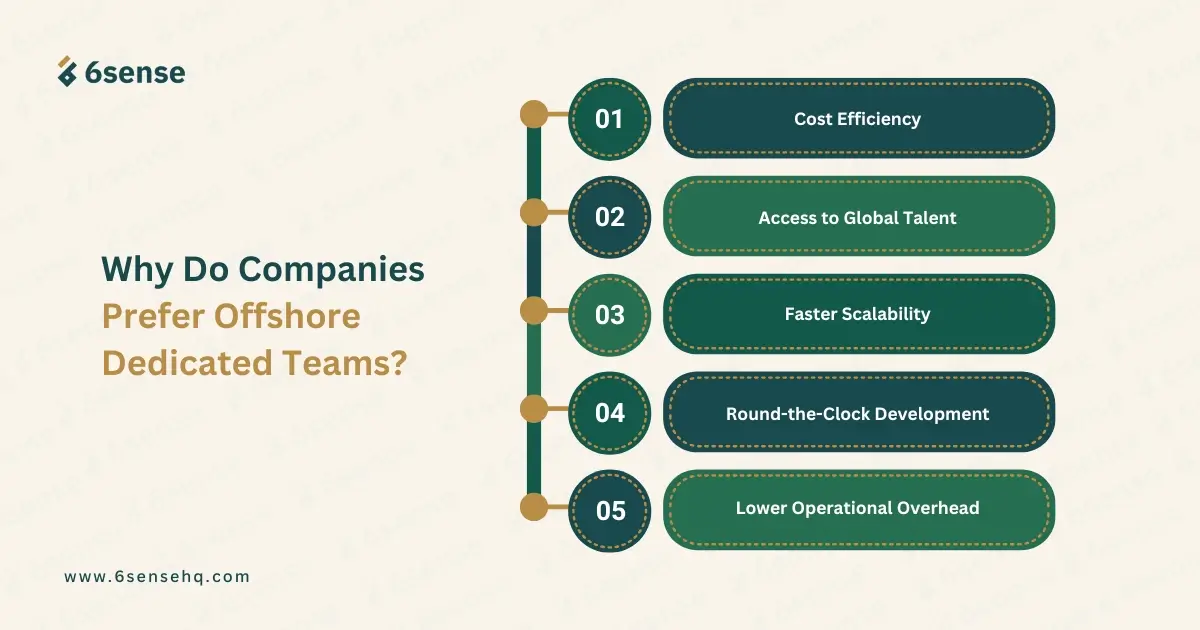
Offshore teams are usually more affordable than local hires. According to Deloitte’s Global Outsourcing Survey, 59% of businesses choose offshore outsourcing mainly to reduce costs. . Companies save on salaries, office space, and HR costs, making offshore software development attractive for budget‑conscious firms. Reports show that such services can be up to 50 % more cost‑effective compared with in‑house teams.
When hiring offshore, you’re not limited by geography. You can find skilled remote developers in AI, blockchain, or DevOps, roles that may be difficult or expensive to fill locally. This opens the door to a much wider talent pool and keeps your development team strong.
Offshore partners often have a bench of ready‑to‑hire developers, letting you grow your development team quickly without long recruiting cycles. This flexible scalability helps businesses meet project deadlines and respond to shifting priorities faster than building an internal team.
With offshore teams in different time zones, your project can progress even when your onshore team is offline. Continuous development cycles help accelerate delivery and reduce time‑to‑market, a big advantage in competitive industries.
Most offshore partners handle recruitment, payroll, office space, and compliance. This allows companies to focus internal resources on product strategy and innovation rather than administrative tasks, making software development outsourcing a sensible option for many businesses.
When comparing an in‑house vs offshore software development team, many companies see that offshore setups offer both cost savings and ease of scaling while still delivering quality work. This balance often makes offshore a practical choice for long‑term or fast‑moving projects.
Companies prefer in‑house dedicated development team members because they offer more control, better communication, and a stronger connection to the company’s goals. Let’s see why many businesses choose to build their teams internally, especially when handling core software development work that demands deep alignment and ongoing ownership.
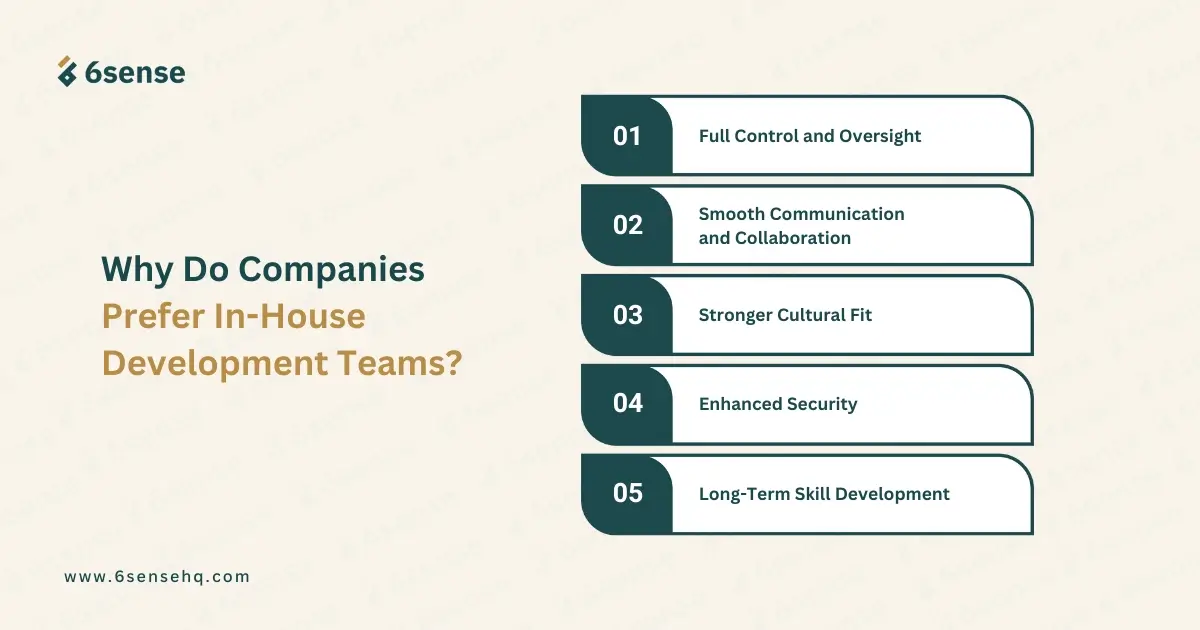
With an in‑house development team, managers can directly guide the work, make quick changes, and keep a close eye on progress. This level of control is especially beneficial for projects that are complex, fast‑paced, or require frequent decision‑making and tight ownership of the entire software development lifecycle.
Working in the same time zone, or even the same office, makes it easier to talk, share ideas, and solve problems quickly. In‑house developers participate in live discussions and keep communication flowing with other teams, which helps reduce delays and miscommunication common in remote settings.
In‑house teams grow with the company’s mission and values, which strengthens teamwork and long‑term commitment. A shared culture helps team members make decisions that align with business priorities, driving consistent progress as part of the core software development vision.
When sensitive data or strict regulations are involved, in‑house developers keep crucial information within controlled environments. This is especially important in sectors like finance or healthcare where security, compliance, and intellectual property protection are non‑negotiable.
Over time, an in‑house development team gains deep product knowledge and understands customer needs intimately. This institutional knowledge improves consistency, helps with innovation, and builds a strong foundation for future growth without relying on external partners.
When comparing average costs between offshore developers and in‑house teams, the difference can be significant, especially in 2026. In the U.S. and other Western markets, a typical software developer’s annual salary can range between roughly $100,000 and $180,000 or more depending on experience and location.
By contrast, offshore developers, whether based in Eastern Europe, Latin America, or Asia — often work at much lower rates. Estimates suggest that offshore development rates globally can range around $25–$150 per hour or roughly $30,000–$90,000 per year, depending on region and skill level.
This means startups and companies can save 40 % or more on overall labor costs by choosing offshore talent, though they should balance cost with communication, time zone, and quality factors.
The main difference is that offshore dedicated teams offer faster scaling, lower costs, and wider talent access, while in-house teams provide stronger control, tighter security, and better team alignment.
| Aspect | In-House Team | Offshore Dedicated Team |
| Cost | High (salaries, office, HR) | Lower (wages, less overhead) |
| Scalability | Slow (hiring takes time) | Fast (ready-to-hire developers) |
| Expertise | Limited to local talent | Access to global skills |
| Control | Full control over the team and work | Needs strong communication and planning |
| Security | Better data and IP protection | Relies on contracts and safeguards |
| Time to Market | Medium, depends on team size | Faster with 24/7 development |
Both offshore and in-house teams present their own unique set of challenges. Offshore teams may face communication and security issues, while in-house teams struggle with high costs, limited talent, and slower scaling.
To choose the right model, match your business needs with what each team type offers, whether it’s cost savings, speed, security, or long-term growth. Use this simple framework to guide your decision:
| Question | Choose In-House If... | Choose Offshore If... |
| Is the budget tight? | No | Yes |
| Is long-term innovation key? | Yes | Not always |
| Is quick scaling required? | No | Yes |
| Do you need rare/niche tech skills? | Harder | Easier |
| Is IP/data security a concern? | Yes | Needs extra safeguards |
| Is your project highly collaborative or evolving fast? | Yes | Needs a structured process |
There’s no single answer to the offshore dedicated team vs in-house team debate. Each model has strengths and limitations that depend on your company’s priorities.
Offshore teams are great for businesses that want to save costs, scale quickly, or access global talent. In-house teams, meanwhile, work best when control, cultural fit, and long-term innovation are the main focus. The right choice depends on your budget, security needs, and growth goals.
So, if you’re considering building an offshore dedicated team, 6sense Technologies makes it simple. With their expertise, you can scale faster and smarter; connect with them today to get started.
Learn how to build a dedicated development team, choose the right roles, compare costs, and manage collaboration for faster, scalable product growth.
6 min read

Racing against the clock to ship your MVP? A dedicated development team gives you immediate access to skilled engineers, predictable output, and a streamlined build process. So you can validate your product faster without getting stuck in hiring cycles or management overhead
6 min read

This breakdown of the dedicated development team structure shows exactly who you need, why you need them, and how each role keeps your product moving without friction.
8 min read