


How to Build Dedicated Development Team in 2025
Learn how to build a dedicated development team, choose the right roles, compare costs, and manage collaboration for faster, scalable product growth.
6 min read
Loading…
Picking the right development team isn’t just a decision; it can make or break your project’s timeline, quality, and budget.
Written by: Nasif Sid Created on: 17 Nov 20257 min to read

A dedicated team is best for long-term, evolving projects where control and collaboration matter. On the other hand, outsourcing is great for quick, cost-efficient delivery of well-defined tasks.
Choosing between the two isn’t just a technical call; it’s a strategic one. Your decision affects team dynamics, timelines, budget, and ultimately, product quality. Dedicated teams feel like an extension of your in-house staff, while outsourcing hands over the reins to a third-party vendor.
In this blog, we’ll break down the key differences between both models, help you understand when to use each, compare cost, communication, and control, and give you a simple way to choose the right one for your next software project.
Let’s begin!
The key difference is that a dedicated team works with you, while an outsourced team works for you.
Dedicated Team: You “rent” a team of professionals (developers, designers, testers, PMs) who work exclusively on your project. You manage them directly, much like an internal team, but without hiring full-time employees.
Outsourced Team: You hand over your project (or part of it) to a third-party vendor. They manage the team, deliver the work, and oversee everything from planning to execution, often with minimal day-to-day involvement from you.
Here are side-by-side comparisons of dedicated vs outsourced team models:
| Aspect | Dedicated Team | Outsourced Team |
| Control | High | Low to Medium |
| Commitment | Long-term | Short to mid-term |
| Communication | Direct | Through vendor PM |
| Onboarding Time | Slower | Faster |
| Cost Transparency | Predictable | Variable |
You should choose a dedicated software development team when your project needs long-term focus, flexibility, and more control over how things are built and managed.
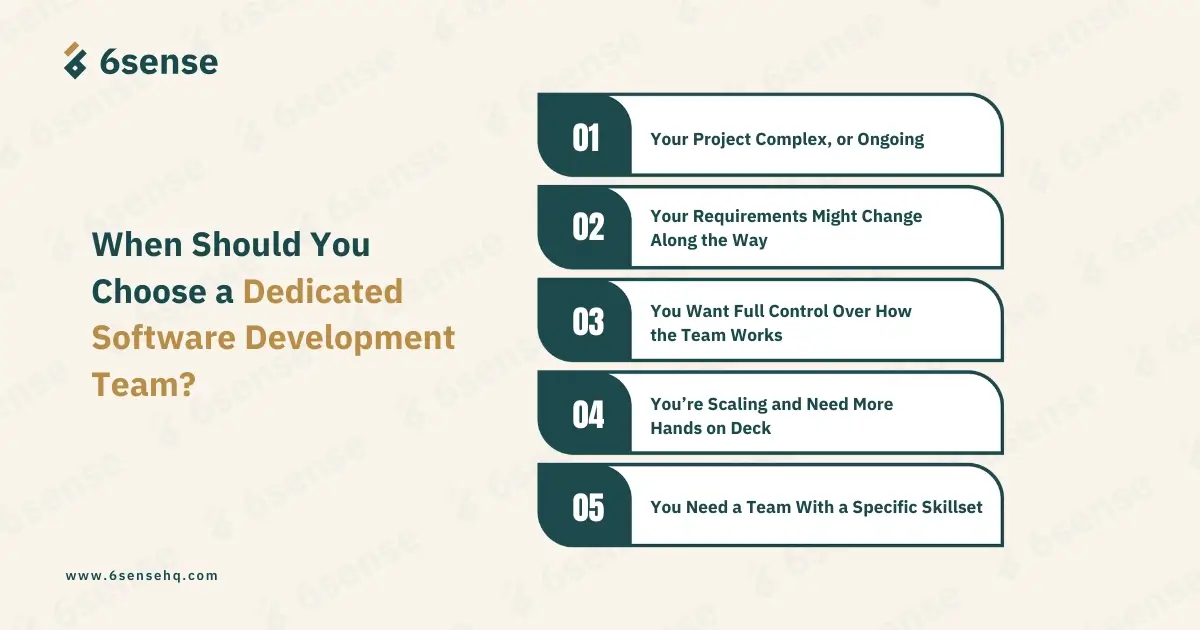
When your project is complex and ongoing, having the same team on board is extremely helpful. A dedicated team builds deep knowledge over time, so you avoid repetitive explanations, miscommunication, and delays caused by frequent handovers or team changes.
If your project is still evolving or likely to shift direction based on feedback, a dedicated team gives you room to adapt. You won’t need to renegotiate terms constantly; the external team simply adjusts with you as your priorities or product roadmap change.
Dedicated teams operate under your guidance. You decide the workflows, tools, and daily tasks. This model is perfect if you want to stay hands-on, review progress regularly, and make quick changes without going through a third-party project manager.
When your product gains traction and your current team can't keep up, a dedicated team helps you grow fast without the time and cost of traditional hiring. You can quickly expand app development capacity while keeping everything aligned with your internal goals.
Sometimes, you need developers with experience in a certain framework, industry, or technology. With a dedicated team model, you can pick specialists that match your project needs exactly and avoid the struggle of finding and retaining niche talent on your own.
Outsourcing is the more intelligent choice when you want fast delivery, lower costs, and don’t have the time or team to manage software development yourself.
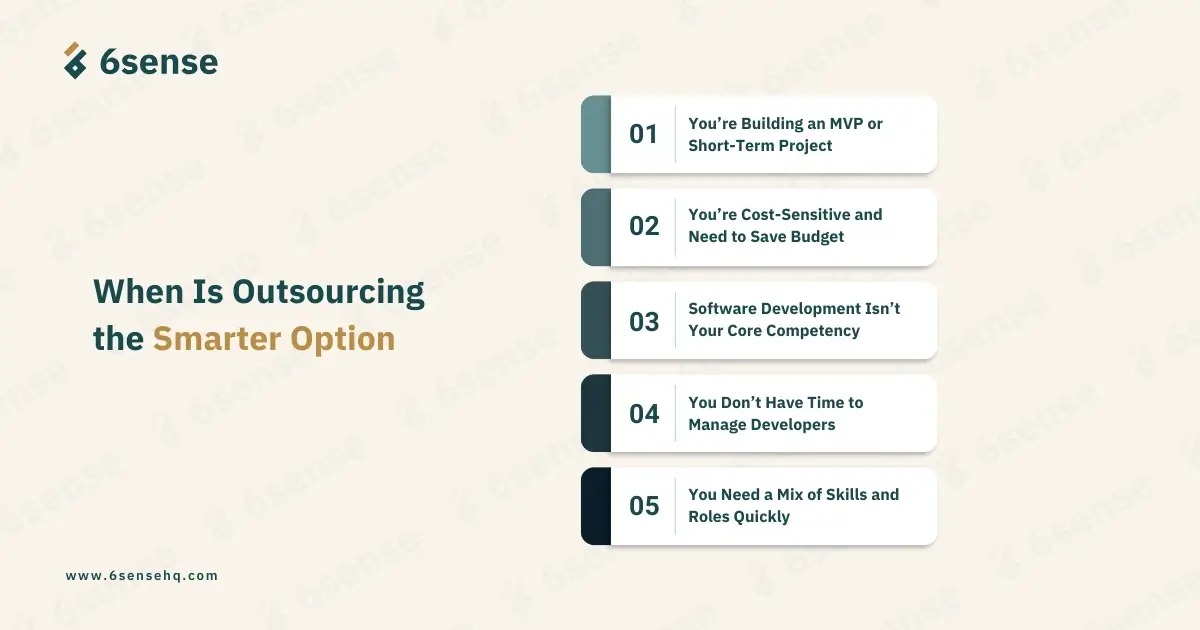
If your goal is to launch quickly or test an idea with a minimum viable product (MVP), outsourcing is an ideal approach. Agencies already have teams in place, and those teams may get started right away. This helps you hit tight deadlines without hiring from scratch.
Outsourcing reduces overhead. You skip costs like salaries, benefits, office space, and equipment. The vendor handles it all, so you only pay for the actual work. This makes it an excellent fit for early-stage startups or businesses with limited funding.
If you don’t have a technical background or an internal tech team, outsourcing development helps you stay focused on business strategy while experienced developers build the product. You get the tech output without needing to learn how to manage developers yourself.
Managing a dedicated development team requires daily attention, including assigning tasks, reviewing progress, and resolving blockers. If you’re stretched thin, outsourcing gives you a ready-made structure. Plus, the agency provides project managers and reporting, so things move forward with minimal effort on your end.
Many projects require more than just developers; they also need UI/UX designers, QA testers, DevOps specialists, and more. Outsourcing firms already have multi-skilled teams ready to go. You don’t need to find, vet, and onboard each person separately; they bring the complete package.
Dedicated teams give you more control and better collaboration, while outsourcing often saves more time and money upfront, but with less direct involvement.
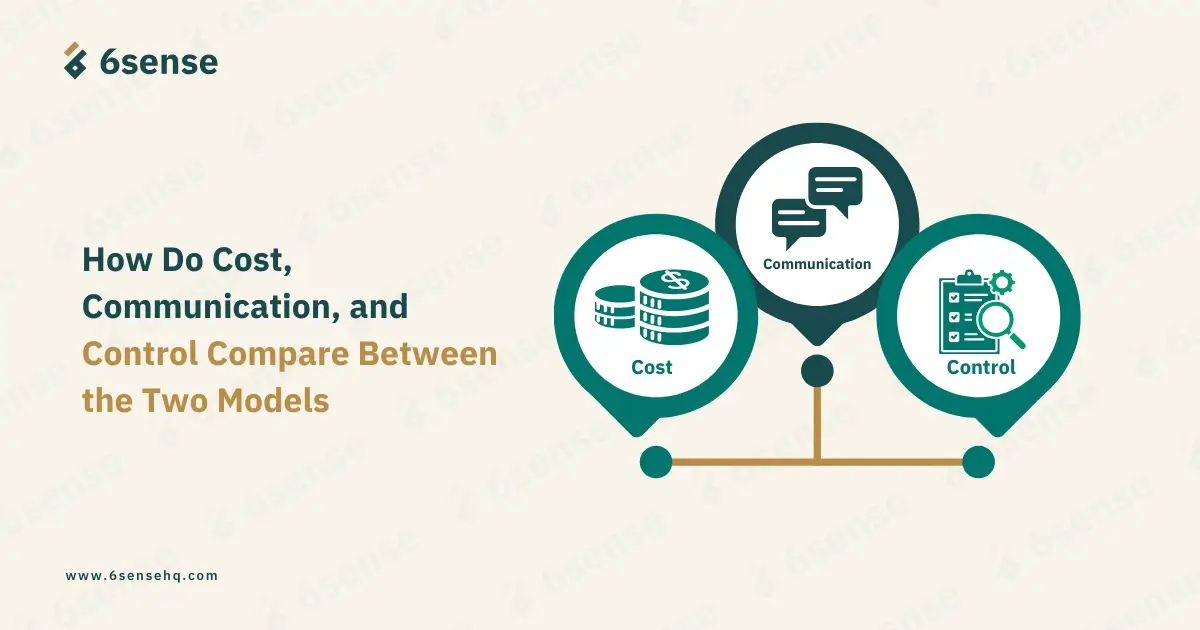
Outsourcing usually has a lower starting cost. You pay for the project or hours, without worrying about hiring or managing people. Dedicated teams cost more month-to-month, but they’re better if your product is growing and you want a stable, long-term team that learns and evolves with it.
With a dedicated team, you can speak directly with developers and other team members. It’s great for projects that need quick feedback and constant iteration. In outsourcing, communication often goes through a project manager, which works fine for some, but it can slow things down or create confusion.
Dedicated teams give you full control. You can decide who does what, change priorities on the fly, and manage things your way; outsourcing hands control over to the vendor. That’s easier if you don’t want to be involved daily, but it limits how much you can influence the process.
If you want speed and lower costs, go with outsourcing. If you want control and long-term team alignment, go with a dedicated team.
Startups usually outsource early on, especially when they’re building an MVP or testing the market. It helps them move fast without hiring a full tech team. Later, once they’ve validated their product and need to scale, they often switch to a dedicated team for better control and deeper collaboration.
Enterprises tend to prefer dedicated teams for ongoing digital transformation or big internal systems. However, they also outsource tasks such as legacy system upgrades, bug fixes, or when they need extra help on short notice.
According to Deloitte’s Global Outsourcing Survey, 70% of companies choose outsourcing to cut costs; however, many still turn to dedicated teams for critical, evolving projects where quality and control are most important.
Each model fits a different stage and need, so choose based on where you are.
If your project is short, needs quick delivery, and you don’t want to manage a team, outsourcing is the better choice. But if you’re in it for the long haul and want full control, go with a dedicated team.
Here’s a quick decision framework to help you decide:
| Ask Yourself | If Yes → Choose |
| Do I need results fast with minimal oversight? | Outsourcing |
| Is my project short-term with a fixed scope? | Outsourcing |
| Do I want long-term collaboration and team integration? | Dedicated Team |
| Will the project evolve over time? | Dedicated Team |
| Do I want to manage the team directly? | Dedicated Team |
| Do I lack internal tech leadership or hiring capacity? | Outsourcing |
Choosing between a dedicated team and project-based outsourcing ultimately depends on your product goals, timeline, and internal capacity. If your product is complex, expected to evolve over time, and requires a stable group of people who deeply understand the codebase, a dedicated model is often the better choice.
On the other hand, if you need something built quickly such as an MVP or a one-time feature, outsourcing can be a faster and more cost-effective option. There’s no universally “right” model. The best approach is the one that fits your budget, delivery expectations, and desired level of day-to-day involvement.
If you’re aiming to build sustainably while keeping flexibility, working with an offshore development team can give you access to experienced talent, predictable costs, and the ability to scale without the friction of long hiring cycles.
Partnering with 6sense HQ allows you to tailor that model to your exact needs, whether you’re starting small or planning for long-term growth.
Learn how to build a dedicated development team, choose the right roles, compare costs, and manage collaboration for faster, scalable product growth.
6 min read

Racing against the clock to ship your MVP? A dedicated development team gives you immediate access to skilled engineers, predictable output, and a streamlined build process. So you can validate your product faster without getting stuck in hiring cycles or management overhead
6 min read

This breakdown of the dedicated development team structure shows exactly who you need, why you need them, and how each role keeps your product moving without friction.
8 min read