


How to Build Dedicated Development Team in 2025
Learn how to build a dedicated development team, choose the right roles, compare costs, and manage collaboration for faster, scalable product growth.
6 min read
Loading…
Learn how dedicated teams vs staff augmentation differ: full-time committed teams vs flexible staff added to your current setup.
Written by: Nasif Sid Created on: 15 Aug 20259 min to read
The core difference is simple: dedicated teams work exclusively on your product over the long term, while the staff augmentation model helps you temporarily extend your existing team with skilled professionals. Both approaches support growth, but they serve different needs depending on how much control, continuity, and commitment your business requires.
If you’re a founder or CTO weighing dedicated teams against staff augmentation, it helps to think in terms of ownership and timelines. One option gives you a stable, fully aligned team focused solely on your product. The other provides short-term flexibility ideal for filling urgent skill gaps without committing to long-term hires.
In this guide, I’ll walk you through both models clearly and practically, so you can decide which approach fits your product roadmap and growth stage. The goal is to help you plan your next development hire or sprint with confidence without unnecessary complexity.
Let’s get started.
Staff augmentation adds skilled individuals to your existing team for short-term gaps or urgent needs with full control. Dedicated teams are independent units working long-term only for your project, offering stability, ownership, and deeper product understanding.
| Aspect | Staff Augmentation | Dedicated Teams |
| Duration | Short to mid-term | Long-term collaboration |
| Control | Full control by the client | Shared control with vendor |
| Onboarding | Fast & flexible | Structured, takes longer |
| Cost Model | Pay per hour/resource | Fixed monthly retainer |
| Scalability | Easy to scale up/down | Harder to scale instantly |
| Integration | Directly into the existing team | Operates as an independent unit |
| Focus | Task-specific |
A dedicated team is a full group of experts that works only on your project, like your own team, but hired through an outsourcing partner. They usually include developers, designers, testers, and project managers who focus only on your goals. Unlike freelancers who juggle many projects, dedicated teams commit completely to your product.
For example, recent surveys show that many startups prefer dedicated teams for long-term tech builds because they bring stability and a deeper understanding of the business.
Imagine them as your remote office, handling daily tasks, tech decisions, and product improvements without the headache of local hiring. You don’t have to spend months recruiting or training them. They come ready with skills, processes, and proven workflows. This saves you time and ensures faster launches.
In short, dedicated teams give you end-to-end ownership, ongoing support, and strategic alignment so you can focus on growth while they build your product confidently.
Dedicated teams provide long-term commitment, product knowledge, and brand alignment. However, they require structured onboarding, cultural integration, and upfront costs. Let’s see these clearly:
| Pros | Cons |
| Full product focus | Requires longer onboarding |
| Deep understanding of your business | Cultural and time zone differences |
| Better collaboration and loyalty | Less flexibility to scale instantly |
| Ideal for complex, evolving projects | Higher upfront cost |
Startups should hire a dedicated team when they need a stable group working only on their product for long-term growth, especially for complex builds, scaling fast, and avoiding hiring headaches.
Here is when it makes sense for you:
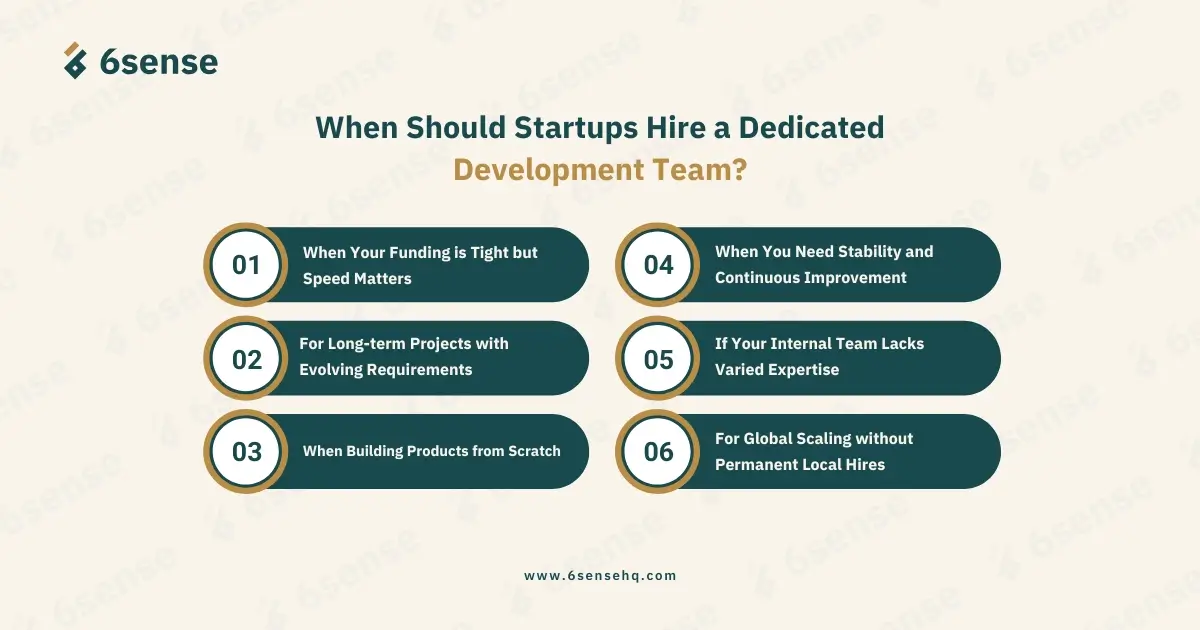
Startups often don’t have enough money for full in-house teams. A dedicated development team gives you skilled people at a lower cost, so you can build fast without hiring delays. With teams like 6sense, you save money and still move quickly, perfect when you need to launch fast and show results to investors.
If your startup has a product roadmap that keeps growing with new features or user needs, hiring a dedicated team makes sense. They’ll work like your own employees, understand your vision deeply, and adapt quickly.
For example, 6sense HQ offers dedicated team members, trained in Agile, who adapt with evolving sprints, ensuring your product never stalls due to team gaps.
Starting from an idea to launch needs a reliable, full-skilled team. Dedicated development teams handle backend, frontend, UX, and QA without you hiring each person separately.
Companies that provide ready, sprint-trained teams are needed so you can skip the recruitment process and focus on validating your product in the market faster.
Dedicated teams give you people who stay for the entire project and beyond, unlike freelancers who leave after the tasks. They ensure stable releases, bug fixes, and updates. For startups, this means consistent user experience, stronger code quality, and better customer trust because the same team manages your product lifecycle.
Sometimes your in-house team is great at operations but lacks technical depth in newer stacks, AI, or DevOps. Dedicated development teams fill these gaps with experts across technologies, helping you innovate faster.
6sense’s dedicated team model, for instance, provides full-stack developers, PMs, and QA with proven project delivery without needing in-house training.
When expanding to new markets or serving global users, you need more people but can’t hire full-time due to budget or legal limits.
Dedicated teams, like those at 6sense from Bangladesh, give you scalable talent at 1/10th the US cost while maintaining high-quality work under their project management, saving you both time and money.
Staff augmentation is when you temporarily hire skilled professionals from outside to fill gaps in your team without making them permanent employees. They work directly under your control, just like your own staff, but you don’t handle their HR or long-term contracts.
This augmentation model is super helpful when you need extra developers, designers, or testers for a few months to finish urgent tasks. It’s like borrowing talent when your project workload increases or your team lacks a specific skill, such as React Native or AI integration. You get flexibility, save time on hiring, and avoid high full-time salaries.
However, remember they won’t stay forever, so their commitment is short-term. In simple words, augmented staff helps you get the right people at the right time to keep your projects moving smoothly.
Staff augmentation gives you flexibility, quick hiring, and cost control without permanent commitments. But it may affect team cohesion, culture integration, and consistency if relied on long-term.
| Pros | Cons |
| Quick hiring process | Lower loyalty & ownership |
| Full control over tasks | Cultural & integration challenges |
| No long-term hiring costs | Quality consistency issues |
| Flexibility in scaling resources | Hidden costs in long projects |
Startups should hire staff augmentation when they need skilled people fast for urgent projects, short-term goals, or to fill sudden team gaps without long-term hiring commitments. Here’s exactly when this model works best for you:
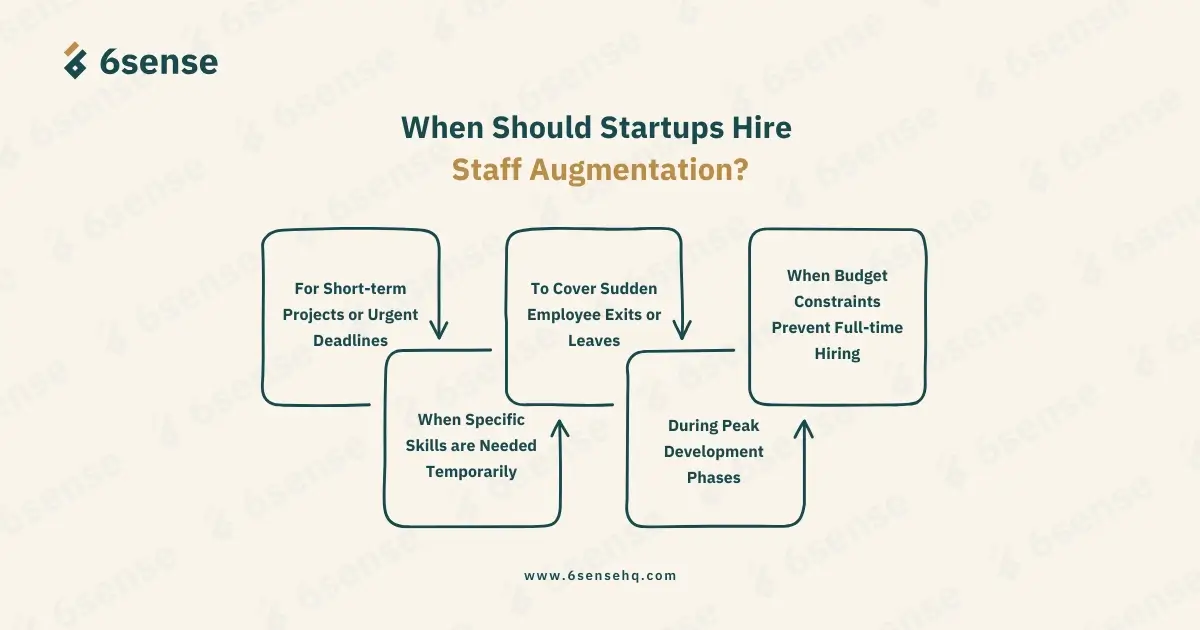
If your startup has a sudden project deadline approaching and your current team is already overloaded, staff augmentation is the best choice. You can add experienced developers quickly without wasting weeks on recruitment.
Companies like 6sense HQ provide vetted engineers within days, ready to join your sprints and workflows immediately, ensuring your product releases never get delayed.
Sometimes you need expertise in AI, DevOps, or a specific framework just for a sprint or two. Instead of hiring full-time staff, staff augmentation lets you bring in specialists only for the needed duration.
For example, 6sense offers developers trained in advanced stacks who integrate seamlessly into your team. This helps you finish specialised tasks efficiently without long onboarding processes or training costs.
If a key developer suddenly leaves or goes on unexpected leave, your product timeline may get stuck. Staff augmentation helps you fill that gap instantly with an external resource who works under your management, like your own employee. It keeps your sprints moving smoothly without disturbing your team’s focus or customer commitments.
When you’re launching a big feature or your product is scaling fast, your team may struggle with the extra workload. Staff augmentation provides additional engineers to handle overflow tasks efficiently.
Companies like 6sense have Agile-ready developers who work on your tools, attend daily standups, and help your internal team maintain quality and speed even during high-pressure releases.
Hiring full-time employees comes with high salaries, onboarding, and HR costs. For startups with limited budgets, staff augmentation is a smart option to get skilled people without these overheads.
Providers like 6sense let you hire top 0.5% global talent at almost 1/10th the US cost, saving up to 52% on software development expenses while keeping your projects on track.
If you’re a startup founder, here’s my direct advice: choose staff augmentation if you need immediate skills to fix issues or meet tight deadlines. You keep control and avoid long contracts.
But if your goal is to build a strong product roadmap with continuous iterations, a dedicated team is better. They’ll understand your business deeply, work as your core team, and help you innovate faster. Both models have their place. For MVPs, staff augmentation is fast.
For scaling products and adding features long-term, dedicated teams ensure stability and product ownership. Assess your current gaps, future goals, and budget clarity.
If you want my personal choice for long-term growth, a dedicated team wins for startups aiming to build solid, scalable tech products.
Many founders on Reddit and IndieHackers say staff augmentation is best for urgent deadlines or filling expertise gaps quickly. They value cost savings without onboarding hassles.
However, they caution about communication lags if freelancers are spread globally. On the other hand, dedicated teams receive praise for their long-term commitment, brand understanding, and smoother releases.
Some CTOs mention that dedicated teams feel like their own employees, making collaboration and ownership stronger. A common view is: staff augmentation is a short-term fix; dedicated teams are strategic partners for scaling.
One founder said, “I tried staff augmentation for quick UX fixes, but hired a dedicated team later to build our entire platform. It saved us rework costs.”
So, choose based on what you want: quick results or strategic, stable growth.
Choosing between dedicated teams vs staff augmentation depends on what your startup really needs. If you want quick access to skilled experts for short-term tasks or to fill sudden gaps, staff augmentation is a great fit. But if you’re building a product that needs long-term care, deep involvement, and consistency, a dedicated team offers great solutions.
Remember, each model offers strong value; it just depends on your goals, deadlines, and how fast you plan to grow. Make the decision based on what will truly help your product succeed.
And if you need help scaling fast or building reliably, contact 6sense HQ for flexible staff augmentation and a dedicated team. It’s a custom-fit for all your startup's needs.
Learn how to build a dedicated development team, choose the right roles, compare costs, and manage collaboration for faster, scalable product growth.
6 min read
Racing against the clock to ship your MVP? A dedicated development team gives you immediate access to skilled engineers, predictable output, and a streamlined build process. So you can validate your product faster without getting stuck in hiring cycles or management overhead
6 min read
| Commitment | Lower loyalty | Higher loyalty & ownership |
This breakdown of the dedicated development team structure shows exactly who you need, why you need them, and how each role keeps your product moving without friction.
8 min read