


How to Build Dedicated Development Team in 2025
Learn how to build a dedicated development team, choose the right roles, compare costs, and manage collaboration for faster, scalable product growth.
6 min read
Loading…
Startups often face a tough choice: scale with a dedicated team or opt for project-based outsourcing. The right call can accelerate growth, while the wrong one risks draining time, budget, and momentum.
Written by: Nasif Sid Created on: 18 Aug 202512 min to read

If your product needs long-term development, constant iteration, and close collaboration, a dedicated team is the better fit. But if your project has a clear scope, tight deadline, and limited involvement from your side, project-based outsourcing will save you time and money.
Your startup’s development model directly impacts your speed, control, and overall costs. That’s why understanding when and why to use each model is so important, especially as your product and priorities evolve.
By the end of this article, you’ll be able to confidently match the right model to your timeline, budget, and internal capacity.
Let’s start then!
If your product needs long-term support, close collaboration, and a team that can grow alongside your roadmap, a dedicated team is usually the better fit. You maintain full visibility and control over how development happens, day to day.
Project-based outsourcing, on the other hand, works best when the scope, timeline, and deliverables are clearly defined upfront. In this model, execution is largely vendor-driven, with limited involvement from your side.
Both approaches fall under the broader umbrella of offshore software development, but they serve very different business needs depending on how much flexibility and ownership you want.
| Factor | Dedicated Team | Project-Based Outsourcing |
| Engagement Type | Long-term, ongoing | Short-term, fixed |
| Control & Communication | High, need direct involvement | Low, it is vendor-managed |
| Scope Flexibility | Flexible, scope can evolve | Fixed, limited flexibility |
| Hiring Speed | Fast through outsourcing partners | Fast, but limited to scope only |
| Best For | Complex, growing products | One-time builds, MVPs, quick fixes |
| Cost Model | Monthly, time-based | Fixed-price or per-project |
| Team Integration | Feels like in-house | Separate from internal team |
A dedicated team gives you ongoing access to tech talent that works only on your product. You stay in control of the priorities, tasks, and workflow, while your outsourcing partner handles hiring and operations in the background.
It's a reliable model when you want to build long-term product knowledge and keep momentum without starting from scratch every time you scale.
In fact, 50% of organizations outsource to gain access to new capabilities, according to Deloitte’s Global Outsourcing Survey.
Dedicated teams offer flexibility, deep business integration, and faster iterations, but require ongoing management and higher initial commitment.
| Pros | Cons |
| Builds product knowledge over time | Needs regular involvement from your side |
| You control tools, tasks, and priorities | Not suited for one-off or small projects |
| Easy to scale the team up or down | Higher upfront cost commitment |
| Faster progress on evolving features | Takes time to set up and onboard |
| Better alignment with long-term product goals | Might be underutilized during slow phases |
| Seamless collaboration across sprints | Depends on clear internal communication |
Dedicated agile teams work closely together using short development cycles, constant feedback, and regular planning sessions. Because the same people stay on the project long term, communication becomes smoother and delivery becomes faster over time.
Many Reddit developers say dedicated teams improve sprint consistency and reduce confusion compared to constantly changing team structures.
These teams are also highly adaptable. Agile environments often require quick changes based on customer feedback, and dedicated teams can respond faster because they already understand the product, workflows, and business goals.
Research also shows agile teams improve collaboration, transparency, and continuous improvement when team members stay aligned for longer periods.
Early-stage startups often hire dedicated teams when they need to grow fast without spending months on local hiring. A dedicated team helps startups launch products quicker, reduce hiring pressure, and access experienced developers immediately. Many Reddit founders also mention that dedicated teams help them stay lean while scaling operations efficiently.
Dedicated teams work well when project requirements are unclear or likely to change over time. Instead of locking everything into fixed contracts, businesses can adjust priorities, features, and timelines as they learn more. This flexibility is especially useful in Agile environments where continuous feedback shapes the product direction.
Long-term products benefit from dedicated teams because the same developers stay involved throughout the journey. Over time, the team gains deeper knowledge about the product, users, and business goals, which improves efficiency and decision-making. Many tech leaders say this consistency reduces onboarding delays and improves long-term delivery quality.
You should choose a dedicated team when your product requires long-term development, continuous iteration, and close daily collaboration.
This model offers the most value when your goals are evolving and you want to avoid rebuilding context with every release. So you will need a dedicated team when-
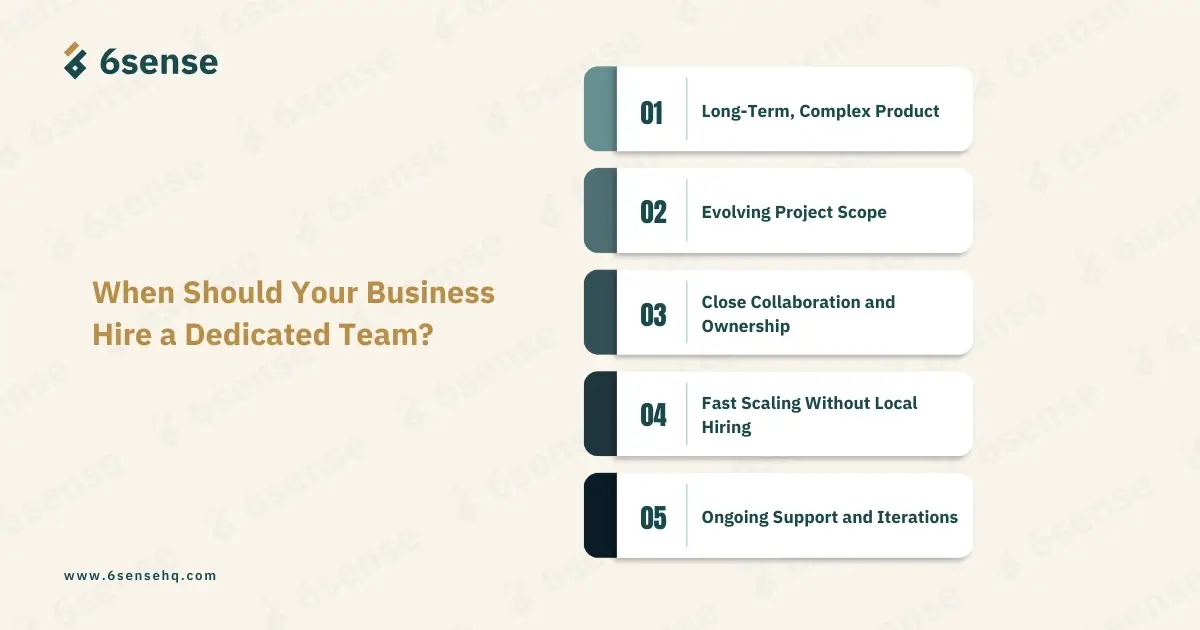
If you're building a SaaS platform, marketplace, or API-driven product that will evolve over months or years, a dedicated team helps maintain context and speed.
When your team needs daily communication, task updates, and fast decision-making, having direct access to developers makes execution smoother.
A stable team working consistently allows you to plan roadmaps, release cycles, and hiring with fewer surprises.
Switching freelancers or vendors every few months slows down work. A dedicated team learns your product once and stays aligned.
Roles like DevOps, backend architecture, or platform specialists are easier to retain through a managed, long-term setup.
Many people think dedicated teams are the same as traditional outsourcing, but they work very differently. In a dedicated model, the team works only for your business and follows your workflows, goals, and communication style.
Reddit founders often describe dedicated teams as “remote in-house teams” rather than outside vendors.
Many startups believe dedicated teams are only for large companies, but small businesses often use them to avoid expensive local hiring. Reddit discussions show startups save money on recruitment, office space, and operations while still getting experienced developers.
Dedicated teams can actually reduce long-term development costs significantly.
Remote management can feel difficult at first, but many companies succeed with clear communication, regular meetings, and strong project tracking. Reddit users often say remote teams fail because of unclear expectations, not because the model itself is bad. Good processes usually solve most collaboration problems.
Dedicated teams are now used by healthcare, finance, eCommerce, education, and marketing companies, not just tech startups. Businesses use dedicated teams for design, support, operations, and product development.
Remote collaboration tools and global hiring have made dedicated teams useful across many different industries today.
Project-based outsourcing is when you assign a full project to an external vendor. This includes everything from planning and design to final delivery.
You provide the scope, timeline, and requirements upfront. From there, the vendor handles the work independently and delivers the final result. You don’t need to manage the team directly, which saves your time and attention.
This model is ideal when your project is specific, clearly defined, and doesn’t require ongoing input or collaboration from your side.
Project-based outsourcing offers predictability and speed for well-scoped tasks, but lacks flexibility and long-term knowledge retention.
| Pros | Cons |
| Clear cost and timeline from the start | Limited flexibility once work begins |
| Less involvement needed from your team | Less control over daily decisions |
| Fast delivery for small or mid-size projects | Harder to adjust scope mid-way |
| No hiring or onboarding required | Team disbands after delivery |
| Great for MVPs or pilot projects | No long-term knowledge retention |
| Easy to compare vendor quotes before starting | Less time for relationship or trust building |
Project-based outsourcing works best when your company needs fast, focused delivery and you already know exactly what the final outcome should look like. It’s built for efficiency, not iteration.
You’ll benefit most from this model when your scope is fixed, deadlines are tight, and your internal team can’t afford to be hands-on. You can use project-based model when -
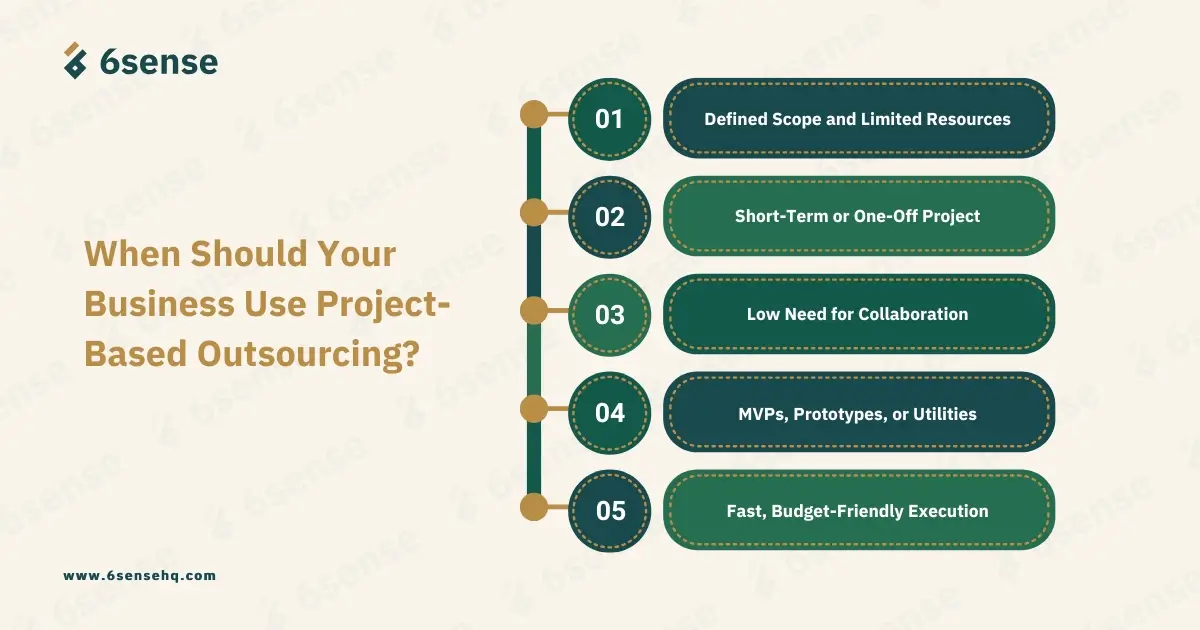
This is ideal for MVPs, marketing sites, utilities, or internal dashboards that don’t require long-term updates or team retention.
If you have a clear list of features, delivery milestones, and a deadline, a project-based team can execute quickly without much back-and-forth.
Projects with tight launch goals, investor demos, or time-sensitive campaigns often benefit from this model’s simplicity and clear budgeting.
If your internal team is stretched thin, handing off execution lets you focus on strategy, marketing, or user testing while the vendor builds.
A lean MVP can be shipped using project-based outsourcing. Once it gains traction, you can shift to a dedicated team for scaling and iteration.
For example, 6sense helped Pattern50, a U.S. startup, save over $500K in product costs by delivering 25,000+ dev hours with a fully managed team. Their process-focused delivery ensures fast turnarounds without extra hiring headaches.
AI is changing how project teams are built and managed. Instead of manually assigning people, companies are starting to use AI tools to match developers, designers, and managers based on skills, past performance, availability, and communication style. Many Reddit discussions suggest AI will help teams form faster and reduce hiring mistakes, especially for remote and global projects.
AI is also improving Agile workflows by helping teams prioritize tasks, predict delays, automate documentation, and analyze risks earlier.
However, many developers on Reddit and Quora say AI should support teams, not replace human decision-making completely. Most experts believe the future will be hybrid — humans handling strategy and creativity while AI manages repetitive coordination and planning tasks.
Choosing between a dedicated team and project-based outsourcing depends on how much control you want, how long the work will last, and how flexible your product roadmap is.
Here’s a quick decision guide to help you match your needs to the right model:
Many Reddit founders say communication problems are the biggest reason outsourced teams fail. Choose a dedicated team that gives regular updates, clear timelines, and direct access to developers. Good communication helps avoid delays, confusion, and missed expectations, especially when projects change quickly during development.
Before hiring, review the team’s past projects, technologies, and industry experience. Many startup founders on Reddit recommend asking for case studies, GitHub examples, or client references. A strong portfolio shows whether the team can handle projects similar to yours and deliver quality work consistently.
Many experienced founders suggest beginning with a small trial project before committing long term. This helps you evaluate work quality, communication style, and reliability without taking major risks. If the collaboration goes well, you can confidently scale the relationship into a larger dedicated team setup.
A good dedicated team should care about your business goals, not just coding tasks. Reddit developers often mention that the best teams ask questions, suggest improvements, and think long term. Teams that understand your product vision usually deliver better decisions, stronger collaboration, and more successful outcomes.
When it comes to dedicated teams vs project-based outsourcing, the tech world has a lot to say, and most opinions point in the same direction.
Many experts agree that dedicated team members are ideal for businesses seeking deep collaboration and long-term growth. These teams act like an internal extension, making it easier to handle evolving projects, improve project management, and stay aligned with business goals. A stable team structure also helps companies avoid delays caused by constantly changing developers.
On the other hand, project-based software development outsourcing works best when the project is clearly defined, has a set deadline, and limited resources. This model works well for short-term projects because the roles and responsibilities are usually fixed from the beginning, making planning easier and improving overall cost efficiency.
Startups are often advised to begin with project-based outsourcing services to test an idea or quickly launch a prototype. Then, as the product matures, switching to a dedicated team offers better control, speed, and long-term value. Many founders say this transition improves collaboration between team members and creates clearer team roles as the company grows.
On Reddit, developers and startup founders often share similar experiences. Many start lean with outsourced software projects, then move to dedicated teams to reduce chaos, improve delivery timelines, and create better project management workflows. Some discussions also mention that dedicated teams make it easier to define technical roles and ownership during scaling.
In summary, both models are valid. Your choice depends on your budget, flexibility, specific needs, and how involved you want to be.
If you’re launching fast and working with a fixed budget, project-based outsourcing gives you speed with minimal involvement.
But if your product is evolving, and you need long-term collaboration and control, a dedicated team will scale with you not just deliver and exit.
There’s no one-size-fits-all. The right model depends on your timeline, team capacity, and product complexity.
Still unsure what fits your roadmap?
At 6sense HQ, we help startups and growing teams choose and implement the model that fits both their goals and growth pace. Let’s chat and build something great together.
Learn how to build a dedicated development team, choose the right roles, compare costs, and manage collaboration for faster, scalable product growth.
6 min read

Racing against the clock to ship your MVP? A dedicated development team gives you immediate access to skilled engineers, predictable output, and a streamlined build process. So you can validate your product faster without getting stuck in hiring cycles or management overhead
6 min read

| Easy to scale over time |
| Not scalable post-delivery |
| Involvement Needed | High, needs day-to-day input | Low, follows milestone approvals |
This breakdown of the dedicated development team structure shows exactly who you need, why you need them, and how each role keeps your product moving without friction.
8 min read