

6sense HQ vs DevToDollars: Best MVP Partner in 2026
Compare 6sense HQ and DevToDollars on MVP speed, team models, proof, pricing, and post-launch support to pick the right fit.
15 min read
Loading…
Learn how vibe coding helps founders build MVPs faster, cheaper, and without coding ideal for non-technical startups.
Written by: AKM Ahsan Created on: 7 May 20268 min to read
What if you could turn your idea into a working product in just days, without writing a single line of code? That’s the promise that’s pulling thousands of founders toward vibe coding MVPs right now.
A vibe coding MVP is an early version of your product built using AI tools where you describe what you want, and the system generates the code for you. Instead of traditional development, you guide the process through prompts and refine it step by step.
At 6sense HQ, we’ve helped 50+ founders experiment with vibe coding, including one SaaS founder who built a working MVP in 11 days using Cursor and Claude Code, onboarding 20 paying users within 3 weeks before rebuilding for scale.
This blog will guide you through what vibe coding MVP really is, why it’s trending, where it fails, and how to make it actually work.
A vibe coding MVP is a minimum viable product built using AI tools where founders describe features in natural language and let AI generate the code. Long before AI-assisted development became available, the early MVP stories of Airbnb, Uber, and Dropbox showed how founders could test one core assumption without building a complete product. Vibe coding follows the same lean principle, but tools such as Cursor, Bolt, and Lovable now make it possible to create and validate functional product ideas much faster. Instead of writing code manually, you guide the system through prompts and refine outputs iteratively.
Tools like Cursor AI code editor, Bolt.new, and v0.dev allow founders to generate full applications from prompts, making “English” a programming layer, as Andrej Karpathy famously described. Research suggests a growing portion of early-stage startup code is AI-generated, especially in MVP phases.
This approach is growing fast; some reports suggest that up to 25% of startup code in early-stage companies is largely AI-generated.
It prioritizes speed over structure, allowing non-technical founders to launch products quickly. But it also creates hidden risks like poor architecture and debugging challenges.
As Andrej Karpathy put it: “The hottest new programming language is English.”
Best for: Founders with some technical familiarity Cost: ~$20/month Use case: AI-native code editor that helps refine and iterate code
Best for: Non-technical founders Cost: Free tier available Use case: Browser-based tool that generates full apps from prompts
Best for: Frontend-first MVPs Cost: Free tier Use case: Generates UI components instantly
Best for: Iterative AI-assisted development Cost: Usage-based Use case: Advanced prompt-driven coding and debugging
Best for: Full-stack MVPs Cost: Free + paid plans Use case: Cloud-based development + deployment
Building an MVP used to take months and a full team. Now, founders are skipping that process. They’re testing ideas faster using AI-driven vibe coding tools and vibe-based workflows. But before you build anything, it’s critical to validate your idea first → see our guide on MVP validation.
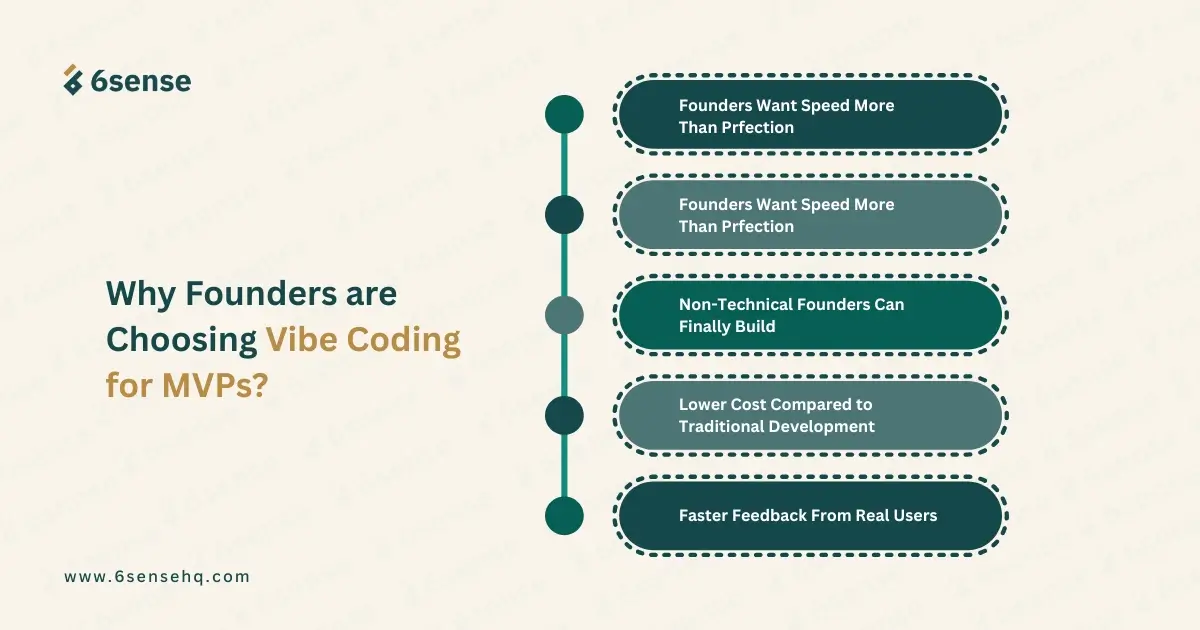
Many founders shared they built MVPs in 10-60 days using vibe coding, something that previously took months. This speed helps validate ideas quickly. But most admit the product feels unfinished and requires improvement once real users start using it.
People without coding backgrounds are now launching products themselves. Instead of waiting for developers, they describe features and let AI handle execution. This creates independence but also leads to shallow technical understanding, making future fixes harder.
Some founders built MVPs with just a few thousand dollars using AI tools. This is far cheaper than hiring a development team. However, hidden costs appear later when rebuilding or fixing unstable systems becomes necessary.
With quick builds, founders can launch early and collect real user feedback. Many mentioned reaching functional versions quickly. But they also faced issues when scaling, as early architecture decisions were often weak or incomplete.
The biggest attraction is the feeling of control. You describe something, and it appears. This creates excitement and momentum. But many founders later realize they don’t fully understand how their own product works.
| Aspect | Benefit | Risk | Mitigation |
| Speed | Build in days | Poor structure | Document everything early |
| Cost | Low upfront | Expensive fixes | Reserve 30% budget for rebuild |
| Accessibility | Anyone can build | No technical understanding | Get expert review early |
| Development | Fast prototyping | Hard debugging | Use structured prompts + testing |
| Scalability | Quick launch | Breaks at scale | Plan rebuild at ~100 users |
| Code Quality | Fast output |
If this level of risk feels too high, many founders choose to explore no-code MVPs as a safer alternative before jumping into AI-generated code.
Most failures don’t happen during building, they happen after launch. That’s when reality hits.
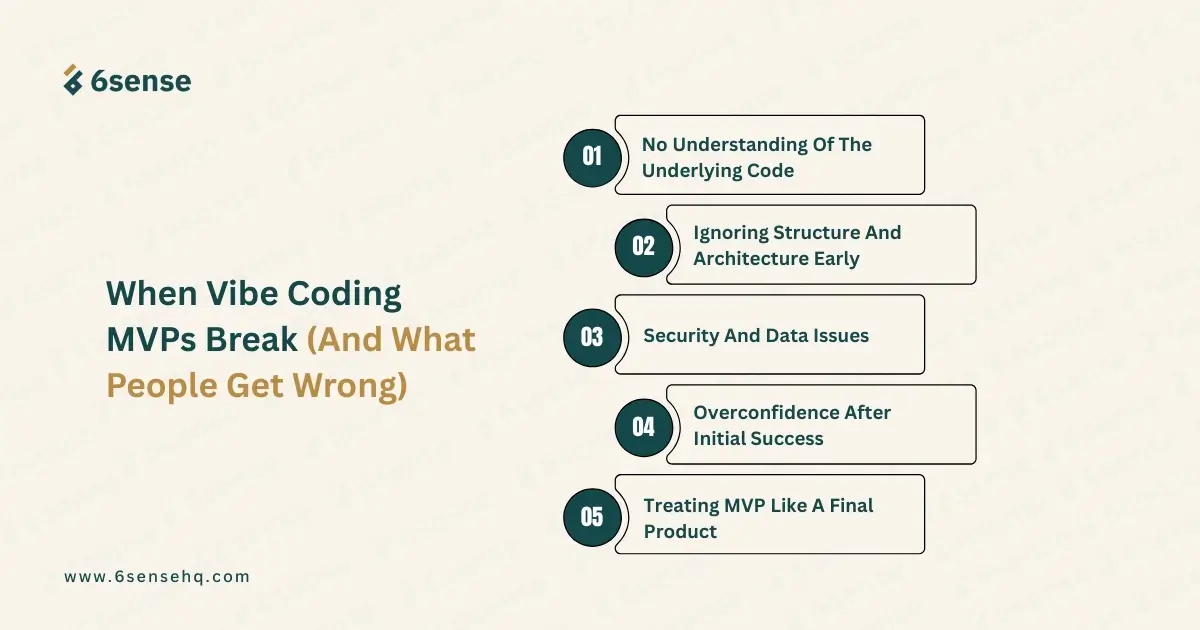
Founders rely fully on AI → cannot fix issues
Many founders rely fully on AI without learning the basics. When bugs appear, they struggle to fix them. Some even rebuild entire systems because they cannot understand what the AI generated initially. Studies show AI-generated code has more issues and vulnerabilities when not reviewed properly.
Speed-first builds skip structure → complexity explodes
Speed-focused builds often skip planning. This leads to messy codebases with too many dependencies and no clear structure. Later, even small changes become complex and risky to implement, especially when the system was never designed for scale.
AI-generated code often lacks secure patterns, increasing vulnerability risks
AI-generated systems may expose API or sensitive data if not properly configured. Research shows AI often fails to generate secure code patterns, increasing risks like data leaks and vulnerabilities if security is ignored early.
Initial traction hides long-term issues
Getting an MVP working creates a false sense of confidence. Founders assume scaling will be easy, but performance and reliability issues quickly appear once real users start using the product in real-world scenarios.
Skipping rebuild → long-term technical debt
Many founders forget that MVP is for validation, not perfection. They try to scale directly from a vibe-coded version instead of rebuilding properly, which leads to technical debt and long-term problems.
Here’s a simple way to start:
Start with Bolt.new or Cursor
Use this structure:
Check for:
Before you even begin building, it’s worth stepping back to learn how to validate startup ideas before building so you’re not testing the wrong thing faster.
A complete MVP often uses multiple tools:
This stack allows founders to build full products in hours, not months
You should stop vibe coding and rebuild when:
At this stage, 6sense HQ helps founders rebuild with proper engineering while keeping what works.
You don’t need to avoid vibe coding. You just need to use it smartly. Let’s see how:
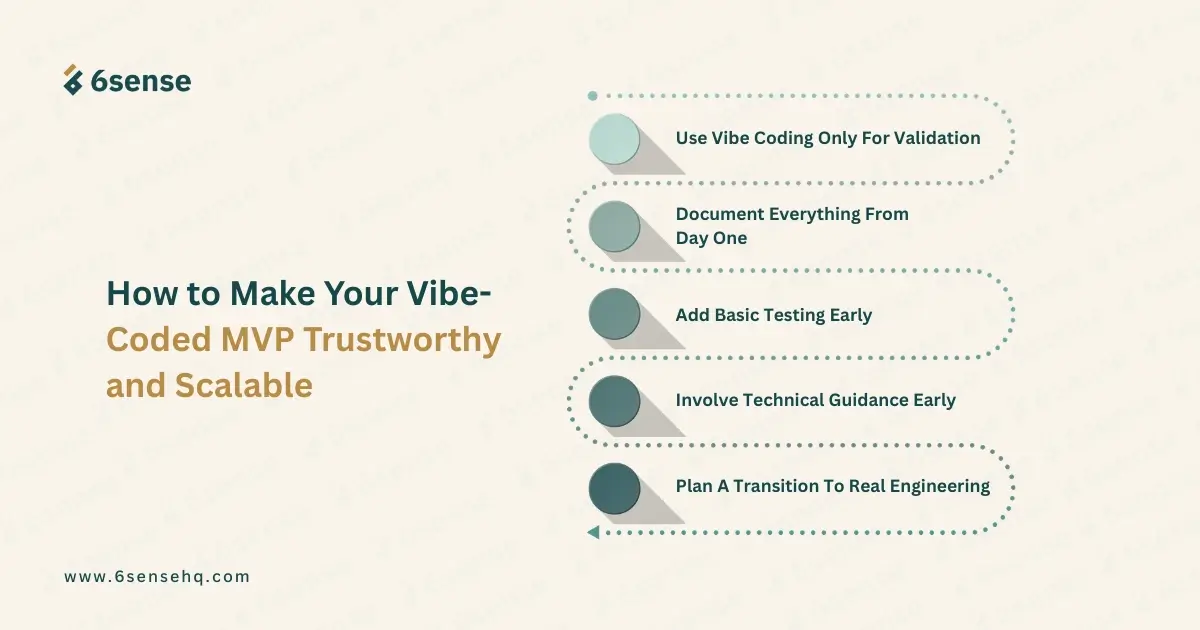
Treat your MVP as a test, not a final product. Focus on validating your idea, not building perfect systems. Once validation is clear, plan for rebuilding with better structure and proper engineering practices.
Keep track of features, flows, and logic in simple documents. This helps you understand your product better and makes it easier to rebuild or scale later with developers.
Even simple testing can prevent major issues. Many vibe coding projects skip QA, which leads to hidden bugs that only appear after launch. Adding testing early improves reliability significantly.
Even if you build alone, getting a developer’s input early can save you from major mistakes. They can help improve structure, security, and scalability before problems grow.
For more advanced implementations, many founders transition toward structured builds and understand AI MVP development for deeper features once validation is clear.
Most successful founders use vibe coding first, then move to structured development. Build fast, validate, then rebuild properly. This approach reduces long-term risk and improves product stability.
Vibe coding MVPs are changing how startups begin. They remove barriers, speed up validation, and give founders control like never before. But they also come with real risks, messy code, hidden bugs, and scalability issues.
The smartest founders don’t avoid vibe coding; they use it with awareness. Build fast, test early, and be ready to rebuild when needed. That’s how you turn speed into real success.
Receive professional insights from 6sense HQ to turn your vibe-coded MVP into a scalable, secure product that actually survives real users and growth.
Compare 6sense HQ and DevToDollars on MVP speed, team models, proof, pricing, and post-launch support to pick the right fit.
15 min read
Compare 6sense HQ alternatives for MVP development in 2026 and find the best software team for your startup budget and goals.
17 min read
| Have developer audit before launch |
Learn whether one developer can build an MVP in 2026 with cost, scope, AI tools, low-code tips, risks, and launch advice.
22 min read