

6sense HQ vs DevToDollars: Best MVP Partner in 2026
Compare 6sense HQ and DevToDollars on MVP speed, team models, proof, pricing, and post-launch support to pick the right fit.
15 min read
Loading…
Learn whether one developer can build an MVP in 2026 with cost, scope, AI tools, low-code tips, risks, and launch advice.
Written by: AKM Ahsan Created on: 25 May 202622 min to read
One developer building an MVP sounds risky until you see it done properly. At 6sense HQ, we have seen founders start with one clear idea, one focused developer, and one simple goal: get a usable first version in front of real users. That is often enough to test demand before spending big.
So, can one developer build an MVP?
Yes, one developer can build an MVP if the scope is small, the features are clear, and the goal is learning, not perfection. A solo developer MVP works best when the product has one main user flow.
6sense HQ is trusted by 50+ founders and has helped 40+ funded startups launch MVPs, with support across MVP development, dedicated teams, QA, UI/UX, project management, and post-launch scaling.
A solo developer MVP works when the founder keeps the product small, clear, and testable. The goal is not to build everything. The goal is to prove one useful thing. In 2026, this often means working with a strong full-stack developer who can handle the first version across frontend, backend, database, deployment, and basic product decisions without needing a large team from day one.
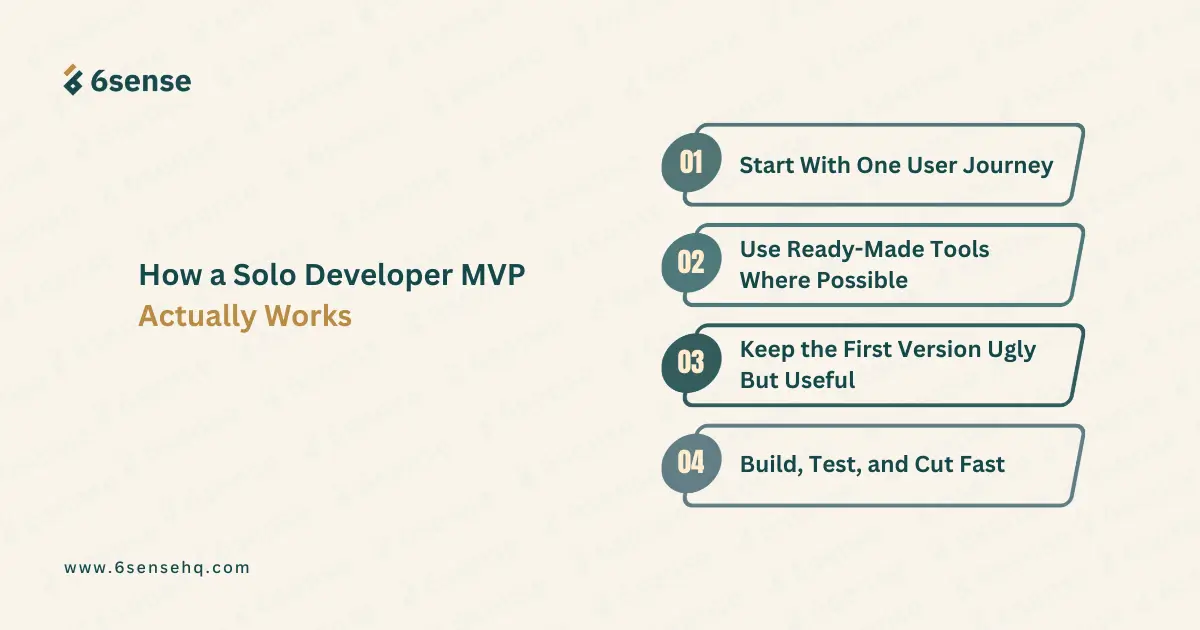
At 6sense HQ, we have seen this pattern across 50+ MVP launches: the first version moves fastest when the founder and developer agree on one core user flow before writing code. That is why a solo-developer MVP should start with a narrow product goal, not a full platform roadmap.
A solo developer should not build a full platform first. For example, a marketplace MVP can begin with user signup, profile creation, listing, and messaging. Payments, dashboards, referrals, and admin tools can wait until users prove real demand.
Across 6sense HQ’s MVP work with 40+ funded startups, the projects that stay closest to the first user journey are usually the easiest to scope, test, and launch. The delay usually begins when founders add second-stage features before the first user flow is validated. This is why MVP planning for funded startup teams should focus on validation, delivery speed, and scope control before adding investor-friendly but unnecessary features.
One person can move faster by using Stripe for payments, Firebase for backend, Supabase for database, and Webflow or Bubble for simple interfaces. This reduces custom coding and lets the developer focus on the feature that matters most.
For many solo builds today, Next.js has become the dominant solo-developer stack because it lets one developer build frontend pages, backend routes, APIs, and production-ready web app flows in one framework.
A developer can then use Vercel for fast frontend deployment and Railway for hosting backends, databases, or server-side services when the MVP needs more than a static interface. For UI speed, tools like shadcn/ui help solo developers move faster with reusable, customizable component libraries instead of designing every button, form, modal, and dashboard element from scratch.
Many early founders overthink design. A solo developer MVP only needs to be usable enough for real users to try it. A clean dashboard with working actions is better than a beautiful app that takes six months.
This is where modern MVP building has changed. A founder and developer can now use AI pair-programming tools like Cursor, Claude Code, and Copilot to speed up repetitive coding, refactor messy sections, generate test cases, or explore implementation options faster.
6sense HQ’s own MVP positioning now includes AI-assisted development because it can help delivery move 30-40% faster when senior engineers still review the output. The important part is not just using AI. It is using AI inside a controlled delivery process with human judgment, testing, and scope discipline.
A one-person MVP needs short feedback loops. Build one feature, show it to users, then decide what to keep. A one-person MVP needs short feedback loops. Build one Feature, show it to users, then decide what to keep. Across 40+ MVP projects scoped by 6sense HQ, the most common reason early builds slow down is not coding speed. It is scope growth when extra dashboards, admin tools, integrations, or “nice-to-have” features keep getting added before the first user flow is validated.
Some founders now call this vibe coding, where they describe what they want and use AI tools to quickly generate screens, flows, or app logic. That can be useful for experimentation, but it becomes risky when founders treat generated code as production-ready without review.
A serious MVP still needs someone to check the flow, security, database structure, edge cases, and user experience before real users depend on it.
The cost of a solo developer MVP depends on how much the founder can prepare before development starts. Clear wireframes, a short feature list, and fast feedback usually reduce cost. A vague idea, changing requirements, or too many features will increase the budget quickly.
For a serious custom MVP, a solo freelance developer often costs around $50–$150 per hour in 2026. This range is realistic for experienced freelance or contract developers. Codementor’s freelance developer rate data has commonly placed experienced developers around $60–$100/hour, while broader contract developer data shows rates can go higher depending on skill, location, and project type.
| Build Type | Typical 2026 Cost | Timeline | Best For |
| Solo developer freelancer | $50–$150/hour, usually $15K–$45K total | 6–12 weeks | Founders who need a custom MVP with one clear user flow |
| Solo developer monthly retainer | $8K–$20K/month | 2–4 months | Founders who need ongoing development, fixes, and launch support |
| Low-code DIY | $50–$500/month in tool costs | 4–10 weeks | Non-technical founders testing a simple idea before hiring |
| AI-assisted solo build | $30–$150/month in AI tools plus developer time | 2–6 weeks | Simple prototypes, landing pages, dashboards, and early product flows |
A low-code DIY MVP is cheaper because the founder is doing more of the work. It can be enough for forms, directories, internal tools, landing pages, or simple dashboards. An AI-assisted solo build can be faster because tools like AI code assistants and app builders reduce repetitive work. But the hidden cost is still time, review, and cleanup.
The safest budget approach is to start with the smallest useful version. If the MVP needs payments, user roles, integrations, AI features, or compliance, expect the cost to move toward the higher end.
One developer can build a strong MVP when the product is simple, focused, and low-risk. But some products need more support from the beginning. Here are eight red flags that show one developer may not be enough.
| Area | Prototype | MVP | Full Product |
| Main purpose | To show how the idea may look or feel | To test if users actually need the product | To serve users at scale with complete features |
| Is it usable by real users? | Usually no, or only in a demo setting | Yes, but with limited core features | Yes, with polished features and support |
| Code needed | Sometimes no code is needed | Usually some code or low-code setup is needed | Full production-level development is needed |
| Best for | Pitching, early validation, design feedback | Market testing, user feedback, early traction | Growth, retention, revenue, and scaling |
| Example | A Figma clickable app design | A working booking app with signup and payment |
An MVP is not just a rough demo. Eric Ries describes it as the version that helps a team collect the most validated learning with the least effort.
One person can build more than most founders think, but not everything. A single developer can build a landing page, user signup, dashboard, basic database, simple payment flow, booking system, admin panel, or lightweight SaaS tool. That is enough for many early products.
A capable full-stack developer can often own the entire first version if the product is narrow: one user journey, one database model, one dashboard, and one clear outcome. With AI app builders like Lovable, Bolt.new, and v0.dev, founders can also prototype interfaces, landing pages, and early product flows faster before committing to full custom development. These tools are especially useful when the goal is to visualize the idea, test a user flow, or prepare a cleaner starting point for the developer. This is also the practical answer to how to build an MVP without a technical co-founder. Start with a small product idea, reduce it to one core workflow, and use simple tools to create a version real users can test. You do not need a large technical team for the first version if the MVP is narrow, testable, and built around one clear outcome.
As Eric Ries says, “remove any feature, process, or effort that does not contribute directly to the learning you seek.” That is the right mindset for a solo developer MVP. The developer should not build the dream version. They should build the learning version. If users respond, the product can grow with a bigger team later.
A single developer startup product makes sense when the idea is clear, the build is not too complex, and the founder needs speed. It is best for early learning.
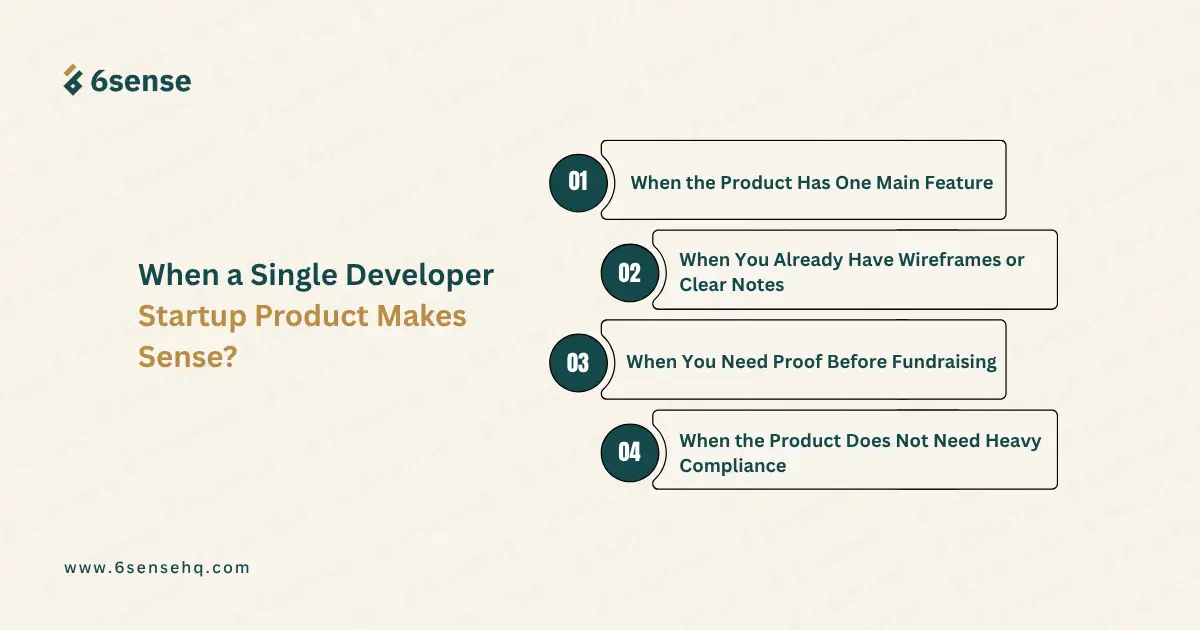
If your product is built around one action, one developer can usually handle it. For example, a simple appointment booking tool, lead capture dashboard, or internal tracker can start with one flow before becoming a bigger product.
One developer works better when the founder brings a clear scope. A messy idea creates rework. A simple Figma, feature list, or user story helps the developer build faster and avoid guessing.
In 2026, clear notes can also include rough outputs from AI app builders such as Lovable, Bolt.new, or v0.dev. These tools can help a founder explain the product visually, but the developer still needs to decide what should be rebuilt properly, what can be reused, and what should be removed from the MVP scope.
A solo developer MVP is useful when you need something working before talking to investors. It can help show traction, collect feedback, and prove that people care about the problem.
If your product handles health data, fintech data, banking workflows, or sensitive identity information, one developer may not be enough. You may need architecture, QA, security review, and stronger documentation from the start.
This is especially important when using vibe coding or AI-generated code. AI can help a developer move faster, but it should not replace security thinking, compliance planning, access control, audit trails, or proper review for sensitive products.
AI has changed the answer to “Can one developer build an MVP?” A few years ago, one developer had to write almost every screen, form, database query, and bug fix by hand. In 2026, that same developer can move much faster with AI pair-programming tools like Cursor, Claude Code, and GitHub Copilot.
These tools do not replace the developer. They sit beside the developer and help write boilerplate code, explain errors, refactor messy files, create test cases, and suggest better ways to structure a feature. In a controlled GitHub Copilot study, developers completed a coding task 55.8% faster with Copilot than without it.
In real MVP work, where a developer is using AI across planning, coding, debugging, and documentation, one strong developer can sometimes ship 2–3× more usable code per week than they could with a fully manual workflow.
AI app builders have also changed what happens before a developer is hired. Tools like Lovable, Bolt.new, and v0.dev let non-technical founders turn plain English prompts into early screens, prototypes, and simple app flows. Bolt.new, for example, says users can create apps and websites by chatting with AI, while v0.dev is commonly used to generate UI components and front-end screens quickly.
Design is also becoming less of a blocker. v0.dev can help generate clean interface ideas, and Figma’s AI features help teams get started faster, explore ideas, and stay in the design flow. This means a solo developer does not always need to wait for a full design team before building the first version.
But there is an important limit. AI tools are excellent for speed, prototypes, and first drafts. They are not a replacement for good engineering judgment. A real MVP still needs someone to think through security, database structure, user permissions, payments, performance, and future scaling. AI can help one developer move faster, but it cannot decide what should be built, what should be cut, or what is safe enough for real users.
| Factor | Why It Matters | What Goes Wrong Without It | Better MVP Approach |
| Scope | Keeps the MVP small enough to finish | The developer keeps building extra features | Pick one core problem and one core user flow |
| Speed | Helps you learn before money runs out | The MVP takes months and loses momentum | Launch the first usable version fast |
| User feedback | Shows what people actually need | The product becomes based on guesses | Test with real users after each milestone |
| Feature priority | Keeps work focused on value | Nice-to-have features eat the timeline | Separate must-have from later features |
| Clear acceptance criteria | Helps the developer know when a feature is done | Founder and developer disagree after delivery |
Today, founders have another option between no-code and full custom development: AI app builders like Lovable, Bolt.new, and v0.dev. These tools can turn prompts into early screens, workflows, and app-like prototypes, which makes them useful for testing an idea before a full engineering sprint. But they should still be treated as acceleration tools, not a replacement for product thinking, technical review, or long-term architecture.
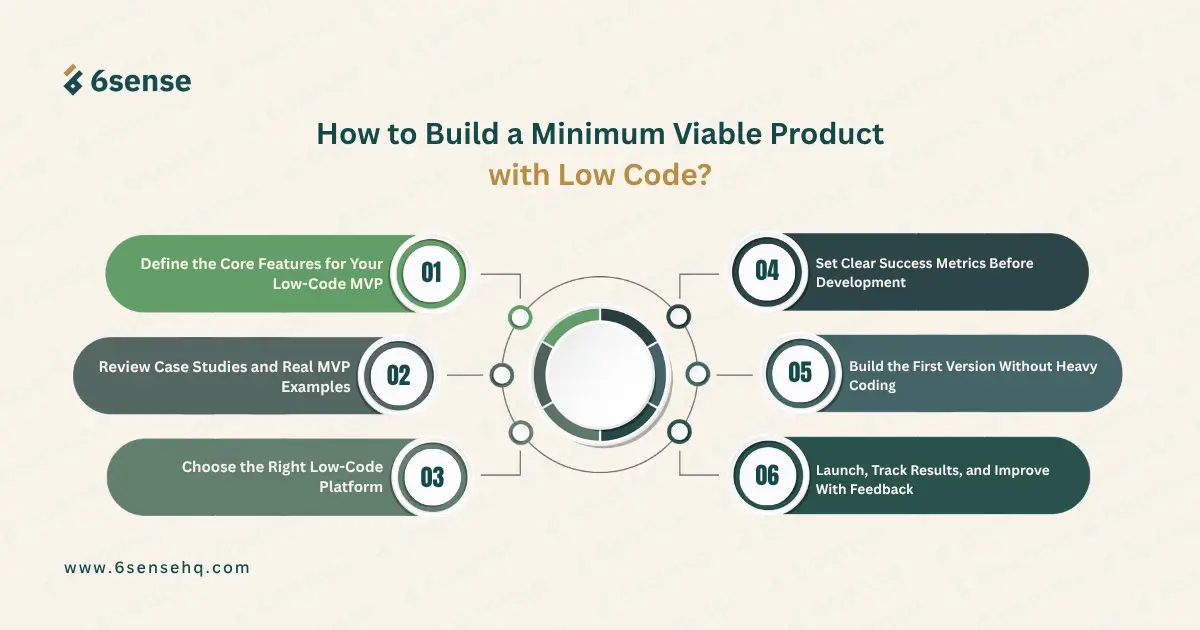
Start by writing the one job your MVP must do. For example, “users can book a coach,” “users can upload receipts,” or “teams can track leads.” Then list only the features needed for that job. This keeps the low-code MVP simple.
Before choosing a tool, look at real examples similar to your product. If others built marketplaces, dashboards, or booking tools with the same platform, that lowers risk. A solo developer should avoid tools that look easy but fail at real workflows.
Pick the platform based on your product type. Bubble can help with web apps, Webflow with marketing sites, Airtable with internal tools, and FlutterFlow with mobile-style apps. The right tool saves time. The wrong tool creates rebuild costs later.
If you are building a web-based SaaS MVP with one developer, Next.js is often the practical default because it supports full-stack product development in one framework. The developer can pair it with Vercel for deployment, Railway for backend services or databases, and shadcn/ui for fast, clean interface components. This kind of stack helps a solo developer avoid wasting weeks on setup and focus more on the actual user flow.
Do not just launch and hope. Decide what success means first. It could be 100 signups, 20 active users, 5 paid trials, or 10 completed bookings. Clear metrics help you know if the MVP is working or just existing.
Use templates, plugins, APIs, and existing services where possible. For example, use Stripe for payment, Calendly-style flows for booking, and prebuilt authentication. One developer should not rebuild common systems unless the product truly depends on them.
This is also where AI pair-programming with Cursor, Claude Code, or Copilot can help. A developer can use these tools to generate boilerplate, debug errors, write small functions, or speed up implementation. The key is to use AI to reduce repetitive work, not to let it make product, security, or architecture decisions alone.
After launch, watch what users actually do. Track signups, drop-offs, messages, payments, and repeated use. At 6sense HQ, the MVP approach focuses on structured delivery, sprint visibility, QA, and launch support so founders can improve based on real usage.
A useful example from 6sense HQ is Impromek, founded by Gabriel Sotomayor. Gabriel was a young founder fresh out of college with a clear product vision but an unfinished platform, a limited budget, and growing maintenance issues. He had tried to move fast on his own, but as a single founder balancing product development, engineering decisions, and investment efforts, the build became too difficult to complete alone. For founders in a similar situation, knowing how to recover from a difficult MVP development experience can help them avoid repeating the same scope, communication, or team-selection mistakes.
The product idea was an online coaching marketplace where students could connect with expert mentors. Instead of trying to build every possible coaching, sports, or marketplace feature from day one, 6sense HQ focused the MVP around the core marketplace flow: separate admin, teacher, and student panels, lesson requests, built-in chat, feedback, ratings, secure payments, and a refund feature for trust. More complex expansion work was deferred so the first version could stay lean, maintainable, and usable for real users.
The build was not positioned as a solo-developer project. The case study lists the team size as a dedicated development team and the duration as around three months, using React, Node.js, and Stripe. That distinction matters: Gabriel’s case shows where a founder’s solo effort reached its limit, and where a focused technical team helped turn an incomplete product into a complete MVP. This is also a good example of how to build a startup product without a CTO. The founder did not need to hire a full technical leadership team immediately, but he did need structured development support, clear delivery ownership, and a team that could turn an unfinished product into a working MVP.
The outcome was a fully functional platform that allowed Gabriel to bring in real users, start operations smoothly, reduce ongoing tech stress, and focus more on growth and investment instead of fixing technical issues. A public testimonial attributed to Gabriel says, “Their strong technical skills and speed of development are super impressive.” Before publishing, get Gabriel’s explicit permission to use the quote and confirm whether he can share any user numbers, growth milestones, or follow-on funding details.
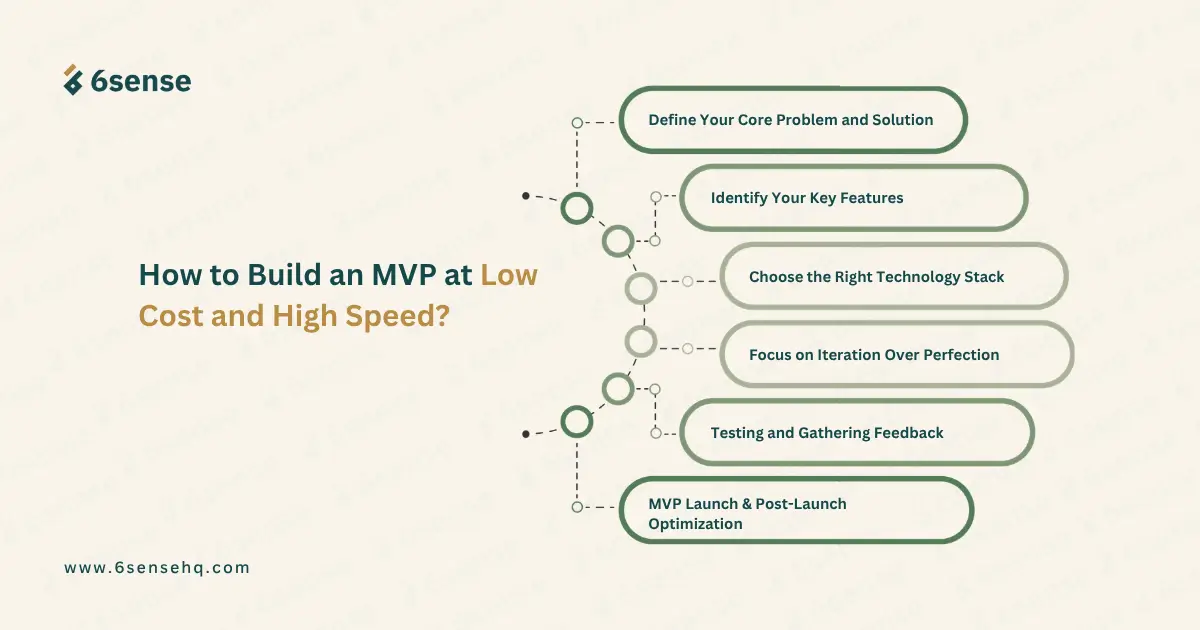
Start with one painful problem and one simple solution. Do not begin with features. For example, instead of “build a full HR platform,” start with “help hiring managers shortlist candidates faster.” This keeps the MVP small, cheaper, and easier to test with real users.
Pick only the features needed to prove the idea. Many founders build too much too early, then run out of time or budget. A good MVP may need signup, one dashboard, one main action, and basic notifications. Everything else can wait.
Use the stack your developer already knows well. In 6sense HQ’s MVP scoping experience, the fastest stack is rarely the trendiest one. It is usually the stack the developer can ship, debug, deploy, and maintain confidently without wasting early budget on tool experimentation.
Do not wait until the product feels perfect. Launch a useful first version, then improve it based on what users actually do. A small feature done well is better than a large product nobody understands. Speed matters because feedback reduces guesswork.
Test the core flow before launch: signup, payment, forms, dashboard, and main user action. Then ask early users what confused them, what helped them, and what they expected next. This feedback shows whether your MVP is solving a real problem.
Launch to a small group first, not the whole market. Watch usage, bugs, drop-offs, and repeated actions. Then improve the parts users touch most. Low-cost MVPs become stronger when you avoid big rebuilds and optimize step by step after launch.
Low code can make MVP development faster, but it also creates hidden risks. Founders should think about control, security, and scope before choosing tools.
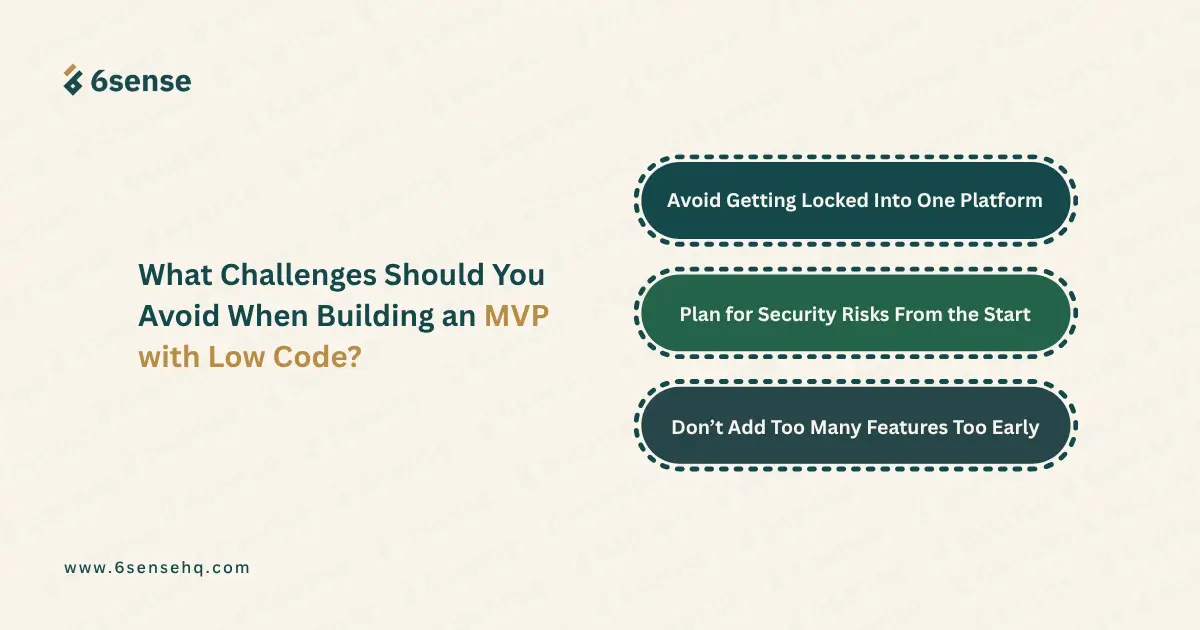
Some low-code tools make it hard to move your product later. If your MVP succeeds, you may need custom code, better performance, or more control. Check export options, database access, API limits, and pricing before building everything there.
This is why many founders eventually move from pure no-code or AI-generated prototypes into a more flexible stack like Next.js with Vercel, Railway, and a reusable UI system such as shadcn/ui. It gives the developer more control when the product starts moving from validation to real growth.
Even a small MVP can collect emails, payments, files, or user behavior data. Use trusted tools, limit admin access, protect API keys, and avoid storing sensitive data unless needed. Security problems can hurt trust early.
Low-code tools make it easy to add pages, plugins, and automations. That can become a trap. Keep the MVP focused on one clear user problem. If a feature does not help users test the core value, leave it out.
Low-code tools and AI tools can make an MVP feel almost instant. A founder can describe an idea, generate screens, and get a working demo much faster than before. But vibe coding and AI app builders like Lovable, Bolt.new, and v0.dev can also create a false sense of completion.
A generated app may look impressive, but it still needs proper review. Someone must check whether the database is structured correctly, whether user permissions work, whether payments are safe, whether the code can be maintained, and whether the product actually solves the user’s problem.
So, can one developer build an MVP? Yes, but only when the MVP is treated like a learning tool, not a full product. One developer can build a useful first version if the scope is simple, the founder gives clear direction, and users test it early.
In 2026, one developer can move faster than ever with AI pair-programming tools like Cursor, Claude Code, and Copilot, AI app builders like Lovable, Bolt.new, and v0.dev, and practical solo-developer stacks like Next.js, Vercel, Railway, and shadcn/ui. But tools do not remove the need for judgment. The real advantage comes when a skilled full-stack developer uses these tools to ship faster while still protecting scope, quality, security, and the user experience.
But if the product needs complex architecture, security, QA, AI, compliance, or fast scaling, one developer may need support from a product team. The smartest move is to start small, launch fast, and use real feedback before spending heavily.
Build your MVP with 6sense HQ when you need speed, structure, senior developers, and founder-friendly delivery from idea to launch.
Compare 6sense HQ and DevToDollars on MVP speed, team models, proof, pricing, and post-launch support to pick the right fit.
15 min read
Compare 6sense HQ alternatives for MVP development in 2026 and find the best software team for your startup budget and goals.
17 min read
| A full booking platform with analytics, admin, CRM, and automation |
| User feedback type | “Do users understand the idea?” | “Will users use or pay for this?” | “Will users stay, upgrade, and recommend it?” |
| Time needed | A few days to a few weeks | A few weeks to a few months | Several months or longer |
| Cost level | Low | Medium | High |
| Risk level | Low technical risk, but no market proof | Medium risk, because users test the real thing | High cost risk if built before validation |
| Who should build it? | Designer, founder, or product strategist | Solo developer, small team, or MVP agency | Full product team |
| When to use it | Before writing heavy code | Before scaling or fundraising | After the MVP shows real demand |
| Success signal | People understand the concept | People use it, pay, or ask for more | Users return, revenue grows, and operations scale |
| Define what “done” means before coding |
| Technical stack | Affects speed, cost, and future scaling | Wrong tools slow down changes later | Use simple, proven tools for the first version |
| Design quality | Helps users understand the product | Users leave because the flow is confusing | Make it clean and usable, not overdesigned |
| Testing | Prevents basic bugs from blocking users | Users face broken flows during early trials | Test signup, payment, dashboard, and key actions |
| Documentation | Makes future scaling easier | A second developer struggles to understand the code | Keep basic notes on setup, features, and decisions |
| Founder involvement | Keeps the product close to the problem | The developer builds without business context | Founder reviews progress every week |
| AI-assisted development | AI pair-programming tools like Cursor, Claude Code, and Copilot can help one developer move faster | The founder assumes AI-generated code is automatically production-ready | Use AI for speed, but keep human review for architecture, security, testing, and product judgment |
| Stack choice | Next.js, Vercel, Railway, and shadcn/ui can give a solo developer a faster path from idea to live MVP | The MVP gets delayed by custom setup, messy deployment, or rebuilding common UI patterns | Use proven tools that reduce setup time and help the developer ship a usable version faster |
Learn how to manage developers as a non-technical founder using clear sprints, demos, scope control, and PM-led delivery tips.
12 min read