


6sense HQ vs DevToDollars: Best MVP Partner in 2026
Compare 6sense HQ and DevToDollars on MVP speed, team models, proof, pricing, and post-launch support to pick the right fit.
15 min read
Loading…
Compare 6sense HQ alternatives for MVP development in 2026 and find the best software team for your startup budget and goals.
Written by: AKM Ahsan Created on: 1 Jun 202617 min to read

Choosing a software partner is not just about who can write code. It is about who can understand your idea, build the right version first, and help you avoid wasting months.
As of May 2026, 6sense HQ holds a 5.0/5 overall rating on Clutch based on 2 verified reviews. Clutch also lists 6sense HQ’s average hourly rate at $25–$49/hour, a minimum project size of $10,000+, and a most common reviewed project size of $10,000–$49,999.
6sense HQ has also worked with founders through MVP development, offshore software development, dedicated teams, and staff augmentation. Its MVP service page lists fixed-price MVPs from $30K, dedicated teams at $5K–$15K/month, and hourly support at $20–$35/hour.
Many founders compare 6sense HQ with MVP agencies, freelancers, marketplaces, and dedicated team providers. The real question is not “which one is famous?” It is “which one gives you the right team, process, speed, and price for your stage?”
This blog will guide you through the best 6sense HQ alternatives, when to choose each option, how 6sense HQ compares, and why its dedicated team, offshore development, and staff augmentation models can work better for many founders.
Yes, 6sense HQ is worth considering if you want a software team that gives you more than code. The company offers three main service paths: dedicated development teams, offshore software development, and staff augmentation. That means a founder can choose between a fully managed team, a remote team that works with their in-house team, or 1-2 developers added to an existing workflow.
The strongest part of 6sense HQ is the delivery model. In its dedicated team service, you get developers, a project manager, and QA support. The team handles planning, sprints, daily work, and delivery while you stay focused on product decisions. This is useful for non-technical founders who do not want to manage every development task themselves.
The pricing also makes it attractive. 6sense HQ’s MVP service page lists fixed-price MVPs from $30K, dedicated teams from $5K–$15K/month, and hourly work from $20–$35/hour. For founders comparing U.S. agency costs, that gives 6sense HQ a clearer cost-control story than many premium local providers.
Another strong point is speed. 6sense HQ says its AI-assisted workflow can support 30–40% faster development cycles by using AI for repetitive code, early error detection, test creation, and documentation. This claim should be framed as a 6sense HQ service-page claim, not as an independently verified universal benchmark.
The honest limitation is social proof volume. 6sense HQ’s Clutch rating is strong, but the review count is still small at 2 verified reviews. That means the page should not rely on the rating alone. It should also show named case studies, project examples, pricing transparency, delivery process, and direct client quotes.
Pricing is one of the biggest reasons founders compare 6sense HQ with Toptal, freelancers, and traditional MVP agencies. But the cheapest hourly rate is not always the safest choice. A low-cost freelancer can become expensive if the work needs rework, while a premium network can be too costly if the founder still has to manage scope, QA, and delivery alone.
| Option | Typical 2026 Pricing Signal | What It Usually Means for Founders |
| 6sense HQ | $20–$35/hour, $5K–$15K/month dedicated teams, MVPs from $30K | Best for founders who want cost control plus managed delivery, PM, QA, and sprint structure. |
| Toptal | Third-party 2026 reviews commonly estimate $60–$200+/hour depending on skill and specialization. Toptal itself promotes access to the “top 3%” of talent. | Best for companies that want vetted senior talent and can manage the work internally or pay for more managed team support. |
| Freelancer platforms | Upwork lists software developers at $10–$100/hour and web developers at $15–$50/hour, depending on skill and experience. | Best for small tasks, prototypes, or founders who can manage quality, timeline, and scope themselves. |
| Traditional software agencies | Clutch’s 2026 pricing guide says many software development companies charge $25–$49/hour on average, while U.S.-focused custom software sources commonly show higher ranges such as $100–$180/hour or more for U.S. teams. | Best for funded companies that need strategy, design depth, local collaboration, or enterprise-grade delivery. |
Toptal’s own site supports the “top 3%” positioning, while third-party Toptal pricing reviews commonly place client rates in the $60–$200+/hour range. Upwork lists software developer rates from $10–$100/hour and web developer rates from $15–$50/hour. Clutch’s 2026 software development pricing guide lists many software development companies at $25–$49/hour, while other U.S.-focused custom software pricing guides show higher U.S. role-based rates.
The point is not that 6sense HQ is always the cheapest option. The point is that 6sense HQ combines offshore pricing with a managed delivery structure, which can be more useful than hiring one cheap freelancer vs agency or one expensive senior contractor without PM and QA support.
The payroll savings claim is strongest when the math is visible. 6sense HQ’s dedicated team pricing starts at $5K–$15K/month. By comparison, the U.S. Bureau of Labor Statistics reported a median annual wage of $133,080 for software developers in May 2024. That equals about $11,090/month before employer costs such as benefits, payroll taxes, equipment, recruiting, onboarding, and management overhead.
A fully loaded U.S. software developer can therefore cost meaningfully more than base salary alone. If a founder needs one developer, QA support, and project management, the in-house cost can grow quickly. 6sense HQ’s model may reduce cost by using offshore delivery, flexible team structure, and short-term engagement options instead of permanent hiring.
This is why the savings range should be explained as a comparison between flexible offshore delivery and fully loaded in-house hiring, not as a fixed guarantee for every project. The exact savings depend on team size, seniority, location, timeline, and how much product management or QA support the founder needs.
| Factor | 6sense HQ | Toptal | Freelancer Platforms | Traditional MVP Agency |
| Best for | Founders who want managed MVP delivery, offshore teams, staff augmentation, or flexible dev support | Companies that want vetted individual experts or custom teams | Small tasks, quick fixes, and low-budget experiments | Full-service product builds with strategy and design depth |
| Pricing model | Fixed price, dedicated team, hourly | Talent-rate based pricing; managed support depends on model | Hourly or fixed per freelancer | Usually fixed price, retainer, or milestone-based |
| Cost position | Startup-friendly: $20–$35/hour, $5K–$15K/month, or MVPs from $30K | Usually premium; third-party 2026 reviews commonly estimate $60–$200+/hour | Wide range; Upwork lists software developers at $10–$100/hour | Varies by region; U.S. teams can be much higher |
| Management support |
For a decision-stage founder, the real question is not only “who is cheaper?” It is “who reduces the most risk before I spend serious money?” Use this checklist to compare the delivery model behind each option.
| Feature | 6sense HQ | Toptal | Freelancer | Traditional MVP Agency |
| NDA protection | Available during professional engagement | Usually available | Depends on freelancer | Usually available |
| IP ownership clarity | Should be defined in the project contract | Contract-dependent | Contract-dependent | Usually contract-defined |
| Source code access | Should be included in delivery terms | Contract-dependent | Must be agreed clearly | Usually included |
| Fixed-price MVP option | Yes — MVPs from $30K | Not the main model |
Before choosing an MVP agency, look beyond the portfolio. Founders often struggle because they pay upfront, get weak code, or lose time with teams that do not understand the product. Compare structure, communication, delivery process, and proof before price.
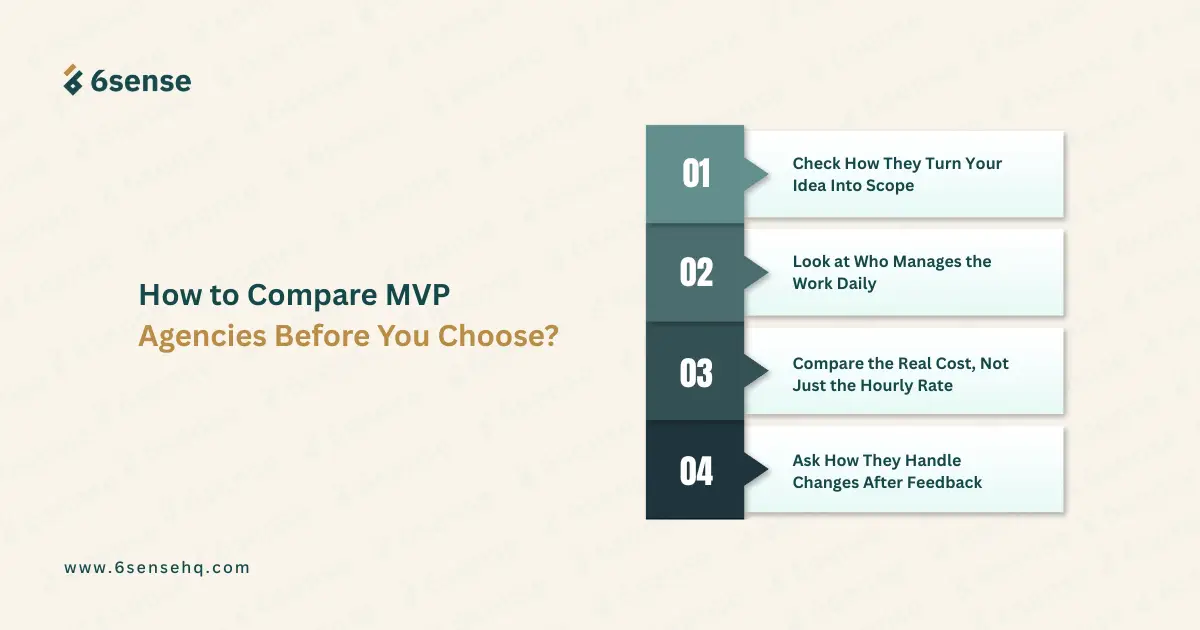
A good agency should not start with coding. They should help define features, user flow, must-have screens, and launch goals. For example, if your idea has payments, admin, and AI, they should separate MVP needs from later features.
Many problems happen when founders hire developers but no one manages sprints, QA, or deadlines. Choose a team with a project manager, clear task tracking, and weekly updates. It protects you from unclear progress and surprise delays.
A cheap hourly developer can become expensive if the work needs rework. A higher but structured MVP team may save money because they include planning, testing, and delivery. Always compare total outcome, not only rate.
Your MVP will change once users test it. The right team should expect feedback and build in cycles. For example, if beta users ask for a new dashboard view, the team should explain cost, timeline, and impact clearly.
6sense HQ is one of the stronger MVP company choices for founders who want managed delivery without the cost of building a full in-house team. Many founders do not only need a developer. They need someone to help them build the first usable version, avoid unnecessary features, test the idea, and prepare for the next stage.
For founders, 6sense HQ stands out because it offers fixed-price MVPs, dedicated teams, and hourly support. Its MVP page also explains that AI-assisted workflows help reduce repetitive development work, detect errors earlier, create tests faster, and support documentation.
That matters because early-stage founders usually need speed without losing control. A cheap build that breaks after launch is not really cheap. A premium build that takes too long may also be wrong for a founder trying to validate demand. The safer choice is usually the team that matches the founder’s stage, budget, technical complexity, and need for management support.
| Option | Best for | Strength | Limitation | Why 6sense HQ compares well |
| 6sense HQ | Founders who want MVP delivery with PM, QA, and devs | Managed team, flexible pricing, AI-assisted workflow, offshore cost advantage | Needs clear founder input and scope | Strong balance of price, speed, and delivery structure |
| Toptal | Companies needing vetted senior talent | Large vetted talent network and top 3% positioning | Can be costly, and management may need extra support | 6sense HQ gives more built-in delivery support for startup MVPs |
| Freelancers | Small tasks or early prototypes | Low starting cost and flexible hiring | Quality, timeline, and reliability can vary | 6sense HQ reduces delivery risk with PM, QA, and sprint structure |
| Traditional MVP Agency | Design-heavy or strategy-heavy builds |
| Situation | Choose 6sense HQ When | Choose Other Alternatives When |
| You are a non-technical founder | You need PM, QA, developers, planning, and delivery support in one team | You already have a technical co-founder who can manage freelancers |
| You need an MVP | You want fixed-price or dedicated team support with clear scope and faster build cycles | You only need a no-code prototype or landing page |
| You need cost control | You want offshore pricing and flexible team models instead of permanent hiring | You have the budget for premium local agencies or senior consultants |
| You need vetted talent only | You want a full team, not just one expert | You only need one expert from a marketplace like Toptal or it’s alternatives |
| You need flexibility | You may scale up or down as your roadmap changes | You want permanent full-time employees from day one |
| You need staff augmentation | You already have a team and want 1–2 developers to join your workflow |
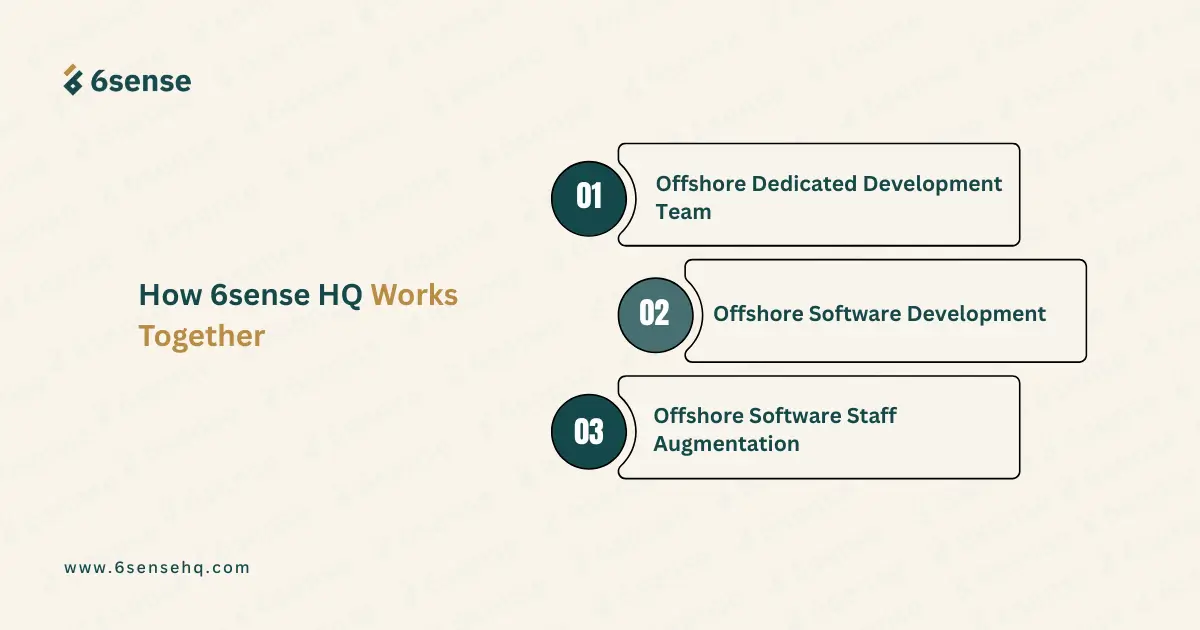
With an offshore dedicated development team, 6sense HQ gives you a full team that can include developers, a project manager, and QA. This works well when you want to build a serious product but do not want to hire everyone in-house.
The team manages planning, sprints, daily work, and delivery while you stay involved in product decisions.
Offshore software development is useful when you want a remote team that works closely with your internal staff. 6sense HQ positions this as a way to build and scale products faster while saving cost.
This model is good for companies that already know what they want to build but need more engineering power without local hiring delays.
Staff augmentation is best when you already have a team but need extra developers, QA, UI/UX, mobile, backend, frontend, or DevOps support. 6sense HQ learns your tech stack and goals, sends matched candidates, handles payroll and HR, and lets the developer join your tools, meetings, and workflow.
As of May 2026, 6sense HQ has a 5.0/5 overall rating on Clutch based on 2 verified reviews. Clutch also shows 5.0/5 ratings for quality, schedule, cost, and willingness to refer.
That review count is still small, so it should be treated as early but positive proof. The rating alone should not carry the whole trust argument. The stronger signal is what the clients actually describe: speed, technical skill, clear communication, sprint structure, daily updates, and schedule discipline.
One Clutch review describes an online marketplace project connecting college and professional baseball athletes with younger players. The client said the goal was to build a platform that was easy to use, intuitive, and technically advanced enough to support online training interactions.
The project followed an MVP-style process. The client and 6sense HQ first created a feature list, then divided the work into roughly two-week sprints. The reviewer said the team took control of design and development and completed the work within the estimated time.
The strongest direct quote from this review is: “Their strong technical skills and speed of development are super impressive.”
This project should be connected to the Impromek/Gabriel Sotomayor story already used in BL164. Add an internal link here: “Read the full solo-developer MVP analysis for this product type.”
Client profile: Gabriel Sotomayor, founder of Impromek, was building a sports marketplace designed to connect athletes, coaches, and younger players looking to improve.
Challenge: The product needed more than a basic website. It needed a usable marketplace flow, profiles, communication between both sides, and a smooth enough experience for early users to trust the platform.
6sense HQ’s approach: The team helped organize the MVP feature list, worked in sprints, handled design and development, and stayed flexible when requirements changed. This matters because marketplace MVPs often fail when founders try to build every possible feature before proving the core user flow.
Outcome: The Clutch review says the client was pleased with early user feedback, the team worked in an organized sprint process, delivered on time, and handled changing requirements with flexibility.
Why it matters for founders: This is the kind of proof a comparison page needs. It shows not only that 6sense HQ can write code, but that the team can turn a founder’s idea into a scoped MVP process with sprint structure and delivery discipline.
The second Clutch review is from the owner of an employee management platform. The client hired 6sense HQ to create a program with minimal bugs and help turn the idea into a working product. The team provided sketches, UI, wireframes, mobile-responsive design, development, basic branding, and ongoing feature work.
The client said they worked with around four people from 6sense HQ, including the project manager, team leader, owner, and a developer. They also said the team gave daily updates, used Jira, and communicated through WhatsApp, email, and Zoom.
The strongest direct quote from this review is: “It establishes trust between us.”
For founders, this review supports a different trust signal: not just speed, but process. The client specifically valued schedule discipline, regular updates, and clear communication. That is important because many MVP problems happen when founders cannot see what is being built until it is too late.
A brand-owned comparison page should not pretend competitors are weak. Toptal has a much larger brand presence and a major vetted talent network. Freelancer platforms have large global talent pools. Traditional agencies may have stronger local relationships, deeper discovery processes, or more public reviews.
6sense HQ’s strongest proof today is not review volume. It is the combination of transparent pricing, managed delivery, offshore cost structure, and early positive Clutch evidence. As of May 2026, the Clutch profile shows 2 verified reviews and a 5.0/5 overall rating. That is a good start, but the review count should grow over time.
For transparency, this page should be reviewed quarterly. Update the Clutch rating, review count, pricing references, competitor pricing, and service claims whenever public data changes.
The best 6sense HQ alternative depends on what you need. If you only need one developer, Toptal or a freelancer may work. If you need a big strategy project, a traditional agency may fit.
But if you want a practical mix of cost savings, team structure, MVP support, offshore delivery, and flexible scaling, 6sense HQ is a strong choice. It gives founders more than code. It gives them a delivery system, managed team, and clearer path from idea to product.
Choose the option that reduces risk, protects your budget, and helps you launch with confidence.
Start your project with 6sense HQ today and turn your idea into a real product with a flexible expert team.
Compare 6sense HQ and DevToDollars on MVP speed, team models, proof, pricing, and post-launch support to pick the right fit.
15 min read

Learn whether one developer can build an MVP in 2026 with cost, scope, AI tools, low-code tips, risks, and launch advice.
22 min read
| Client manages team, or chooses a more managed Toptal option |
| Mostly self-managed |
| Usually managed |
| Speed | MVP pricing page claims 30–40% faster AI-assisted development cycles | Toptal Teams supports custom team building and Teams Advanced for management support | Depends on freelancer availability | Depends on agency pipeline |
| Social proof | 5.0/5 on Clutch based on 2 verified reviews as of May 2026 | Strong brand recognition and large talent network | Depends on individual freelancer profile | Depends on agency portfolio and reviews |
| Best advantage | Strong balance of cost, team structure, and delivery support | Large vetted talent network | Low entry cost | Strategy, UX, and enterprise process depth |
| Main risk | Best fit still requires clear scope and active founder input | Can be costly for early-stage startups | Reliability and quality gaps | Higher budget and slower start |
| Usually yes |
| Dedicated team option | Yes — $5K–$15K/month | Yes, through Toptal Teams | Rare | Yes |
| Hourly support | Yes — $20–$35/hour | Yes, usually premium | Yes | Sometimes |
| Project manager included | Yes in managed/dedicated team model | Depends on model; Teams Advanced adds more support | Usually no | Usually yes |
| QA included | Yes in managed/dedicated team model | Depends on team setup | Usually separate | Usually yes |
| Post-launch support | Available depending on engagement | Depends on contract | Depends on freelancer | Usually available |
| Onboarding speed | Fastest when scope is clear and team availability matches | Toptal Teams can build custom teams; exact timing depends on role and fit | Can be fast but inconsistent | Often slower due to discovery and contracts |
| Mobile app capability | Yes — 6sense HQ lists Kotlin, Swift, and Flutter under mobile technologies | Yes, if hired talent matches | Depends on freelancer | Usually yes |
| AI feature capability | Yes — 6sense HQ lists AI-assisted workflow and AI-related services | Yes, if hired talent matches | Depends on freelancer | Depends on agency |
| Clutch rating | 5.0/5 based on 2 verified reviews as of May 2026 | Varies by Toptal profile/category | Individual ratings vary | Agency-specific |
| Verified review count | 2 verified Clutch reviews | Platform and review count vary by source | Varies by profile | Varies by agency |
| Best fit | Founders who want delivery structure, cost control, and flexible team support | Companies that want vetted senior talent | Founders testing small tasks |
| Can offer strong product strategy |
| Often higher cost and longer timeline |
| 6sense HQ can be more practical for cost-sensitive founders |
| In-house Team | Funded startups with long-term hiring plans | Full control and culture fit | Slow hiring, payroll cost, and HR burden | 6sense HQ helps founders start without full-time hiring overhead |
| You need full delivery ownership | You want 6sense HQ to manage sprints, QA, planning, and delivery | You want to directly manage every developer yourself |
| You need AI features in the MVP | You need a team that can build AI-assisted product features while still handling normal product architecture, QA, and delivery | You need deep model training, custom ML infrastructure, or a specialist AI research team |
| You are in a regulated industry | You need stronger documentation, access control, QA, and structured delivery from the start | You already have internal compliance, security, and engineering leadership |
| You have a 6-week deadline | You have a tight but clear scope and need fast onboarding with a focused delivery team | The scope is still unclear, design is missing, or the build needs enterprise-level complexity |
Learn how to manage developers as a non-technical founder using clear sprints, demos, scope control, and PM-led delivery tips.
12 min read