

6sense HQ vs DevToDollars: Best MVP Partner in 2026
Compare 6sense HQ and DevToDollars on MVP speed, team models, proof, pricing, and post-launch support to pick the right fit.
15 min read
Loading…
Learn how to manage developers as a non-technical founder using clear sprints, demos, scope control, and PM-led delivery tips.
Written by: AKM Ahsan Created on: 22 May 202612 min to read
A non-technical founder can have a strong product idea, paying users, and a clear market gap, but still get stuck when developers start building the wrong thing. MVP development for non-technical founders works differently than most people expect it is less about writing requirements and more about building a structure where clarity replaces assumption at every stage. At 6sense HQ, this is a common problem we help founders solve: turning ideas into clear scopes, managed sprints, and working software without forcing the founder to become technical.
So, how to manage developers as a non-technical founder?
You manage outcomes, not code. That means you define the product goal, explain user needs, approve milestones, ask clear questions, and use a process where developers show progress regularly.
6sense HQ helps non-technical and early-stage founders build and scale products with structured offshore teams. The company offers dedicated development teams, offshore software development, and staff augmentation, with onboarding in under 7 days and delivery support through planning, reporting, and Agile workflows.
Across PM-led engagements at 6sense HQ, founders typically start seeing their first working feature demos within the first two weeks of kickoff. The goal is not to make founders technical. The goal is to give them enough visibility and structure to make confident product decisions.
Non-technical founders manage developers successfully by focusing on communication, goals, visibility, and structured processes instead of trying to manage code directly. They define clear outcomes, use sprint systems, review working demos, and rely on PM-led workflows to keep projects moving.
You do not need to understand every technical choice. Your real job is to make the product direction clear, protect focus, and check progress through simple business outcomes.
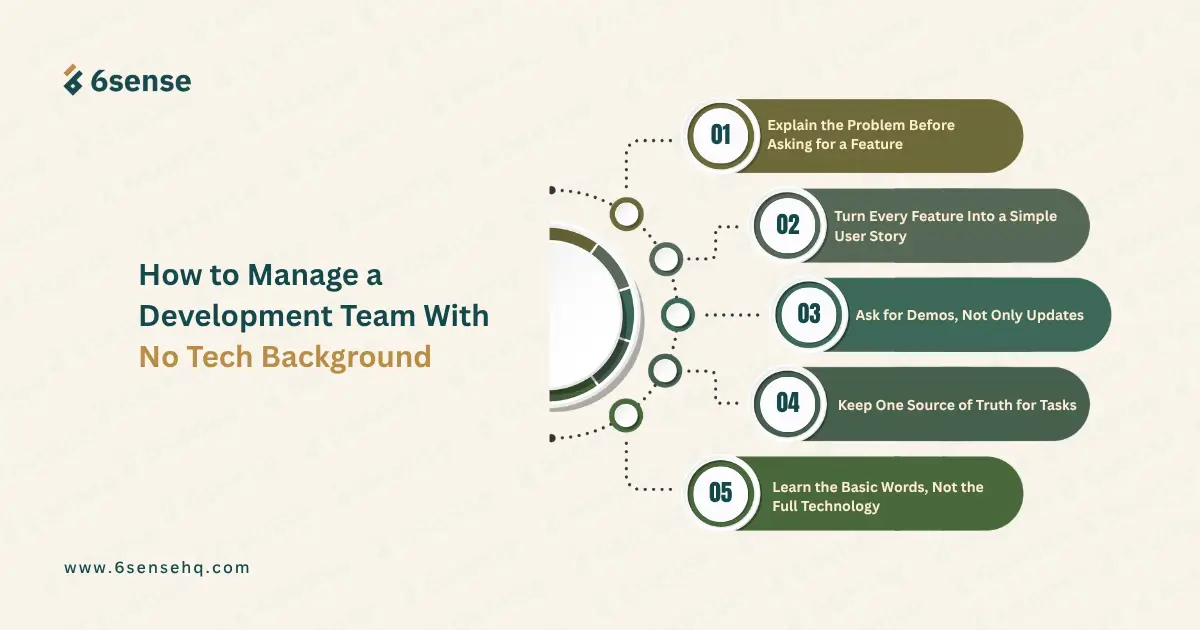
Do not just say, “Build a dashboard.” Explain who uses it, what problem it solves, and what action the user should take. For example, “Admins need to see failed payments quickly so they can contact customers before churn happens.”
A user story helps developers understand the real purpose. Use this format: “As a user, I want to do X, so I can achieve Y.” Then add clear success rules, such as what should happen after clicking a button.
Example 1 - Marketplace
As a marketplace seller, I want to receive email notifications when a buyer messages me, so I can respond before they leave the platform.
Acceptance criteria:
Example 2 - Admin Dashboard
As an admin, I want to see failed payment transactions, so I can contact users before churn increases.
Acceptance criteria:
Example 3 - Payment Flow
As a customer, I want to save my payment method securely, so I can check out faster next time.
Acceptance criteria:
A message saying “80% done” often creates false confidence because progress is hard to verify.
Ask developers to show actual working software using:
Good example:
"Show me the payment flow on staging and walk me through both successful and failed transactions."
Bad example:
"Just tell me whether it is almost finished."
Common mistake: Founders approving screenshots instead of workflows.
Recovery: Always click through the feature yourself.
Requirements spread across email, WhatsApp, calls, and memory create confusion quickly.
Recommended tools:
Your board should include:
Common failure mode: Teams discussing requirements in multiple places.
Recovery: Create one shared workspace and treat it as the source of truth.
You do not need to learn React, Node, or database design deeply. But you should understand words like frontend, backend, API, staging, production, bug, sprint, and deployment. This helps you ask better questions and avoid blind approval.
One of the most common questions 6sense HQ receives is how to build an MVP without a technical co-founder. The honest answer is that a strong PM-led workflow replaces much of what a technical co-founder would typically handle translating product goals into developer tasks, maintaining sprint discipline, and owning quality checks so the founder can stay focused on business direction. This becomes even more important for founders who already have capital, because structured MVP planning after funding helps prevent budget waste, unclear sprint priorities, and rushed hiring decisions.
| Area | Without PM-Led Development | With PM-Led Development |
| Requirements | Founder explains ideas loosely | PM turns ideas into tasks, flows, and acceptance criteria |
| Developer focus | Developers may guess priorities | Developers work from a clear sprint plan |
| Communication | Founder asks random updates | PM gives structured progress, blockers, and next steps |
| Scope control | New ideas enter anytime | New ideas go into backlog for later review |
| Quality checks | Founder only checks what they can see | PM coordinates QA, staging review, and bug tracking |
| Timeline | Estimates feel unclear | Work is broken into smaller milestones |
| Founder role | Founder manages every detail |
One non-technical founder approached 6sense HQ after struggling through six weeks of development with a freelance team. Features kept getting delayed, communication happened across email and WhatsApp, and the founder had no idea which work was actually complete.
The problem was not developer quality. The problem was visibility.
The solution introduced:
Within two sprints:
The biggest change was not technical. It was clarity.
Many founders think Agile means attending every meeting. It usually does not. The goal is visibility, not meeting overload.
| Ceremony | Cadence | Founder Attend? | What to Contribute |
| Sprint Planning | Every 1–2 weeks | Yes | Priorities and business goals |
| Daily Standup | Daily | Usually No | Ask for written Slack summary |
| Sprint Review / Demo | Every 1–2 weeks | Yes | Product feedback |
| Sprint Retrospective | Every 1–2 weeks | Optional | Review lessons learned |
Good rule: Attend meetings where business decisions happen. Skip meetings focused only on technical implementation details.
Development workflows changed significantly over the last few years. Developers now commonly use:
These tools help with:
Founders should also understand:
Because these tools can create prototypes very quickly.
For project visibility:
AI speeds up development. It does not remove the need for product decisions.
Micromanaging usually happens when the founder feels blind. The fix is not more control. The fix is better visibility, better checkpoints, and clearer ownership.
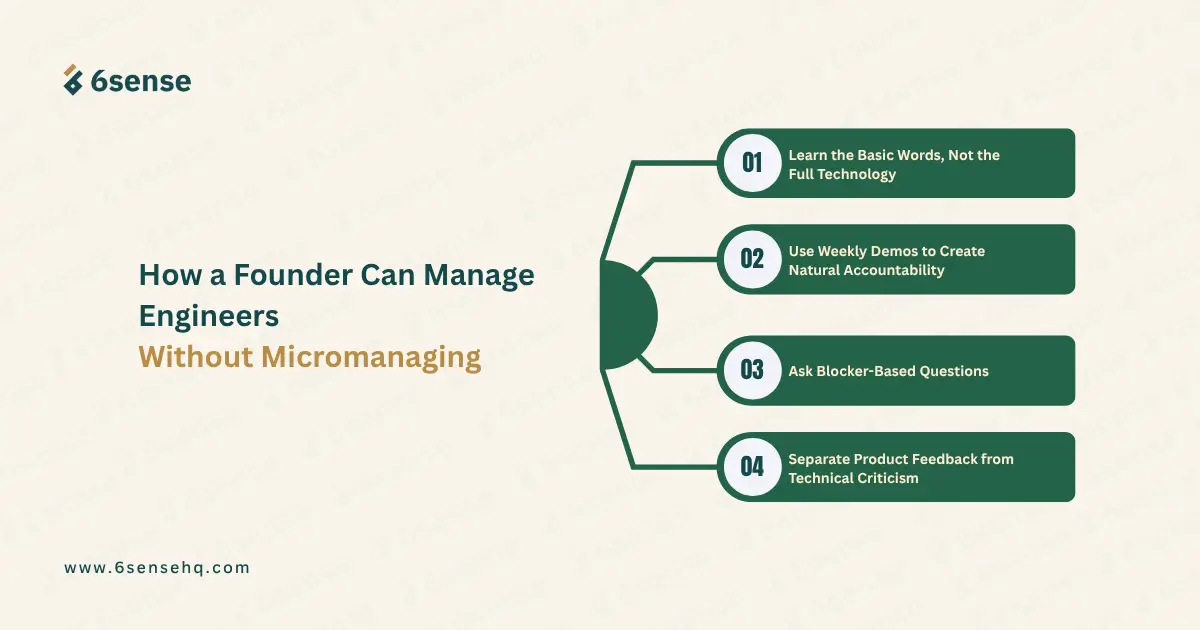
Instead of telling developers exactly how to build something, explain the result you need. For example, say, “Users must reset passwords safely in under two minutes.” Let the engineers decide the best technical route.
A weekly demo keeps everyone honest without daily pressure. Developers know they must show working progress, and you get a chance to give feedback early. This prevents the painful moment where three weeks of work go in the wrong direction.
Do not ask, “Why is this not done yet?” Ask, “What is blocking this?” or “Do we need to reduce the scope to keep the deadline?” This keeps the conversation practical and helps developers bring bad news early.
You can say, “This flow does not solve the user problem,” without saying, “The code is bad.” Your role is to judge whether the product works for the customer. Let a tech lead, senior engineer, or CTO review the code quality.
Knowing how to build a startup product without a CTO is one of the most practical challenges an early-stage founder faces. The answer is not to skip technical leadership entirely, it is to access it without a full-time hire. A fractional CTO helps you avoid expensive blind spots before developers write too much code. They can review estimates, check whether the tech stack makes sense, vet developers, inspect architecture, and warn you when a “simple feature” is actually risky.
This matters because poor communication is a major reason projects fail; PMI reported that poor communication contributed to 56% of failed projects. A fractional CTO gives you translation, structure, and protection.
Jeff Bezos once said, “Good intentions never work; you need good mechanisms to make anything happen.” That is exactly why a fractional CTO helps. They create mechanisms: technical review, sprint planning, code checks, delivery gates, and realistic tradeoff decisions.
Missing one commitment does not automatically mean the project is failing.
But repeated patterns require action.
Do not ask:
"Why is this not done?"
Ask:
"What changed?" "What is blocking progress?" "What needs to change to hit the next milestone?"
A fractional CTO or technical reviewer can inspect:
If these patterns continue, it may be time to switch teams. Understanding how to start again after a failed MVP development experience matters more than people admit the same mistakes often repeat with a new team unless the root cause (scope, communication, or process) is fixed first. If you reach that point, review guidance on choosing a reliable MVP development agency before moving again.
Many development problems start before coding begins. The biggest mistakes usually come from unclear scope, weak checks, rushed hiring, and assuming developers will fill every product gap.
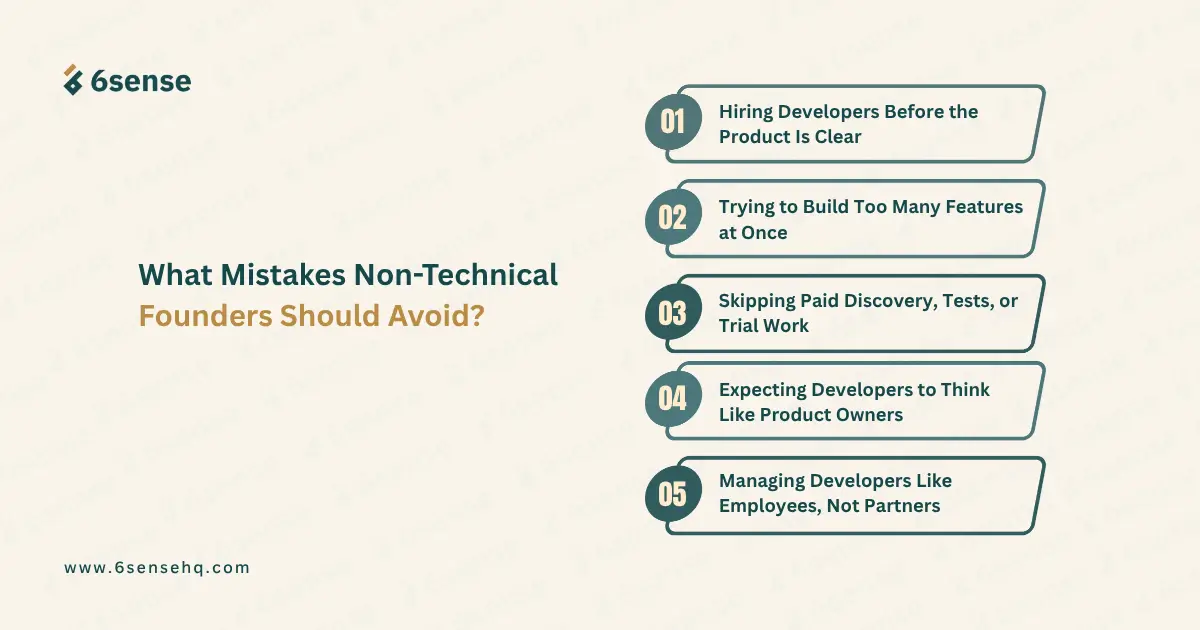
If your idea is still vague, developers will either wait, guess, or build the wrong thing. Before hiring, write the core user problem, target user, first workflow, and must-have features. A clear product brief saves money before development starts.
A bloated MVP is one of the fastest ways to waste budget. Start with the smallest version that proves the business idea. This is also where founders should think carefully about whether one developer can realistically build the first MVP before expanding scope too early. For example, build booking, payment, and profile first before adding referrals, analytics, chat, and AI features.
A short paid discovery phase can reveal how the developer thinks, communicates, and estimates. Skipping this step may feel cheaper, but it can create bigger losses later. Start with wireframes, technical planning, or one test feature before signing a large build.
Good developers can suggest better ways to build, but they should not guess your business model. You must bring customer pain, priorities, and product logic. Developers can build the engine, but you must explain where the car needs to go.
If you treat developers like task machines, they will stop sharing useful ideas. Invite their input early, especially around tradeoffs, effort, and risk. A strong developer can save you weeks if they feel safe enough to challenge a weak feature idea.
No. You need to understand product goals, workflows, and communication — not programming syntax.
Demos. Working software reveals progress more accurately than written status reports.
For most founders: Notion + ClickUp or Linear + Slack is enough to start.
Usually once per week for sprint review and planning.
Unclear requirements and scattered communication systems.
Managing developers as a non-technical founder is not about becoming technical overnight. It is about building a simple system where your idea becomes clear tasks, your team works in short cycles, and every feature is checked against real user value. You need clear requirements, regular demos, smart scope control, and someone technical to review quality when needed.
The best founders do not try to control every line of code. They control the direction, protect the product vision, and create a process where developers can do their best work.
If you're managing developers and facing scope creep, unclear updates, missed milestones, or technical confusion, book a 30-minute session with our PM lead. We’ll review your process and provide a written assessment within 48 hours, no commitment required.
Compare 6sense HQ and DevToDollars on MVP speed, team models, proof, pricing, and post-launch support to pick the right fit.
15 min read

Compare 6sense HQ alternatives for MVP development in 2026 and find the best software team for your startup budget and goals.
17 min read
| Risk | Problems appear late | Blockers are raised early and fixed faster |
Learn whether one developer can build an MVP in 2026 with cost, scope, AI tools, low-code tips, risks, and launch advice.
22 min read