

6sense HQ vs DevToDollars: Best MVP Partner in 2026
Compare 6sense HQ and DevToDollars on MVP speed, team models, proof, pricing, and post-launch support to pick the right fit.
15 min read
Loading…
Validate your startup idea with MVP testing, real user feedback, demand signals, and simple steps before building your product.
Written by: AKM Ahsan Created on: 4 May 20268 min to read
What if the real risk isn’t building the wrong startup, but spending months building something no one ever asked for? That’s where most founders quietly lose time, money, and momentum without even realizing it.
Startup idea validation is the process of confirming that a real problem exists, that real users experience it frequently enough to act, and that they would pay or change behavior to solve it, before writing a single line of code.
At 6sense HQ, the first thing we ask any founder before scoping an MVP is simple: Have you spoken to at least 10 real users facing this problem? In our experience working with 50+ founders, over 70% had not, and that’s where most mistakes begin.
In this blog, we’ll guide you through how to validate your startup idea using an MVP, how to test real demand, find the right users, and measure if your idea is worth building.
Before you build anything, you must be sure the problem is real. Many founders skip this and fail later. These simple steps help you confirm the problem actually matters.
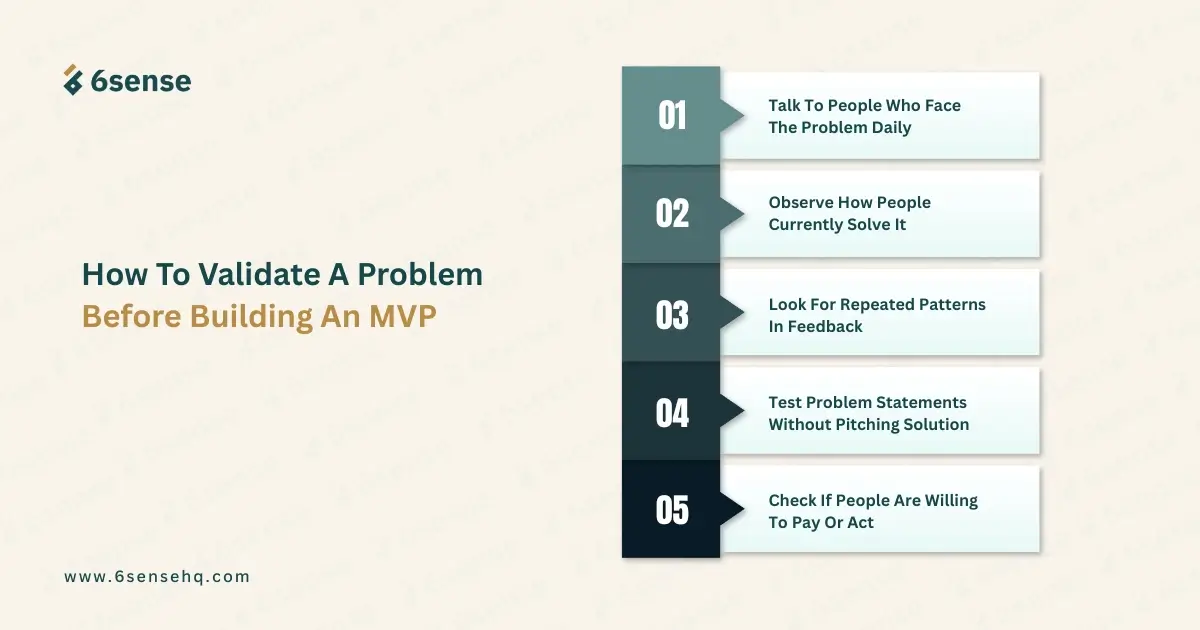
In practice: Schedule 10-15 short interviews within a week. Ask about their last experience solving the problem, not your idea.
Benchmark: Patterns usually emerge after 10-15 interviews, and strong validation appears when multiple users repeat the same pain point unprompted.
Common mistake: Asking “Would you use this?” instead of “How do you solve this today?”
If people are:
The problem is real
You’re not validating opinions, you’re validating repetition.
If 3 out of 10 users are willing to pay or commit early → strong signal
Finding the right users is key. If you talk to the wrong people, your validation will fail even if the idea is good. These steps help you find your true users.
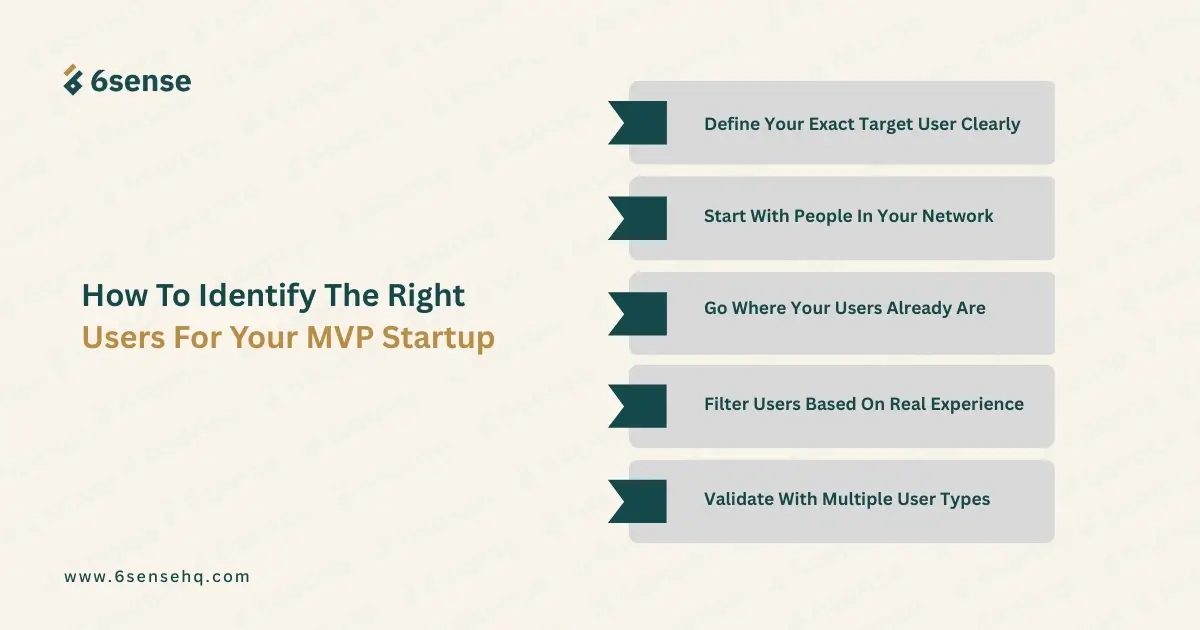
Don’t say “everyone.” Focus on a specific group with a clear problem. For example, not “business owners,” but “small ecommerce sellers struggling with returns.” Clear users give clearer feedback and better validation results.
Reach out to friends, colleagues, or communities who match your target users. It’s easier to start here. Even if there is some bias, early conversations still give useful direction and help you move faster.
Find online groups, forums, or platforms where your users spend time. Observe discussions, problems, and complaints. This gives real insights into what they care about without forcing conversations.
Only talk to people who actually face the problem. Avoid general opinions. Experienced users give better feedback because they understand the pain deeply and can explain it clearly.
Talk to different segments within your target group. Beginners, experienced users, and even competitors’ customers. This helps you understand the full picture and avoid building something too narrow.
Before studying these startup stories, it helps to look at Famous MVP Examples that show how simple tests can prove real demand before full product development.
These startups didn’t guess; they tested behavior before building.
For founders still deciding how to test their idea, this section can work as an Early-Stage Startup MVP Development Guide to compare low-cost validation methods before choosing what to build.
| Method | What it tests | Best for | Time | Cost |
| Landing page (smoke test) | Interest | Early ideas | 1–3 days | Low |
| Concierge MVP | Real usage | Service ideas | 1–2 weeks | Low |
| Fake door test | Click intent | Feature testing | 1–2 days | Low |
| Prototype | UX | Design validation | 1–2 weeks | Medium |
| Interviews | Problem |
At this stage, startup MVP development should focus only on testing the core problem, not building every feature users might ask for later. An MVP is not a full product. It’s just enough to test if your idea works. Keep it simple and focused.
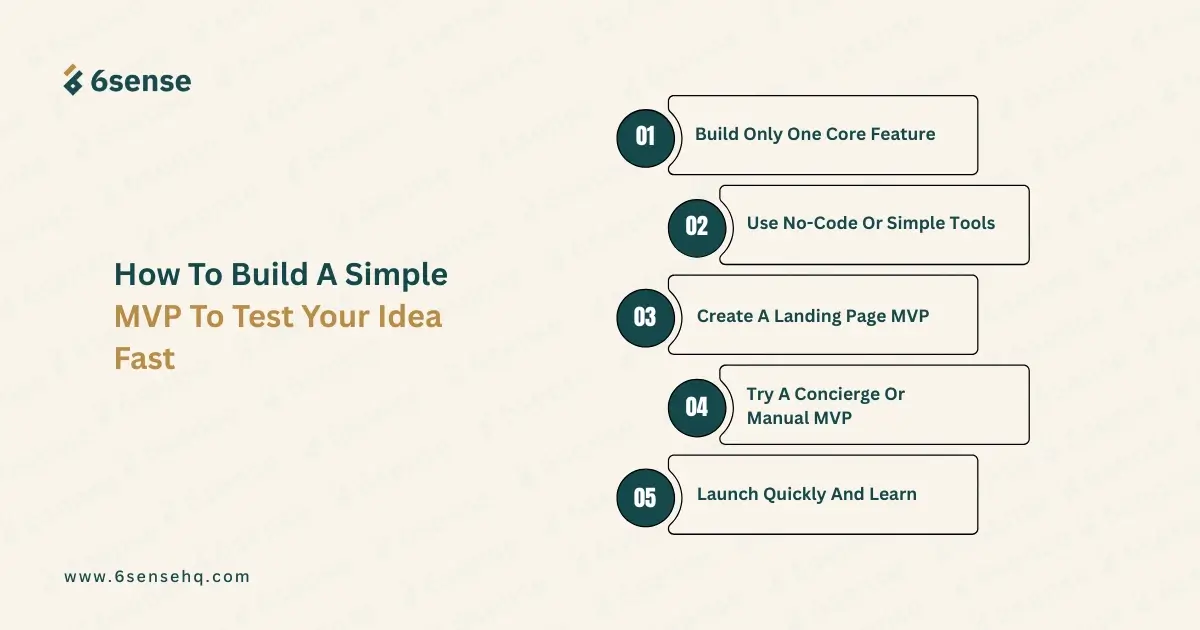
Your MVP should test one main idea, not everything. Adding too many features makes it slow and confusing. Focus on solving one problem clearly and see if users care about that specific solution.
Founders can build a no-code MVP without writing traditional software by using landing page builders, workflow automation platforms, databases, and visual app-building tools. This approach makes it possible to test the core user journey, collect signups, and validate demand before investing in custom development. The goal is not to create a complete product, but to build the simplest functional version that produces reliable user feedback.
Founders with some technical knowledge can also use vibe coding to create an MVP with tools such as Cursor, Bolt, and Lovable. These AI-assisted development platforms can turn natural-language instructions into interfaces, workflows, and working application features, helping founders move from an idea to a testable prototype faster.
However, AI-generated code still needs careful review. Start with one core workflow, test every generated feature, protect sensitive data, and avoid adding unnecessary functionality before users validate the idea.
Do the service manually before building tech. This helps you understand real user needs and edge cases. It also proves if people actually want the outcome, not just the idea.
Don’t wait for perfection. Release your MVP fast, test it with real users, and improve based on feedback. Validation is about learning, not building something perfect from day one.
Once your MVP is ready, the real learning begins. These methods help you collect honest and useful feedback.
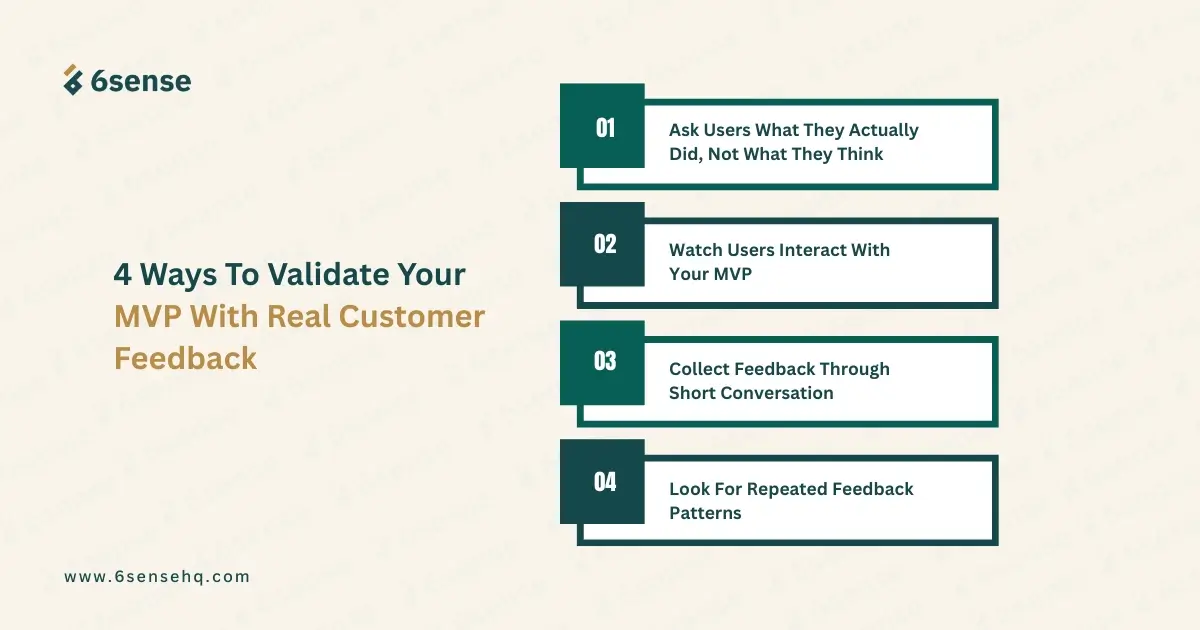
When validating your MVP, what users do matters far more than what they say. Many users will tell you your idea “sounds good,” but that doesn’t mean they will actually use or pay for it.
Instead, focus on actions:
Why this matters: Validation is about collecting evidence, not opinions; real usage data gives you reliable signals about demand.
One user’s feedback is noise. Patterns across multiple users are a signal.
After testing your MVP:
In practice: If 6 out of 10 users struggle with the same step, that’s not a coincidence; it’s a product issue you need to fix.
Why this matters: Customer validation relies on identifying consistent themes across users, not reacting to isolated feedback.
After users interact with your MVP, talk to them briefly. Don’t ask general questions like “Did you like it?”
Instead ask:
Why this matters: Specific questions reveal real friction points and unmet expectations, far more useful than generic feedback.
Validation is not a one-time step; it’s a loop.
Best practice: Update your MVP every 5-7 days based on real feedback.
Why this matters: The faster you iterate, the faster you move toward product, market fit, and avoid wasting time building the wrong thing.
To validate your startup idea properly, you need real numbers, not guesses. Track these simple signals to understand if your MVP is working.
| Metric | What It Means | Benchmark (NEW) |
| Signup Rate | Interest | >15% = strong |
| Conversion Rate | Action | >5% = promising |
| Retention | Returning users | 40%+ week 2 |
| Willingness To Pay | Revenue signal | 3+ out of 10 users |
| Usage Frequency | Product value | Daily/weekly use |
You are validated when:
We call this the 6sense HQ Validation Threshold
In 2026, founders can validate ideas in 48 hours using AI:
This compresses weeks of validation into days.
Validating a startup idea is not about proving you’re right. It’s about learning fast and avoiding costly mistakes. The smartest founders don’t build first; they test first.
Focus on real problems, talk to real users, and build simple MVPs to test your idea quickly. Look for real signals like usage, feedback, and willingness to pay. If the signals are strong, move forward. If not, adjust or pivot early.
The goal is simple: don’t build something people might want, build something they clearly need. Start small, learn fast, and grow with confidence.
Want to validate your startup faster? Talk to our expert team or get expert guidance from 6sense HQ today and turn your idea into reality.
Compare 6sense HQ and DevToDollars on MVP speed, team models, proof, pricing, and post-launch support to pick the right fit.
15 min read
Compare 6sense HQ alternatives for MVP development in 2026 and find the best software team for your startup budget and goals.
17 min read
| Early stage |
| 1 week |
| Free |
Learn whether one developer can build an MVP in 2026 with cost, scope, AI tools, low-code tips, risks, and launch advice.
22 min read