

6sense HQ vs DevToDollars: Best MVP Partner in 2026
Compare 6sense HQ and DevToDollars on MVP speed, team models, proof, pricing, and post-launch support to pick the right fit.
15 min read
Loading…
Learn user research for MVP methods to validate demand, choose the right users, reduce risk, and build features people need fast.
Written by: AKM Ahsan Created on: 8 May 20268 min to read
Most founders don’t fail because they can’t build. They fail because they build the wrong thing. That’s the real problem. You can have the best tech, the cleanest UI, even funding, but if users don’t care, nothing works. That’s where everything starts to fall apart.
User research for MVP is simply the process of understanding your users before and during building your product. It helps you test your idea, validate demand, and learn what people actually need, before you invest too much time or money.
Most non-technical founders we work with are afraid of one thing: spending $60,000 on a product nobody wants. User research is the only reliable way to find out before you build. We’ve guided 50+ founders through this, and the difference between success and failure almost always comes down to whether they spoke to real users early.
This blog will guide you through how to do user research, what methods to use, and how to turn insights into a better MVP. If you are still planning the full build journey, our guide on MVP Development Process Explained can help you understand how research fits into the broader product development process. You can also use a structured MVP development framework and methodology to connect research findings with validation, prioritization, development, testing, and iteration.
User research for MVP is the process of learning about your target users, their problems, and how they behave before and after building your first version of a product. It focuses on validating whether your idea solves a real problem.
Studies show that around 42% of startups fail due to a lack of market need, meaning they build something users don’t actually want.
User research helps avoid that mistake by grounding decisions in real feedback instead of assumptions.
As product leader Marty Cagan once said: “The only way to build a great product is to understand your users deeply.”
User research doesn’t need to be complex or expensive. Founders often learn the most from simple, direct interactions with users. These methods focus on clarity, speed, and real feedback.
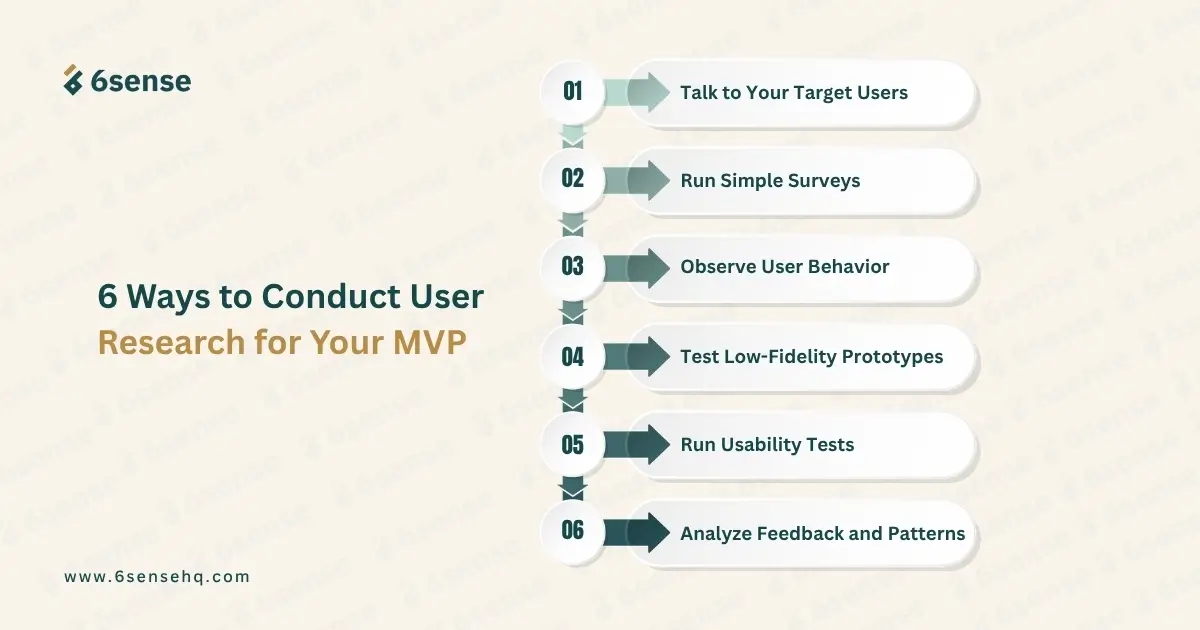
User interviews are the fastest way to understand real problems.
Tools to use:
Time & cost: 30 minutes per interview → $0
How to do it:
Common mistake: Pitching your solution instead of listening
Example insight: A fintech founder discovered users were solving compliance manually in spreadsheets; not with software; changing their entire product direction.
Surveys help validate patterns across more users.
Tools to use:
Time & cost: 1–2 hours setup → free
Best practice:
Common mistake: Asking “Would you use this product?”
Watch how users solve problems in real life.
Tools to use:
Time & cost: 2–3 hours observation
Example insight: Users often behave differently than what they say; revealing hidden friction points.
Show simple mockups before building.
Tools to use:
Time & cost: 3–5 hours
Common mistake: Over-designing early prototypes
Test real interaction with your MVP.
Tools to use:
Time & cost: 30–60 minutes per session
What to watch:
Turn feedback into insights.
Tools to use:
Key rule: One opinion = noise Repeated patterns = signal
Once you’ve completed your research, the next step is to learn how to validate startup ideas before building so you can turn insights into real validation signals.
| Situation | Recommended Method |
| No product yet | Interviews + Surveys |
| Prototype ready | Prototype testing + Usability tests |
| Want behavioral insight | Observation |
| Need fast data | Surveys |
Once you choose the right research method, the next step is to organize your findings into a clear execution plan. A structured MVP Development Roadmap for Startups can help you prioritize features, plan milestones, and move from research to launch with less risk.
Finding users is often harder than research itself.
Here’s how founders actually do it:
| Reason | What It Means |
| Avoid wrong product | 42% fail without validation |
| Reduce risk | Focus only on needed features |
| Faster learning | Feedback loops accelerate growth |
| Product-market fit | Built on real demand |
| Smarter decisions | Data replaces assumptions |
Choosing the right users is critical. If you talk to the wrong people, your research will mislead you. Focus on users who actually face the problem you want to solve.
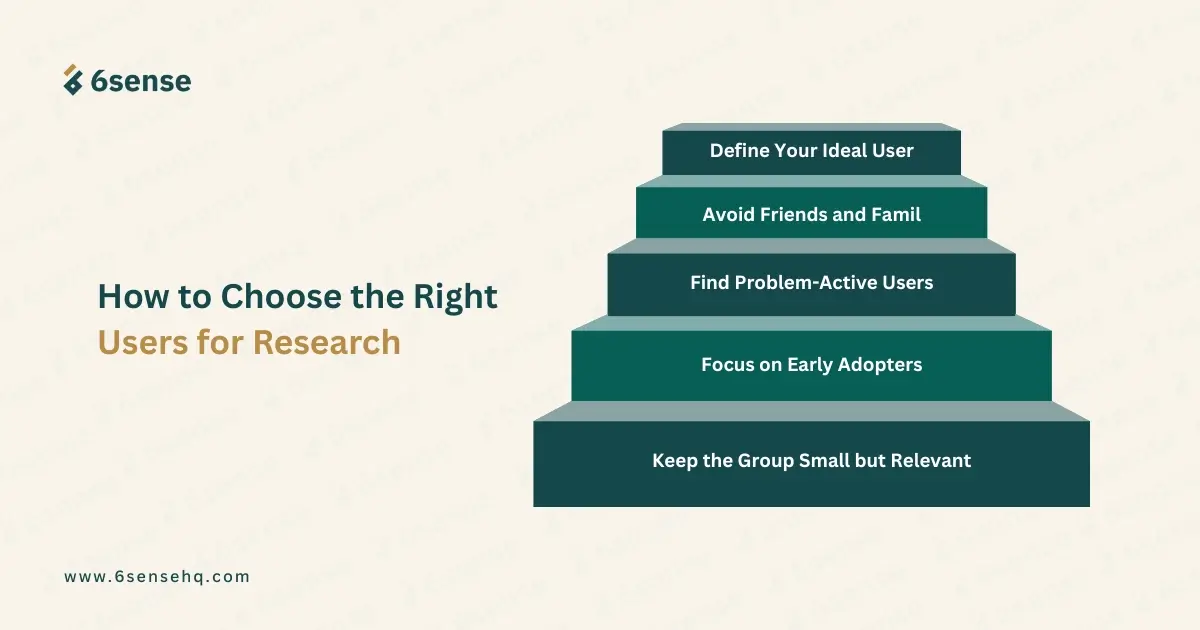
Start by identifying who your product is for. Think about their role, behavior, and problems. Turning these findings into evidence-based user personas for your MVP helps the team align research, product decisions, and messaging around specific user needs. Avoid being too broad. The clearer your user profile, the better your research results will be.
Feedback from close contacts is often biased. They may support your idea instead of giving honest feedback. Real users will challenge your assumptions and provide more useful insights for building your MVP.
Look for people already trying to solve the problem. These users care more and give deeper insights. They also help validate if your idea has real demand in the market.
Early adopters are more open to trying new products. They are willing to give feedback and tolerate imperfections. These users are ideal for MVP testing and early validation.
You don’t need hundreds of users at the start. Even 5-15 targeted users can reveal strong patterns. The key is quality feedback, not quantity.
Collecting feedback is not enough. The real value comes from turning insights into clear product decisions that improve your MVP. At this stage, understanding the MVP Development Phases & Timeline can help you place research insights into the right part of the journey, from discovery and design to development, testing, and post-launch iteration.
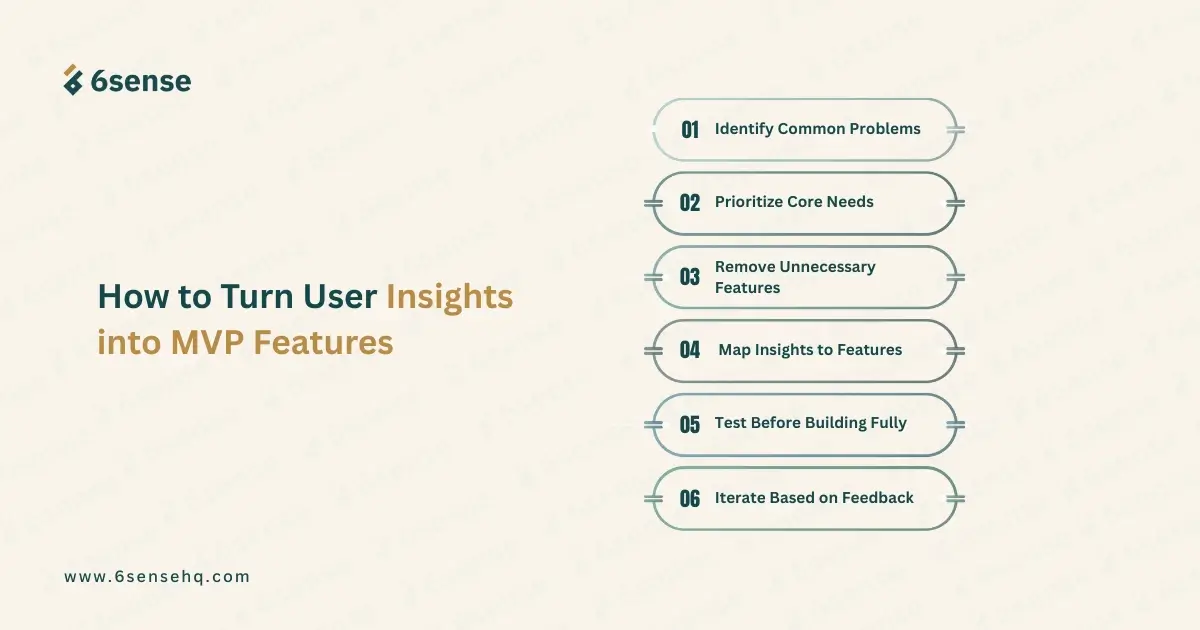
Look for repeated issues across multiple users. If many people mention the same problem, it’s likely worth solving. Avoid focusing on one-off opinions that don’t reflect broader needs.
Focus only on the most important problems. MVPs are not about building everything. Teams can compare MoSCoW, RICE, and Kano for MVP feature prioritization to rank validated needs by urgency, user value, confidence, and delivery effort. The goal is to solve one key problem really well before expanding further.
Many founders try to add too many features early. User research helps you cut what isn’t needed. This keeps your MVP simple, faster to build, and easier to test.
Translate each validated problem into a feature. Keep it simple and direct. Avoid overcomplicating solutions. The goal is to test value, not build perfection.
Before investing heavily, validate features through prototypes or small experiments. This reduces risk and ensures you’re building something users actually want.
User research is not one-time. Keep collecting feedback after launch and improve continuously. This build-measure-learn cycle helps your MVP evolve into a strong product.
Not sure how to interpret your findings? Book a free 20-minute validation call.
For more advanced product building after research, you can understand AI MVP development for deeper features once your core idea is validated.
Score each insight:
Score >10 → Build Score <7 → Ignore
Modern research is faster than ever.
Research errors often become product errors later. Reviewing the common mistakes that can derail MVP development helps teams recognize weak validation, confirmation bias, feature creep, and premature scaling before they become expensive.
User research for MVP is not optional, it’s essential. It helps you understand real problems, validate your idea, and avoid costly mistakes. Instead of guessing what users want, you learn directly from them. This leads to better decisions, faster growth, and higher chances of success.
Start small, talk to real users, and focus on learning. A practical MVP development checklist from research to launch can help your team confirm that critical validation, planning, prioritization, testing, analytics, and launch tasks have not been overlooked. That’s how great products are built.
Get expert guidance from 6sense HQ to validate your MVP faster, reduce risk, and build products users actually want.
Compare 6sense HQ and DevToDollars on MVP speed, team models, proof, pricing, and post-launch support to pick the right fit.
15 min read
Compare 6sense HQ alternatives for MVP development in 2026 and find the best software team for your startup budget and goals.
17 min read
Learn whether one developer can build an MVP in 2026 with cost, scope, AI tools, low-code tips, risks, and launch advice.
22 min read