

6sense HQ vs DevToDollars: Best MVP Partner in 2026
Compare 6sense HQ and DevToDollars on MVP speed, team models, proof, pricing, and post-launch support to pick the right fit.
15 min read
Loading…
Learn how user personas for MVP help you build what users actually need, prioritize features, and launch faster with confidence.
Written by: AKM Ahsan Created on: 11 May 20269 min to read
A user persona for MVP development is a research-based profile of your target user that captures their goals, frustrations, behaviors, and context. Unlike general marketing personas, MVP personas exist to make one decision: what to build first and what to skip.
Most MVPs don’t fail because of bad code. They fail because they solve the wrong problem for the wrong people. That’s where most founders get stuck; they build fast, but not for the right user.
User personas MVP is about understanding who you are building for before you build anything. It helps you focus on real user needs, not guesses. Instead of adding random features, you design something specific for a clear type of user.
Most non-technical founders we work with are afraid of the same thing: spending $60,000 on a product nobody wants. User personas are the most reliable way to find out who actually wants it, before you spend a dollar on development. We’ve guided 50+ founders through this exact process.
This blog will guide you through user personas, how to create them, and how to use them to build better MVPs. A structured MVP development framework and methodology can then connect those persona insights with validation, prioritization, development, testing, and iteration.
User personas MVP are simple, semi-fictional profiles that represent your target users. They are based on real data like interviews, behavior, and feedback. These personas help teams understand goals, problems, and expectations of users.
They help teams understand:
In MVP development, this matters because a minimum viable product is built to test ideas quickly with real users. Without clear personas, you risk testing with the wrong audience.
A study showed teams using personas created more usable products and improved communication.
As Steve Blank famously said, “Get out of the building.” Personas are central to the customer discovery process, allowing businesses to engage directly with users and gain insights faster. This methodology encourages learning from real users, which helps validate product ideas and achieve better product-market fit.
One founder we worked with at 6sense HQ, building a SaaS tool for freelancers with a $55K budget and no technical background, ran 8 persona interviews over 3 days using the framework below. By interview 5, she realized her original user segment was wrong.
Instead of targeting freelancers struggling with invoicing, the real pain point came from consultants managing multiple client payments across disconnected tools. She pivoted the feature set before development began, simplified the MVP scope, and launched to paying users within 10 weeks.
That early research prevented months of wasted development and helped the product reach validation significantly faster.
Before you decide what to build, you first need to understand who you are building for. Begin with focused user research for an MVP to study real behaviors, recurring pain points, current workarounds, and the outcomes users care about most. This first framework focuses on how founders gather user insights, identify patterns, and create practical personas that guide MVP decisions. At 6sense HQ, this is the exact process we use across founder validation sprints before product scoping begins.
Building personas doesn’t need months of research. Start small, stay real, and focus on learning from users early for your startup. Here are six practical ways founders actually use.
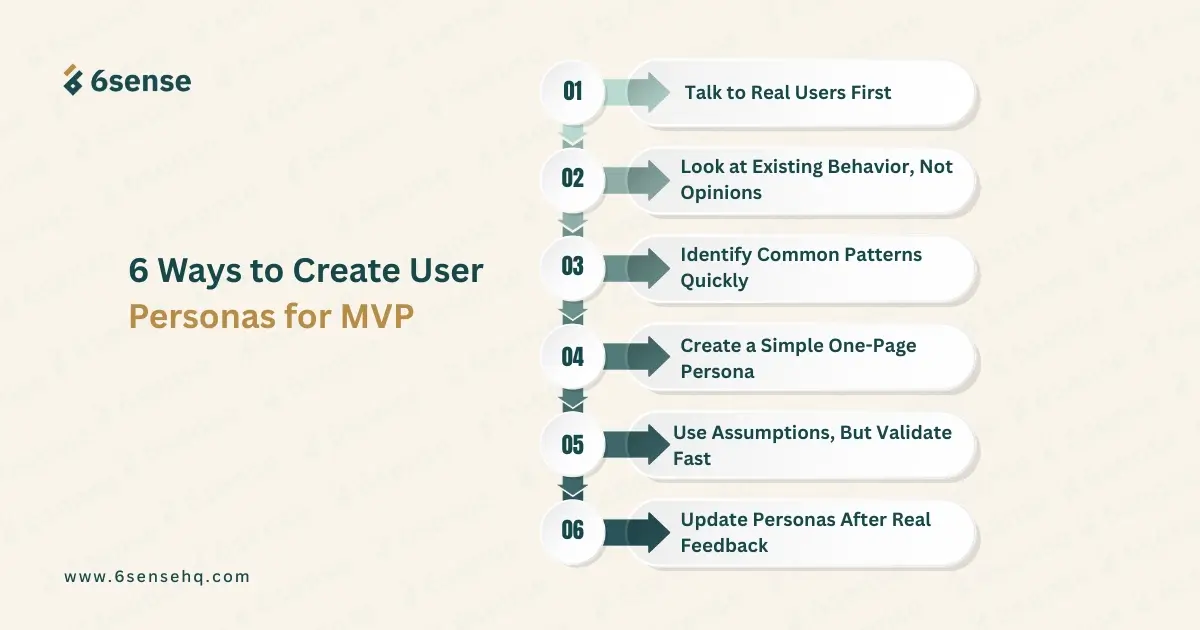
Before the session, prepare customer discovery questions that test your MVP assumptions. Focus on past behavior and existing workarounds instead of asking whether someone likes your proposed product. Tools: Calendly (free), Loom (free tier)
Time: 20–30 minutes per interview Cost: $0
Start with conversations, not assumptions.
Ask:
Common mistake: pitching your idea instead of listening
Signal it’s working: You start hearing the same problem repeated by multiple users
Tools: Hotjar (free), Reddit / Quora
Time: 2–3 hours Cost: Free
People say one thing but do another. Focus on:
Signal it’s working: You identify real friction patterns that users don’t explicitly mention
Tools: Notion, Dovetail
Time: 1–2 hours Cost: Free
Group users based on:
Signal it’s working: 5+ users describe the same issue in similar language
Tools: Xtensio, HubSpot Persona Builder, Notion
Time: 1 hour Cost: Free
Name: Sarah (36, Marketing Consultant) Goal: Manage all client invoices in one place Problem: Uses 3 tools that don’t connect Behavior: Spends 2+ hours weekly reconciling invoices Context: Solo founder, $55K budget, completed 12 interviews
Key Insight: Manual reconciliation is the real pain—not invoicing itself
Early personas are called proto-personas
Tools: Google Forms, Tally
Signal it’s working: assumptions start matching real user behavior
Tools: Dovetail AI, Notion AI
Time: Continuous
Personas are not static
Signal it’s working: persona evolves with every new insight
Once you have created your personas using the methods above, the next question is how to use them to decide what to build. The following framework is what our PM team at 6sense HQ applies in every founder sprint to translate user insights into focused MVP feature decisions.
Personas are not just documents; they are decision tools. They help you choose what to build and what to ignore during MVP development.
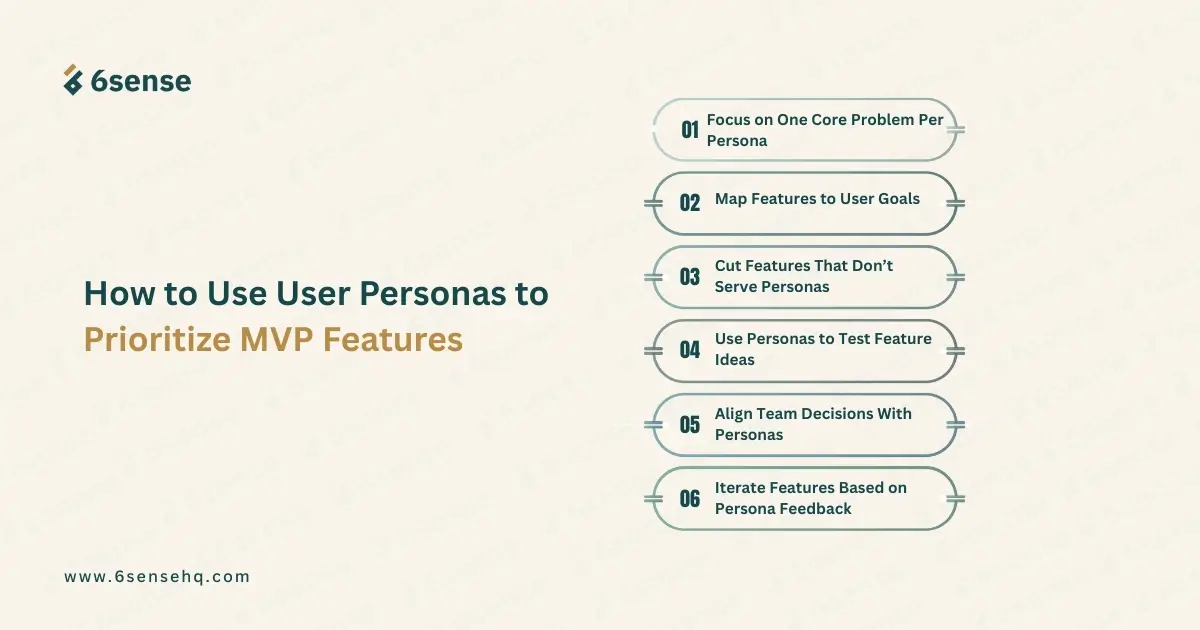
Each persona should have one main problem. Build features that solve that problem first. This keeps your MVP simple and useful instead of overloaded.
Every feature should connect to a user goal. If it doesn’t, it doesn’t belong in the MVP. Teams can compare MoSCoW, RICE, and Kano for MVP feature prioritization to rank persona-backed features by necessity, user value, confidence, and delivery effort. This prevents feature creep and keeps development focused.
It’s tempting to add more features. But if they don’t help your persona, remove them. Simplicity leads to faster launches and better user experience.
Before building, ask: Would this persona use this? If the answer is unclear, the feature needs more validation. This saves time and effort.
Personas create a shared understanding across the team. Designers, developers, and founders all work toward the same user goal. This reduces confusion and improves execution.
After launch, track how personas interact with your product. Use feedback to improve or remove features. MVP is a continuous learning process.
At this stage, following a structured MVP development process ensures your personas translate into real product decisions instead of scattered features. A practical MVP roadmap for startup teams can then organize those decisions into milestones, responsibilities, and measurable learning goals.
| Step | What to Do | Why It Matters |
| Define problem | Use Jobs-to-be-Done thinking | Avoid building for everyone |
| Look for early adopters | Find users already solving it | Higher validation quality |
| Check urgency | Ask: “How do you solve it now?” | Long answers = real pain |
| Study alternatives | Observe current tools | Positioning clarity |
| Validate willingness | Ask for 20-min call commitment | Commitment = real signal |
If you want to move faster after identifying users, many founders choose to try out no-code MVPs as a safer alternative before committing to full development.
Persona validation should happen early enough to influence scope. Reviewing the MVP development phases and realistic delivery timeline helps teams understand where persona research informs discovery, design, development, testing, and post-launch iteration.
Use these 4 signals:
As your product evolves beyond basic personas, you can understand AI MVP development for deeper features and build more intelligent, adaptive experiences.
At 6sense HQ:
You don’t manage engineers; we translate your users into product decisions.
Persona errors often become product and scope errors later. Reviewing the common mistakes that can derail MVP development helps teams identify confirmation bias, weak validation, feature creep, and premature scaling before they become expensive.
Good personas are not guesses; they are grounded in real user signals. Many founders fail because they build based on what they think users want instead of what users actually do.
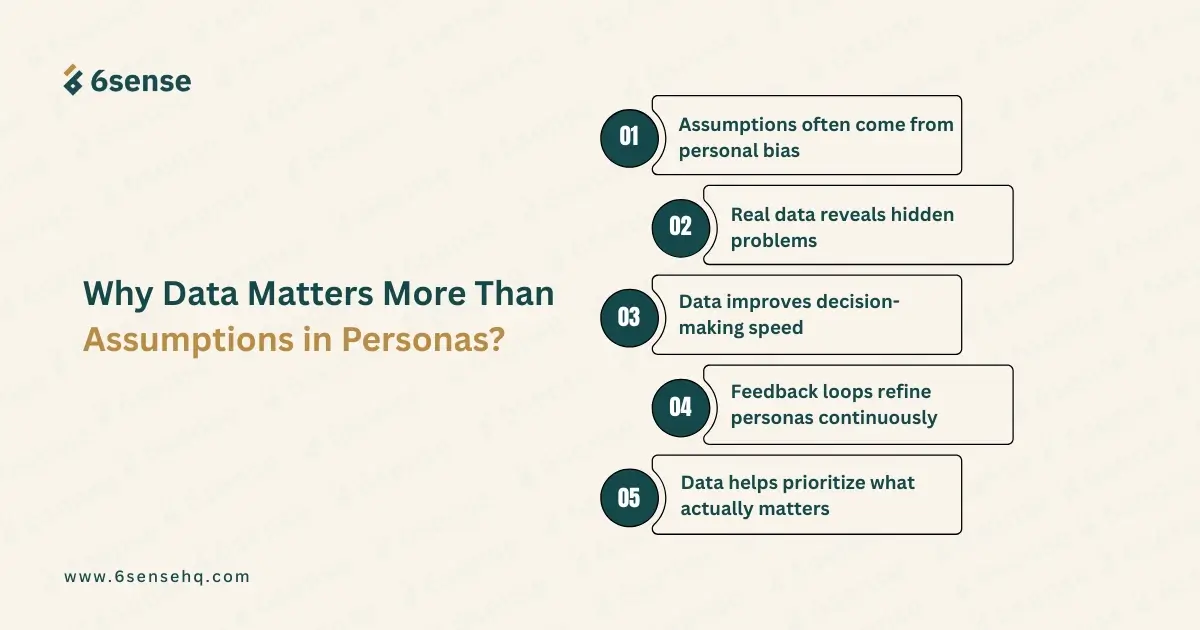
User personas MVP is not about making perfect profiles. It’s about making better decisions. When you understand your users clearly, you stop guessing and start building with purpose. MVP becomes faster, simpler, and more effective.
The best founders don’t build for everyone. They build for someone very specific, learn from them, and improve continuously. That’s how real products grow.
Start small. Talk to users. Build with clarity. A practical MVP development checklist from research to launch can help your team confirm that critical validation, planning, prioritization, testing, analytics, and launch tasks have not been overlooked.
Get expert guidance from 6sense HQ to turn your idea into a real MVP, validate faster, and build products users actually need.
Compare 6sense HQ and DevToDollars on MVP speed, team models, proof, pricing, and post-launch support to pick the right fit.
15 min read
Compare 6sense HQ alternatives for MVP development in 2026 and find the best software team for your startup budget and goals.
17 min read
Learn whether one developer can build an MVP in 2026 with cost, scope, AI tools, low-code tips, risks, and launch advice.
22 min read