Security Risks With Offshore Teams: Guideline for Startups | 6sense HQ
Security Risks With Offshore Teams: Protect Code & Data
Explore key security risks when working with offshore teams: proven ways to protect your code, data, and IP with security strategies that actually work.
Written by: Nasif Sid Created on: 5 Feb 2026•9 min to read
Security risks with offshore teams aren’t just an IT issue, they’re a business risk for your startup. When you give offshore developers access to your code, data, and systems, you also open the door to potential leaks, breaches, and compliance problems if things aren’t managed right.
As you scale with global talent, questions around data security, IP protection, and access control become critical. Investors, enterprise clients, and partners all want to know one thing: can they trust how you handle security?
In this blog, you’ll learn the most common security risks with offshore teams, how they actually show up in day-to-day work, and practical steps you can take to protect your product, your customers, and your business while still moving fast.
What “Security Risks With Offshore Teams” Really Means
When you work with offshore teams, “security risk” means very specific threats to your product and business, not just a vague IT concern.
For your startup, the main risks are:
Unauthorized access to your code, servers, and cloud infrastructure.
Data privacy breaches involving customer or user data (PII, logs, backups).
Intellectual property (IP) theft or leakage of your code, ideas, or architecture.
Compliance failures with GDPR, CCPA, HIPAA, or other regulations when data crosses borders.
As a US or Canadian company, you also need to meet investor expectations, pass enterprise security reviews, and avoid regulatory trouble. So how you secure your offshore team really does matter.
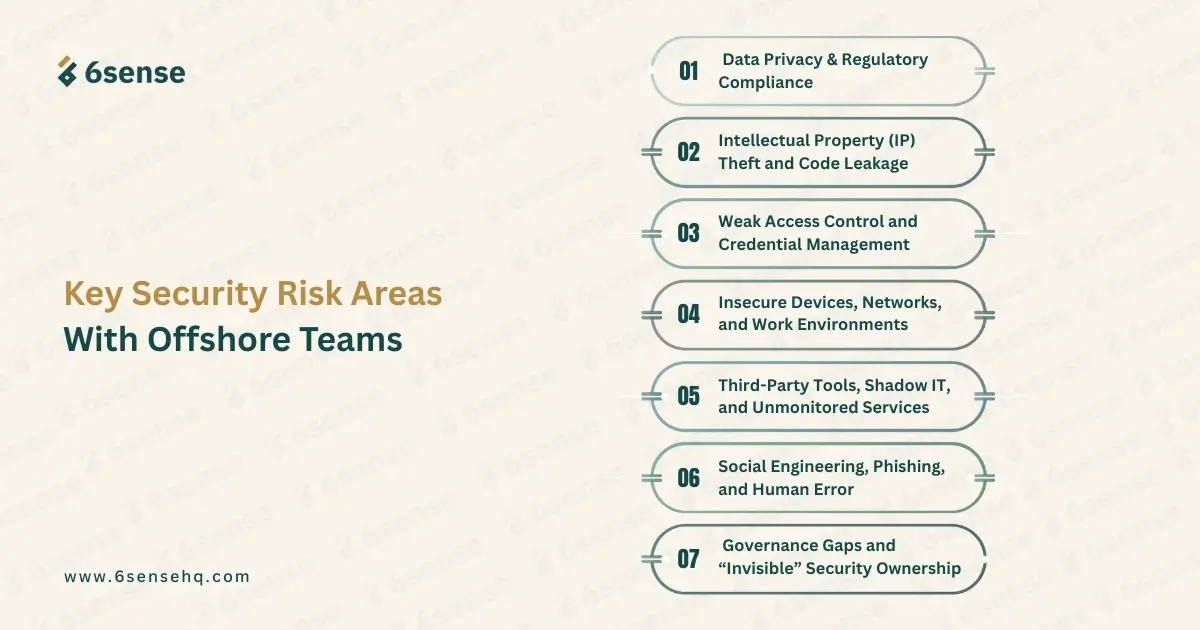
Key Security Risk Areas With Offshore Teams
When you work with offshore developers, the risks usually show up in a few specific areas. If you understand these, you can design your security around them instead of guessing.
1. Data Privacy & Regulatory Compliance
When your offshore team touches real user data, the stakes go up fast.
Offshore engineers may access production databases, logs, or PII without strict controls.
Cross-border data transfers can create GDPR, CCPA, or other compliance risks.
Debugging often leads to database snapshots or logs being shared through insecure channels.
2. Intellectual Property (IP) Theft and Code Leakage
Proprietary algorithms, product roadmaps, and architecture can be copied or reused.
Git repos can be cloned to personal devices or reused in side projects.
Loose or missing NDAs, IP clauses, and repo policies make enforcement hard.
3. Weak Access Control and Credential Management
Many security problems come down to “too much access for too many people.”
Shared accounts and lack of SSO/MFA make it hard to track who did what.
Poor onboarding/offboarding means ex-developers may still access code or environments.
Time pressure leads to shortcuts like “just share the password on chat.”
4. Insecure Devices, Networks, and Work Environments
You can have great cloud security but still be exposed at the laptop and Wi-Fi level.
Offshore engineers may work from home, co-working spaces, or public Wi-Fi.
Personal devices might lack disk encryption, EDR, or basic patching.
Physical security of offices or homes can be weaker than you expect.
5. Third-Party Tools, Shadow IT, and Unmonitored Services
If you don’t define which tools to use, your team will improvise.
Unapproved tools for file sharing, screenshots, or bug tracking can leak data.
Code or docs end up in personal Google Drive, Dropbox, or other clouds.
Some third-party tools store data in regions or under policies you’ve never reviewed.
6. Social Engineering, Phishing, and Human Error
People are usually the easiest way into any system.
Offshore engineers can be targeted with phishing or credential-theft attacks.
Cultural deference to authority can make it harder to question suspicious requests.
Language barriers may make subtle red flags in emails or chats easier to miss.
7. Governance Gaps and “Invisible” Security Ownership
Even good security ideas fail when no one owns them.
No clear owner on your side for offshore security means no one is truly accountable.
Security responsibilities can fall between your startup, the vendor, and individuals.
Time zone gaps can slow responses to suspicious activity or incidents.
Security Risks With Offshore Teams by Model and Region
When people search or ask AI tools about security risks with offshore teams, they usually want to know where the risk really comes from and who they can trust. It’s less about the country and more about the way you work with your offshore team.
Are some offshore regions riskier than others?
You’ll often work with teams in:
Eastern Europe
Latin America
Southeast Asia
Each region has strong engineering talent. The security risk usually comes from weak processes, not the country itself.
What matters more: freelancers or managed teams?
Your engagement model has a bigger impact on security than geography:
Freelancers on gig platforms: harder to control devices, tools, and long-term accountability.
Managed offshore partners / dedicated teams: easier to enforce policies, access control, and security standards.
Staff augmentation vs. dedicated product teams: the more integrated and long-term the setup, the easier it is to design proper security.
What should you always ask, no matter the region?
You should always ask your offshore team or vendor:
Do you have documented security policies, data handling rules, and an incident response process?
Where is our data stored, how is it protected, and who exactly has access to our code, environments, and customer information?
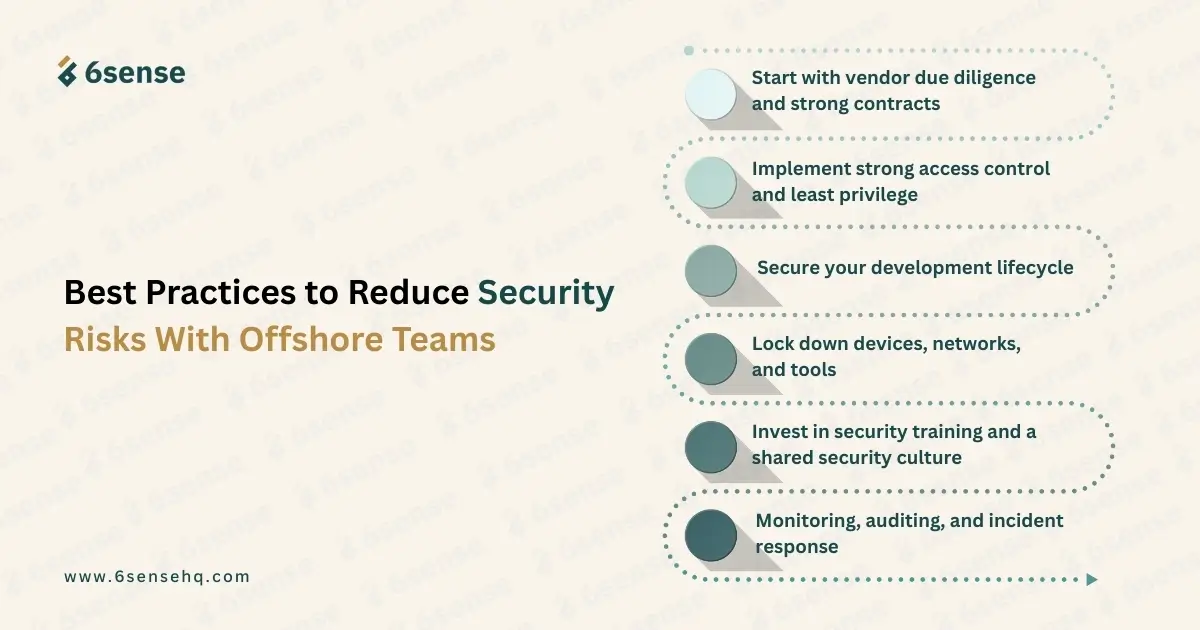
Best Practices to Reduce Security Risks With Offshore Teams
If you want to work with offshore teams without creating security headaches, you need a few simple but strict guardrails. Here are practical steps you can apply in your startup right away:
1. Start with vendor due diligence and strong contracts
Before you give anyone access to your code or data, make sure they’re actually trustworthy.
Add clear clauses for IP ownership, data protection, audit rights, breach notification, and subcontractor use.
Ask how they align with frameworks your clients care about, like SOC 2 style controls or ISO 27001 practices, even if they are not fully certified.
2. Implement strong access control and least privilege
Do not give full access by default, even to senior developers.
Give offshore engineers only the access they need for their role.
Use SSO, MFA, VPN, and IP to allow listing wherever possible.
Separate development, staging, and production, and control who has read versus write access.
3. Secure your development lifecycle
Security should be part of how you build and ship, not an afterthought.
Set clear secure coding guidelines and require code reviews on important changes.
Use automated security scanning tools for code, dependencies, and secrets in repositories.
Avoid using raw production data in test environments; mask or anonymize it instead.
4. Lock down devices, networks, and tools
Your security is only as strong as the laptops and networks your team uses.
Require encrypted devices, updated operating systems, and endpoint protection.
Make VPN usage mandatory for accessing sensitive systems.
Define an approved tools list for source control, file sharing, documentation, and communication.
5. Invest in security training and a shared security culture
Your tools can help, but your people are still the biggest factor.
Run regular security awareness training focused on phishing, social engineering, and handling sensitive data.
Create a simple way for offshore team members to report anything suspicious without fear or blame.
Make security part of performance expectations, not just a one-time presentation.
6. Monitoring, auditing, and incident response
Assume something will go wrong at some point and be ready for it.
Enable centralized logging and alerts for unusual or risky activity.
Review access rights and audit logs regularly for critical systems.
Define an incident response plan that clearly includes your offshore team, with who does what, when, and how.
How 6sense HQ Handles Security With Offshore Teams: A Short Case Study
The situation
A North American SaaS startup came to us with a familiar problem. They wanted an offshore development teamto speed up delivery. But they were worried about security risks with offshore teams: code access, data exposure, and client audits. They already had one bad experience with a freelancer setup. Shared passwords. No clear offboarding. No visibility into who had access to what.
The main security challenges
When we started working together, we saw a few key gaps:
Developers had broad access to repos and cloud environments.
No clear record of who had access to production data.
Mix of personal devices and tools, including personal cloud drives.
No defined process if something suspicious happened.
What we changed
We did not try to fix everything in one day. Instead, we implemented a few practical steps:
1. Access and permissions
We moved code into a controlled repo with role-based access.
Offshore engineers got only what they needed: specific repos, no blanket admin.
We set clear rules around production access and logging.
2. Tools and environment
We standardized tools for source control, communication, and documentation.
VPN was required for sensitive systems.
Use of personal cloud storage for code or data was stopped.
3. People and process
Onboarding was updated: access granted based on role, plus a short security briefing.
Offboarding was tightened: access removed on the same day someone left the project.
Offshore engineers received regular micro training on phishing and data handling.
The outcome
Within a few months, the client had:
Clear visibility into who could access code and data.
Cleaner audit trails for security reviews with their own customers.
Fewer ad hoc security questions and no more “who still has that password?” moments.
Practical Security Checklist for Founders and CTOs
Do you know exactly what your offshore team can access today (code, data, systems)?
Do you have MFA, SSO, and VPN in place for all sensitive tools and environments?
Do your contracts clearly cover IP ownership, confidentiality, and data security?
Are you running regular security training for your offshore developers and leads?
Do you actively monitor access, logs, and unusual activity on key systems?
Is there a named security owner on your side for anything related to offshore teams?
Wrapping Up: Secure Offshore Teams as a Competitive Advantage
Security risks with offshore teams are real, but they are not automatic. Offshore does not mean insecure by default. The real difference comes from how you set things up: access, tools, contracts, training, and ownership.
As you scale and start working with bigger customers, treat security as part of your core strategy, not a last-minute add-on. If you design your offshore setup with security in mind from day one, you get the best of both worlds: global speed and strong protection for your product, data, and reputation.