


15 Best Sites to Hire Offshore Developers in 2026
Stop scrolling, start hiring: 15 best offshore dev sites for 2026 with rates, vetting process, and quick picks. Tap in!
14 min read
Loading…
Optimize your 2026 offshore strategy with a Mirror Stack, Zero Trust security, and AI to scale execution while saving 40-70%.
Written by: Nasif Sid Created on: 30 Mar 20269 min to read

If you're considering offshore teams in 2026, the key to success is pairing your onshore strategy with offshore execution. This Right-shoring approach lets you scale efficiently while keeping control over your IP.
The right way to do it is to use a Mirror Stack with identical tools for both onshore and offshore teams. Maintain 2 to 4 hours of overlap for critical syncs to ensure everyone stays aligned.
Implement Zero Trust security to ensure only authorized users can access sensitive data. Power the model with data and AI to maintain high productivity, even across time zones.
With a projected shortage of 4 million developers in the US, offshoring helps you fill those gaps while saving significantly compared to domestic teams.
This guide shows you how to design your operating model, set the right KPIs, transfer knowledge smoothly, and leverage 6sense’s data and AI agents to drive real, measurable results.
US companies are keeping strategy onshore but scaling execution globally. Why? To access in-demand skills, cost savings, and 24/7 productivity.
Offshore teams can reduce your development costs by 40% to 70% compared to US teams. This is crucial for early-stage businesses like yours, it preserves your runway and frees up budget for R&D.
US companies are facing a shortage of 4 million developers, pushing leaders to seek talent from global hubs. Offshore teams bring in the AI, data, and platform expertise your business needs.
The global outsourcing market is expected to reach $525 billion by 2030, showing that the demand for distributed teams is only growing.
Start by defining why you’re transitioning and how you’ll measure success. Choose an operating model that fits your goals, and then confirm market demand and staffing feasibility before scaling.
In 2026, a hybrid is the best approach. Keep your CTO, lead architects, and product strategy onshore, while execution pods work offshore for faster results and cost control.
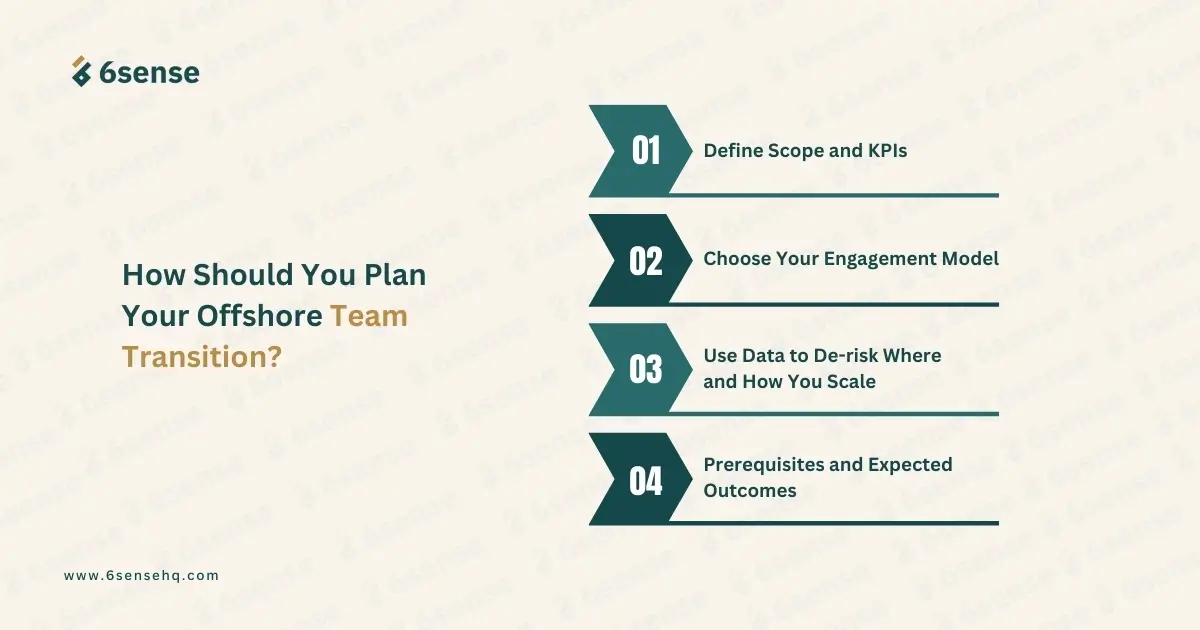
Pick an offshoring model that aligns with your speed, control, and budget constraints. Use the right structure to meet your team’s needs and align them.
Before you dive in, validate market potential and account coverage. Many companies use intent data to analyze markets and guide staffing, ensuring offshore teams focus on the right accounts.
Building and integrating an offshore team isn’t that complicated. By following a clear process, you can seamlessly scale your team, boost productivity, and stay aligned with your goals.
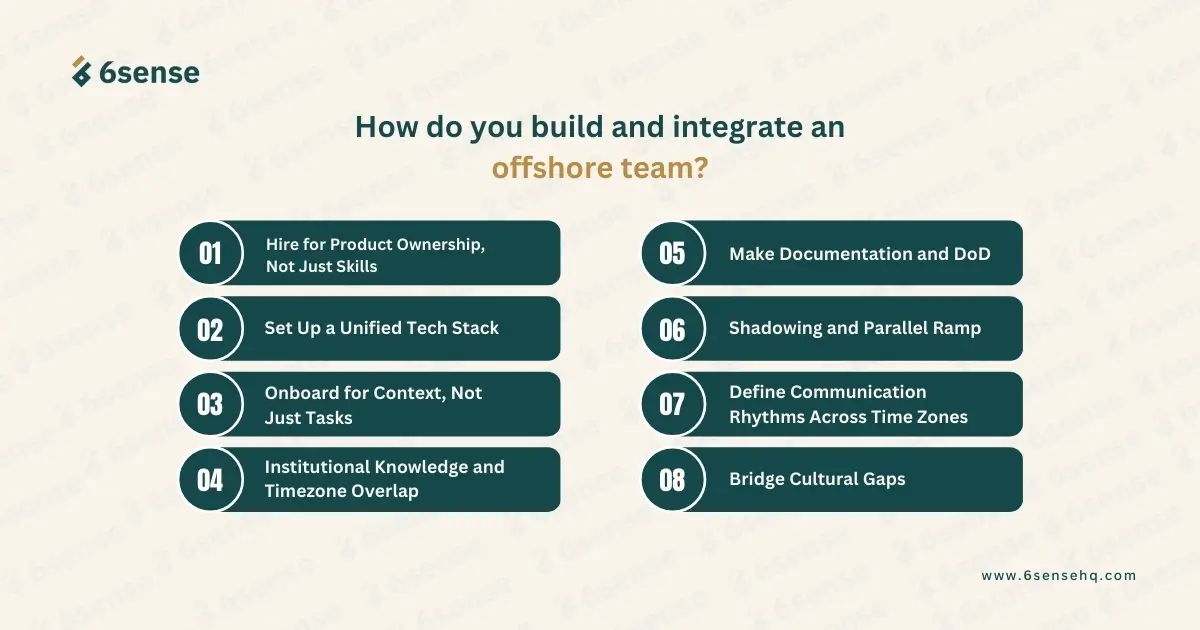
For your technical expertise, hire people who take ownership of the product and communicate effectively. The top partners work with the top 0.5% to 1% of talent. This will raise your code quality and reduce supervision.
Use the same tools for both your onshore and offshore teams. This eliminates confusion and keeps things smooth. Here’s what you need:
Don’t just onboard your team with tasks. Start with the product vision, explain who the users are, and set clear expectations for SLAs. Get your offshore team involved in All-Hands meetings, design reviews, and demo days.
Align roles with a RACI model and establish a shared Definition of Done to ensure quality across the board.
Knowledge transfer is an ongoing process and not a one-time meeting. Centralize your standards, workflows, and decisions in a searchable repository like Confluence or Notion.
Make sure no single engineer becomes a point of failure. During the first few sprints, maintain 2 to 4 hours of overlap for real-time collaboration, and reduce it as the team stabilizes.
Your documentation must stick. Use centralized docs for coding standards, runbooks, and architecture decisions.
For asynchronous collaboration, record Loom walkthroughs for system tours and demos, especially for teams across different time zones.
Define your Definition of Done, acceptance criteria, test coverage, and release notes to ensure smooth handoffs.
For the first 2-3 sprints, have the offshore lead shadow the onshore lead to understand the process. After that, swap ownership so the onshore lead can review the offshore work. This reduces rework and spreads knowledge.
Set up synchronous overlap for planning and problem-solving, and use asynchronous updates to keep things moving.
Make sure you have clear SLAs for response times and define which channels to use for urgent issues. Train both teams on cultural norms, so questions are raised early, and decisions are documented properly.
Avoid yes/no questions. Ask open-ended ones like, “What will block this?” or “How long will this take, given our current constraints?” This encourages transparency.
Create a culture where raising blockers is a positive move and not penalized. This builds trust and keeps things running smoothly.
When transitioning to offshore teams, you’ll face common challenges. Here’s how to avoid them:
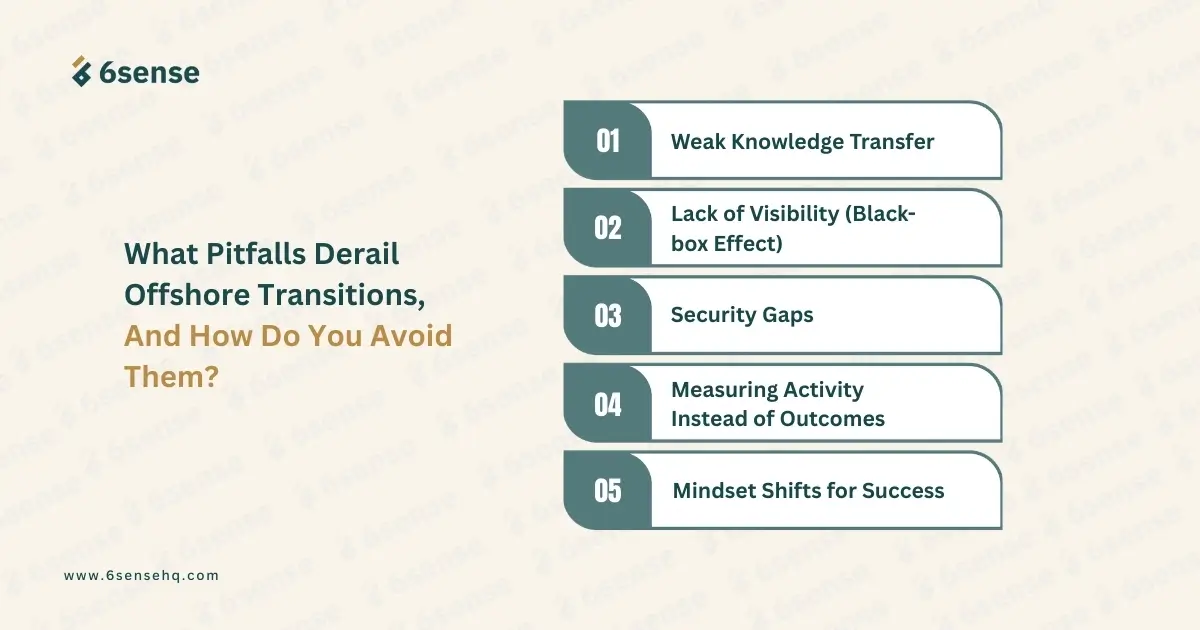
Poor knowledge transfer can derail your offshore team’s success.
How to Avoid This:
Without visibility into progress, it’s hard to spot issues early.
How to Avoid This:
Security concerns are high when working with offshore teams.
How to Avoid This:
Tracking hours worked or tasks completed doesn’t always show true performance.
How to Avoid This:
Work with your offshore team to design sprints, share context, and set expectations together.
Shift focus from tracking hours to delivering quality work and results.
Managing and scaling your offshore team after go-live is all about continuous improvement and adaptability. Follow these steps to ensure long-term success:
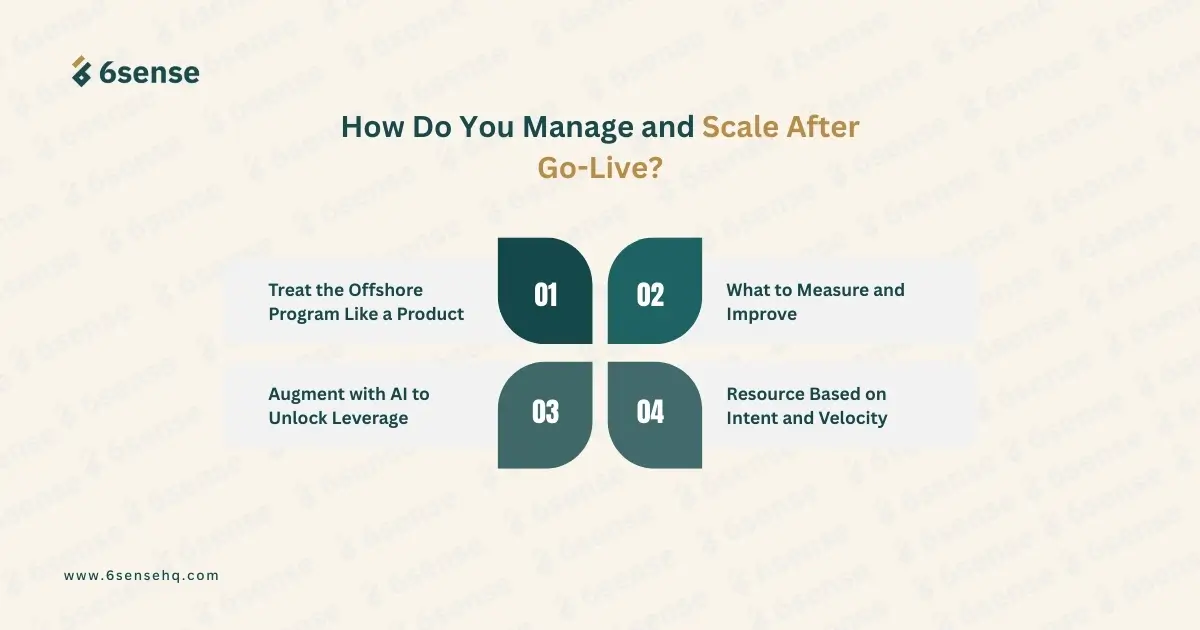
After go-live, treat your offshore team like a product that needs regular attention. Set clear, measurable outcomes and track progress consistently.
To manage effectively, you need to track the right metrics. Here are the key areas to focus on:
AI tools can help you scale without increasing headcount. For instance, Simpro used AI email agents to save 2 hours per BDR daily, while increasing MQLs by 34% year-over-year. This boosted pipeline quality without adding more team members.
Adjust your offshore team’s size and expertise based on performance data. Use intent signals (such as customer interest or market demand) to prioritize which segments your offshore team should focus on next. This ensures the effort is always mapped to the highest-impact tasks.
Transitioning to offshore teams in 2026 requires careful planning and execution. This checklist outlines the key phases to ensure a smooth and successful transition from strategy to scaling.
Success with offshore teams in 2026 is all about having the right systems in place. Focus on a solid operating model, shared tools, clear knowledge transfer, and measuring results.
Keep your strategy and IP onshore, but run your offshore teams using the same tools (Mirror Stack), and protect everything with Zero Trust security. Use intent data and AI agents to make sure your teams are working on what will have the biggest impact.
If you're ready for a smooth transition and want a plan that fits your goals, we’re here to help. Our product-trained engineers will work alongside your team to ensure everything runs smoothly. Book a demo call with us to get started, and we’ll map out your plan together.
Stop scrolling, start hiring: 15 best offshore dev sites for 2026 with rates, vetting process, and quick picks. Tap in!
14 min read
Offshore ROI in 2026: calculate true TCO, payback & NPV, dodge rework traps, and scale faster, grab the checklist now!
7 min read
Top offshore mobile app dev firms for US: prices, trends, and tips to pick the perfect partner. Tap in to compare now!
6 min read