


How to Transition to Offshore Teams Without Losing Control
Optimize your 2026 offshore strategy with a Mirror Stack, Zero Trust security, and AI to scale execution while saving 40-70%.
9 min read
Loading…
Offshore software development can supercharge your growth or slow you down, depending on how you use it.
Written by: Nasif Sid Created on: 15 Oct 20256 min to read

The pros and cons of offshore software development come down to this: it can save you money, speed up delivery, and give you access to global talent, but it can also bring challenges like time zone gaps, communication hurdles, and less control.
Offshoring has evolved from a simple cost-saving move to a smart strategy for startups and growing companies looking to scale fast without burning through budgets. But like any business decision, it’s not one-size-fits-all.
In this blog, we’ll break down what offshore development actually is, how it compares to other outsource software development models, and walk you through the real pros and cons of offshore software development.
Let’s dig in!
Offshore software development means hiring a team in another country, usually far from your home base, to build, manage, or support your software projects.
These teams handle everything from developing new apps to maintaining legacy systems, running QA, or even extending your in-house team with dedicated software developers. It’s a flexible way to scale your tech efforts without the overhead of hiring locally.
Countries like Bangladesh, India, Vietnam, Ukraine, and the Philippines are common offshore hubs thanks to their strong talent pools and lower labor costs.
In fact, the global offshore software development market is expected to surpass $905 billion by 2027.
But it’s not just about saving money anymore; it’s about speed, talent access, and building innovative, scalable teams across borders.
Because it helps them move faster, save money, and tap into global talent all without compromising on quality. Here’s how it works in practice:

Hiring local devs can take months. Offshore teams are usually pre-vetted, trained, and ready to plug into your project. This means you can kick off work in days instead of dragging through long hiring cycles.
Offshore teams' development costs significantly less than building everything in-house. You save on salaries, benefits, and overhead without sacrificing quality. It’s a smart way to stretch your budget while still shipping great software.
Can’t find that rare AI engineer or Flutter expert locally? Offshore gives you access to massive global talent pools. You’re no longer limited by geography; just focus on finding the right fit for your stack.
For early-stage startups, speed matters. Offshore teams help ship MVPs faster, test ideas sooner, and get real user feedback without draining all your runway on hiring or infrastructure.
For growing companies, offshoring makes it easy to scale up for big projects or new markets without committing to full-time local hires. It’s flexible, lower risk, and lets your core team stay focused on strategy.
Offshore, onshore, and nearshore development all involve outsourcing, but the key difference is location, which affects cost, communication, and collaboration.
Here’s a simple breakdown:
| Model | Description | Pros | Cons |
| Onshore | Outsourcing to teams in your own country | Easier communication, similar time zones | Expensive, limited talent pool |
| Nearshore | Outsourcing to nearby countries (e.g. U.S. to Latin America) | Time zone alignment, moderate cost savings | Talent still more expensive than offshore |
| Offshore | Outsourcing to distant countries (e.g. India, Vietnam, Ukraine) | Major cost savings, large talent pool | Time zone & communication challenges |
In short, it helps you build faster, cheaper, and smarter, especially when your in-house resources are stretched. Here’s how it makes a difference:
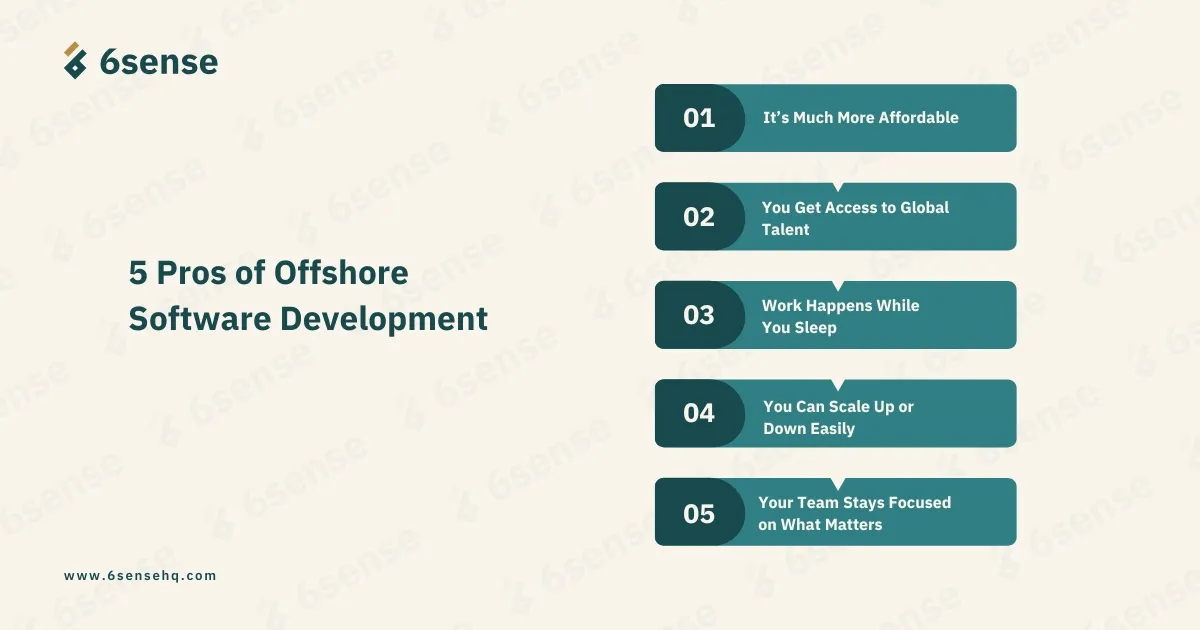
Offshore development can cost 30-70% less than hiring locally. You save on salaries, office space, and other overhead. This makes it perfect for startups and companies that want to do more with a limited budget.
Need someone with rare skills like AI, blockchain, or Flutter? Offshore teams give you access to a much bigger talent pool, so you can find the right expert faster instead of searching locally for months.
Because offshore teams are in different time zones, work can keep moving even after your local team signs off. It means faster turnarounds and the ability to respond to issues 24/7 if needed.
Offshore teams make it easy to grow your team during busy times and shrink it when things slow down. You’re not stuck with full-time salaries if you only need help for a few months.
Offloading development work lets your core team focus on strategy, customers, and growth. Instead of juggling everything, they can do what they do best while offshore teams handle the build.
Offshore development has clear perks, but it’s not without challenges. Here are the common drawbacks you’ll want to think through before jumping in:

Time zone differences, accents, and cultural habits can cause misunderstandings. Simple feedback might get lost in translation, especially when things are moving fast and clarity is key to hitting deadlines.
You’re not sitting next to the team, so quick check-ins and course corrections are harder. If your project managers aren’t proactive, things can easily drift off track without anyone noticing right away.
Not every offshore team works the same way. Some deliver excellent results, others might cut corners. Picking the cheapest option without checking their track record can lead to poor quality or missed expectations.
Your offshore team may handle sensitive data or proprietary code. If they don’t follow strong security standards, you could risk leaks, breaches, or even intellectual property issues down the line.
These challenges don’t mean offshore development is a bad idea, but they do highlight why following a clear offshore hiring checklist is essential before selecting a partner. The right due diligence dramatically reduces risk and improves long-term outcomes.
When it comes to offshore development, Reddit users have a mix of praise and caution.
One startup founder shared that their offshore team helped them build and launch an MVP in just 3 months and at half the local cost. Others mentioned it’s great for specific tasks, like front-end builds or QA.
But not everyone had smooth sailing. Some users warned about language barriers and time zone delays slowing down feedback loops.
A standard tip is not to choose the cheapest option, but focus on communication and project management skills.
Offshore software development can be a game-changer, but it’s not for everyone. For startups and fast-growing teams, it offers speed, savings, and global talent. But the pros and cons of offshore software development depend on your team’s setup, communication skills, and what kind of product you’re building. If you need flexibility, niche expertise, and can manage a remote software development team well, it might be the right move.
But if in-person collaboration or tight data control is critical, you’ll need to think twice. Success comes down to who you work with, not just where they are.
Looking to scale smarter? Discover how 6sense HQ helps teams grow with precision, insight, and the right technology.
Optimize your 2026 offshore strategy with a Mirror Stack, Zero Trust security, and AI to scale execution while saving 40-70%.
9 min read

Stop scrolling, start hiring: 15 best offshore dev sites for 2026 with rates, vetting process, and quick picks. Tap in!
14 min read

Offshore ROI in 2026: calculate true TCO, payback & NPV, dodge rework traps, and scale faster, grab the checklist now!
7 min read