

6sense HQ vs DevToDollars: Best MVP Partner in 2026
Compare 6sense HQ and DevToDollars on MVP speed, team models, proof, pricing, and post-launch support to pick the right fit.
15 min read
Loading…
Learn how to outsource MVP development to save costs, launch faster, and avoid common pitfalls through a clear five-step guide.
Written by: AKM Ahsan Created on: 30 Mar 202611 min to read
Outsourcing MVP development can help you launch faster, control development cost, and access experienced developers without building a full in-house team. But the outcome depends on how well you choose and manage your outsourcing partner.
If you’re a founder with a product idea and limited resources, you’ve probably asked yourself: Should you outsource MVP development or build it with an in-house team? Many startup teams face this decision early.
The right approach can help you build your MVP, gather user feedback, and validate your idea quickly. The wrong one can waste time and money. With the global IT outsourcing market expected to exceed $650 billion by 2025, more founders are choosing to outsource, but doing it the right way makes all the difference.
Before you decide to outsource MVP development, it’s important to understand what you’re really outsourcing. Many founders assume it means handing the project to a developer and waiting for the final product. In reality, it’s a collaborative development process where your startup works closely with an external development team to build your MVP.
A minimum viable product is the simplest version of your product that still solves a real problem. Its purpose is to validate your idea with real users and gather early user feedback before investing heavily in full product development.
According to Mordor Intelligence’s research, by 2031 the IT market size will be USD 752.08 Billion. And to stay present in this massive market it is important you validate your product by an MVP
When you outsource, you’re bringing in a team of developers to handle the technical side of software development. Depending on your setup, this team may support an in-house team or act as the primary engineering team responsible for building early MVPs. This is also where founders should understand the difference between an MVP development partner and a traditional agency, because the right model affects communication, ownership, strategy, and long-term product suppor
If you’re planning to build an MVP, one of the first decisions you’ll face is whether to outsource the work or rely on an in-house team. Both approaches can work, but the right choice depends on your startup’s resources, timeline, and technical capabilities.
For many early-stage founders, outsourcing is the fastest way to move from idea to product. It can be a strong option if:
In these cases, working with an external development team can help you build your MVP faster and focus on validating the product.
There are also situations where building internally makes more sense. An in-house approach may work better if:
For many early-stage founders, choosing to outsource MVP development isn’t just about saving money, it’s about moving faster and reducing risk. When done correctly, outsourcing your MVP development can help your startup launch sooner, access experienced engineers, and focus on validating the business idea.
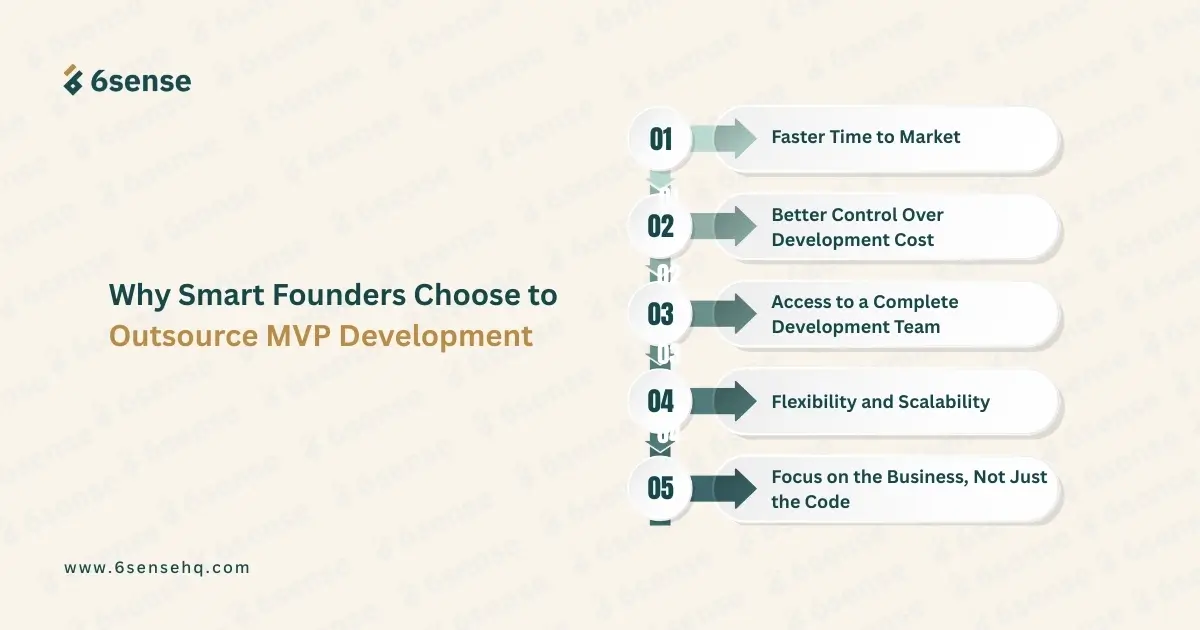
Hiring and onboarding an internal team of developers can take months. When you outsource, you can work with a team that is already structured and ready to begin the development process.
This allows your startup to build your MVP faster and reach users earlier, which is critical for validating a new idea or meeting a market deadline.
Building an in-house team requires salaries, benefits, infrastructure, and long-term commitments. By choosing to outsource, startups can manage development cost more efficiently.
Many founders work with outsourcing companies in regions like Eastern Europe, where skilled developers are available at lower costs while still delivering high-quality work.
When you outsource, you often gain access to more than just a single developer. A typical outsourced team may include:
This structured setup ensures that all parts of the software development workflow are covered without needing to build a full internal team.
Another advantage of outsourcing is flexibility. As your startup grows, you may need to scale development quickly.
An external partner can expand the development team when needed and reduce resources once the initial MVP is launched, giving your product the scalability required for growth.
When founders try to manage every aspect of product development, progress often slows down. By outsourcing, you can focus on customer discovery, market strategy, and achieving product-market fit while experienced developers handle the engineering work.
If you’re building a startup, deciding to outsource MVP development can help you move faster and reduce early technical risks. Instead of spending months assembling an in-house team, you can work with experienced developers who already have a structured development process in place.
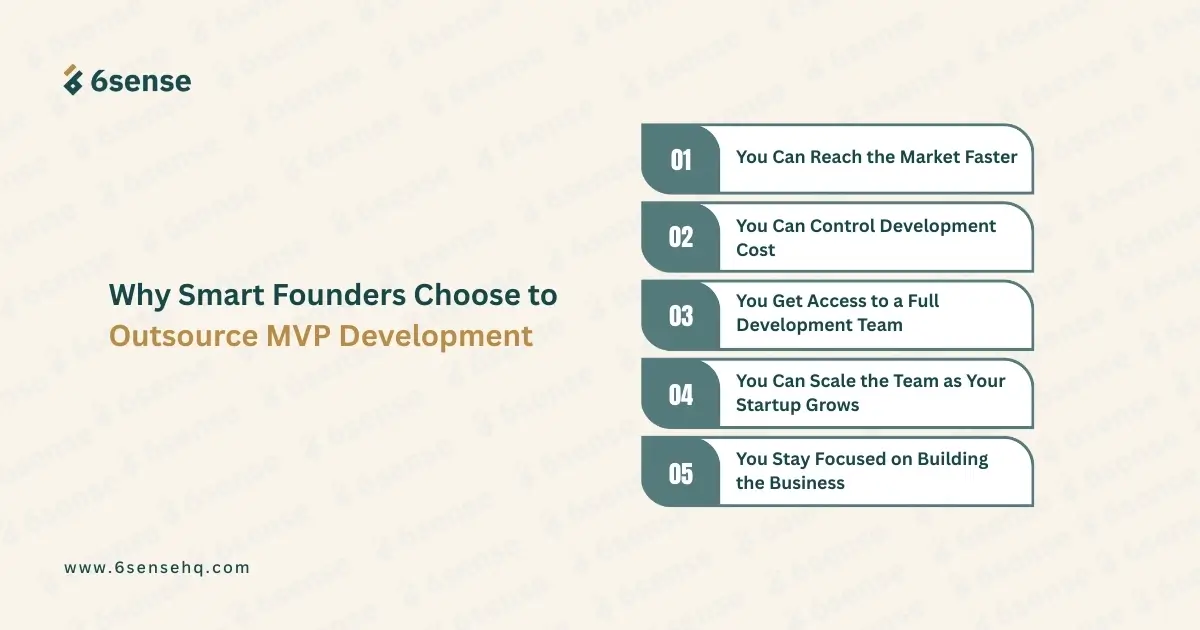
When you try to hire an in-house team, recruiting and onboarding engineers can take months. If you outsource, you can start working with a team of developers almost immediately.
This allows you to build your MVP faster, launch earlier, and begin collecting user feedback to validate your idea before competitors move ahead.
As a founder, managing development costs is critical. Building an in-house team requires salaries, benefits, and long-term commitments.
When you outsource, you only pay for the work being done. Many startups also work with teams in regions like Eastern Europe, where strong engineering talent is available at lower costs while maintaining good quality of code.
If you hire a single developer, you still need people for design, testing, and infrastructure. When you outsource, you often work with a full outsourced team that may include:
This setup makes the software development workflow much smoother.
Another benefit of outsourcing is flexibility. As your startup grows or attracts an investor, you may need to expand the team quickly.
An experienced outsourcing partner can scale the development team when needed and reduce resources after launch, giving your product the scalability it needs without the pressure of maintaining a large in-house structure.
When you try to manage every technical detail yourself, it’s easy to lose focus on the bigger picture. By choosing to outsource, you can spend more time refining the product vision, reaching users, and improving the product based on user feedback while the engineering work continues in the background.
If you decide to outsource for MVP, the process should be structured and intentional. Successful founders don’t jump straight into actual development. They follow a clear MVP development process to ensure the product solves the right problem.
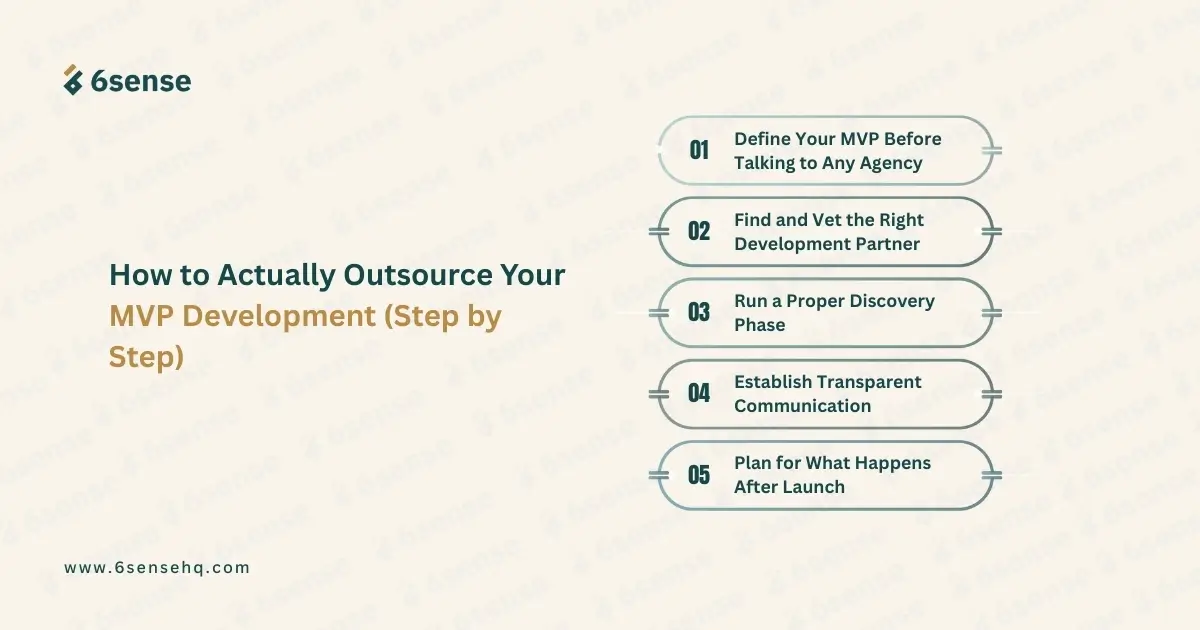
Before contacting MVP development agencies or any development companies, you should clearly define what your startup MVP needs to achieve.
Focus on the essential parts of an MVP, such as:
A well-defined brief helps an MVP developer or an MVP development company understand the project more quickly and ensures the MVP development process stays focused on delivering a good MVP rather than an overloaded product.
The next step is finding the right partner. Look for an established development agency with proven experience in MVP development for startups. Founders can also compare MVP development companies for startup launches based on portfolio, pricing, team structure, and post-launch support before making a final decision.
When evaluating a potential development partner, check for:
If your product is subscription-based or platform-driven, it’s worth evaluating SaaS-focused MVP development companies that understand onboarding, dashboards, billing flows, retention features, and scalable product architecture.
A professional MVP development company will rarely jump straight into coding. Instead, they start with discovery to plan the project development.
This stage typically includes:
Skipping this stage during outsourcing the development often leads to wasted time and resources and delays in reaching market fit.
Once development begins, strong collaboration is critical. You should expect transparent communication, clear sprint updates, and structured progress reviews.
A reliable partner will usually assign a dedicated team and follow industry best practices to keep the MVP development process organized.
This approach ensures your startup stays involved while the technical MVP is built efficiently.
Launching your startup MVP is only the first step. After you get your MVP to market, you’ll need to improve the product based on user insights.
A good partner will help you:
A well-known example of a smart MVP strategy comes from Dropbox, a cloud storage platform that now serves hundreds of millions of users worldwide. When founder Drew Houston first had the idea, building the full product required complex backend infrastructure and a significant software development effort. Instead of jumping directly into full project development, he focused on validating the concept first.
Rather than building a complete minimum viable product immediately, Dropbox created a short explainer video demonstrating how the product would work. The video showed the core functionality of the MVP software and explained how users could sync files across devices.
The company’s waitlist grew from 5,000 to over 75,000 signups overnight. This early traction proved strong demand before investing heavily in actual development.
Dropbox’s approach highlights an important lesson for founders considering whether to outsource development or build internally. The team first confirmed that users wanted the product before investing significant time and resources into engineering.
Choosing to outsource your MVP can be a smart decision, but many startups run into problems by overlooking a few critical details. Avoiding these mistakes can save you time, money, and frustration as you build your minimum viable product.
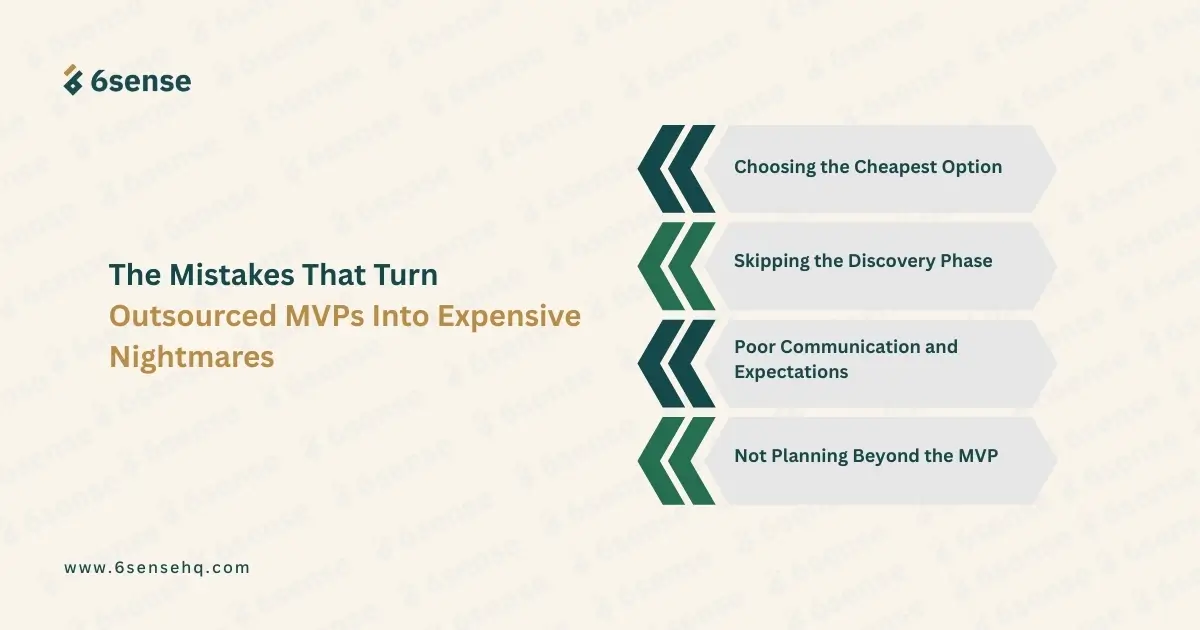
Trying to reduce costs too aggressively often leads to poor results. Some founders select the lowest-priced developer or agency without evaluating their experience in mvp development for startups.
This can lead to weak architecture, poor code quality, and a product that becomes difficult to maintain as the startup grows.
One of the most common mistakes during outsourcing development is jumping straight into coding. Without a clear understanding of the parts of an MVP, teams often build unnecessary features.
A proper mvp development process should always begin with planning and validation before starting actual development.
Even when working with a capable development partner, projects can fail if communication is unclear. Lack of updates, undefined milestones, or missing feedback loops can cause confusion during project development.
Consistent communication ensures that your startup remains aligned with the team of experts responsible for building the product.
Some founders treat the MVP as the final product instead of the first step toward product market fit. A good MVP should be built with future growth in mind so it can evolve into full-scale development once traction appears.
Deciding to outsource MVP development can be one of the smartest moves for a growing startup, especially when speed, expertise, and cost control matter. By working with the right development partner, you can build your MVP, launch faster, and start collecting real user feedback that helps you move closer to product-market fit.
The key is approaching the process strategically. Define your product clearly, follow a structured MVP development process, and choose partners with proven experience in MVP development for startups. When done correctly, outsourcing development lets you focus on validating your idea and growing your business while a skilled team handles the technical side.
If you're ready to get your MVP built and bring your product idea to life, partnering with an experienced team like 6sense HQ can help you reduce risks, accelerate development, and launch a scalable product that evolves as your startup grows.
Compare 6sense HQ and DevToDollars on MVP speed, team models, proof, pricing, and post-launch support to pick the right fit.
15 min read

Compare 6sense HQ alternatives for MVP development in 2026 and find the best software team for your startup budget and goals.
17 min read
Learn whether one developer can build an MVP in 2026 with cost, scope, AI tools, low-code tips, risks, and launch advice.
22 min read