Top Offshore Development Tools for US Companies in 2026 | 6sense HQ
15 Offshore Development Team Tools US Teams Need in 2026
Upgrade your offshore setup: 15 offshore team tools US teams need in 2026, secure workflows, faster delivery, and smoother collaboration.
Written by: Nasif Sid Created on: 13 Feb 2026•7 min to read
If you’re leading an offshore engineering team in 2026, you know that the right tools can make all the difference. With the right stack, you can boost offshore productivity by20 to 30 percent, ensuring your teams stay aligned and efficient.
With AI-native tools becoming the norm, you can accelerate development, increase transparency, and eliminate the black box effect.
In this blog, we have listed the must-have tools by use case, along with the evaluation criteria we use with clients. You will see where AI-native dev tools fit, how to gain passive visibility without micromanaging, and how a Mirror Stack reduces friction. A short case shows the results teams can expect when the stack, process, and people align.
Why the Right Tools Matter in Offshore Development
What are the right tools for your offshore development team? Choosing the best tools can eliminate time zone friction and boost your productivity.
Here’s how the right stack can streamline your process and deliver faster, more efficient results for your business.
AI-native tools help your developers work 55% faster and improve build success rates by84% .
With AI, you’ll experience fewer errors, faster results, and smoother handoffs, making your team more efficient.
Tools like Enji.ai and Linear give you real-time insights from Git and issue trackers, so you get visibility without the need for constant status updates.
According togaper.io the US is facing a shortage of 1.2 million developers in 2026, making offshore teams essential to meet your project deadlines.
The right tools ensure your offshore team works seamlessly with your in-house team, so you get consistent results and quicker delivery.
What Are 2026’s Must-Have Offshore Development Team Tools?
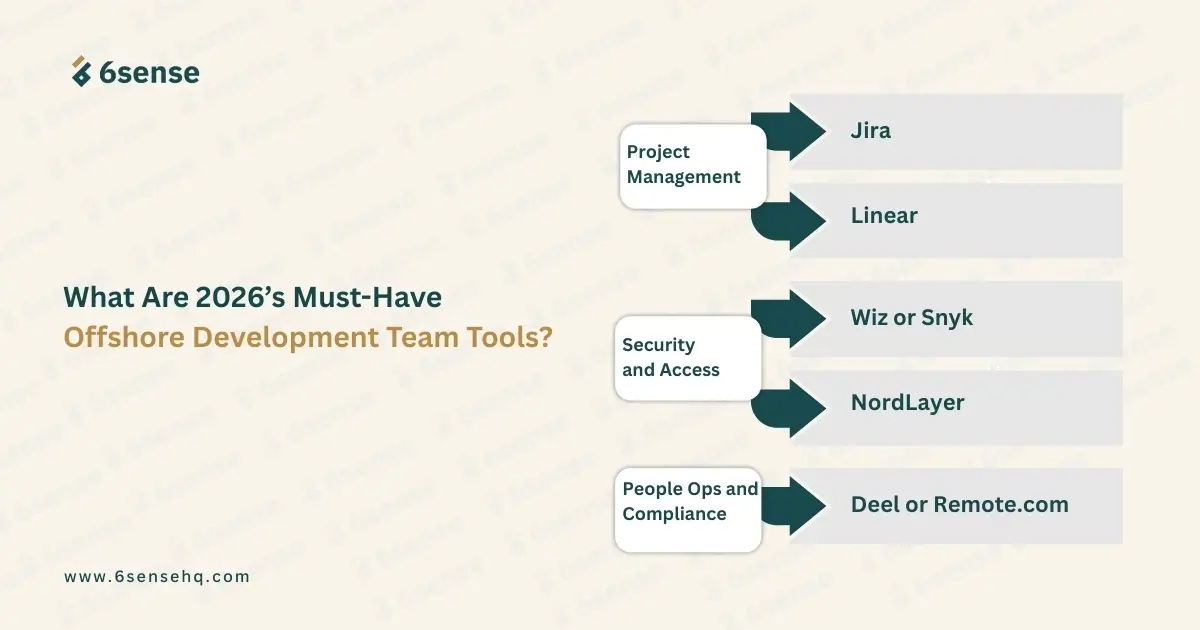
If you’re managing an offshore team, the right tools are essential to keep everything running smoothly. Here’s a breakdown of 15 tools you should consider for your business, organized by use case. These tools will help streamline your processes, boost productivity, and ensure seamless collaboration with your offshore team.
Project Management
Jira: If your business needs structure and strong workflows, Jira is the perfect tool. It’s especially useful for regulated teams that need to stay organized and efficient.
Linear: Looking for something faster and high-velocity? Linear is a favorite among startups. It integrates with Git and reduces the need for status reports, making collaboration easier.
Security and Access
Wiz or Snyk: Security is a top priority, and these tools provide shift-left security, scanning your code and dependencies early to catch issues before deployment.
NordLayer: If security is a major concern, NordLayer offers Zero Trust Network Access to enforce least privilege and segment access for offshore users, keeping your data protected.
People Ops and Compliance
Deel or Remote.com: For global hiring, payroll, and contractor management, Deel or Remote.com are key tools for staying compliant with local regulations. Be sure to adjust your strategy based on your company’s needs and the specific country requirements.
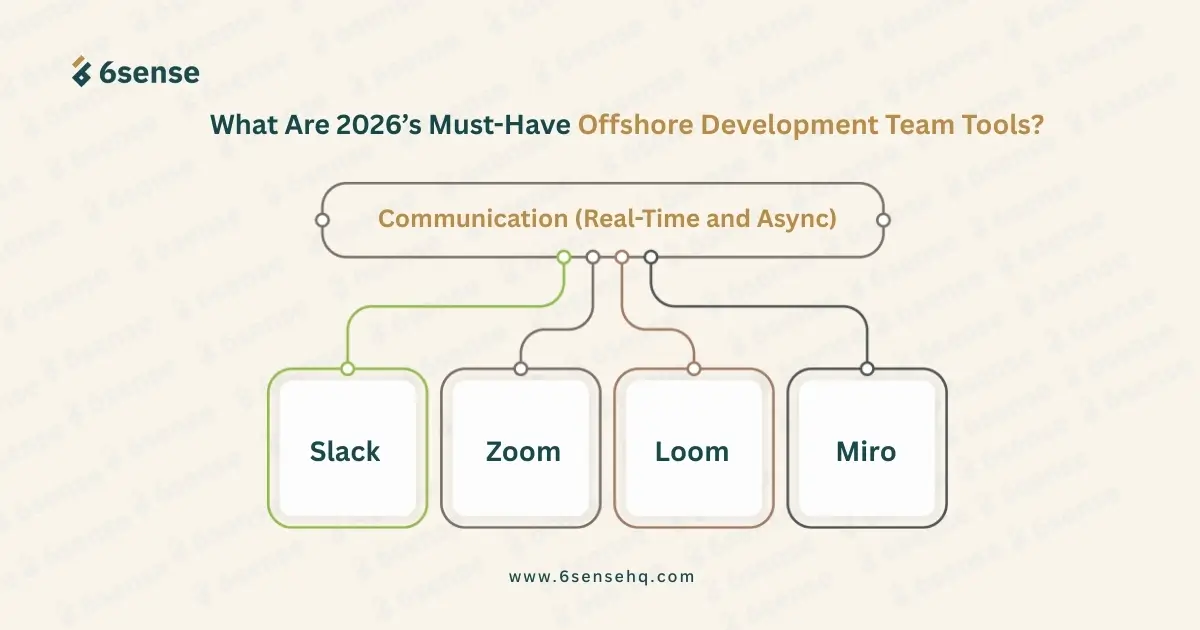
Communication (Real-Time and Async)
Slack: For quick decisions and daily collaboration, Slack is your go-to. Set up channels for different squads, incidents, or projects and keep communication flowing seamlessly.
Zoom: Whether you’re holding standups or stakeholder reviews, Zoom is reliable and easy to use. It supports the 2 to 4-hour sync time overlap that many offshore teams aim for.
Loom: Avoid late-night meetings with Loom. Record a 5-minute video walkthrough, and your team can stay in the loop while you sleep.
Miro: When you need to visually collaborate, whether for architecture reviews or sprint planning, Miro is the tool you need. Plus, it’s great for informal, cross-culture "watercooler" moments.
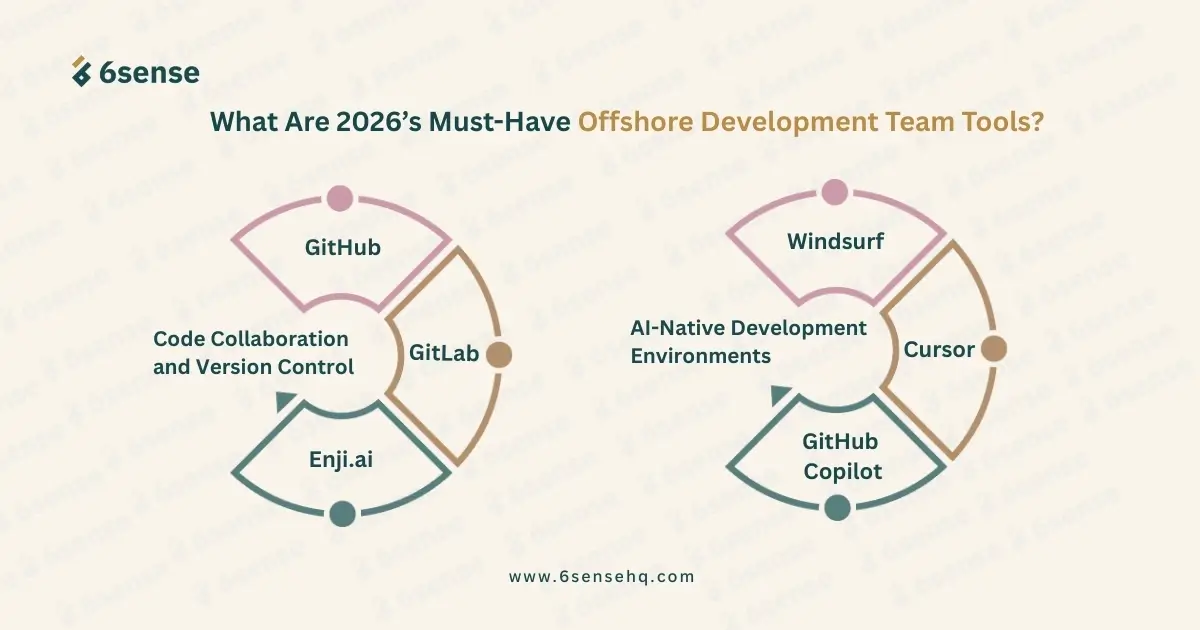
Code Collaboration and Version Control
GitHub: GitHub is the standard when it comes to code hosting and pull requests. Its ecosystem makes it a safe and reliable choice for distributed teams like yours.
GitLab: If you prefer using a single platform for repositories, CI, and security scanning, GitLab is an integrated alternative that brings everything together.
Enji.ai: For passive visibility, Enji.ai works directly with Git and issues trackers to visualize work activity. No need for constant manual status updates.
AI-Native Development Environments
Cursor: If you want to speed up your development process, Cursor is an AI-first editor that understands your full codebase and supports multi-file edits. It’s already taken a significant market share from GitHub Copilot due to its ability to handle deeper context.
Windsurf: Windsurf’s flow-based AI editor tracks your actions and predicts the next steps, which helps keep momentum high on multi-step tasks.
GitHub Copilot: If you’re not already using GitHub Copilot, now’s the time. It’s projected that over 90% of enterprise software engineers will be using it by 2028.
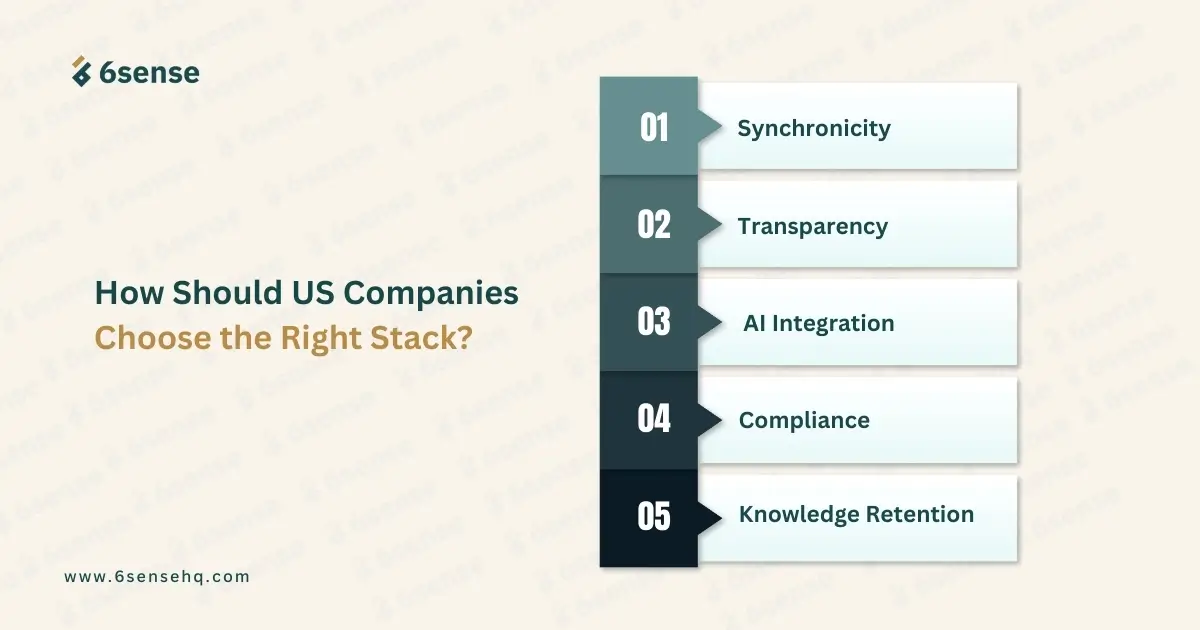
How Should US Companies Choose the Right Stack?
When picking the right tools for your offshore team, you need a strategy that ensures smooth work, security, and efficiency. Here’s a simple approach to make that choice clear and easy:
The STACK Framework:
Synchronicity: Choose tools that work well in both real-time (live meetings, chats) and async (updates, recorded videos) formats. This helps your teams collaborate effectively, regardless of time zone.
Transparency: Make sure you have clear visibility into your team’s work. The right tools should automatically provide you with updates without requiring constant status reports.
AI Integration: Use AI tools that help your team work faster and smarter. But make sure they don’t complicate things or interfere with your team’s processes.
Compliance: Pick tools that meet your company’s security and legal standards, such as SOC2 or ISO certifications.
Knowledge Retention: Choose tools that help your team store and share important information. This ensures that valuable knowledge stays within your company.
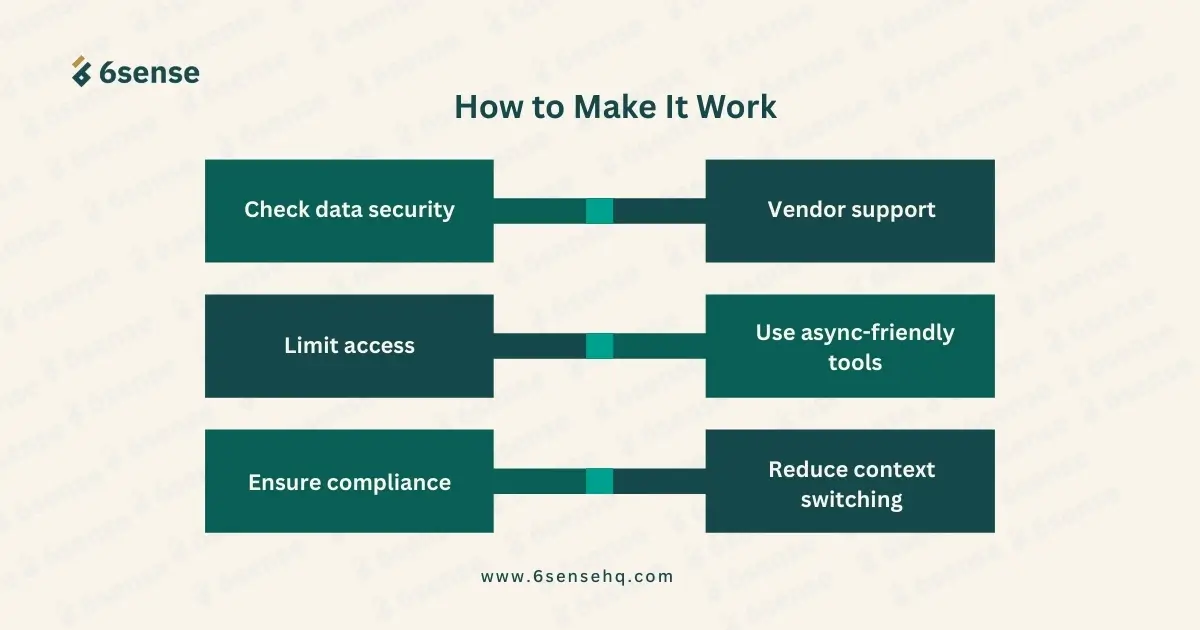
How to Make It Work:
We recommend a Mirror Stack strategy. This means using the same tools for both your offshore and onshore teams. It keeps things consistent, compliant, and easy to manage.
Your Checklist:
Check data security: Ensure your tools protect sensitive data.
Limit access: Use security practices like Zero Trust to minimize risks.
Ensure compliance: Make sure your tools meet necessary standards (SOC2, ISO).
Vendor support: Confirm your tools work well across different time zones.
Use async-friendly tools: Tools like Loom for updates and Linear or Jira for task management make things smoother.
Reduce context switching: Choose tools that integrate well with each other, so your team doesn’t waste time jumping between systems.
Case Study: US Company Scales With an Offshore Stack
Pattern50, a US software company led by Jim Swain, needed to speed up delivery across multiple startup projects. To solve this, 6sense HQ set up a team of 13 experts using a standardized Mirror Stack, including Jira, Slack, GitHub, and Zoom.
How it worked:
By using integrated tools and clear working agreements, 6sense removed the common "black box" effect of offshore teams.
The result?
25,000+ developer hours saved
Over $500,000 in product costs saved compared to hiring US-based developers
Next Steps: Get Expert Guidance from 6sense
If you’re ready to build a stack that works, 6sense is here to help. Whether you’re an early-stage founder or leading an established team, we’ll help you set up the right offshore stack for your business.
Here’s how we support you:
We implement your Mirror Stack, using the same tools for both your offshore and onshore teams.
We configure workflows in Jira or Linear, set up Slack channels, create CI pipelines, and establish ZTNA security policies.
We then staff a product-trained team that works just like your in-house engineers.
Whether you're a technical founder optimizing your runway or a non-technical leader bringing an idea to life, we align the right tools, processes, and people to meet your goals.
If you want to see the impact, Pattern50 saved over $500k and gained 25,000+ engineering hours using our approach. Reach out, and let’s tailor an offshore strategy that works for your team.
Conclusion
To succeed with offshore teams in 2026, you need a smart, AI-powered tech stack. When your tools are aligned, you can boost productivity by 20-30%. AI-native environments help teams work faster and achieve more successful builds. Combine that with passive visibility from your repos and issue trackers, plus Zero Trust security, and you eliminate the black box issues that have traditionally slowed down distributed teams.
At 6sense, we help you create a streamlined system that works for your team. We integrate the right tools, set up workflows, ensure strong security, and provide a product-trained team that fits smoothly with your company culture.
If you’re ready to improve your offshore team’s efficiency and save costs, get in touch. We’ll map out a plan tailored to your goals and help you implement it right away.