How to Transition to Offshore Teams Without Losing Control
Optimize your 2026 offshore strategy with a Mirror Stack, Zero Trust security, and AI to scale execution while saving 40-70%.
9 min read
Loading…
Both nearshore and offshore software development promise cost savings and global talent, but which one truly fits your business needs?
Written by: Nasif Sid Created on: 27 Oct 20258 min to read
The global talent market has made software development more flexible than ever. Today, businesses can hire skilled engineers from anywhere in the world. But with so many options, one big question always comes up.
Nearshore vs offshore software development, which one actually works better?
Both models help companies cut costs, scale faster, and access specialized talent that may not be available locally. The difference lies in how close your development partner is in distance, time zones, culture, and communication.
For some companies, proximity makes collaboration easier. For others, a fully offshore setup offers the scalability and savings they need to stay competitive.
This guide breaks down how both models work, their advantages and challenges, and what factors truly matter when making your choice.
Whether you are a startup trying to move fast or an enterprise improving efficiency, understanding these differences will help you choose the model that fits your goals.
Offshore software development means hiring a team or company in another country, often one that is far from your home base.
These teams usually work in very different time zones and regions, such as a company in the United States working with developers in India, Eastern Europe, or the Philippines.
The main goal is to access skilled professionals at a lower cost while maintaining quality. Offshore development has become popular because it allows companies to scale quickly without the high expenses of local hiring.
It also provides access to global talent pools where engineers specialize in modern technologies that might be hard to find nearby.
Many offshore companies follow international quality standards and use Agile methods to manage projects smoothly. They also rely on digital tools to stay connected, share updates, and ensure transparency.
However, offshore development is not just about cost savings. It is about finding a trusted partner who can deliver value across distance through clear communication, structured collaboration, and strong project management.
Nearshore software development is when a company partners with a development team located in a nearby country or region. The key advantage is proximity. Time zones are similar, travel is easier, and communication feels more natural because of overlapping working hours and often similar cultures.
For example, a company based in the United States might work with a nearshore team in Mexico, Costa Rica, or Colombia. A business in Western Europe might choose developers from Poland, Romania, or Portugal.
This setup makes it easier to collaborate in real time and manage projects more closely.
Nearshore development combines the benefits of outsourcing with the comfort of shared time and communication. It allows faster feedback loops, simpler coordination, and better relationship building between teams.
Many companies choose this model when they want to save costs but still maintain close collaboration and quick decision-making.
In short, nearshore development bridges the gap between local and offshore models. It gives businesses flexibility, skilled talent, and smoother communication without the long-distance barriers.
Both nearshore and offshore software development models allow businesses to extend their teams, reduce costs, and tap into global expertise. The difference lies in how distance, time zones, and communication affect collaboration.
| Aspect | Nearshore | Offshore |
| Time Zone | Similar hours enable real-time discussions and quick decisions. | Different time zones allow continuous development and faster overall delivery. |
| Culture | Shared business culture makes communication natural and smooth. | Diverse perspectives bring innovation and new problem-solving approaches. |
| Cost | Slightly higher rates but easier coordination. | Greater cost savings, ideal for long-term scaling and larger teams. |
| Talent Access | Strong regional expertise and communication skills. | Wider global talent pool with rare and high-demand technical skills. |
| Travel | Easier to visit for workshops and planning sessions. | Travel takes longer, but remote tools make in-person visits less necessary. |
Both models deliver excellent results when managed well. Nearshore development shines in collaboration and cultural alignment, while offshore development excels in scalability, innovation, and cost efficiency.
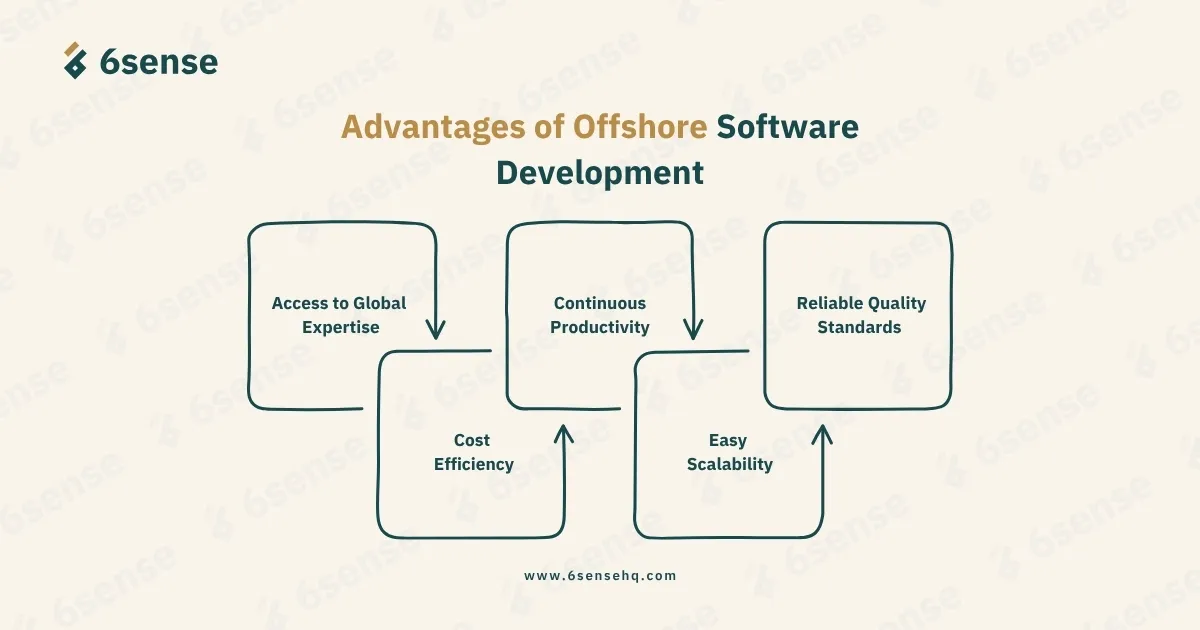
Offshore software development remains one of the most effective ways to build high-quality products while keeping costs manageable. It gives companies the flexibility to scale, access specialized skills, and maintain productivity around the clock.
1. Access to Global Expertise Offshore development opens access to a worldwide talent pool. Instead of hiring locally, companies can find experts in fields like AI, DevOps, and mobile development. A 2024 Statista report found that 6 out of 10 companies outsource offshore to gain specialized technical skills that are hard to find in-house.
2. Cost Efficiency Lower labor costs in offshore regions help reduce overall expenses without compromising on quality. The savings can be reinvested into innovation, marketing, or expansion, allowing businesses to grow faster while staying within budget.
3. Continuous Productivity Different time zones can become a strategic advantage. Offshore teams can keep projects moving after local hours, creating a continuous workflow that shortens delivery times and speeds up releases.
4. Easy Scalability Offshore partnerships make it simple to adjust team size as projects evolve. Whether scaling up for a launch or scaling down post-release, offshore teams offer flexibility that local hiring often cannot match.
5. Reliable Quality Standards Most offshore companies follow global frameworks such as ISO, CMMI, and Agile. This ensures accountability, consistent performance, and transparent project management from start to finish.
When managed well, offshore development is not just about saving money. It is about achieving faster innovation, broader expertise, and steady progress, all supported by reliable global collaboration.
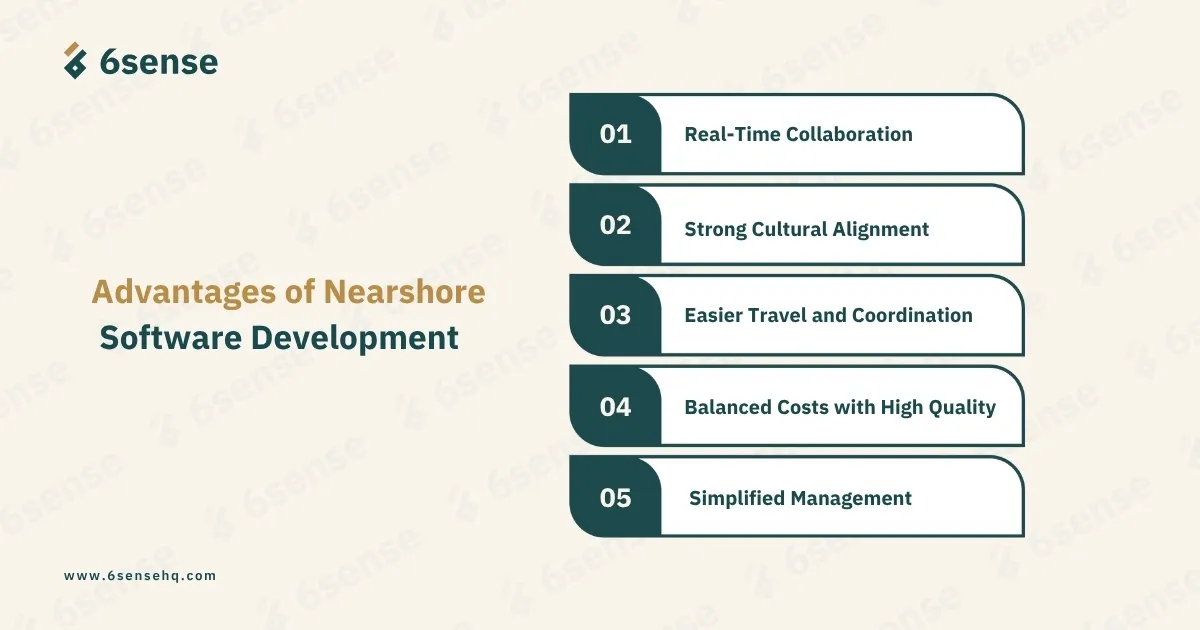
Nearshore software development offers the perfect balance between convenience, collaboration, and cost. It allows companies to access skilled talent in nearby regions while maintaining smoother communication and cultural alignment.
1. Real-Time Collaboration The biggest advantage of nearshore development is time zone alignment. Teams can work during similar hours, making meetings, feedback, and decision-making much faster. This real-time communication helps avoid delays and keeps projects moving efficiently.
2. Strong Cultural Alignment Working with teams that share similar business culture, work ethics, and communication styles builds trust quickly. Fewer cultural gaps mean smoother teamwork and less time spent on clarifying expectations.
3. Easier Travel and Coordination Nearshore locations are geographically closer, making it easier to arrange in-person visits, workshops, or project kickoffs. Quick travel strengthens relationships and adds a personal touch that remote calls cannot always replace.
4. Balanced Costs with High Quality While nearshore rates can be slightly higher than offshore options, the overall value remains strong. The reduced communication barriers and faster turnaround often make up for the difference in cost, resulting in better efficiency and quality.
5. Simplified Management Because of similar time zones and shared language, project oversight becomes simpler. Managers can stay directly involved without long waiting periods for updates, creating a stronger sense of teamwork and accountability.
Overall, nearshore development is an excellent choice for businesses that value collaboration and quick communication without giving up the cost benefits of outsourcing. It offers a middle ground where quality, convenience, and efficiency work together in harmony.
Choosing between nearshore and offshore software development depends on your company’s priorities, goals, and working style. Both models can deliver excellent results when aligned with the right project needs and management approach.
If your business values real-time communication, quick feedback, and close collaboration, then nearshore development may be the better fit. The shared time zones and cultural familiarity make it easier to coordinate projects and maintain a steady workflow.
However, if your goal is to scale quickly, access highly specialized talent, or manage larger, long-term projects at a lower cost, hiring an offshore development team might be the smarter choice. The global talent reach and round-the-clock productivity can help accelerate delivery without overstretching your budget.
It is also worth considering a hybrid approach, where the core project management or design team is nearshore, and development resources are offshore. This combination can deliver the best of both worlds: seamless communication and cost efficiency.
When making your choice between nearshore vs offshore development, think about the following:
Ultimately, the right model is the one that aligns with how your team works best. By focusing on communication, trust, and clear processes, both nearshore and offshore setups can help you build great products and long-term partnerships.
Understanding the real differences in nearshore vs offshore software development helps businesses make smarter outsourcing decisions. Both models offer clear advantages. Nearshore brings closer collaboration and cultural alignment, while offshore provides scalability, global reach, and cost efficiency.
The right choice depends on what your business values most. If communication speed and teamwork are your top priorities, nearshore might fit better. If flexibility, specialization, and budget efficiency matter more, offshore can be a game-changer.
No matter which model you choose, focus on building strong communication, setting clear expectations, and choosing a partner who shares your vision. That is how successful long-term collaborations are built.
Ready to build your offshore team as per your needs? Let's talk and see how we can help you.
Optimize your 2026 offshore strategy with a Mirror Stack, Zero Trust security, and AI to scale execution while saving 40-70%.
9 min read
Stop scrolling, start hiring: 15 best offshore dev sites for 2026 with rates, vetting process, and quick picks. Tap in!
14 min read
Offshore ROI in 2026: calculate true TCO, payback & NPV, dodge rework traps, and scale faster, grab the checklist now!
7 min read