

6sense HQ vs DevToDollars: Best MVP Partner in 2026
Compare 6sense HQ and DevToDollars on MVP speed, team models, proof, pricing, and post-launch support to pick the right fit.
15 min read
Loading…
Learn the key differences between MVP, Prototype, and PoC to reduce startup risk and build the right product at the right time.
Written by: AKM Ahsan Created on: 24 Apr 20269 min to read
Most startups don’t fail because of bad ideas. They fail because they build the wrong thing at the wrong time.
At 6sense HQ, when a new founder asks whether to start with a PoC, prototype, or MVP, the first question we ask is: what are you trying to validate right now?
Not what you want to build, but what risk you need to reduce first. The difference between MVP, Prototype, and Proof of Concept comes down to what you are trying to validate: PoC validates technical feasibility, Prototype validates design and user experience, and MVP validates real market demand. Choosing the wrong one at the wrong stage can cost startups $20,000-$100,000 in wasted development effort.
Our team at 6sense HQ has helped 100+ founders decide the right approach for their stage and budget.
This guide breaks it down simply, based on what actually works.
This is the simplest decision rule we use with founders at 6sense HQ, and it avoids most early-stage mistakes.
A Proof of Concept (PoC) is the earliest step in building a product. It helps you check if your idea can actually work from a technical point of view. Instead of building a full product, you test only the core logic.
In fact, many teams use PoC to avoid wasting time and money on ideas that cannot be built. According to industry insights, PoCs are usually small internal experiments designed to validate feasibility before major investment.
As startup expert Eric Ries says,
What it is NOT: A PoC is not a product, not user-facing, and not meant to be reused in production.
Who is involved: Typically, a founder + engineer testing core logic or integration feasibility.
Example:
An AI startup testing whether a model can accurately detect fraud would first build a PoC using sample datasets, without UI or product design.
Tools Used
Time & Cost
2026 Insight
AI tools like Cursor and Claude now allow founders to build PoCs in hours instead of days, dramatically reducing early validation time.
A Prototype is a visual or interactive model of your product. It shows how your idea will look and feel without building the full system. It helps teams test design, user flow, and experience early.
Research shows prototypes are widely used to evaluate user interaction and catch design issues before development starts.
As Steve Jobs once said,
A prototype may look real, but it often lacks backend logic. You can click through screens, but it may not actually function. The goal is not performance, it’s clarity.
What it is NOT
A prototype is not a working product; it simulates interaction but does not solve the problem fully.
Low-Fidelity vs High-Fidelity Prototypes
Use low-fidelity for early ideas, high-fidelity for testing user experience.
Example:
Dropbox created a prototype video demonstrating product flow before building the actual product, validating interest early.
Tools Used
Time & Cost
A Minimum Viable Product (MVP) is a real, working product with only the most essential features. It is built to test how users react in real life.
The idea is simple: launch fast, learn fast. Instead of building everything, you build just enough to solve a core problem. According to startup methodology,
As Eric Ries explains,
The main advantages of developing an MVP come from putting a functional product in front of real users without committing to a full-scale build. Startups can validate demand, collect practical feedback, control initial costs, and improve the product based on evidence rather than assumptions.
What it is NOT
An MVP is not a full product; it focuses only on essential features needed to validate demand.
Example:
Slack started as an internal MVP used by a small team before becoming a global product.
Tools Used
Time & Cost
One of the biggest questions founders ask isn’t what to build, it’s how much it will cost and how long it will take. Each stage serves a different purpose, so the investment varies significantly.
| Stage | Typical Duration | Typical Cost Range (USD) | Key Output |
| Proof of Concept (PoC) | 1–2 weeks | $2,000 – $10,000 | Technical validation (can it work?) |
| Prototype | 2–4 weeks | $5,000 – $20,000 | Design & user flow validation |
| MVP | 2–6 months | $20,000 – $150,000+ | Working product for real users |
These ranges align with industry benchmarks and 2026 MVP cost data, where MVPs alone can range widely depending on complexity, team, and features.
The key insight:
In real projects, the difference becomes very clear. Founders often start with a PoC when they are unsure about technology. For example, if you’re building an AI feature, the first step is testing whether the model works at all. No design, no UI, just raw validation.
Then comes the prototype. Teams create clickable designs to show investors or test user flows. It looks real, but it doesn’t actually solve the problem yet.
Finally, they built an MVP. This is where things get serious. Real users use the product, bugs appear, and feedback comes in.
In practice, skipping steps often leads to wasted time or rebuilding later. Many founders realize this only after launching too early.
Here’s a quick, practical comparison to make things clear.
| Aspect | Proof of Concept (PoC) | Prototype | MVP |
| Purpose | Test if idea works | Test design & experience | Test market demand |
| Functionality | Very limited or none | Partial, simulated | Fully working (core features) |
| Audience | Internal team | Stakeholders/users | Real users/customers |
| Stage | Earliest stage | Early design stage | Pre-launch stage |
| Typical Duration | 1–2 weeks | 2–4 weeks | 8–26 weeks |
Many founders mix these terms because they sound similar, but the confusion often leads to costly MVP challenges. Here are the most common reasons behind it.
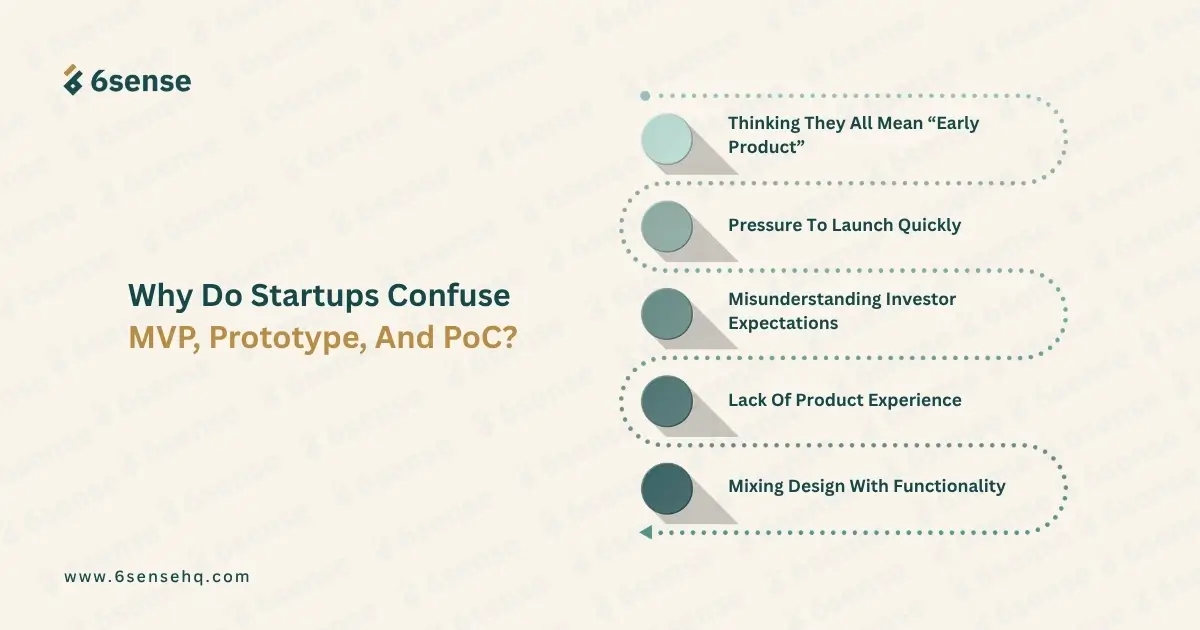
Many founders assume all three are just early versions of a product. In reality, each one serves a completely different purpose. PoC tests feasibility, prototype tests experience, and MVP tests demand. When teams skip this clarity, they often build too much too early without validating the basics.
Startups feel pressure to launch fast and show progress. Because of this, they jump straight to MVP without validating feasibility or design first. This leads to rebuilding later, which costs more time and money than doing proper PoC and prototyping early on.
Some founders believe investors want a polished MVP development from day one. In reality, many investors value learning and validation more. A clear PoC or prototype can sometimes be more powerful than a rushed MVP that lacks direction or user validation.
First-time founders often don’t understand product development stages. Without guidance, they mix up terms and processes. This leads to building features without clear goals, resulting in confusion, wasted effort, and poor product-market fit later.
Teams often confuse a good-looking prototype with a working product. Just because something looks real doesn’t mean it works. This misunderstanding creates false confidence and delays real testing with users, which only happens at the MVP stage.
Choosing the right approach depends on what problem you are trying to solve at that moment. Here’s how to decide clearly.
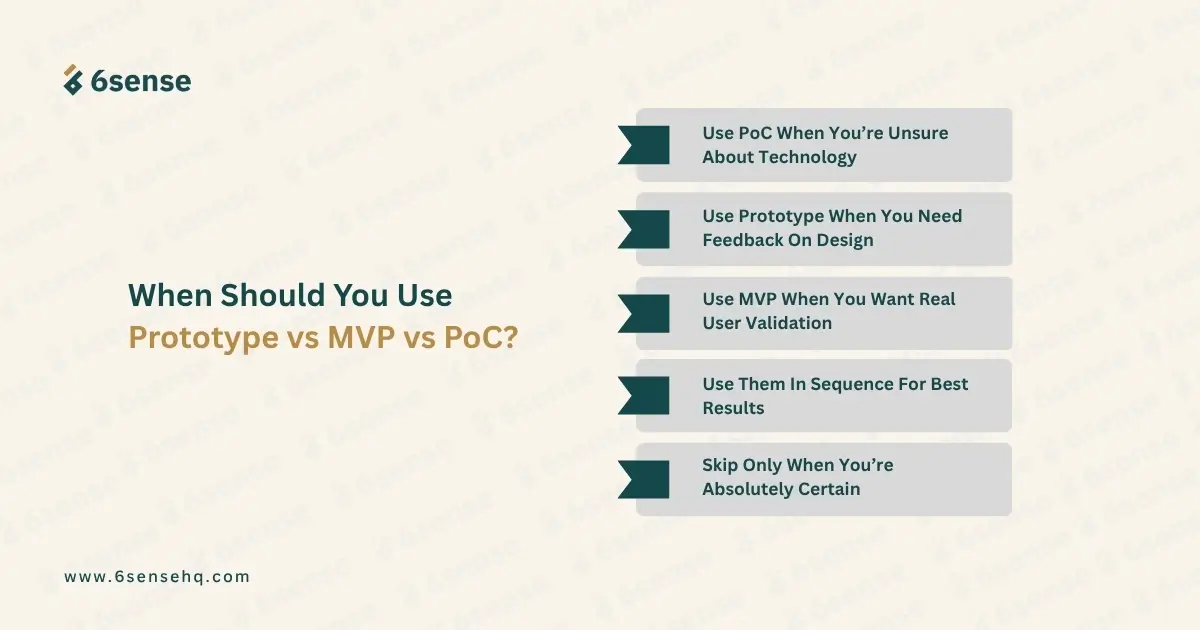
If your idea depends on new tech, integrations, or complex systems, start with a PoC. It helps you test feasibility before investing in design or development. This prevents building something that may fail at a technical level later.
If your idea is clear but you’re unsure about user experience, build a prototype. It helps you test flows, layouts, and usability. This stage ensures your product is easy to use before writing any heavy code.
Once technical feasibility and product design are clear, the next step is building an MVP. This stage demonstrates why MVP development is essential for startups: it allows real users to interact with the product, confirms whether genuine market demand exists, and gives founders reliable feedback before they invest in scaling. The insights collected at this stage help teams improve the product and make better growth decisions.
The smartest approach is not choosing one, but using all three in order. Start with PoC, move to prototype, then build MVP. This reduces risk at every stage and improves your chances of success significantly.
Sometimes, experienced teams skip the PoC or prototype stages. But this only works when the idea, technology, and market are already well understood. For most startups, skipping steps increases risk rather than saving time.
| Stage | Tools |
| PoC | Replit, GitHub, Jupyter |
| Prototype | Figma, InVision, Framer |
| MVP | React, Node.js, Bubble |
Understanding MVP vs Proof of Concept vs Prototype is not just theory, it’s a practical decision that can save your startup time, money, and failure. Each stage solves a different problem: PoC checks feasibility, prototype improves design, and MVP tests real demand.
If you use them in the right order, you reduce risk and build smarter. If you skip them, you increase uncertainty.
The key is simple: test before you build, and learn before you scale.
Want expert guidance? Talk to our expert team or get expert guidance from 6sense HQ to build your product the right way.
Compare 6sense HQ and DevToDollars on MVP speed, team models, proof, pricing, and post-launch support to pick the right fit.
15 min read
Compare 6sense HQ alternatives for MVP development in 2026 and find the best software team for your startup budget and goals.
17 min read
| $2K–$10K |
| $5K–$20K |
| $30K–$150K+ |
| Team Required | 1–2 engineers | Designer + PM + dev | Full team (FE, BE, QA, PM) |
| Tools Commonly Used | Jupyter, Replit, API sandboxes | Figma, InVision, Framer | React, Node.js, Django, Bubble |
| Code Reusability | Usually discarded | Rarely reused | Built for production |
| Risk Reduced | Technical risk | Design risk | Market risk |
Learn whether one developer can build an MVP in 2026 with cost, scope, AI tools, low-code tips, risks, and launch advice.
22 min read