

6sense HQ vs DevToDollars: Best MVP Partner in 2026
Compare 6sense HQ and DevToDollars on MVP speed, team models, proof, pricing, and post-launch support to pick the right fit.
15 min read
Loading…
Have a startup idea but no tech background? Discover how to validate, plan, and build your MVP step by step.
Written by: AKM Ahsan Created on: 6 Mar 20269 min to read
If you’re a non-technical founder with a big idea, you might feel stuck between vision and reality. You know your product could change lives, but building it seems confusing, technical, and expensive.
Good news: you don’t need to write code to build something real! What you do need is a smart approach that lets you learn quickly, test your assumptions, and build with confidence. MVP development isn’t about perfection; it’s about starting small, learning faster, and validating ideas before spending too much time or money.
In this guide, we’ll walk you through the essentials so you can navigate MVP development with clarity and purpose, even if “coding” feels like a foreign language.
An MVP (Minimum Viable Product) is the most basic version of a product that still solves a real user problem and lets you learn from real people before building the full thing. It’s not about perfection; it’s about learning what works fast and cheaply.
This reminds founders that the goal isn’t features, it’s learning. For example, Dropbox began with a simple demo video explaining the idea. The video alone helped them get thousands of sign-ups before building the full app, proving demand first.
So, basically, an MVP helps you reduce risk, save money, and focus on building products users truly want.If you want a deeper breakdown of the full process, this complete MVP development guide explains how founders can move from idea validation to launch with a structured approach.
Before you build your MVP, you must be sure there’s a real problem worth solving. As there are different types of MVP, validating early helps you avoid spending time and money on ideas nobody truly needs, and ensures you build with confidence.
Startup experts strongly emphasize testing ideas before building products. The Lean Startup methodology, widely discussed in publications like Harvard Business Review, explains that startups should first test their assumptions with customers before investing heavily in development. Launching a small MVP allows founders to validate hypotheses quickly and learn what users actually want.
A well-known real-world example is the founder of Dropbox, Drew Houston. Before building the full product, he released a simple demo video explaining the concept, which attracted thousands of sign-ups and proved that users actually wanted the solution.
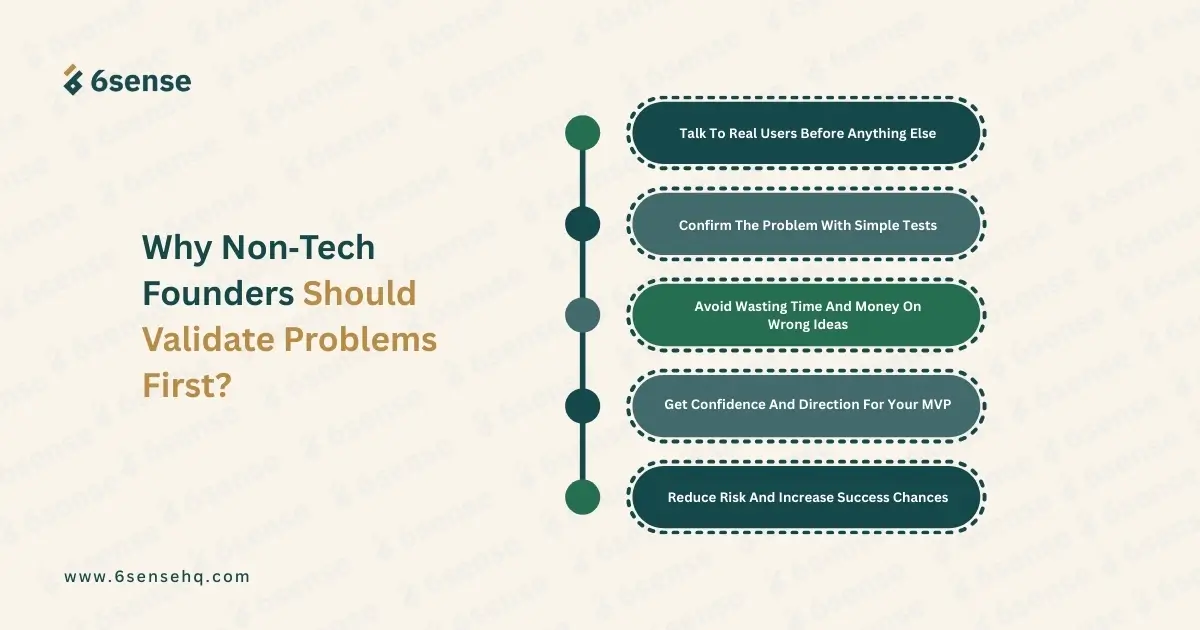
Here are the key reasons why problem validation matters for non‑tech founders.
Talking directly to your potential customers lets you see if the problem you want to solve really exists for them. Conversations, interviews, and genuine user feedback show whether they struggle with the issue you’re solving or if it’s just an assumption in your head.
You don’t need a full product to validate; use simple tools like surveys, landing pages, or waitlists to see if people pay attention. These low‑cost tests can show real interest before you build anything complex.
Building without validation means risking months of work on something people might ignore. Early validation reduces wasted development effort and keeps your budget focused on what matters most.
When you validate a problem well, you build with data instead of guesswork. This gives you clear confidence that your MVP will serve a real need, rather than being another idea that never catches on.
MVP validation for startups before building lowers the risk of failure by confirming your idea matches a real market need. Startups that test assumptions early have a far better chance of creating something people want.
No-code platforms allow founders to build working products without writing code. These tools use visual builders, templates, and drag-and-drop components so startups can launch MVPs faster and at a lower cost. Many startups use them to validate ideas quickly before investing in full development.
Here are some popular no-code tools and when to use them.
Bubble lets you build full web applications with workflows, databases, and integrations. It’s widely used for SaaS products, marketplaces, and dashboards without traditional coding.
Webflow combines a visual website builder with CMS and hosting tools, making it great for startup websites, marketing pages, and early product demos.
Adalo allows founders to build native iOS and Android apps using a drag-and-drop interface and built-in database features. It’s useful for testing mobile-first product ideas.
Glide converts spreadsheets such as Google Sheets into working apps in minutes. It’s ideal for internal tools, directories, booking systems, or quick MVP experiments.
Airtable works like a flexible database for your MVP and can connect with other tools like Zapier or Glide to power your product backend.
When selecting a no-code platform for your MVP, consider these factors:
Choosing the right features for your startup’s MVP development means focusing on what really matters: the parts that solve your users’ core problem and help you learn fast. Skip the clutter, keep it simple, and let feedback shape what comes next.
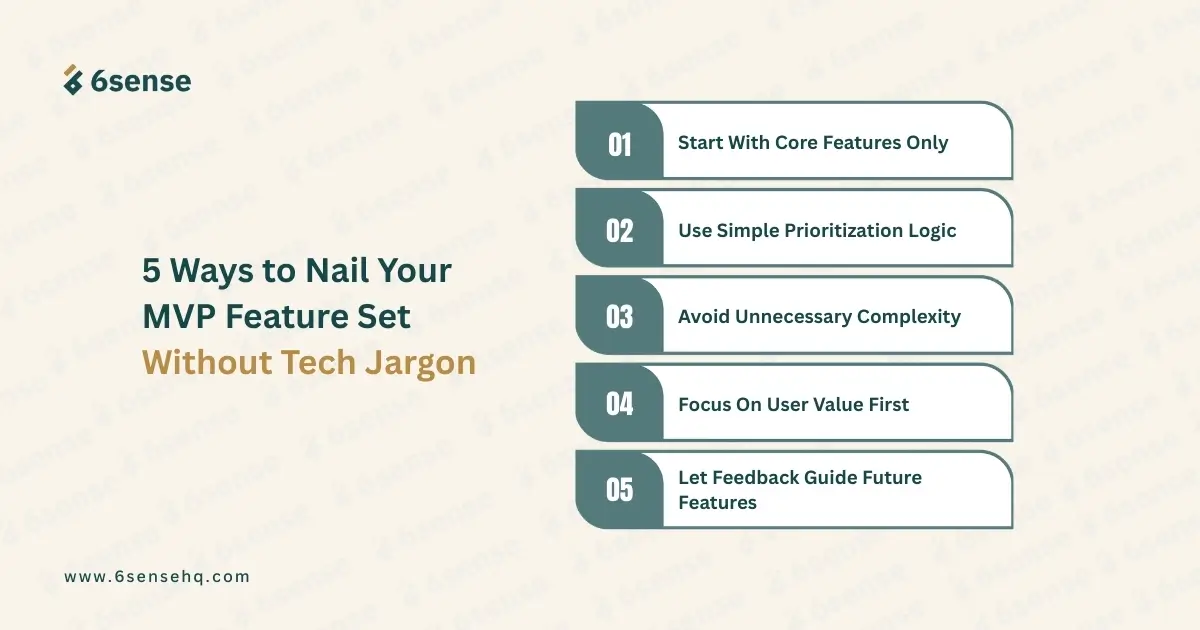
Once you’ve confirmed the problem is real, list the must‑have features, the ones that let users complete the main task your product is built for. Don’t try to include everything you wish your product could do. A tightly focused MVP delivers value and tests your idea quickly.
Separate features into must‑have vs nice‑to‑have categories using simple checks like “Does this solve the core problem?” and “Will this teach me something important?” This basic prioritization keeps your MVP lean and removes guesswork from your feature set.
Adding too many features slows development, increases cost, and makes your first version harder to test. A minimal set of essential features helps ensure your MVP launches sooner and gives you faster feedback on what matters.
Choose features that directly help users solve the problem — not ones that are merely “nice.” Your MVP should make the user’s life easier in a simple way, not confuse them with extra options they don’t need yet.
Once real users are engaging with your MVP, their feedback will tell you which features matter most next. Use actual user responses and behavior to shape future updates, so that your product grows in the right direction, not just the way you imagined.
Starting a tech product without a technical background is possible, but many founders fall into similar traps during the MVP stage. Most mistakes happen not because founders cannot code, but because they misunderstand how startups should validate ideas and build products.
Here are some of the most common mistakes non-technical founders make.
One of the biggest mistakes is trying to build the full product instead of a simple MVP. Adding dashboards, messaging systems, and complex features increases development cost and delays launch. A true MVP should focus on the smallest feature set that solves the core user problem.
Many founders jump straight into development without confirming whether users actually want the solution. The customer development methodology created by Steve Blank stresses that startups must test assumptions with real customers before building products.
Some founders choose developers based only on the lowest price. This often leads to communication problems, unclear expectations, and delayed projects. Selecting a team that understands startup MVP development is usually more important than choosing the cheapest option.
Without a clear MVP scope, projects often suffer from endless feature requests and changing requirements. This causes development delays, budget overruns, and confusion for the team building the product.
Another mistake is building features based on assumptions instead of real user feedback. The Lean Startup methodology encourages releasing early versions of a product and improving them through continuous learning from users.
Some founders delay launch because they want the product to be perfect. In reality, startups learn the most after releasing an MVP to real users. Early feedback helps teams improve faster and avoid building unnecessary features.
Now comes the fun part: building the MVP and you have choices:
Tools like Bubble, Webflow, Glide, and Adalo let you create real working products using visual builders and drag‑and‑drop interfaces, no coding required. These platforms are ideal for non‑technical founders who want control without the code.
If your idea needs more complexity than no‑code can handle, you can hire a freelance developer or team. The key is clear communication, defined milestones, and regular check‑ins so your vision translates into the product you want.
Some founders combine no‑code tools with occasional developer help, which gives you fast build times and professional polish without blowing your budget.
You don’t have to go it alone! Even no-code MVP development founders benefit from support systems. Here are people who can make your MVP journey smoother:
Great relationships make great products, and for non‑tech founders, the right support network is worth its weight in insights.
Building an MVP doesn’t have to be intimidating, even if you don’t write code. By validating early, focusing on core features, choosing the right tools, and surrounding yourself with the right support, you can launch a product that truly resonates with users.
Remember: your MVP is a learning machine, not a final product. Each user interaction, piece of feedback, and test result brings you closer to something that people love.
Kickstart your MVP journey with 6sense HQ and partner with expert developers!
Compare 6sense HQ and DevToDollars on MVP speed, team models, proof, pricing, and post-launch support to pick the right fit.
15 min read
Compare 6sense HQ alternatives for MVP development in 2026 and find the best software team for your startup budget and goals.
17 min read
Learn whether one developer can build an MVP in 2026 with cost, scope, AI tools, low-code tips, risks, and launch advice.
22 min read