


6sense HQ vs DevToDollars: Best MVP Partner in 2026
Compare 6sense HQ and DevToDollars on MVP speed, team models, proof, pricing, and post-launch support to pick the right fit.
15 min read
Loading…
Stop guessing MVP features. Compare MoSCoW, RICE & Kano with real examples, a decision matrix & free template. Build smarter.
Written by: AKM Ahsan Created on: 13 May 202614 min to read

When building your Minimum Viable Product (MVP), one of the most crucial steps is prioritizing the right features. With limited resources and time, focusing on the most essential features can mean the difference between success and failure.
But how do you know which features truly matter?
MVP feature prioritization is the process of selecting and prioritizing the most valuable features to build first, ensuring that the product addresses the core problem without overbuilding.
At 6sense HQ, we've assisted over 50+ founders with feature prioritization to streamline their product development process. Of those builds, founders who used structured prioritization frameworks shipped their MVP an average of 6 weeks earlier than teams prioritizing features intuitively. Here is the framework approach we recommend based on what has consistently worked across those projects.
This blog will guide you through the best frameworks for prioritizing MVP features, the benefits of proper prioritization, and how to avoid common pitfalls like scope creep. A structured MVP development framework and methodology helps connect those feature decisions with validation, development, testing, and iteration instead of treating prioritization as an isolated workshop.
Let’s start!
| Framework | MoSCoW | RICE | Kano |
| Focus | Prioritizes based on necessity and value | Focuses on reach, impact, confidence, and effort | Focuses on customer satisfaction with basic, performance, and delighter features |
| Approach | Must have, should have, could have, won't have | Assigns a score based on 4 factors | Categorizes features into basic, performance, and delighters |
| Ease of Use | Simple and easy to understand | Requires data input and scoring | Focuses on user satisfaction and expectations |
| Data Required | No data needed, subjective | Requires estimates on reach, impact, and effort | User satisfaction data or surveys |
| Best For | Managing limited resources in a small team |
This framework is simple yet effective. The MoSCoW method categorizes features into four categories: “Must Have,” “Should Have,” “Could Have,” and “Won’t Have.” The “Must Have” features are crucial for the MVP to be viable. “Should Have” features add value but are not critical for launch. “Could Have” features are useful but optional for version one, while “Won’t Have” features are intentionally excluded to keep development focused.
This framework is especially useful for non-technical founders because it does not require analytics, scoring models, or complex product management experience. It forces teams to separate what is truly necessary from what simply feels exciting.
Run your MoSCoW session in Notion or a simple Google Sheets document with four columns; no specialist tool is required for a first prioritization session.
At early MVP stages, MoSCoW works well because it creates immediate clarity and reduces scope creep before development begins.
RICE stands for Reach, Impact, Confidence, and Effort. Each feature is scored using these four factors:
The formula is:
RICE=Reach×Impact×ConfidenceEffortRICE = \frac{Reach \times Impact \times Confidence}{Effort}RICE=EffortReach×Impact×Confidence
This method is more data-driven than MoSCoW and works best once founders have:
Productboard includes built-in RICE scoring with automatic ranking. For non-technical founders, a Notion database with formula columns replicates RICE without requiring a paid subscription.
As your MVP evolves, prioritization frameworks should connect directly to your product backlog and sprint workflow.
Linear and Jira both support custom priority labels, use these to tag your MoSCoW categories directly inside your development backlog. This allows PMs and founders to keep prioritization decisions visible throughout the build process instead of losing them inside spreadsheets or workshop notes.
Mapping those decisions into a practical MVP roadmap for startup teams keeps feature priorities tied to milestones, learning goals, and release boundaries. This allows PMs and founders to keep prioritization decisions visible throughout the build process instead of losing them inside spreadsheets or workshop notes.
Prioritizing MVP features prevents overbuilding by focusing only on the essentials that solve the primary problem. When you prioritize, you make sure that time, resources, and effort are spent on features that matter the most, reducing unnecessary complexity and cost.
Overbuilding often leads to scope creep, where features keep getting added, making the MVP more complicated than necessary. This could delay the product's time-to-market and impact its market fit. By prioritizing effectively, you ensure that your MVP launches with the right features, and you can add others based on real-world feedback later.
Most non-technical founders struggle with feature prioritization because they assume they need perfect data before making decisions. In reality, the right framework depends on how much validation you already have. The goal is not to build a “complete” product. The goal is to confidently decide what deserves to exist in version one.
When you’re still early and haven’t conducted interviews or tested assumptions, the MoSCoW framework is the safest choice. It only requires a clear understanding of the core problem you’re trying to solve.
Focus only on:
Ignore:
This keeps your MVP lean and prevents founders from overbuilding before validation begins.
Once you’ve spoken to users but still lack real usage data, ICE scoring works better than RICE because it relies on qualitative estimates instead of analytics.
ICE stands for:
You estimate:
This helps founders move from vague feedback into structured prioritization without needing dashboards or product analytics.
Once real users interact with your MVP, prioritization becomes more measurable. This is where RICE becomes useful because it incorporates actual product data.
RICE evaluates:
At this stage, founders can prioritize based on:
RICE is ideal once your MVP moves from assumptions into measurable behavior.
Most founders are not supposed to know how to prioritize features alone. That’s the product manager’s job.
Instead of founders translating abstract product frameworks themselves, the PM converts user research, user personas, and business goals into a focused MVP roadmap that engineering can execute confidently. Following the MVP development process from validation to launch ensures those priorities continue guiding design, development, testing, and post-launch learning.
At 6sense HQ, the PM runs the prioritization session with the founder. The output is a 6-item Must-Have list the founder has approved in plain English before any build begins. Instead of founders translating abstract product frameworks themselves, the PM converts user research, user personas, and business goals into a focused MVP roadmap that engineering can execute confidently.
The Value vs Effort Matrix is one of the simplest and most practical MVP prioritization frameworks for non-technical founders. Instead of using formulas or complex scoring systems, it visually maps features into four quadrants based on two questions:
The framework creates four categories:
| Quadrant | Meaning |
| High Value + Low Effort | Build immediately |
| High Value + High Effort | Plan for later |
| Low Value + Low Effort | Optional |
| Low Value + High Effort | Avoid |
This framework is powerful because founders can use it immediately without needing analytics, engineering estimates, or product management experience. A login system, onboarding flow, or simple dashboard often falls into “high value, low effort,” while advanced AI automation may sit in “high value, high effort.”
At early MVP stages, speed matters more than completeness. The Value vs Effort Matrix prevents founders from wasting months building technically impressive features users may not even care about. It is especially useful before development begins, when prioritization still depends heavily on assumptions and early interviews rather than real usage data.
At 6sense HQ, founders often use this framework during the first scoping session because it turns abstract ideas into clear build priorities within minutes.
ICE scoring is one of the most practical prioritization frameworks for startups that have conducted some user interviews but still lack product analytics or large-scale usage data. Created by growth expert Sean Ellis, ICE helps teams make fast decisions without overcomplicating prioritization.
ICE stands for:
Each feature is scored from 1–10 across all three categories.
| Feature | Impact | Confidence | Ease | ICE Score |
| Simple onboarding flow | 8 | 9 | 8 | 576 |
| AI recommendation engine | 9 | 4 | 2 | 72 |
The onboarding flow scores higher because it delivers meaningful value quickly and confidently, even if the AI feature sounds more exciting.
What makes ICE especially useful for MVPs is that it works even when data is incomplete. Instead of waiting for analytics, founders use:
to estimate scores. This makes ICE significantly easier to apply than RICE during early-stage development.
At 6sense HQ, ICE scoring is commonly used after founder discovery sessions to turn interview insights into a realistic MVP feature shortlist without slowing momentum through excessive analysis.
One of the biggest problems with prioritization frameworks is that founders often try to use only one framework for every stage of the MVP journey. In practice, experienced product teams combine frameworks depending on the maturity of the product and available data.
A highly practical hybrid approach is:
Start by separating features into:
This creates a clear MVP boundary and prevents scope creep early.
Once Must-Have features are identified, use RICE scoring to prioritize which Must-Have items should actually be built first.
This is especially useful when founders realize they still have:
RICE introduces a more structured way to compare Must-Have features based on:
The result is a prioritization process that stays simple initially but becomes more data-driven as validation improves. This hybrid approach is widely recommended because it balances founder clarity with product rigor.
At 6sense HQ, PM-led founder workshops often begin with MoSCoW to reduce overwhelm, then apply RICE scoring only to the remaining high-priority items. This prevents founders from getting stuck in spreadsheets before they even validate the product.
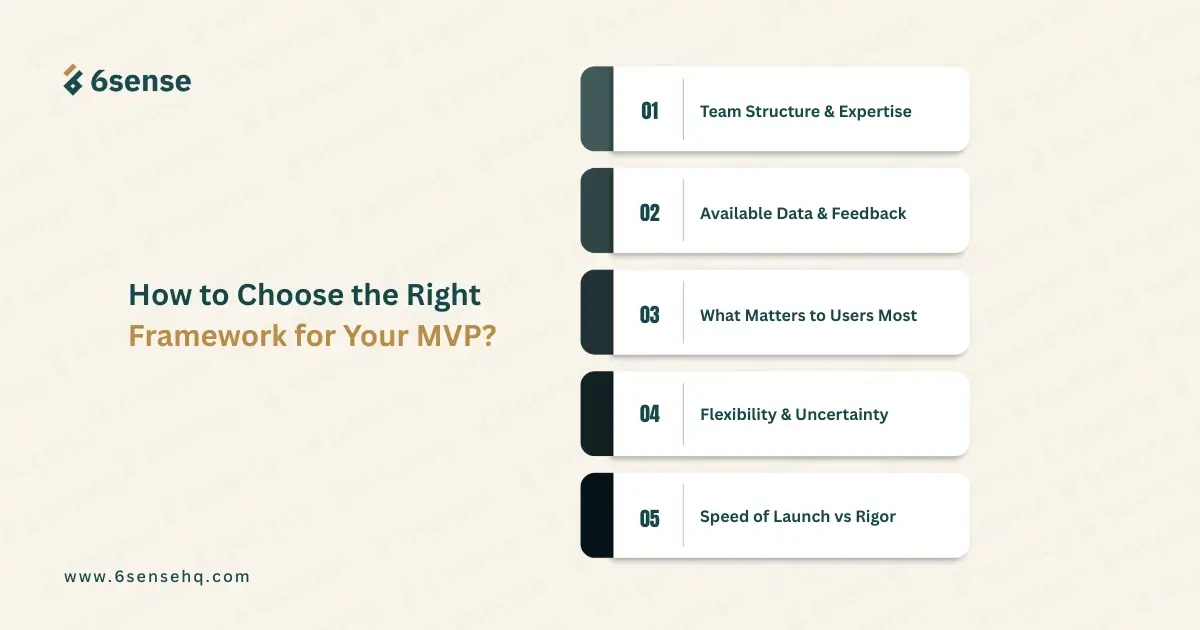
If your team is small or just getting started, pick a simpler model like MoSCoW. It’s easy to understand and doesn’t need lots of data or analysis. Larger teams with product people comfortable with numbers might benefit more from something like RICE.
When you have solid user data or research, frameworks like RICE or Kano help you make more accurate, evidence‑based decisions. If you lack real user insights, stick to simple qualitative models that keep your MVP lean and avoid overthinking.
If delighting users and satisfaction are top priorities, the Kano Model helps uncover features that excite customers versus those they simply expect. It’s great when user experience differentiates your product.
When you’re unsure about specific features and need flexibility, MoSCoW gives room to adjust “should‑have” or “could‑have” items later. It avoids rigid ranking that can block quick iteration.
For fast time‑to‑market, choose lightweight frameworks that don’t require deep analysis. For products with more runway and detailed research, frameworks like RICE provide rigorous scoring to inform future roadmaps.
When evaluating features for your MVP, consider the following:
Each framework suits different situations, and here's when to use them:
In complex projects, you can use MoSCoW for initial prioritization and then RICE or Kano for detailed decision-making.
When Data is Incomplete: If you don’t have enough user feedback or data, MoSCoW is a safe choice to avoid overcomplicating the process.
Airbnb initially launched with just the basic functionality, where users could rent a space, and hosts could list their rooms. They prioritized the core features, which were user-friendly search, booking, and payment. As user feedback came in, additional features were gradually introduced.
Dropbox's MVP was a simple demo video showing how their cloud storage system worked. It wasn’t a fully built product, but it focused on the core user pain point, file synchronization, and validated the demand before investing further resources.
Uber started by providing a simple ride-booking service in San Francisco. It prioritized a seamless experience for riders and drivers, while other features, like fare splitting and tipping, were added later.
Initially, Zappos didn’t build its own inventory system. Instead, they took pictures of shoes from retail stores, posted them online, and bought them from the store when someone ordered them. They validated the e-commerce concept without overbuilding the infrastructure first.
Scope creep is only one of several risks that can weaken an MVP. Reviewing the common mistakes that derail MVP development helps teams recognize weak validation, unclear success metrics, premature scaling, and uncontrolled feature growth before they affect delivery.
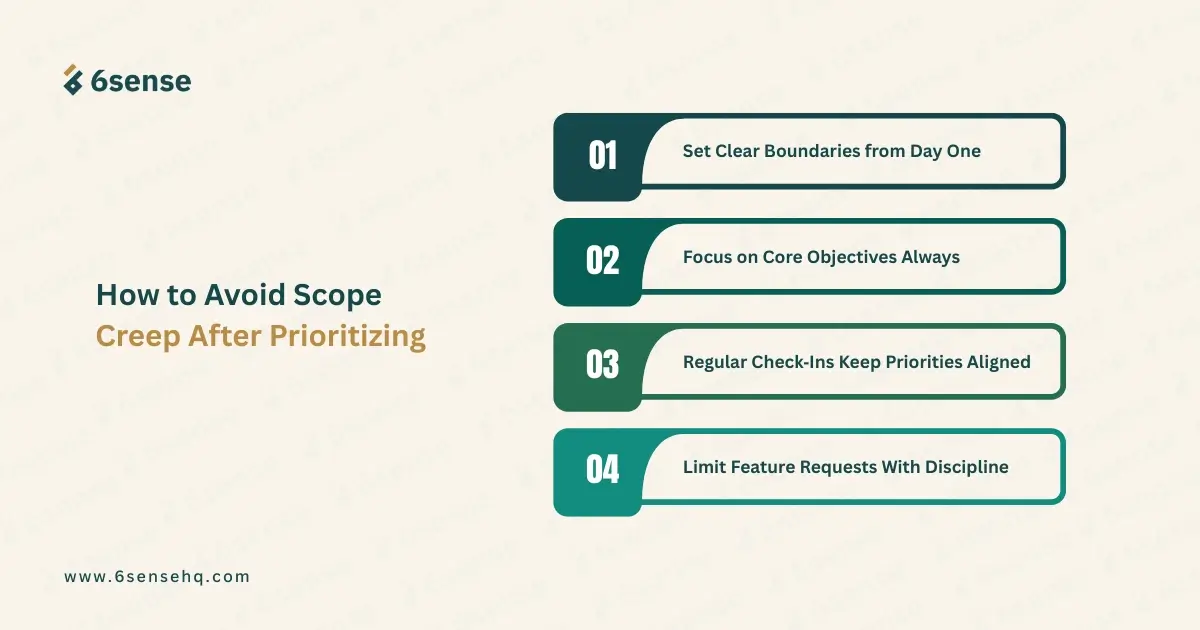
Defining exactly what belongs in your MVP, and what does not, is the strongest protection against scope creep. Before development starts, create a fixed “Must-Have” feature list approved by both the founder and product manager. Anything outside that list automatically becomes future roadmap material instead of active sprint work.
A practical approach is:
Without clear boundaries, founders often add features emotionally instead of strategically, which expands timelines and weakens validation.
Scope creep usually begins when teams lose sight of the MVP’s actual purpose. Every feature should answer one question:
“Does this help validate the core hypothesis?”
If the answer is unclear, the feature likely does not belong in version one.
For example:
A useful tactical rule is:
This keeps prioritization tied to validation instead of ambition.
Holding regular sprint reviews makes it easier to detect when development drifts beyond the approved MVP scope.
At 6sense HQ, we run a Friday demo every sprint where founders review what was built and evaluate the backlog for the following week. Any new feature request must map directly to the original Must-Have list before entering the next sprint.
If it doesn’t map clearly, it moves into the “Could Have” bucket and gets reviewed again during the midpoint roadmap review. This process prevents emotional feature additions from silently expanding the product scope while still allowing founders to capture future ideas.
A consistent review rhythm keeps:
Instead of turning the MVP into an endless feature collection.
Stakeholders almost always request “small” additions that appear harmless individually but become dangerous collectively. Scope creep is rarely caused by one large feature; it usually comes from dozens of minor additions accumulating over time.
To avoid this:
A helpful PM practice is maintaining a visible “Not Now” list. This reassures founders and stakeholders that ideas are not forgotten, only postponed until the MVP validates successfully.
The discipline to say “not yet” is often what allows startups to launch quickly enough to learn from real users.
MVP feature prioritization is a crucial step in ensuring the success of your product. By selecting only the most important features to solve the core problems, you can deliver value faster, avoid overbuilding, and respond to real-world user needs. Avoid scope creep and focus on delivering a product that resonates with your target audience.
A practical MVP development checklist from planning to launch can help your team confirm that critical validation, scoping, testing, analytics, and release tasks remain aligned with the priorities established here.
Get expert guidance from 6sense HQ and accelerate your MVP development. Visit 6sense HQ today.
Compare 6sense HQ and DevToDollars on MVP speed, team models, proof, pricing, and post-launch support to pick the right fit.
15 min read

Compare 6sense HQ alternatives for MVP development in 2026 and find the best software team for your startup budget and goals.
17 min read

| Product managers in data-driven companies |
| UX designers and teams looking to enhance customer satisfaction |
| Feature | Reach | Impact | Confidence | Effort | RICE Score |
| Automated report generation | 500 users/month | 3 (high) | 80% | 2 weeks | 600 |
| Dark mode | 500 users/month | 1 (low) | 50% | 1 week | 250 |
Calculation
Feature A — Automated report generation
(500×3×0.8)÷2=600(500 \times 3 \times 0.8) \div 2 = 600(500×3×0.8)÷2=600
Feature B — Dark mode
(500×1×0.5)÷1=250(500 \times 1 \times 0.5) \div 1 = 250(500×1×0.5)÷1=250
Even though both features reach the same number of users, automated reporting creates significantly more impact and stronger confidence relative to effort.
Build Feature A first.
This example demonstrates why RICE helps teams avoid prioritizing visually attractive but low-impact features. Instead of relying on intuition, founders compare features using measurable tradeoffs.
The Kano Model focuses on customer satisfaction instead of effort or implementation speed. It categorizes features into three main groups:
For example:
The Kano model is especially useful for products where user experience and retention matter heavily. Instead of simply asking users what they want, Kano helps teams understand emotional reactions to features.
Run Kano surveys through Typeform or Google Forms using the two-question format below.
For each proposed feature, ask users two questions:
Use this 5-point scale:
The combination of responses determines whether the feature is Basic, Performance, or Delighter.
| If Feature Exists | If Feature Does Not Exist | Kano Category |
| Love it | Dislike it | Performance |
| Expect it | Dislike it | Basic |
| Love it | Neutral | Delighter |
| Neutral | Neutral | Indifferent |
| Feature | Kano Result |
| Password reset | Basic |
| Faster loading speed | Performance |
| AI-generated summaries | Delighter |
Learn whether one developer can build an MVP in 2026 with cost, scope, AI tools, low-code tips, risks, and launch advice.
22 min read