


6sense HQ vs DevToDollars: Best MVP Partner in 2026
Compare 6sense HQ and DevToDollars on MVP speed, team models, proof, pricing, and post-launch support to pick the right fit.
15 min read
Loading…
See MVP feature cost breakdowns, timelines, scope risks, and budget tips to plan smarter and avoid overspending early in 2026.
Written by: AKM Ahsan Created on: 15 May 202610 min to read
Most founders do not overspend because they build an MVP. They overspend because they build too many features too early, without knowing which ones actually move the product forward.
An MVP feature cost breakdown shows how much each core feature may cost, why some features take longer, and which parts of the product increase the budget. It helps you plan smarter before developers start writing code.
6sense HQ helps early-stage founders build and scale products with a dedicated PM-led engineering team onboarding in under 7 days, fixed price agreed upfront, and a working demo every Friday, covering MVP development, web apps, mobile apps, AI agents, and IoT. Their team has delivered 80+ projects and worked with 50+ companies worldwide.
This blog will guide you through feature costs, cost drivers, scope control, hidden factors, and practical checks before building your MVP.
A minimum viable product feature cost breakdown is a clear list of product features with estimated cost, time, complexity, and business value. Instead of asking, “How much will my MVP cost?” you ask, “How much will login, dashboard, payment, admin, search, and notifications cost?”
This matters because founders often hear very different numbers. Some discussions show people building lean MVPs for a few thousand dollars, while others mention $20,000 to $200,000+, depending on the product and software development team.
A realistic breakdown helps you see what is essential, what can wait, and what might quietly increase the budget. It turns a confusing total price into smaller, easier decisions.
Cost ranges based on 6sense HQ scoping data from 200+ MVP builds (2023–2026) at Eastern European team rates of $50-$80/hour. Costs will be higher with US/UK teams and lower with Asian teams.
| MVP Feature | What It Usually Includes | Simple Cost Range | Typical Build Time | Why It Costs More | Can You Reduce MVP Cost? |
| User Login & Signup | Email login, password reset, basic account setup | $1,000–$5,000 | 1–2 weeks | Social login, 2FA, roles, security rules | Use Auth0 or Clerk instead of custom auth |
| User Profile | Profile page, edit details, image upload | $1,000–$4,000 | 1 week | Privacy settings, verification, rich media | Keep fields simple and use Cloudinary for image handling |
| Dashboard | User view, main metrics, quick actions | $2,000–$8,000 |
These ranges help founders move from feature-level estimates to a more realistic product-level budget. Public 2026 MVP cost guides also show that basic MVPs can start around $15K–$30K, while AI-enabled, fintech, healthcare, marketplace, and compliance-heavy products can move toward $120K-$250K+, depending on scope, integrations, security, and team location.
| Product Vertical | Typical MVP Scope | Estimated MVP Cost | Typical Build Time |
| Simple SaaS | Login, dashboard, subscription, admin | $30K–$55K | 6–8 weeks |
| Marketplace / Two-Sided Platform | Buyers, sellers, payments, escrow, reviews | $70K–$140K | 10–16 weeks |
| Fintech / Payments | KYC, transactions, compliance, reporting | $80K–$180K | 12–20 weeks |
| Health / Telehealth | Appointments, records, HIPAA, video | $90K–$200K | 14–20 weeks |
| AI-Native Product | LLM integration, RAG pipeline, embeddings | $80K–$200K+ | 10–18 weeks |
These numbers are not fixed price quotes. They are planning ranges. A simple SaaS MVP usually stays lower because the workflows are predictable. Marketplace, fintech, healthcare, and AI-native products cost more because they need more roles, permissions, integrations, security checks, edge-case handling, and QA.
For example, recent healthcare and telehealth cost guides place telemedicine platforms anywhere from around $50K to $200K+, while AI and RAG-based products can rise sharply when data quality, retrieval accuracy, and production infrastructure become part of the scope.
Many typical MVP budgets increase because the first estimate only covers “building,” not everything around the building. These five reasons are where founders usually get surprised during real projects.
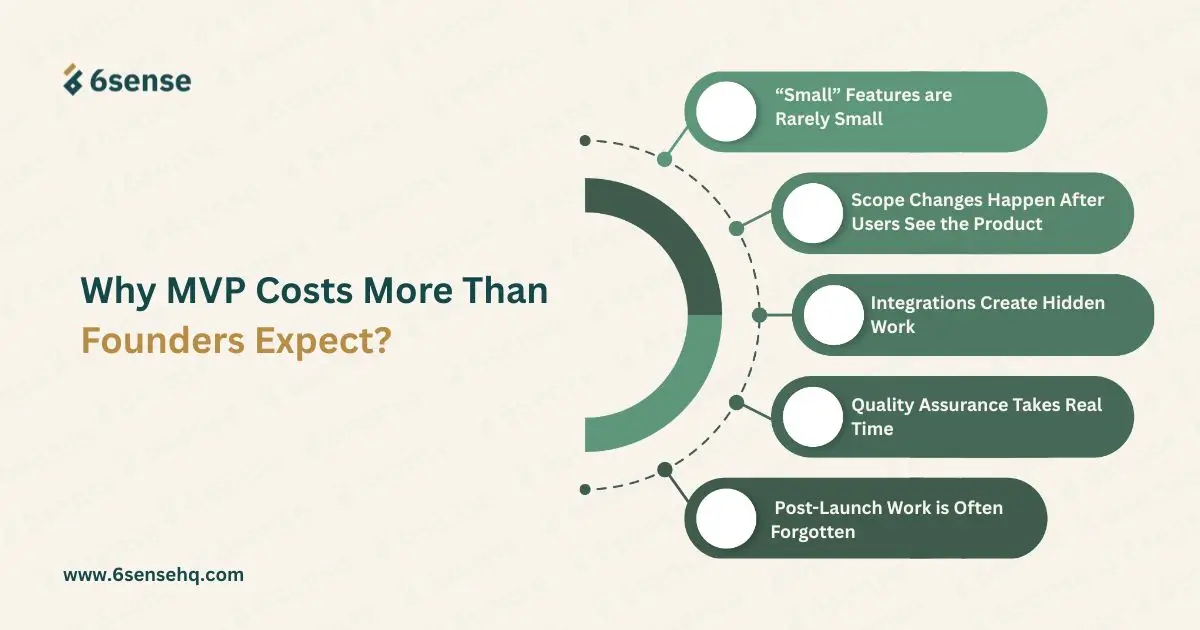
A feature may look simple on the screen, but it needs design, frontend work, backend logic, database changes, testing, and bug fixing. For example, “add payment” can mean checkout, failed payment handling, invoices, refunds, subscriptions, tax rules, and admin controls. That is why the feature cost grows faster than expected.
Founders often understand the product better only after seeing the first working version. Then they ask for cleaner flows, extra fields, new buttons, better filters, or a different dashboard. These changes are normal, but they add hours. If the original scope is not tight, the MVP budget becomes hard to control.
Third-party APIs can save money, but they are not free to connect. Developers still need to read documentation, map data, handle errors, manage failed requests, test edge cases, and secure the connection. Payment, CRM, SMS, maps, and AI APIs can all increase cost when the workflow is more complex than expected.
Testing is not just clicking through the app once. A good MVP needs functional testing, device testing, browser testing, user flow testing, payment testing, security checks, and bug fixes. Skipping QA may save money at first, but it often creates more expensive problems after launch.
The MVP cost does not end when the product goes live. You still need hosting, monitoring, bug fixes, user feedback review, small improvements, and support. Some sources estimate maintenance, bug fixes, hosting, analytics, and product improvements as ongoing post-launch cost items.
Reddit founder discussions often mention the same MVP problem: scope creep starts when a feature sounds simple, but the real product flow keeps expanding. Payment is a perfect example. Stripe’s own docs show that payments can involve checkout sessions, failed payment handling, webhooks, retries, invoice events, refunds, and subscription status changes, not just one button.
One founder came to 6sense HQ with “add payment” as a single scope line. At first, it looked like a $3,000 feature. After our scoping process, it became: Stripe checkout, failed payment retry logic, invoice generation, refund handling, and an admin reconciliation view. The scoped version was $9,500.
We caught this before development started. The founder adjusted the feature list, kept the original budget, and avoided mid-build cost shock. That is why feature names are not enough. Every MVP estimate needs feature behavior, edge cases, and admin needs to be clearly defined upfront.
| Cost Driver | Low-Cost Version | High-Cost Version | Why It Matters | Founder Tip |
| Feature Scope | 3–5 core features | 10+ features with edge cases | More features mean more design, code, and testing | Cut every feature that does not prove the main idea |
| Product Type | Simple SaaS or internal tool | Marketplace, fintech, AI, healthcare | Complex products need security, roles, workflows, and compliance | Match budget to business risk |
| Platform | Web app only | Web + iOS + Android | More platforms mean more UI, testing, and maintenance | Launch where users are most active |
| Design Depth | Basic clean UI | Custom brand system, animations, complex UX |
Scope and cost stay connected because every feature creates work across the whole product. A new feature is not just one screen. It may need user permissions, database changes, API logic, UI states, error messages, analytics, testing, and admin controls.
That is why a tight MVP scope keeps costs under control. If your goal is to test demand, you do not need every future feature. You need the smallest working version that proves the main user problem.
Many founder discussions show the same pattern: people start with a simple idea, then add “just one more thing” until the MVP becomes a full product. The best way to avoid this is to define must-have, should-have, and later features before product development starts.
An MVP feature cost breakdown helps founders stop guessing and start planning. Instead of treating the MVP as one high price, you break it into features, effort, risk, and priority. That makes it easier to see what should be built now, what can wait, and what may increase the budget later.
The smartest MVP is not the cheapest one. It is the one that proves the idea with the least waste. Start with the core user problem, keep the scope tight, choose practical technology, and leave room for feedback after launch.
Get expert guide from 6sense HQ to plan your MVP features, estimate cost clearly, and build with a structured startup-ready team.
Compare 6sense HQ and DevToDollars on MVP speed, team models, proof, pricing, and post-launch support to pick the right fit.
15 min read

Compare 6sense HQ alternatives for MVP development in 2026 and find the best software team for your startup budget and goals.
17 min read
| 2–4 weeks |
| Custom charts, filters, live data |
| Start with basic views using Metabase, Chart.js, or simple admin dashboards |
| Search & Filters | Keyword search, category filters, sorting | $2,000–$7,000 | 1–3 weeks | Advanced ranking, location, AI search | Use Algolia before building custom search logic |
| Payment Feature | Checkout, subscriptions, invoices, payment status | $3,000–$12,000 | 2–4 weeks | Refunds, taxes, wallets, split payments | Use Stripe; it can reduce 60–70% of custom payment build effort |
| Messaging | User-to-user chat or support messages | $4,000–$15,000 | 3–6 weeks | Real-time chat, attachments, moderation | Use Stream Chat or Sendbird; free/small-app tiers can reduce early build cost |
| Notifications | Email, SMS, push, in-app alerts | $2,000–$8,000 | 1–3 weeks | Custom rules, multi-channel alerts | Use OneSignal for push and SendGrid for email instead of custom notification logic |
| Admin Panel | Manage users, content, orders, reports | $3,000–$12,000 | 2–5 weeks | Permissions, audit logs, complex workflows | Use Retool or Forest Admin; this can save 40–60% of custom admin build effort |
| API Integrations | Payments, CRM, maps, analytics, email tools | $1,500–$10,000 | 1–4 weeks | Poor documentation, custom data sync | Choose mature APIs and use Zapier, Make, or n8n for simple workflow automation |
| Analytics | Event tracking, user behavior, reports | $1,000–$5,000 | 1–2 weeks | Custom dashboards,data pipelines | Use Mixpanel or Amplitude free tiers before building custom analytics |
| AI Feature | Chatbot, recommendation, classification, automation | $8,000–$40,000+ | 4–10+ weeks | Model tuning, data quality, testing | Use OpenAI or Anthropic API before training or hosting custom models |
| Mobile App Feature | iOS/Android screens, device behavior, app store setup | $10,000–$60,000+ | 6–12+ weeks | Native builds, offline mode, testing | Use React Native or Flutter to avoid separate native builds at MVP stage |
| Start polished but simple |
| Backend Logic | Basic CRUD and database | Matching, scoring, automation, permissions | Backend complexity is often invisible but expensive | Document rules before development |
| Third-Party APIs | One or two proven tools | Many APIs with custom sync | Integrations add testing, errors, and future maintenance | Use only must-have integrations |
| Security Needs | Basic app security | 2FA, audit logs, encryption, compliance | Security-heavy products need more planning and QA | Do not cut security for fintech or health |
| Team Model | Dedicated remote team or small pod | Full in-house team in high-cost market | Rates and structure heavily affect total cost | Choose the team model by stage |
| Timeline | Flexible phased launch | Rush build with fixed deadline | Faster timelines may need more people | Speed costs money if scope stays large |
| Post-Launch Plan | Light bug fixes | Ongoing product, support, scaling | Real MVP learning happens after launch | Keep 15–25% budget for after launch |
Learn whether one developer can build an MVP in 2026 with cost, scope, AI tools, low-code tips, risks, and launch advice.
22 min read