

6sense HQ vs DevToDollars: Best MVP Partner in 2026
Compare 6sense HQ and DevToDollars on MVP speed, team models, proof, pricing, and post-launch support to pick the right fit.
15 min read
Loading…
Learn how to build a 2026 MVP roadmap, prioritize core features, and use Agile strategies to launch fast while reducing startup risk.
Written by: AKM Ahsan Created on: 11 Mar 202611 min to read
Building a startup product is exciting, but jumping straight into a full product can be risky. That’s why many founders start with an MVP. It allows startups to test their ideas quickly and learn whether people actually need the product before investing heavily.
An MVP development roadmap is the step-by-step plan startups follow to turn an idea into a working product. It usually begins with identifying the problem, selecting essential features, building a simple version, and collecting feedback from early users to improve the product.
In this blog, we’ll explore why startups build MVPs first, key strategies for creating an MVP product roadmap, how to choose the right features, and real examples of successful MVP journeys.
Launching a complete product without testing the idea can be expensive and risky. Many founders build features for months only to realize users don’t actually need them. An MVP helps avoid that mistake by focusing on learning first.
The Lean Startup methodology, popularized by entrepreneur Eric Ries, encourages startups to release a simple version of a product and learn from real user behavior. Ries defines an MVP as
This approach helps founders test assumptions early instead of spending months building features that may not matter to users.
There is also strong research supporting this strategy. A study by CB Insights analyzing more than 100 startup failure post-mortems found that 42% of startups fail because they build products with no real market need.
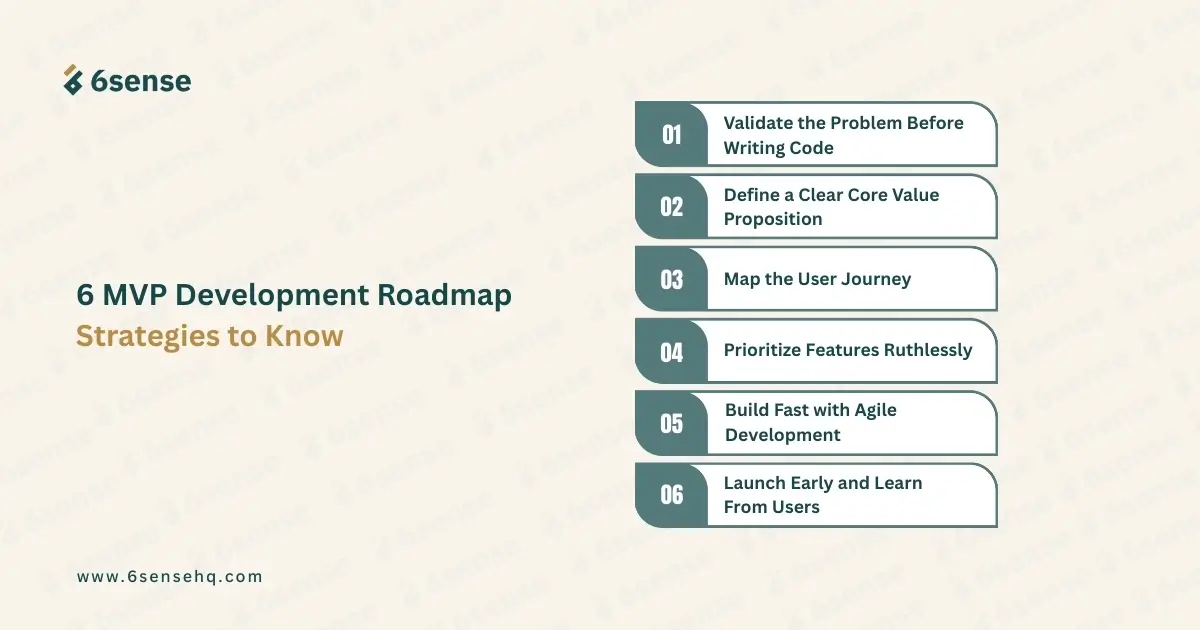
Here’s a quick overview of how most startups plan and build their MVP roadmap. The process follows the Lean Startup “Build-Measure-Learn” approach, where teams release a simple product, collect feedback, and improve it step by step.
Confirm that the problem exists by talking to potential users and understanding their real challenges.
Clearly explain what value your product provides and why users should care.
Outline how users will interact with the product from the first step to the final outcome.
Select only the core features needed to deliver the main value of the product.
Develop the MVP in small iterations so teams can test and improve quickly.
Release the product to early users and analyze their behavior and feedback.
Building a Minimum Viable Product is not just about coding a quick product. It is a structured MVP development process that helps startups validate ideas, prioritize features, and learn from users quickly. The following strategies explain how founders usually approach building an MVP roadmap for startups.
The first step is making sure the problem actually exists. Many founders begin with structured user research for an MVP to understand potential users, their current behavior, and the challenges they repeatedly face.
Before scheduling interviews, prepare customer discovery questions that test your MVP assumptions instead of pitching the solution too early. Some roadmap frameworks recommend conducting 15-20 interviews to confirm recurring pain points before development begins.
Every MVP must focus on one core outcome. Instead of trying to solve many problems, successful startups choose one main value they want users to experience. Reddit founders often emphasize clarity over completeness; one strong feature is better than ten average ones.
When users instantly understand the value of your product, they are more likely to try it and provide feedback.
These user flows are a crucial part of the product roadmap for MVP development. They become more useful when they are based on well-defined user personas for the MVP, because each flow can reflect a specific user’s goals, needs, and obstacles. This helps teams understand how users move through the product and where improvements might be needed.
One of the biggest mistakes in MVP roadmap steps is adding too many features. Reviewing frequent MVP development mistakes and how to prevent them can help teams identify scope creep, weak validation, and premature scaling before they delay the launch. Founders usually use prioritization frameworks such as Must-Have vs Nice-to-Have to decide what should be built first.
Most startups follow Agile practices when building an MVP. Instead of long development cycles, the work is divided into small sprints so teams can release updates quickly.
This approach allows teams to test new ideas faster and refine the startup MVP roadmap framework as they learn more about user needs.
The real purpose of an MVP is learning. Once the product is released, founders observe how users interact with it. Feedback, usage data, and engagement metrics help identify what works and what needs improvement.
This iterative MVP process helps startups evolve their product toward product-market fit.
Many product managers follow structured frameworks when planning MVP development. One common approach comes from Lean Startup methodology, which emphasizes rapid experimentation and learning.
Entrepreneur Eric Ries explains that an MVP should allow teams to learn quickly from real users rather than trying to build a perfect product first. He defines an MVP as:
This concept forms the Build-Measure-Learn cycle, where startups release early versions, measure user behavior, and improve the product through continuous iterations. Many product managers also structure MVP work using Agile sprint planning. Instead of building everything at once, development teams divide work into short 1-2 week sprints, releasing small updates regularly to validate assumptions and improve the roadmap.
Startup founders and product teams often rely on a simple roadmap structure when building their MVP. Teams that need a more repeatable approach can follow a practical framework and methodology for MVP development to connect validation, prioritization, delivery, and iteration.
Typical MVP roadmap phases include:
These roadmap frameworks help founders focus on learning rather than building unnecessary features.
Adding measurable results improves credibility and transparency when discussing MVP strategies. Below is a simplified example based on real MVP development case studies.
| Startup | MVP Goal | Timeline | Result |
| Breaking Mars | LinkedIn outreach automation | ~3 months | Scalable outreach automation platform |
| Impromek | Mentor–student connection platform | ~3 months | Functional learning platform launched |
| Jawhargy | Digital gold marketplace | ~4 months | Mobile app enabling gold trading |
These examples show how early MVP releases allow startups to validate their product ideas quickly and improve the platform based on real user feedback.
Research also supports this approach. As we discussed earlier, 42% of startups fail because they build products that the market does not actually need.
This is why experienced founders focus on validating problems first before investing heavily in development. By launching an MVP early, startups can test their assumptions, gather real feedback, and adapt their roadmap based on actual user behavior.
Choosing the right features is one of the most important parts of an MVP roadmap. Founders who are learning how to create an MVP roadmap often begin by focusing only on features that prove the core value of the product.
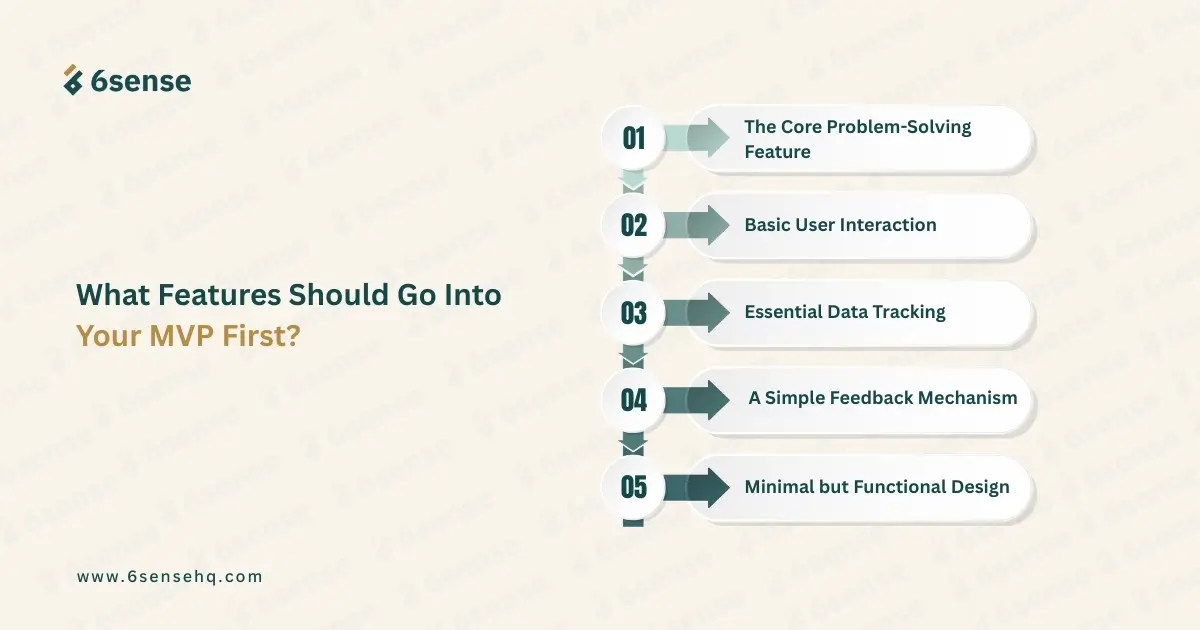
Let’s find out what you actually need:
Every MVP must include the feature that directly solves the main user problem. Reddit founders often suggest focusing only on the single action that represents the product’s core value.
If that feature works well, users will understand the product immediately.
Even a simple MVP needs a basic way for users to interact with the product. This may include account creation, input forms, or simple dashboards. These elements allow users to experience the product without unnecessary complexity.
The focus should remain on usability rather than advanced design.
Tracking user behavior is critical for learning. Startups often include basic analytics to understand how users interact with the MVP. These insights help identify where users drop off and which features they actually use.
Data helps founders make smarter product decisions.
An MVP should make it easy for users to share feedback. Some founders add feedback forms or short surveys directly inside the product. Others collect insights through email or community discussions.
User feedback is the foundation for improving the next version.
Design in an MVP does not need to be perfect, but it should still be usable and clear. According to startup discussions, users are usually willing to overlook design limitations if the product solves a real problem.
Clarity and simplicity matter more than visual polish.
An MVP roadmap usually follows a simple timeline. Most startups move through validation, design, development, and launch phases before improving the product based on feedback. A detailed breakdown of MVP development phases and the expected delivery timeline can help founders estimate dependencies and set more realistic milestones. In many cases, an MVP takes around 2-6 months to build, depending on complexity and team size.
| Stage | Timeframe |
| Problem validation | 1–2 weeks |
| User research | 1–2 weeks |
| Prototype | ~1 week |
| Development | 6–10 weeks |
| Launch + feedback | Ongoing |
This roadmap keeps the team focused on testing the idea quickly instead of building everything at once.
A good MVP roadmap includes clear deliverables so everyone understands what needs to be created during the process. A step-by-step checklist for planning an MVP can also help the team confirm that important validation, design, development, analytics, and launch tasks have not been missed.
Typical deliverables include:
These deliverables help founders move from idea to launch with a clear plan.
Choosing the right features is one of the most important parts of MVP planning. Many teams use frameworks like MoSCoW (Must-Have, Should-Have, Could-Have, Won’t-Have) to decide which features to build first. Teams evaluating several scoring models can compare MoSCoW, RICE, and Kano for MVP feature prioritization before selecting the method that best fits their product stage and available evidence.
Example feature prioritization:
| Feature | Priority |
| Core workflow | Must-have |
| User account | Must-have |
| Advanced analytics | Later |
| Custom integrations | Later |
By focusing only on must-have features, startups can launch faster and test the core value of the product.
An MVP roadmap should always end with measurable outcomes. After launch, teams track metrics to understand whether the product solves a real problem.
Important MVP metrics include:
These metrics help founders decide what improvements should come next.
Many successful and experienced MVP development agencies began with very simple MVPs. Instead of launching a fully developed product, they started small, tested ideas quickly, and improved based on real user feedback.
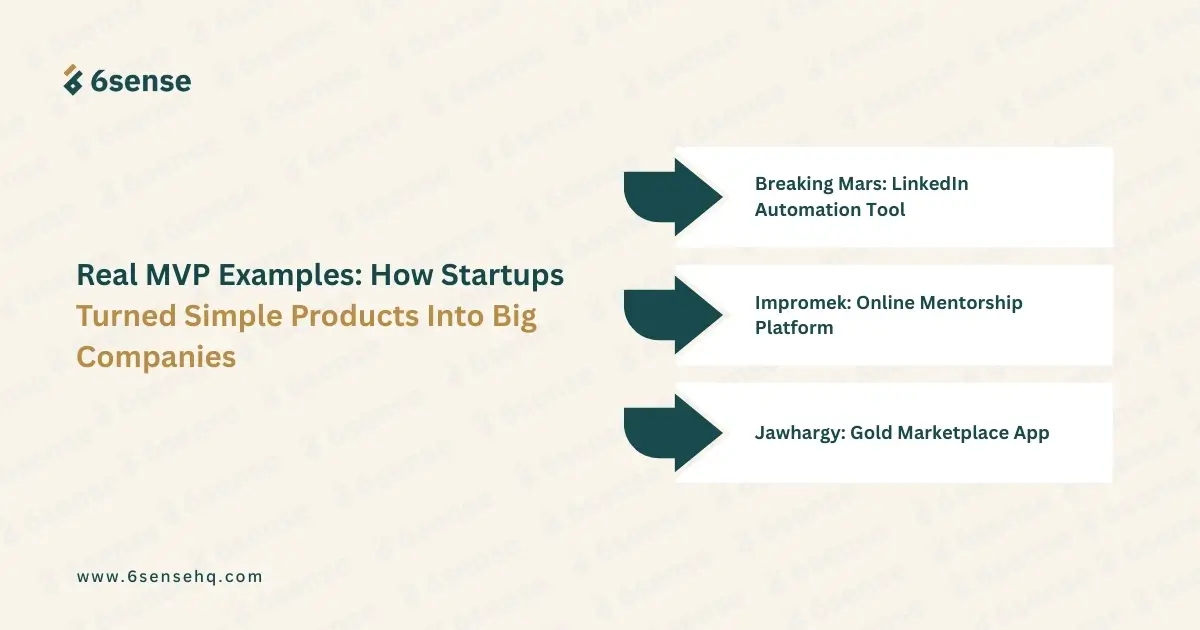
In the Breaking Mars case study, the product started as a simple internal MVP designed to automate LinkedIn lead generation, messaging, and follow-ups. The first version had minimal UI and focused only on campaign automation and account connections. By starting small, the team was able to test how users interacted with the tool and gradually improve the product. This MVP approach allowed the platform to evolve into a scalable automation solution used for managing outreach and campaigns efficiently.
In the Impromek case study, a solo founder struggled to launch his idea without technical support. 6sense helped build an MVP that allowed mentors and students to connect through a simple platform with clear user roles and video messaging features. Once the MVP was launched, the founder was finally able to bring real users onto the platform and begin operations smoothly. This early version validated the idea and reduced months of development uncertainty.
In the Jawhargy Gold Marketplace App case study, the team built an MVP for buying and selling gold with real-time MVP development cost updates and local payment integration.
Despite challenges like changing gold prices and third-party coordination, the MVP was delivered on time and allowed users to trade gold easily through the app. The simple first version helped validate the concept and provided a functional product within the client’s budget.
Building a product without testing the idea can be one of the biggest mistakes a startup makes. An MVP development roadmap helps founders move step by step, from validating a problem to launching a simple product and improving it through user feedback.
Instead of building everything at once, start small, learn from real users, and improve the product over time. This approach reduces risk and increases the chances of building something people actually want.
Talk to the 6sense HQ expert team today and explore how we build scalable MVP solutions.
Compare 6sense HQ and DevToDollars on MVP speed, team models, proof, pricing, and post-launch support to pick the right fit.
15 min read
Compare 6sense HQ alternatives for MVP development in 2026 and find the best software team for your startup budget and goals.
17 min read
Learn whether one developer can build an MVP in 2026 with cost, scope, AI tools, low-code tips, risks, and launch advice.
22 min read