

6sense HQ vs DevToDollars: Best MVP Partner in 2026
Compare 6sense HQ and DevToDollars on MVP speed, team models, proof, pricing, and post-launch support to pick the right fit.
15 min read
Loading…
Learn to build, launch, and scale a startup MVP. This guide covers step-by-step development, core features, and expert insights.
Written by: AKM Ahsan Created on: 10 Mar 20268 min to read
Great products rarely start perfect. They start small, focused, and built to learn quickly. That’s exactly what the MVP development process is about. An MVP, or Minimum Viable Product, is the simplest version of a product that solves one clear problem for users.
Instead of building a full product right away, startups build a smaller version first. They launch it, test it with real users, collect feedback, and improve it step by step. This MVP product development process helps teams understand what people actually need before investing more time and money.
In this blog, we will explore why startups build MVPs, how the MVP development process from idea to launch works step by step, real-world examples, and what happens after launch. Let’s dive in!
Many founders believe they must build a complete product before launching. But experienced startups with MVP non- tech founders or tech founders often say the opposite: launch something small first and learn from real users.
In startup communities, founders frequently say the common MVP development mistake is building too many features before knowing whether people actually want the product. One founder explained that when they removed extra features and focused on a single core function, users finally understood the product and started using it more.
There is also a strong business reason for this approach. According to a CB Insights analysis of startup failure post-mortems, about 42% of startups fail because they build products that the market does not need.
An MVP helps avoid this risk. It allows startups to test ideas early, gather real feedback, and improve the product before investing heavily in full product development.
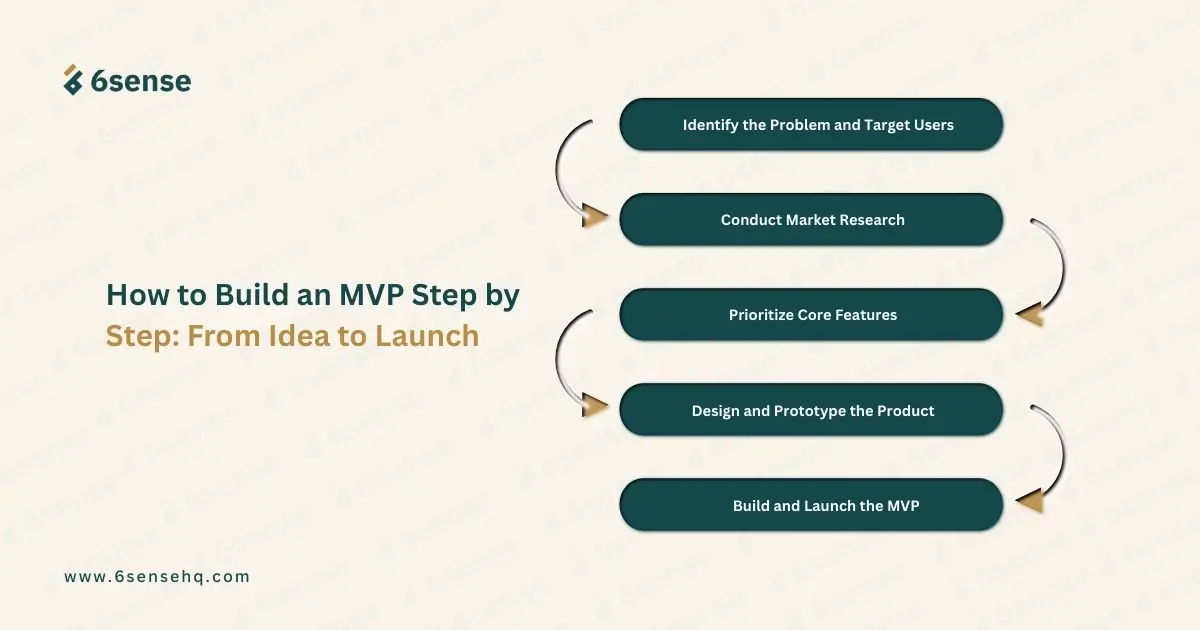
If you want a simple overview, here’s how most startups build an MVP from idea to launch.
1. Define the problem and target user Identify the real problem your product solves and who your ideal users are.
2. Do basic market research Study competitors and understand user needs before building anything.
3. Prioritize core features Select only the essential features that solve the main problem.
4. Create a prototype Build simple wireframes or clickable prototypes to visualize the product.
5. Build and launch the MVP Develop a basic working product with minimal features.
6. Collect feedback and analytics Observe how real users interact with the product and gather feedback.
7. Improve and scale the product Use data and user insights to iterate and add new features gradually.
For a more detailed version of these steps, see our full MVP development checklist.
Building an MVP is not about rushing development. It is about following a simple MVP build process for startups, which helps validate an idea, test it with users, and improve it step by step.
Let’s find out MVP development process steps:
Every successful MVP starts with a clear problem. Instead of trying to build something for everyone, defining user personas for MVP helps startups stay focused on a specific audience, instead of building for everyone and one main pain point. Founders usually conduct user research for MVP validation, talking to potential users, studying their behavior, and identifying a real problem worth solving.
This step helps confirm whether the idea actually has demand before any development begins.
After defining the problem, the next step is validating it with market research. Teams can also follow a structured MVP development framework to systematically move from research through to launch by analyzing competitors, industry trends, and existing solutions and hire MVP development agency. Also, they may run surveys or interview potential users to understand their needs better.
Market research helps determine whether people are willing to use or pay for the solution and whether the idea has real potential.
Feature prioritization sits at one of the most critical MVP development phases; getting it wrong here delays the entire build. Instead of adding many features, product teams focus only on the core functionality that solves the main problem. It also helps reduce MVP development cost and time.
Well, the goal is to create something simple but useful enough for early users to test.
Before coding begins, teams usually create wireframes or prototypes. This helps visualize how the product will work and how users will interact with it. Designers focus on simple and intuitive user experiences.
A basic prototype also helps gather early feedback from users and stakeholders before investing heavily in development.
Before the build starts, having a clear MVP development roadmap helps teams stay on track with timelines, sprints, and priorities. Once the design is ready, developers build the product using agile development methods. The focus remains on speed and simplicity rather than perfection. After testing for major bugs, the MVP is launched to a small group of users.
This early launch allows startups to collect feedback and measure how users actually interact with the product. The Lean Startup methodology emphasizes this approach. Entrepreneur Eric Ries defines an MVP as :
This early launch allows startups to collect feedback and measure how users actually interact with the product.
Choosing the right features is one of the most important decisions in MVP development. Many founders struggle here because they want to include everything. But successful MVPs stay simple and focused.
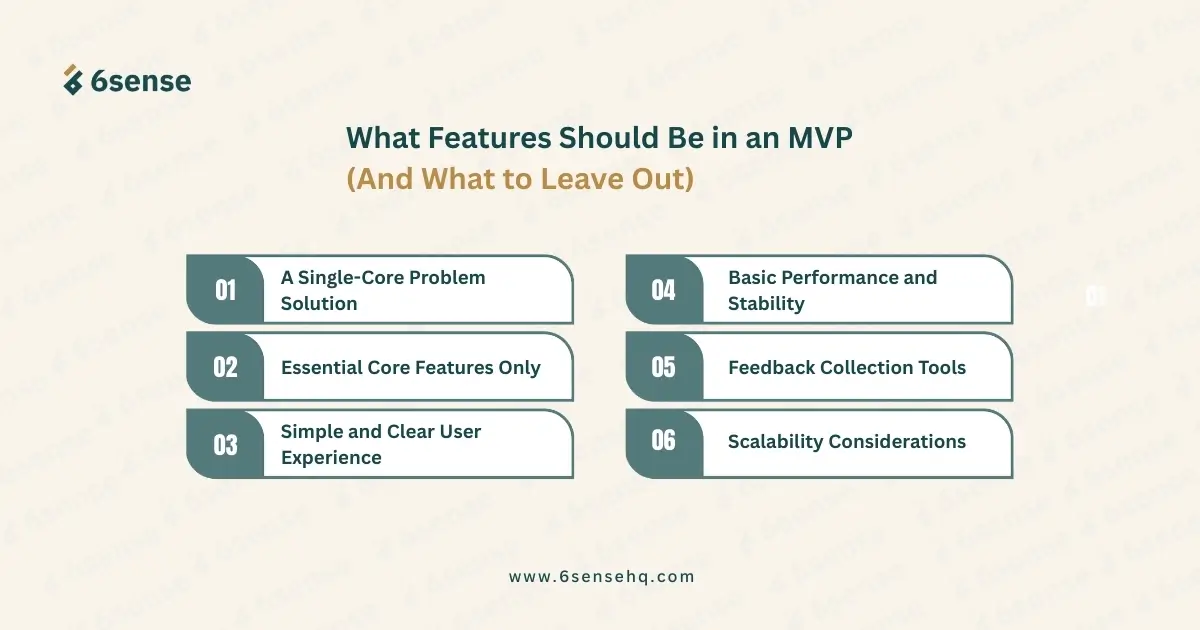
An MVP should focus on solving one clear problem. Many experienced founders recommend identifying the most painful user problem and building only the functionality required to solve it.
When products try to solve too many problems at once, users become confused, and the product loses its main value.
A good MVP includes only the features required to deliver the main value. This means removing anything that is not absolutely necessary for the product to work. Founders often call this “feature trimming.”
By doing this, teams can launch faster and understand which features users actually care about.
Even if the product has few features, the user experience must still be clear and easy to use. Users should immediately understand what the product does and how it helps them. If users struggle to understand the product, they are unlikely to continue using it.
While MVPs are simple, they still need to work reliably. If a product crashes often or loads slowly, users will stop using it before providing useful feedback. Basic stability, performance, and security are essential even in early product versions.
One of the main purposes of an MVP is learning from users. This means startups must build ways to collect feedback, such as analytics tools, surveys, or user interviews. These insights help teams understand how people use the product and what improvements should come next.
Even though the MVP is simple, developers should think about future growth. Clean code, flexible architecture, and scalable technologies make it easier to add features later. This prevents the team from rebuilding the entire product when the user base starts growing.
Many successful companies started with simple MVPs. These examples from 6sense HQ case studies show how early product validation and rapid development helped businesses launch and grow.
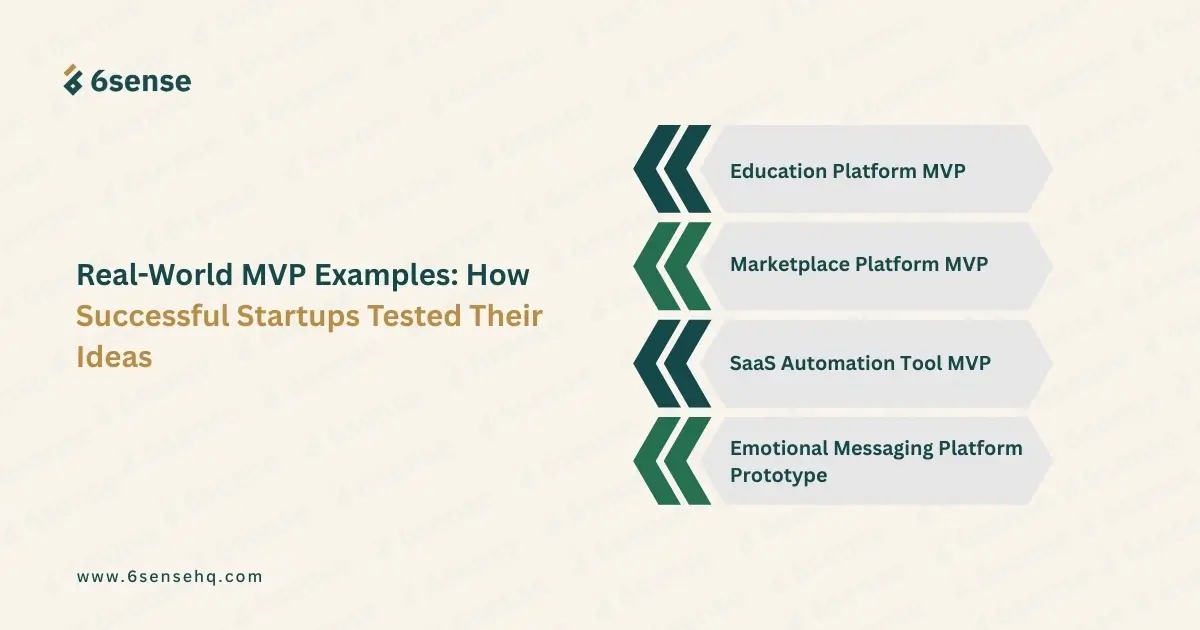
In the Impromek project, a solo founder worked with 6sense HQ to launch a working MVP platform for connecting students and mentors. The product included separate panels for teachers and students and video message responses.
Launching the MVP helped the founder finally bring real users onto the platform and start operations smoothly.
The JAWHARGY marketplace was built as a lean MVP to help users buy and sell gold through a simple mobile app. The client had a limited budget, so the team focused only on essential features and a clean interface.
This MVP allowed the platform to launch quickly while keeping MVP development costs low.
Breaking Mars, a LinkedIn automation tool, originally started as an internal MVP with a minimal user interface. The MVP allowed users to connect accounts, run outreach campaigns, and automate messaging workflows.
Once the core concept worked, the platform continued evolving into a more powerful SaaS product.
The Forget Me Not platform started with a carefully designed prototype and MVP experience. The product allows terminally ill patients to leave future messages and videos for loved ones.
Early testing with real users helped refine the interface and ensure the platform met emotional and usability needs.
Once an MVP launches, the real learning begins. Teams analyze feedback and product usage to decide what to build next.
| Stage | What Happens |
| User Feedback | Collect insights from early users through surveys, interviews, and analytics. |
| Product Analytics | Track user behavior to understand which features are used most. |
| Iteration | Improve the product based on real feedback and usage patterns. |
| Feature Expansion | Gradually add new features once the core concept is validated. |
| Market Validation | Confirm whether the product solves a real problem for a specific audience. |
| Scaling | Prepare infrastructure, team, and strategy for larger user growth. |
The MVP development process helps startups build smarter products. Instead of guessing what users want, teams launch a small version first, gather feedback, and improve the product step by step.
This approach reduces risk, saves development costs, and increases the chances of building something people truly need. Many successful startups started with simple MVPs before growing into full platforms. If you are planning to launch a new product, start small, stay focused on the core problem, and learn from your users.
Talk to the 6sense HQ expert team and launch your MVP faster.
Compare 6sense HQ and DevToDollars on MVP speed, team models, proof, pricing, and post-launch support to pick the right fit.
15 min read
Compare 6sense HQ alternatives for MVP development in 2026 and find the best software team for your startup budget and goals.
17 min read
Learn whether one developer can build an MVP in 2026 with cost, scope, AI tools, low-code tips, risks, and launch advice.
22 min read