


6sense HQ vs DevToDollars: Best MVP Partner in 2026
Compare 6sense HQ and DevToDollars on MVP speed, team models, proof, pricing, and post-launch support to pick the right fit.
15 min read
Loading…
Learn the MVP roadmap: from discovery to launch. Master timelines, avoid feature creep, and build products users actually want.
Written by: AKM Ahsan Created on: 12 Mar 202610 min to read
Every great startup idea begins with a simple question: Will people actually use this? That’s where an MVP, or Minimum Viable Product, comes in. Instead of building a full product immediately, founders launch a smaller version to test their idea quickly.
But building an MVP is not random work. It follows a clear MVP development process and timeline. Teams move through phases like research, design, development, and testing before launching the first version of the product.
In this blog, we’ll explore how long MVP development takes, the key phases involved, how each stage works, and real-world examples that show how successful MVPs are built.
In real startup environments, MVP development timelines vary widely depending on complexity, team size, and market validation. Most founders aim to build fast without sacrificing core quality. Research shows that many MVPs take 8-16 weeks from concept to launch, especially for SaaS products or mobile apps.
A discussion on Reddit’s founder communities highlights that MVP timeline differences usually come down to scope.
Many founders recommend focusing only on essential features. The goal of an MVP is not perfection but validation.
As LinkedIn co-founder Reid Hoffman famously said:
Most startups follow a simple timeline when building an MVP that produces specific deliverables that help teams move from idea to launch. While the exact duration depends on the product’s complexity and team size, many MVPs are built within 8–12 weeks from idea to launch when teams focus only on essential features.
These outputs ensure the product is planned properly before development begins. Below is a typical MVP development timeline used by many startups.
| Phase | Duration | Deliverables |
| Discovery | 1–2 weeks | Market research, user interviews |
| Planning | ~1 week | Product roadmap, prioritized feature list |
| Design | 1–2 weeks | Wireframes, clickable prototype |
| Development | 4–8 weeks | Working MVP with core features |
| Testing | 1–2 weeks | Bug fixes, usability testing |
| Launch | ~1 week | Beta release + analytics setup |
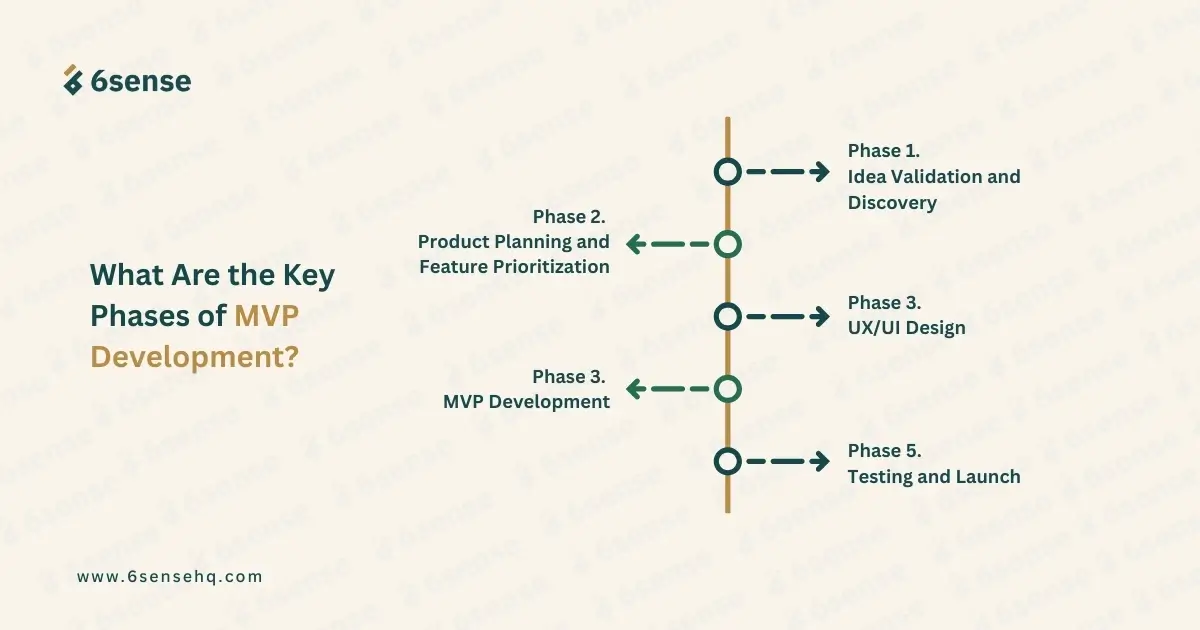
Most MVPs follow a process that helps teams validate ideas quickly while reducing software development risks. A structured MVP development framework and methodology helps connect discovery, planning, design, development, testing, and iteration instead of treating them as isolated tasks. Each phase focuses on learning fast, building smart, and preparing the product for real user feedback.
This phase focuses on understanding the problem and validating the idea before writing any code. Teams begin by conducting focused user research for an MVP, studying existing behavior, unmet needs, and the alternatives people already use.
They can then prepare customer discovery interview questions for MVP validation to explore those problems without leading participants toward a preferred answer. The goal is simple: confirm whether the problem is real and worth solving before investing development time.
This step is critical because many startups fail by skipping it. CB Insights analyzed more than 100 startup failure reports and found that 42% of startups fail because they build products with no real market need.
Once the idea is validated, teams define the core features of the MVP. Only the essential functions that solve the main problem are selected. Product managers often create a feature MVP development roadmap, wireframes, and user flow diagrams to clarify how the product should work.
In this phase, designers create wireframes, prototypes, and interface designs. The goal is to make the product simple and easy to use. A clean design also helps developers understand how the product will function before coding begins.
This is the longest phase of the process. Developers build the core features using the selected tech stack. Instead of creating a full product, the focus stays on the minimum functionality required to test the idea in the real market.
Before releasing the successful MVP, teams test the product to identify bugs, usability issues, and performance problems. After testing, the product is launched to early users so founders can collect feedback and improve the next version.
The development phase is usually the longest part of MVP creation. During this stage, engineers turn the design into a working product.
Typical work includes:
Sprint cycles
Most teams use Agile development with 1–2 week sprints, allowing them to release updates quickly and adjust features based on feedback.
For example, a typical two-week sprint cycle may follow this structure:
These ceremonies are part of the Scrum framework, where work is organized into time-boxed iterations called sprints that usually last up to two weeks.
Frontend development Developers build the user interface using frameworks like React or Flutter so users can interact with the product.
Backend development Engineers build the server logic, database structure, authentication systems, and business logic.
API integration Products often integrate services such as payment systems, email tools, or third-party APIs.
Cloud setup Infrastructure is usually deployed on cloud platforms like AWS or Google Cloud to handle hosting and scalability.
This phase typically lasts 4–12 weeks depending on complexity.
Many startups delay their MVP launch because they make common planning mistakes. Reviewing the common mistakes that derail MVP development can help teams recognize scope creep, weak validation, delayed testing, and perfectionism before they extend the timeline.
Some of the common MVP development mistakes include:
Each stage of MVP development serves a different purpose. From validating ideas to releasing the first version, these steps help teams move quickly while keeping development focused on real user problems.
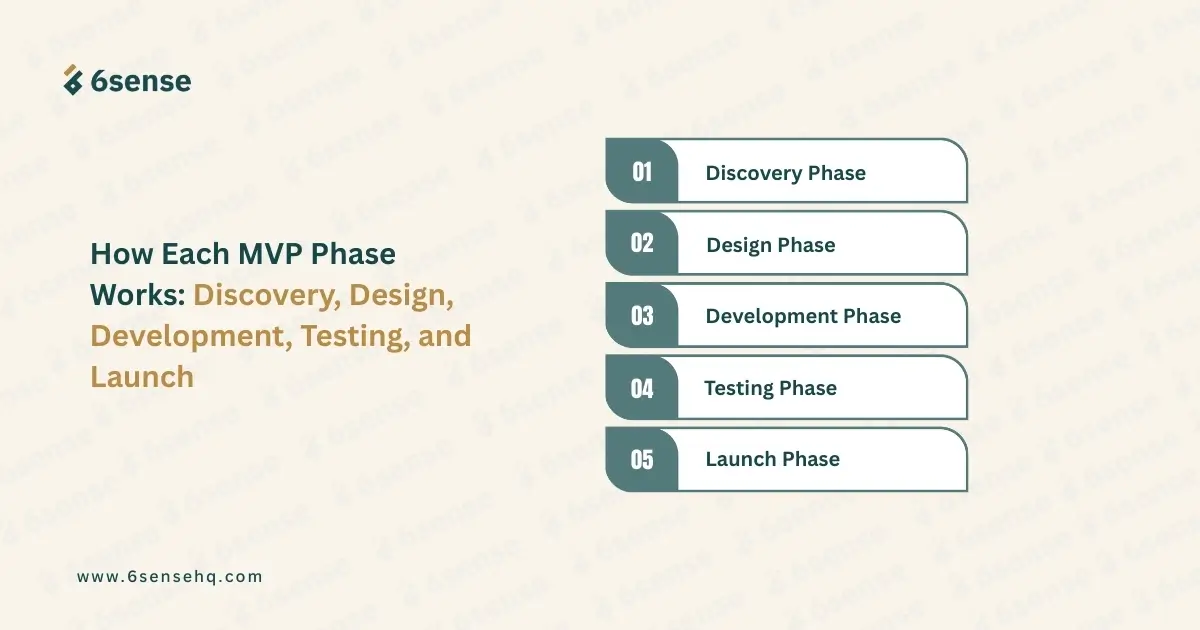
These stages are often referred to as the MVP development stages, which include discovery, design, development, testing, and launch.
The discovery phase focuses on research and idea validation. Teams analyze competitors, interview potential users, and define the product vision. Turning those findings into evidence-based user personas for the MVP helps the team align product decisions with specific user goals, behaviors, and pain points. The goal is to confirm that the problem is real and that a simple solution could attract early users.
Design transforms ideas into visible product concepts. Designers create wireframes and clickable prototypes to demonstrate how users will interact with the product. This stage also helps identify usability issues before development begins.
During development, engineers build the core product features. Teams typically follow agile workflows and short development cycles to release functionality quickly. This phase focuses only on essential features needed for the first version.
Testing ensures the product works smoothly before launch. QA teams check performance, security, and usability. Founders often run beta tests with a small group of users to collect early feedback and identify improvements.
The launch phase introduces the MVP to real users. Startups release the product to gather feedback, measure user behavior, and validate their assumptions. The results guide the next product iteration.
Many startup teams structure MVP development using Agile sprint planning and Lean Startup principles. Instead of building the entire product at once, work is divided into short 1–2 week sprints, where teams design, build, and test small product increments.
A typical Agile MVP development team is cross-functional and usually includes between 5-9 members to maintain fast communication and collaboration.
A typical MVP development team often includes:
In many Agile teams, roles also align with the Scrum framework structure:
This structure helps startups move quickly while maintaining product quality and accountability during rapid development cycles.
The timeline of an MVP often depends on how complex the product is. Below is a typical breakdown used by many development teams.
| Product Type | Typical Timeline |
| Simple SaaS MVP | 6–8 weeks |
| Marketplace MVP | 8–12 weeks |
| Complex platform MVP | 12–16 weeks |
This timeline allows startups to test their idea quickly while keeping development costs manageable.
Adding real metrics improves transparency and credibility. Below are simplified examples based on real MVP projects.
| Startup | Timeline | Key Phase |
| Jawhargy | ~10 weeks | Development + API integration |
| Charge OnSite | ~12 weeks | Complex platform MVP |
| Munca | ~8 weeks | Research-driven MVP |
These timelines show how startups can launch functional products within a few months by focusing on essential features.
Startup research strongly supports this approach.
CB Insights analyzed startup failure reports and found that 42% of startups fail because they build products that the market does not actually need.
This is why experienced founders validate ideas early before building full products.
Launching a simple MVP helps startups test their assumptions quickly and adjust their roadmap based on real user behavior instead of guesswork.
Product managers often structure MVP planning using simple frameworks:
Many product teams also use prioritization models such as:
Teams choosing between these methods can review a detailed comparison of MoSCoW, RICE, and Kano for MVP feature prioritization. These frameworks help teams avoid feature creep and keep the MVP focused on validating the core business hypothesis rather than building unnecessary functionality.
These frameworks help teams avoid feature creep and keep the MVP focused on validating the core business hypothesis rather than building unnecessary functionality.
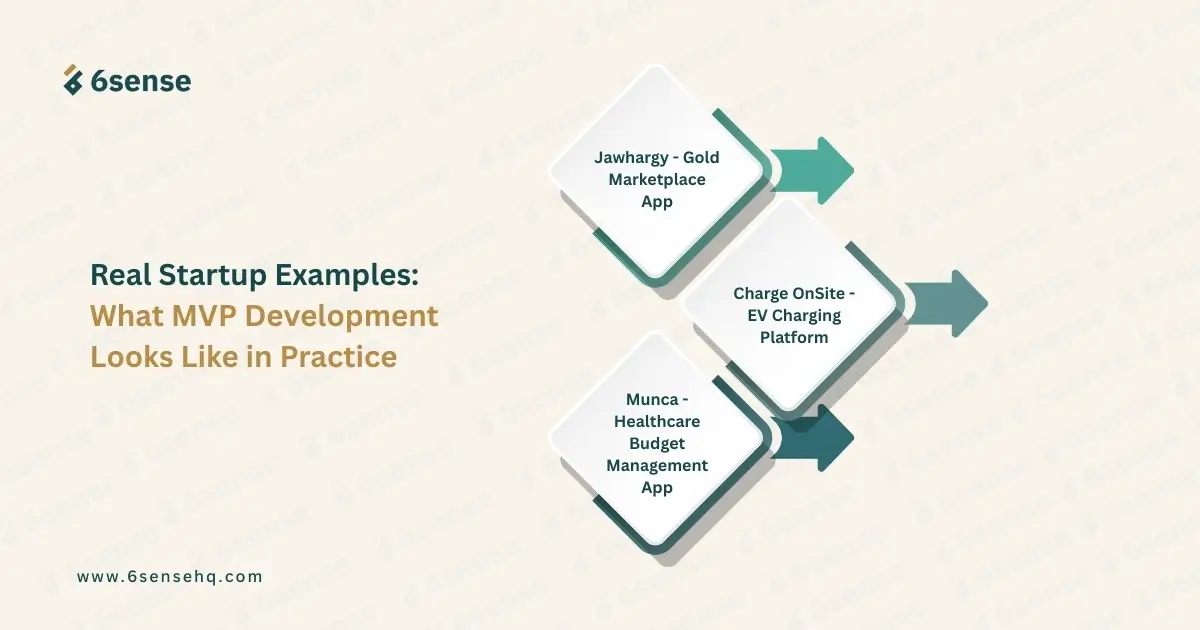
In the Jawhargy case study, the client needed a simple app for buying and selling gold. The team built a lightweight MVP with real-time gold price APIs and a local payment gateway. This allowed the product to launch quickly while staying within a limited budget.
The Charge OnSite case study shows how a complex product can start with a structured development approach. The platform helps EV drivers find chargers, schedule sessions, and handle payments. The system unified chargers from multiple brands and reduced development costs by over 50%.
In the Munca case study, the team interviewed over 50 families to understand how they manage disability funding. They then built a focused platform where users could track expenses, organize invoices, and manage healthcare budgets in one simple app.
Building a successful product rarely starts with a full-featured platform. Instead, most startups begin with an MVP to test their idea, learn from users, and improve the product step by step.
By following structured phases: discovery, planning, design, development, testing, and launch, teams can validate ideas quickly and reduce MVP development costs.
The key is simple: use a practical MVP development checklist from validation to launch, start small, learn fast, and iterate continuously based on real feedback.
Talk with the 6sense HQ expert team and turn your concept into a working product.
Compare 6sense HQ and DevToDollars on MVP speed, team models, proof, pricing, and post-launch support to pick the right fit.
15 min read

Compare 6sense HQ alternatives for MVP development in 2026 and find the best software team for your startup budget and goals.
17 min read
Learn whether one developer can build an MVP in 2026 with cost, scope, AI tools, low-code tips, risks, and launch advice.
22 min read