

6sense HQ vs DevToDollars: Best MVP Partner in 2026
Compare 6sense HQ and DevToDollars on MVP speed, team models, proof, pricing, and post-launch support to pick the right fit.
15 min read
Loading…
Choose between an MVP development partner or agency. Learn key differences, costs, and red flags to build your startup successfully.
Written by: AKM Ahsan Created on: 1 Apr 202610 min to read
Choosing between an MVP development partner and an agency can significantly impact how successfully your startup builds and launches its product. In this guide, you’ll learn the real differences between the two models, how each works in practice, and how to decide which one fits your startup best.
If you’re researching companies to build your minimum viable product, you’ve probably noticed two different labels: development agencies and MVP development partners. While they may sound similar, they often approach software development very differently.
For a startup, choosing the wrong model can lead to wasted time, higher development costs, and a product that fails to validate your idea with real users. This article will help you make that decision with clarity.
Before deciding which option is right for your startup, it’s important to understand what these terms actually mean. Many founders assume that an MVP development partner and an agency offer the same thing. In reality, their roles in the product development process can be very different.
An agency is typically hired to execute a clearly defined project. You provide the requirements, features, and timeline, and the agency focuses on delivering the software development work based on that scope.
Most MVP development agencies follow a structured development process that includes design, coding, testing, and delivery. This model works well when you already know exactly what your prototype or product should include.
An MVP development partner, on the other hand, usually works more closely with your startup during the early stages of building a product. Instead of only executing a predefined scope, a development partner often contributes to discovery, feature prioritization, and strategic decisions throughout the MVP development process.
This approach helps founders validate their ideas earlier and adjust the product through continuous iteration.
| Role | Executes a predefined scope | Helps shape and build the product |
| Discovery Phase | Often limited | Usually built into the process |
| Strategic Input | Low | High |
| Post-Launch Support | Sometimes limited | Often ongoing |
| Best For | Clear project requirements | Evolving startup ideas |
Understanding the definitions is helpful, but what really matters is how each model works during the product development journey of your startup. The day-to-day experience of working with an agency can be very different from working with an MVP development partner.
When you work with a typical development agency, the relationship usually starts after you define your requirements. You outline the features, timeline, and expected outcome of your minimum viable product, and the agency’s job is to deliver that scope.
The development process often follows structured stages like planning, design, prototype development, coding, testing, and launch. Many agencies operate using agile development frameworks and milestone-based contracts.
This model can work well if your startup already has a clear product specification or technical leadership guiding the project. Agencies are often efficient at executing well-defined tasks such as mobile app development or building a feature-complete MVP within a set budget.
However, agencies usually focus on delivering exactly what was requested. If the original scope misses an important assumption or user need, the final product may technically work but fail to validate the idea in the market.
Working with an MVP development partner tends to feel more collaborative. Instead of jumping directly into coding, the process often begins with discovery and product exploration.
In this model, the development partner works alongside your startup to shape the product before it is built. That can include validating assumptions, prioritizing features, and planning the early product development roadmap.
Many partners provide a dedicated development team that stays involved throughout the project, allowing continuous iteration based on testing and user feedback.
Choosing between an MVP development partner and an agency depends on your startup’s situation. The right choice often comes down to a few key factors that influence how your minimum viable product should be built and launched.
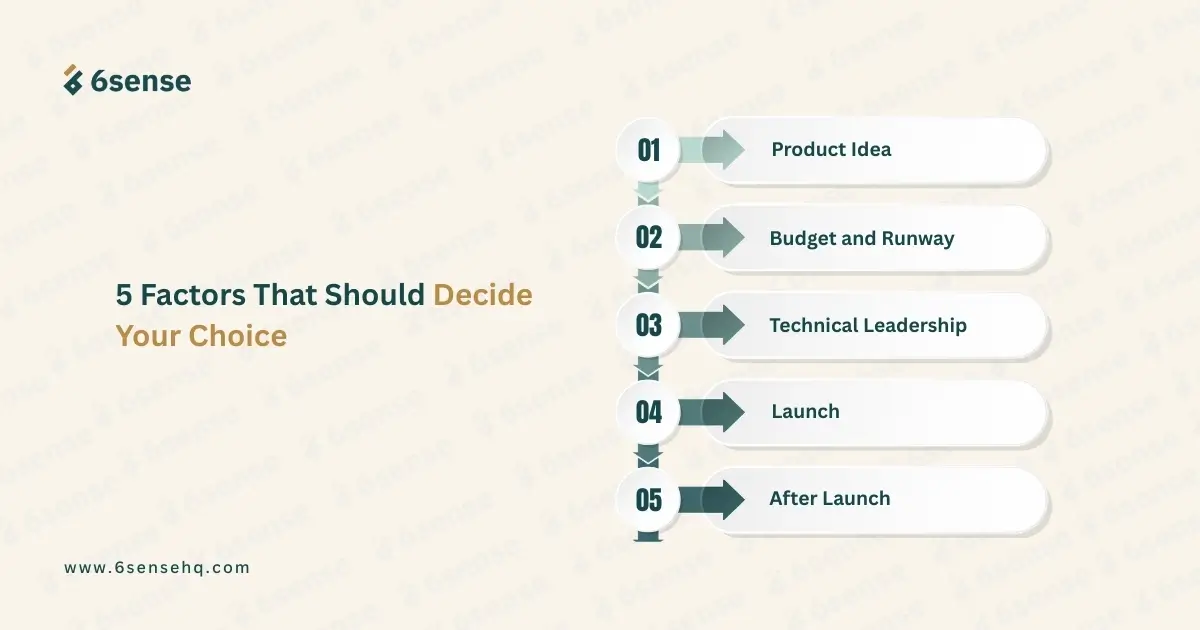
If you already have a well-defined concept, feature list, and prototype, working with MVP development agencies can be efficient. According to CB Insites 43% startups fail due to no market need. Agencies typically excel when the requirements are stable and the development process is straightforward.
However, if your idea is still evolving and you need help to validate assumptions, an MVP development partner can provide guidance through early iteration and product discovery.
Budget plays a big role in deciding the right approach. Agencies often offer defined project scopes with clearer development costs, which can work well if you’re working within a tight budget.
An MVP development partner may require a larger investment because they contribute not only to software development but also to strategy, validation, and ongoing improvement.
If your startup already has a technical co-founder, fractional cto or an experienced engineer overseeing the product development, managing an external agency becomes easier.
But if your team lacks technical leadership, working with a partner who provides development expertise and a dedicated development team can fill that gap. For SaaS products, it is especially important to evaluate SaaS MVP development companies that understand subscriptions, user onboarding, dashboards, integrations, and scalable product architecture.
Speed can also influence your choice. Agencies may move quickly when the scope is clear and the development process is well-defined.
A partner, however, might spend more time upfront refining the idea and validating assumptions. While this can delay the initial build slightly, it often leads to a stronger minimum viable product that reaches mvp to market with fewer costly revisions.
Finally, consider what happens after the MVP goes live. If your goal is a one-time build, agencies may be sufficient.
But if your startup plans ongoing iteration, scaling features, and moving toward full-scale product development, a long-term development partner may provide better continuity and support.
Choosing an MVP development partner or an agency is an important decision for your startup, but not every company that offers software development services will be the right fit. Before shortlisting vendors, founders can compare MVP development companies for startup projects based on portfolio, pricing, startup experience, and post-launch support. Recognizing warning signs early can save you from costly mistakes during the product development journey.
Some MVP development agencies focus primarily on delivering projects quickly, which can sometimes lead to problems if your product needs more strategic thinking.
Watch out for these warning signs:
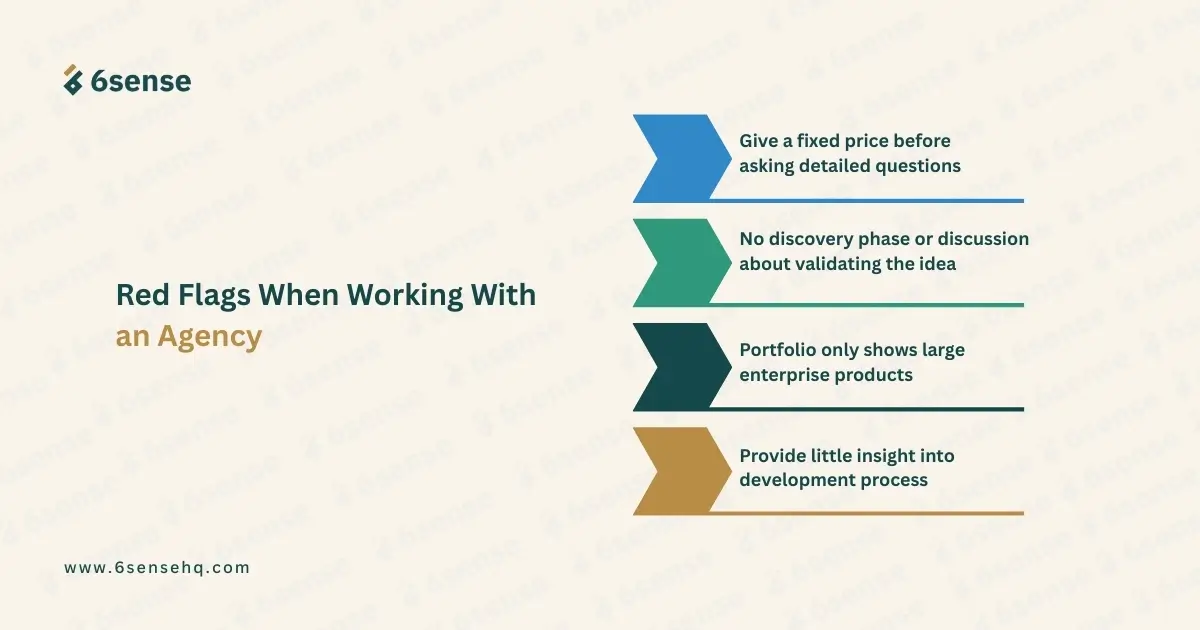
These signals often indicate that the team is focused on execution rather than helping you build the right product.
Even if a company calls itself an MVP development partner, that doesn’t automatically mean they operate like one.
Look out for these potential issues:
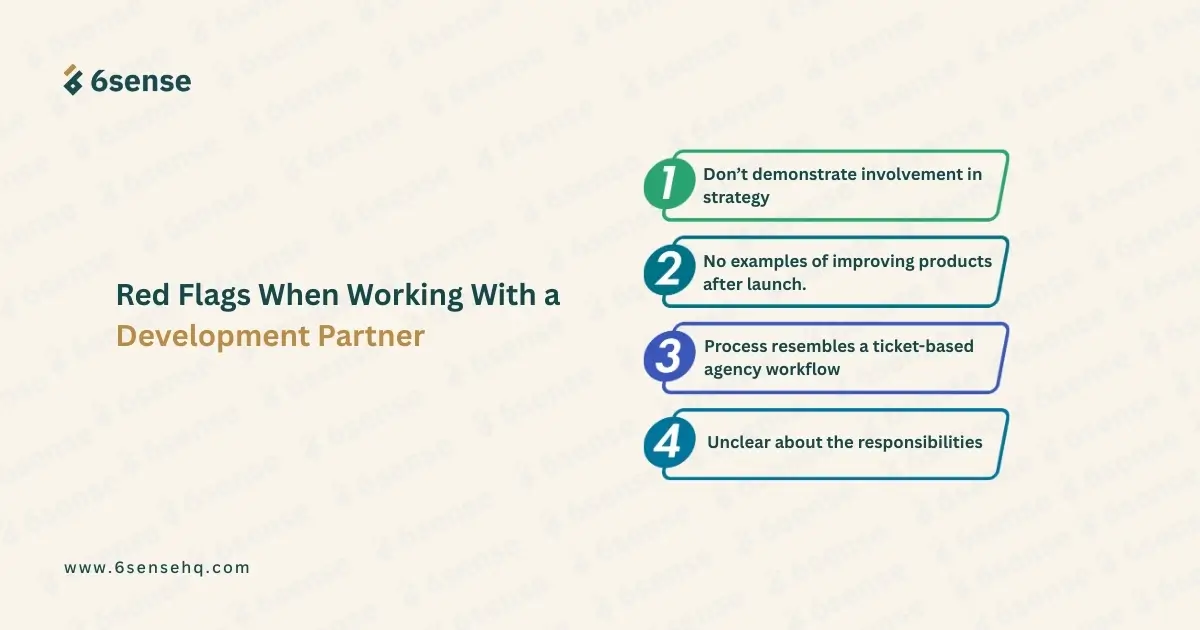
A reliable partner should guide decisions, challenge assumptions, and support the long-term development roadmap of your product.
Selecting the right MVP development partner can significantly influence how successfully your startup builds and launches its MVP. Beyond technical skills, the right partner should help you refine ideas, avoid unnecessary features, and guide the early stages of product development.
Here are some practical tips for choosing a development partner that many founders overlook.
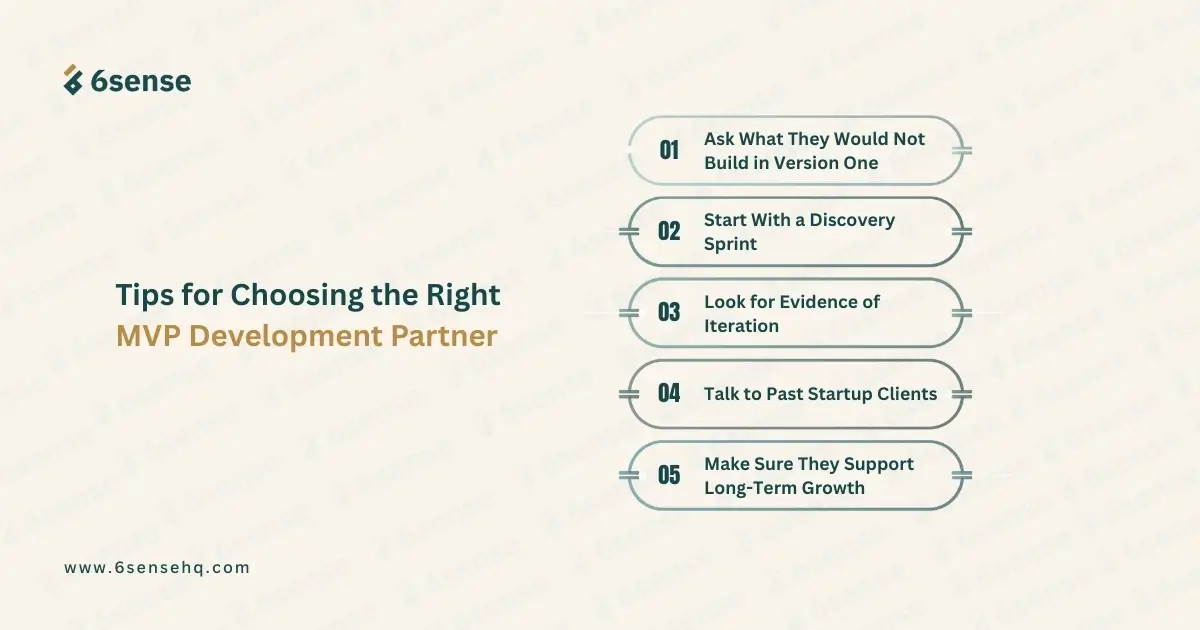
A strong partner doesn’t just agree with everything you suggest. They challenge your assumptions and help narrow the scope to the most important features needed to validate your idea.
If a team agrees to build everything you ask without questioning priorities, they may be acting more like a contractor than a strategic development partner.
Before committing to a full project, consider running a short discovery phase. This helps both sides define the development process, clarify features, and align expectations.
A discovery sprint can reveal whether the team understands your startup’s goals and how they approach building a successful MVP.
Many portfolios highlight polished final products, but that doesn’t always show how the product evolved. The best partners demonstrate how they improved a prototype, refined features through iteration, and supported the product after launch.
Online reviews are helpful, but speaking directly with another founder can provide deeper insight. Ask how the team handled communication, changes in scope, and the overall product development journey.
An MVP is just the starting point. The right partner should help you plan for the next stages of the development roadmap, whether that means expanding features, improving performance, or preparing for full-scale product development.
Choosing between an MVP development partner and an agency depends on your startup’s stage, how clearly your minimum viable product is defined, and the level of strategic support you need during product development. If you are still unsure whether to build internally or hire outside help, this guide on outsourcing MVP development as a founder can help you understand the trade-offs before choosing a partner or agency.
The global market showing a CAGR of 9.5% in a research by Intel Market Research proves founders are leaning more and more towards proper MVP development.
Here is a comparison table to help you with your decision making:
| Decision Factor | Choose an MVP Development Agency | Choose an MVP Development Partner |
| Product clarity | You already have a clear feature list or prototype | Your idea is still evolving and needs validation |
| Technical leadership | Your startup has internal technical guidance | You need external product and technical guidance |
| Development scope | Fixed scope and defined software development requirements | Flexible scope with ongoing iteration |
| Budget structure | Predictable project-based development costs | Ongoing collaboration with strategic input |
| Post-launch support | Limited involvement after launch | Long-term support for scaling and improvements |
| Product growth | One-time build or small update cycle | Continuous product development and scaling |
Choosing between an MVP development partner and an agency ultimately depends on what your startup needs at its current stage. Both can help you build a minimum viable product, but they play different roles in the product development journey.
If you already have a clearly defined scope and only need execution, an agency can deliver the required software development efficiently. However, if your idea is still evolving and you need guidance to shape the product, an MVP development partner can provide strategic input, support iteration, and help refine the product as it grows.
The key is finding a team that understands your goals, communicates clearly, and supports your development roadmap beyond the initial launch.
If you’re planning to build an MVP and want guidance on shaping the right product from the start, consider talking with the team at 6sense HQ.
Compare 6sense HQ and DevToDollars on MVP speed, team models, proof, pricing, and post-launch support to pick the right fit.
15 min read
Compare 6sense HQ alternatives for MVP development in 2026 and find the best software team for your startup budget and goals.
17 min read
Learn whether one developer can build an MVP in 2026 with cost, scope, AI tools, low-code tips, risks, and launch advice.
22 min read