

6sense HQ vs DevToDollars: Best MVP Partner in 2026
Compare 6sense HQ and DevToDollars on MVP speed, team models, proof, pricing, and post-launch support to pick the right fit.
15 min read
Loading…
Learn MVP development: validate ideas, pick core features, build, test, launch, estimate costs, and iterate with real users.
Written by: AKM Ahsan Created on: 2 Mar 202615 min to read
Starting a startup idea is exciting, but it can also be confusing if you don’t know where to begin. One of the smartest approaches early on is building a Minimum Viable Product (MVP), a simplified version of your product that helps you test real demand without incurring significant time or financial costs.
Well, an MVP isn’t a perfectly finished product; it’s your fastest path to learn what users truly want. With an MVP, you can find out what works, what doesn’t, and what people are willing to pay for. This helps you avoid costly mistakes and focus only on what matters most.
In this blog, you will learn why MVP development matters for startups, the key steps in MVP development, how to build, test, and launch your MVP, and more.
Let’s dig in!
MVP in software development is the simplest functional version of a product built with just enough features to solve a core user problem and be usable by early adopters. It lets teams launch quickly, test key assumptions, and gather real user feedback before investing in full-scale development.
So, by focusing on essentials rather than extras, an MVP helps reduce development costs, lower risk, and guide future updates based on real user needs. This approach is a key part of lean and agile development, which helps teams learn fast and build products that users actually want.
MVP development is more than just building a mini product; it’s a way to validate your idea quickly and with less risk. By focusing on the smallest version that still delivers value, you save time and money while learning what users actually need.
In fact, research shows that startups that use an MVP approach can lower development costs by up to 60% compared to traditional software development. This actually helps them stay lean and efficient in the early stages of their startup.
Before building anything, you must be confident that your idea solves a real pain point. Use these practical steps to validate your MVP idea:
Start by defining the specific issue your idea solves, who feels it most, and why it matters enough to fix. A clear problem keeps your MVP focused on real value and prevents you from building unnecessary features that don’t address users’ core needs.
Reach out to 10-20 people who might use your product and ask open-ended questions about their experience with the problem. Avoid pitching your idea, focus on understanding their real frustrations and how they currently deal with them.
Create a basic landing page describing your concept and invite people to sign up or express interest. If enough people click or sign up, it shows real curiosity and demand, not just polite agreement.
Try running low-budget ads to gauge clicks or sign-ups for your idea. A higher conversion rate indicates genuine market interest, helping you decide if your idea is worth building.
Show users a simple mockup (even non-interactive) and collect their feedback. This lets you learn what aspects excite users before investing in development time or costs.
A Minimum Viable Product (MVP) is the simplest version of a product that still solves a real problem, lets you learn from real users, and helps validate your idea before heavy development. Let’s see the types of MVPs and learn how they work:
A Single‑Feature MVP strips your product down to literally one important feature that directly addresses your main hypothesis about user need. By focusing only on what matters, you reduce complexity and get feedback faster on whether your core idea resonates.
Why it works: It forces clarity on what users care about most and avoids wasted investment on secondary or “nice‑to‑have” features.
Pro Tip: MVP isn’t a rushed half‑built product; it’s the simplest product that still delivers real value and lets you interact with customers.
This type of MVP is all about testing demand before you build the product at all. You create a simple page that outlines your value proposition, describes your offering, and captures interest through emails, sign‑ups, or pre‑orders.
What it tests: whether people care enough about your idea to take an action (like subscribing or expressing interest). Because it’s low-cost and fast to launch, you can iterate quickly.
Pro tip: Combine it with small ad campaigns or social posts to see if you can drive traffic and convert visitors, giving early quantitative signals of demand.
With this approach, users think they’re interacting with a fully functional automated product but behind the scenes, much of the work is done manually by humans. This lets you simulate functionality without investing in full engineering up front.
Why use it: It’s ideal when your concept is complex or the workflow is hard to build, but you want to see how customers behave with the full user experience “illusion.”
Common insight: Though manual work happens behind the scenes, this method uncovers real user needs and behaviors before you write a line of code.
A Concierge MVP takes the “manual backend” idea even further; it delivers the entire service manually and transparently rather than faking automation. Your team personally helps each user accomplish what the future product would automate.
Why this is powerful: It builds deep insight into user problems because you experience their journey up close. It’s one of the best ways to refine your product logic before investment in tech.
Founders’ wisdom: The MVP’s purpose is learning, and Concierge MVPs accelerate that learning by directly involving you in the customer outcome.
Not a working product yet, but an engaging representation of how your product would work, often in the form of a short demo, animation, or walkthrough. This is meant to test interest and understanding early.
Where it shines: Complex products with features that are hard to describe in text or static images benefit from being shown in action, boosting interest and feedback.
Expectation: A good explainer communicates value quickly and can be shared across channels to assess interest before any development costs.
With this approach, you don’t just test interest; you test willingness to pay. By offering pre‑orders or crowdfunding campaigns before the product exists, you validate demand and sometimes even raise funds to build it.
What you learn: Whether your idea is not just interesting, but worth paying for, one of the strongest early signals you can get. Successful pre‑sales help de‑risk your project and can inform pricing, positioning, and roadmap decisions.
MVP development follows a structured path that helps turn an idea into a functional, MVP-tested product. Each stage focuses on understanding users, building smartly, and learning from real feedback before scaling.
Start by understanding the problem you want your product to solve and who will use it. This means studying similar products, talking to potential users, and confirming there’s a real need worth solving. Good research reduces risk and prevents building something nobody needs.
Once the idea is validated, decide what matters most, the must‑have features that actually solve the core problem. Ignore nice‑to‑have bells and whistles at this point. This helps you keep the MVP small, fast to build, and focused.
Next, visualize your MVP before building it. Create simple sketches, wireframes, or mockups of screens and user flows. This helps you plan how users will interact and refine your product’s design before coding begins.
Now build the basic working version that includes only the core features you defined. Developers focus on giving users enough functionality to test the idea. Agile methods help teams deliver quickly and adapt as needed.
Once the MVP is ready, let real users interact with it. Track how they use it, where they struggle, and what they like. This stage is all about observing actual behavior and listening to user feedback to guide improvements.
After gathering feedback, refine the product by fixing issues, adjusting features, or adding new ones that matter most to users. This iterative loop of build, measure, learn continues until your product fits the market well.
Building an MVP helps startups test ideas early, learn from real users, and reduce wasted time and money. It’s a smart way to quickly validate your product before full development.
An MVP lets you test whether your product idea actually solves a real problem for users before you build everything. By releasing a minimal version, you learn fast if people engage or pay for it, helping you decide whether to refine or pivot without big investments.
Instead of spending months or years building features no one wants, MVP development limits your work to core functionality. This lean approach drastically lowers upfront costs, reduces wasted development effort, and lets you allocate your budget more wisely based on real feedback.
With an MVP in the hands of real users, you collect honest feedback on what works and what doesn’t. Early adopters help identify needed improvements, so your full product roadmap is shaped by evidence, not guesses. This feedback loop strengthens product‑market fit.
MVP development accelerates your time to market by focusing only on essential features. Instead of waiting to launch a perfect product, you start engaging users sooner. Early presence in the market helps you build awareness and begin traction earlier than competitors.
Startups are risky and big product launches can fail if no one wants what you built. An MVP lets you learn early whether your assumptions are true. By finding issues or a lack of interest up front, you can iterate or change direction without losing huge amounts of resources.
Releasing an MVP helps you connect with early adopters who are willing to try new solutions and offer feedback. These early relationships can turn into loyal users, advocates, or even brand ambassadors who help you refine and improve the product for mainstream launch.
Before building your MVP, follow these essential steps to make sure your efforts lead to real learning and measurable results:
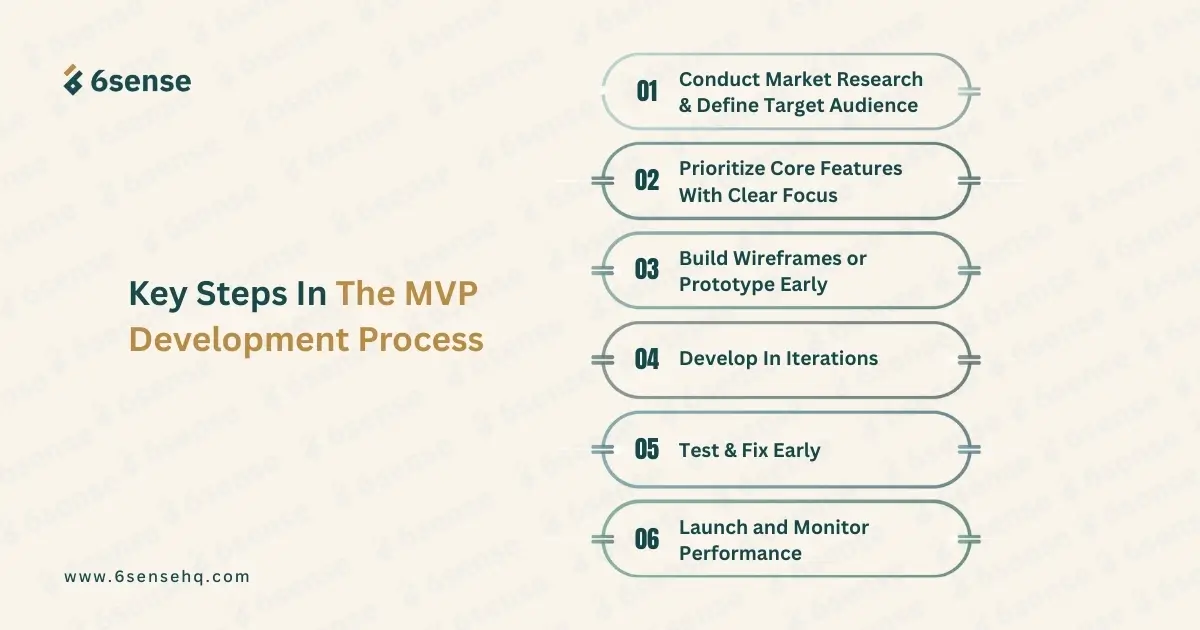
Start by researching the market to understand if your idea truly solves a problem people care about. Identify who your product is for, what alternatives they use, and how big the need is.
Well, knowing your target audience deeply helps you shape features, messaging, and testing goals so your MVP doesn’t miss the mark and gets real user interest from the beginning.
Once your idea is validated, decide on the one core feature that delivers the most value. Use frameworks like MoSCoW to separate must-have vs. nice-to-have elements. Prioritizing keeps your MVP development process lean and prevents unnecessary development work.
Remember, too many features slow progress and cloud feedback. Start small to ensure you test the real value users care about first.
Before coding, create simple wireframes or a clickable prototype showing how your MVP works. Tools like Figma or Adobe XD let you draft the user flow and layout so early feedback reveals confusion points or better ideas before you invest in development.
This saves time and ensures your MVP starts with a user-centered design.
Use agile sprints to build your MVP in short cycles, delivering working pieces fast. Each cycle includes building, MVP testing, and reviewing what works. This approach spots issues early, lets you improve quickly, and keeps the project flexible.
Iterative development ensures your MVP evolves based on evidence rather than guesswork.
Once your MVP is built, test it with real users to find bugs and problems in usability. Invite testers and track how they interact, what blocks them, or where they drop off. Fixing key issues before launch improves the experience and increases meaningful user feedback after release.
After testing internally, launch your MVP to your initial user group or public audience. Track metrics like engagement, retention, and conversion to see how well your new product meets real use cases.
Use analytics tools to measure user behavior and decide what to improve next. This data guides your next decisions and builds a roadmap for iteration.
When planning your MVP, focus on features that prove value and skip extras that do not help with testing. Include what matters most, and leave the rest for later versions:
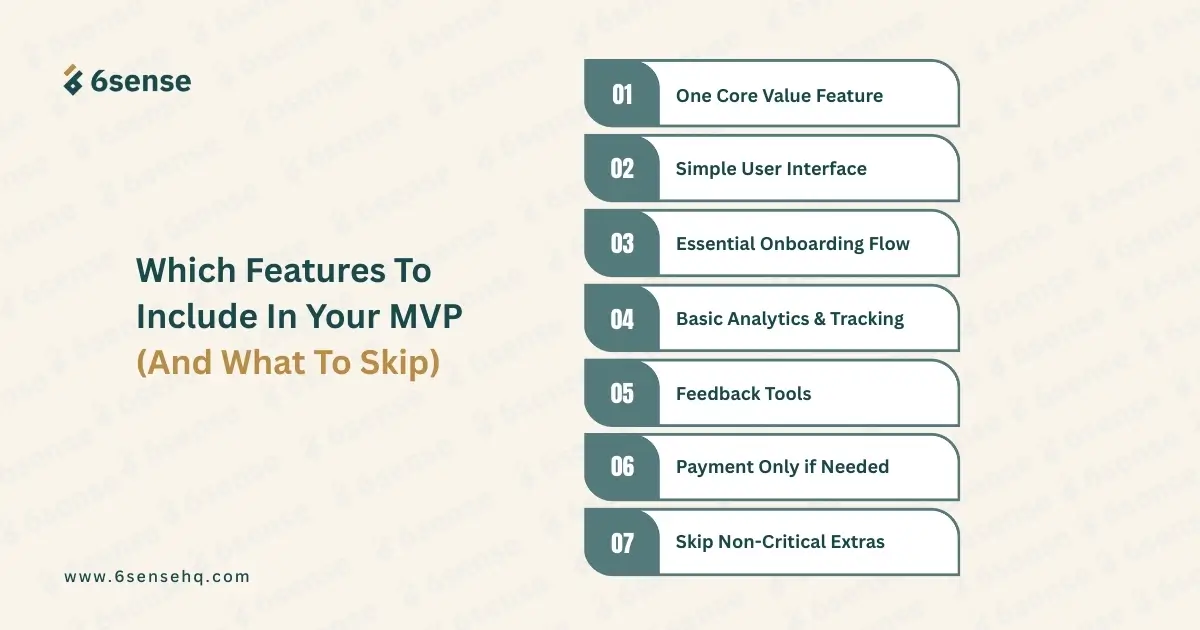
Your MVP should solve the main problem clearly with just one valuable feature. Don’t add extra functions or side options yet; they slow product development and make feedback harder to interpret.
Eric Ries, author of The Lean Startup, says to “remove any feature, process, or effort that does not contribute directly to the learning you seek.”
Keep the UI clean and easy to navigate. Avoid fancy visuals or complex layouts. Users don’t need a perfect design; they need clarity and an intuitive way to complete the core action in your MVP. A simple interface helps users focus on the main value and provides clear feedback on flow and experience.
Include just enough steps to help users understand how to use your MVP without overwhelming them. Skip long tutorials or detailed tours. A quick and clear onboarding ensures users can start interacting quickly and gives you fast insights into usability and engagement.
Add simple tracking to see how users interact with your MVP, like which screens they visit, where they drop off, or how often they return. Skip advanced dashboards or deep reports at first; simple metrics provide the early insights you need without complicating your build.
Include a simple way for users to share their thoughts, like a feedback form, chat widget, or survey link. This direct feedback is often even more valuable than pure analytics because it tells you what users really think and what problems they encounter.
If testing whether people will pay is important, add a simple payment option. Otherwise, skip complex billing systems early on. Many MVPs delay payment until they confirm value, focusing instead on user behavior and interest before monetization.
Avoid features like social media login, multiple language support, advanced reporting, dark mode, or integrations unless they are core to your product’s value. These extras consume time and cost without improving your ability to test core assumptions about value and demand.
Before you dive into writing code, here’s how your MVP development phases should look:
In simple terms: build quickly, test with real users, and launch to collect feedback.
| Phase | What You Do | Purpose |
| Build | Develop core feature + basic UI | Create the smallest working product |
| Test | Share with target users + measure feedback | Learn real user behavior |
| Launch | Release publicly with tracking | Gather wider market insights |
When it comes to MVP development cost, there isn’t one fixed number; real developers talk about real ranges. Founders and builders in SaaS communities report that a basic working MVP with core features often lands around $20K-$40K, especially with standard backend and UI work.
Some startups spend $5K-$25K using freelancers or lean tools, while agencies can quote $10K-$50K+ depending on scope. More complex SaaS MVPs (security, multi‑tenant logic, polished dashboards) can push toward $100K+.
These community ranges show that cost depends heavily on feature depth, team choice, and project goals.
Before you make big decisions after launch, it’s important to measure how well your MVP is doing and use real evidence to guide improvements. Focus on both data and user insight so your MVP evolves in the right direction.
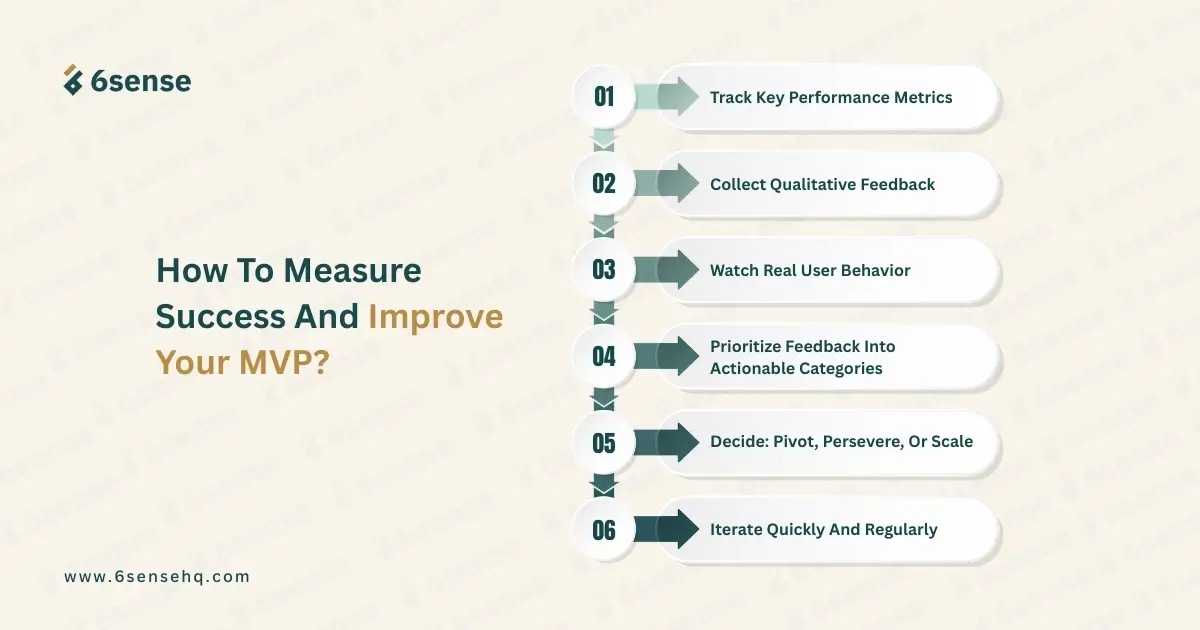
Choose a few numbers that show if your MVP is delivering value, like engagement, retention, or core action completion. Tracking these from day one gives a clear view of whether users find the product useful and stick around.
Tools like analytics dashboards help you see patterns and compare progress over time, so you can decide what to improve next.
Survey users, ask for ratings, or include in-app feedback options so real people tell you what they think and why. Qualitative feedback reveals why users behave a certain way and what frustrates or delights them, which numbers alone can’t show.
This direct insight helps uncover what matters most to users so you know what to improve first.
Look at how users actually use your MVP, where they click, where they stall, and where they succeed. Behavior data shows patterns like drop-offs in key flows or repeat use of certain features, which help you pinpoint problems or opportunities.
Reviewing user journeys with analytics gives a full picture of product performance beyond simple counts. Top MVP dev companies like 6sense HQ prioritize this highly, which leads to more impactful results.
Not all feedback is equal. Separate bug reports, usability suggestions, and feature ideas into groups so you know what to fix first. Give higher priority to issues affecting the core value of your MVP and lower priority to minor requests.
This structured approach prevents random changes and ensures your development team addresses what will have the biggest impact on user satisfaction.
Once you measure success, choose your next steps wisely. If key metrics are poor and feedback shows core issues, you might pivot your product idea. If metrics are promising and users want more, you can add new features or scale up.
If you’re in between, keep improving and testing. This decision framework helps you grow based on evidence, not guesswork.
Use short development cycles to make targeted improvements based on what you learn. Small, frequent updates keep your MVP responsive and let you measure the impact of each change.
Moreover, regular iteration creates a feedback loop where every release is a chance to learn and refine, growing your product closer to what users truly need. Agile cycles help you adapt fast without wasting time on unproven features.
MVP development is all about learning fast, spending smart, and testing real demand before you invest in a full product. With the right steps, idea validation, sharp focus on core features, and quick feedback loops, you give your startup the best chance to succeed without wasting time or money.
Start small, hire MVP development agency wisely, listen closely, and let real users guide your decisions. Remember: an MVP isn’t the final product, it’s your first big step toward something bigger and better.
Ready to build with insights and confidence? Explore smarter product launches with 6sense HQ’s tools and expertise
Compare 6sense HQ and DevToDollars on MVP speed, team models, proof, pricing, and post-launch support to pick the right fit.
15 min read
Compare 6sense HQ alternatives for MVP development in 2026 and find the best software team for your startup budget and goals.
17 min read
Learn whether one developer can build an MVP in 2026 with cost, scope, AI tools, low-code tips, risks, and launch advice.
22 min read