

6sense HQ vs DevToDollars: Best MVP Partner in 2026
Compare 6sense HQ and DevToDollars on MVP speed, team models, proof, pricing, and post-launch support to pick the right fit.
15 min read
Loading…
Stop guessing and start building. Master the MVP framework to launch fast, validate ideas, and scale based on real user data.
Written by: AKM Ahsan Created on: 13 Mar 202611 min to read
Building an MVP successfully requires more than just launching a simple product. It requires a structured framework.
An MVP development framework is a structured methodology that guides teams from idea validation to product launch using Lean Startup principles, the Build-Measure-Learn cycle, and iterative feature prioritization.
The framework usually includes several phases: problem validation, feature prioritization, rapid development, real-user testing, and continuous improvement.
In this blog, we will explore the MVP development framework and methodology. You will learn the core philosophy behind MVPs, the Build-Measure-Learn framework, practical development steps, and how to identify the right features before building your product.
• An MVP framework helps startups validate ideas before investing heavily in development.
• The Lean Startup approach and Build-Measure-Learn cycle guide MVP development.
• Successful MVPs prioritize core features using frameworks like MoSCoW and RICE.
• Famous companies like Airbnb and Dropbox started with simple MVP experiments.
• The goal of an MVP is not perfection; it is fast learning and product-market validation.
The core philosophy of MVP development comes from the Lean Startup approach. The idea is simple: instead of spending months or years building a full product, launch a basic version quickly and learn from real users. MVPs help startups test ideas, validate assumptions, and improve products using real feedback rather than guesses.
Eric Ries summarized the philosophy clearly in his book “The Lean Startup.”
The MVP concept exists to enable this learning process.
The logic behind it is straightforward:
This approach is critical because many startups fail by building products nobody actually wants.
According to CB Insights, they found that the most common reason for failure was “no market need,” cited in 42% of failed startups.
By launching an MVP early, companies can test demand, reduce risk, and build products that people actually want.
The Build-Measure-Learn cycle is the engine behind MVP development.
It is the core feedback loop described in Lean Startup methodology and helps startups iterate rapidly based on real customer data.
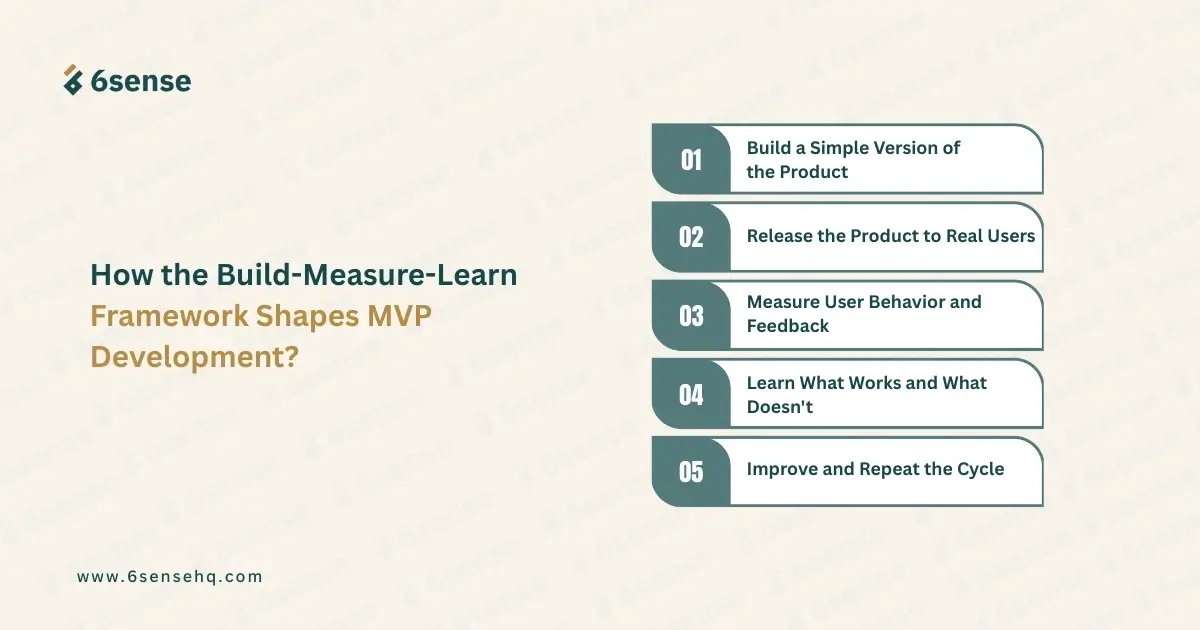
The process usually follows five stages:
The first step is creating a basic product with only essential features. The goal is not perfection. The goal is validated learning. An MVP should focus on solving one clear problem instead of trying to build an entire platform.
Once the MVP is built, it should be launched to a small group of users. These early users provide valuable insights. Many founders emphasize that real feedback from users is far more useful than internal assumptions about what people might want.
Teams then collect real data about how users interact with the product.
Important metrics include:
This data reveals whether the product is actually solving a real problem.
After analyzing user behavior, teams identify strengths and weaknesses in the product.
This learning phase helps determine whether the team should:
MVP development is not a one-time process. Successful teams repeat the Build-Measure-Learn cycle many times. Each iteration improves the product based on user insights until the product reaches a strong product-market fit.
Not every MVP needs to be a fully functional application. In fact, many successful startups validated their ideas using extremely simple MVP formats.
Here are several common MVP types used by startups today.
A landing page MVP is a simple website that explains the product idea and allows users to sign up or join a waitlist. This approach helps validate demand before building the product.
In a concierge MVP, the service is delivered manually behind the scenes.
Instead of building automation immediately, founders perform the service themselves. This approach helps validate the problem and the customer's willingness to pay.
This MVP appears automated to users but is actually powered manually behind the scenes. It allows startups to test product concepts without investing in complex engineering.
This version focuses on delivering one key feature exceptionally well. Many successful startups launch with only a single core capability.
Modern tools like Bubble, Webflow, and Glide allow founders to build MVPs without heavy coding. This approach dramatically reduces development time and cost.
Teams deciding which method fits their product can compare MoSCoW, RICE, and Kano for MVP feature prioritization. These frameworks help teams avoid feature creep and maintain focus on delivering core value.
Below are four widely used frameworks.
| Framework | How It Works |
| MoSCoW Method | Features are categorized as Must-have, Should-have, Could-have, and Won’t-have. |
| RICE Scoring | Features are prioritized based on Reach, Impact, Confidence, and Effort. |
| Kano Model | Features are classified as basic expectations, performance features, or delight factors. |
| Impact/Effort Matrix | Features with high impact and low effort are prioritized first. |
These frameworks help teams avoid feature creep and maintain focus on delivering core value.
Building an MVP requires a clear process. The following steps reflect practical methods used by founders and product teams to turn an idea into a working MVP quickly and efficiently.
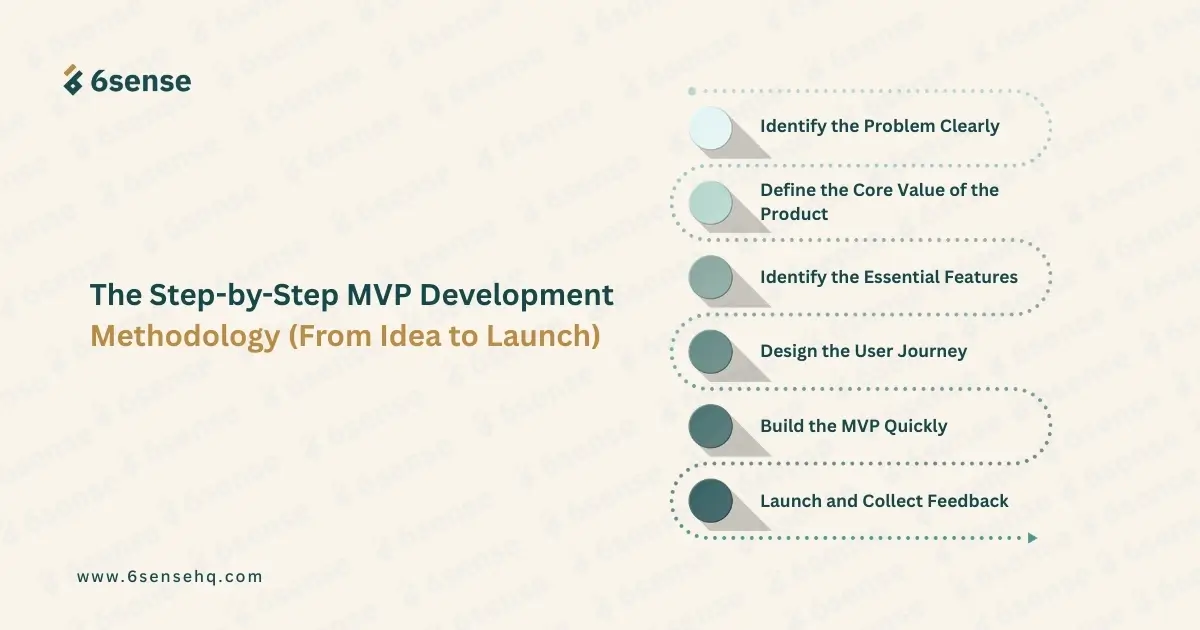
Every successful MVP roadmap starts with a clear problem. Instead of beginning with a product idea, teams should first conduct focused user research for an MVP to understand existing behavior, unmet needs, and the alternatives people already use.
The next step is preparing customer discovery interview questions that validate MVP assumptions. These conversations should uncover real pain points without leading participants toward the proposed solution. Understanding the problem helps teams design solutions that actually matter to users rather than building unnecessary features.
Next, define the core value your product delivers. Ask one important question: what is the main benefit users receive from this product? The MVP should focus only on delivering this value clearly and effectively.
List all possible features for the product and then remove everything that is not essential. The MVP should include only the features required to solve the main problem. This helps teams build faster and test the idea earlier.
Before development begins, map the user journey. Creating evidence-based user personas for the MVP helps the team connect each step of that journey to a specific user’s goals, behaviors, and obstacles. Identify how users will interact with the product from start to finish. This helps ensure the MVP delivers a clear experience even with a limited set of features.
Once the planning is complete, the development team builds the product with a focus on speed and simplicity. The goal is not perfection. The goal is to launch a working version that can collect real feedback.
After the MVP is ready, release it to early adopters and gather feedback. Observe how users behave, listen to their suggestions, and identify areas for improvement. These insights guide future product development.
Many globally successful companies started with extremely simple MVPs.
Airbnb began when its founders rented out air mattresses in their apartment and created a simple website listing available rooms. The experiment validated demand for short-term home rentals before the platform expanded globally.
Key lesson: Test demand with a simple solution before building a large platform.
Dropbox initially validated its idea with a demo video explaining the product concept before building the actual software. The video generated thousands of signups and proved there was strong demand for the service.
Key lesson: Sometimes you can validate a product idea without building the full product.
Slack started as an internal communication tool created during the development of a failed online game. The team realized the messaging tool was more valuable than the original game and turned it into a standalone product.
Key lesson: Great products sometimes emerge from unexpected experiments.
One of the most important decisions after launching an MVP is determining what to do next. Founders typically face three options.
If users show interest but the product still needs improvement, teams continue refining features.
A pivot involves changing the product direction while maintaining the original vision. The Lean Startup methodology encourages pivots when data shows the current approach is not working.
If strong product-market fit appears, startups invest in scaling the product and expanding their user base.
These three terms are often confused but represent different stages of product validation.
| Stage | Purpose |
| Prototype | Demonstrates the product concept or design. |
| Proof of Concept (PoC) | Tests whether the idea is technically feasible. |
| MVP | A real product with minimal features used by real users. |
An MVP is the first version of the product that reaches the market.
The timeline for building an MVP depends on product complexity.
However, most MVPs follow a structure similar to this:
| Phase | Typical Timeline |
| Discovery & Research | 2-3 weeks |
| UX/UI Design | 2-4 weeks |
| Development | 6-10 weeks |
| Testing & Launch | 2 weeks |
Most MVPs can be launched within 3-4 months, depending on scope.
Launching an MVP is only the beginning. Founders must track the right metrics to evaluate progress.
Important metrics include:
These metrics help determine whether the product is moving toward product-market fit.
Many startups fail because they repeat avoidable planning and execution errors. Reviewing the common mistakes that undermine MVP development can help teams identify weak validation, feature creep, missing success metrics, and premature scaling before those issues delay learning.
Common mistakes include:
Modern tools are dramatically accelerating MVP development.
Platforms like Bubble, Webflow, and Glide allow founders to build functional applications without extensive coding. Meanwhile, AI tools such as GitHub Copilot help developers write and test code faster.
These technologies allow startups to launch MVPs faster than ever before.
Choosing the right features is one of the most important parts of MVP development. Many startups fail because they build too many features instead of focusing on the core value.
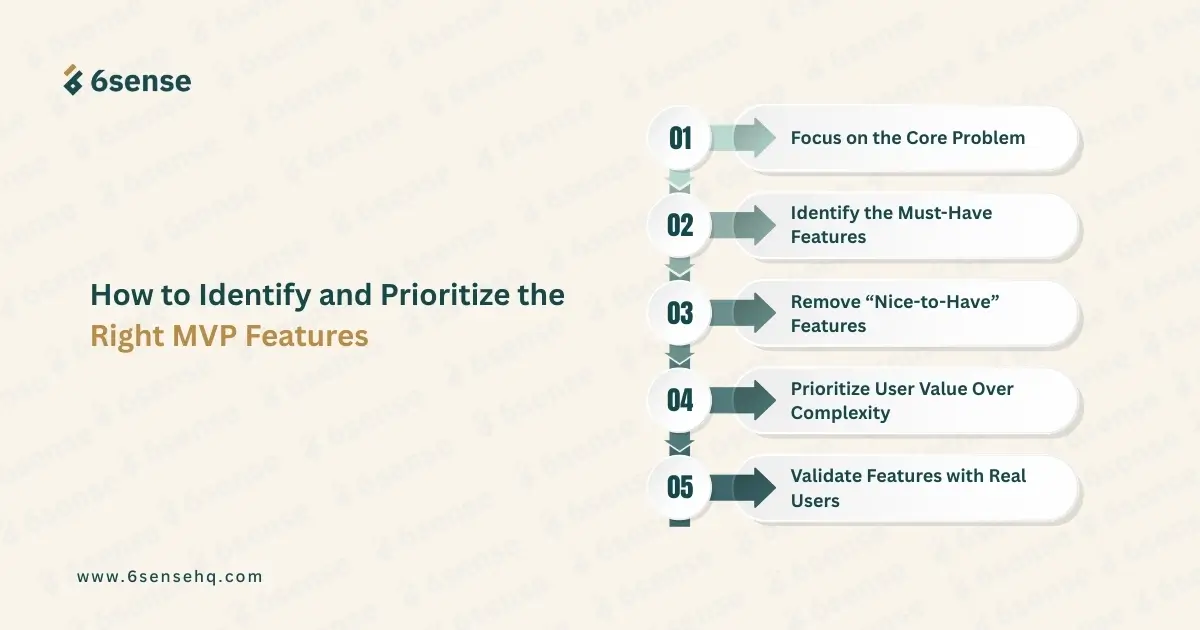
The most important rule is simple: every feature must solve the main user problem. If a feature does not directly contribute to solving that problem, it should not be part of the MVP. This keeps development focused and efficient.
Start by identifying the features required for the product to work. These are the must-have features that allow users to complete the main task. Everything else can wait for later versions of the product.
Many founders add extra features because they believe users will like them. However, MVP development requires discipline. Features that are not essential should be removed to keep the product simple and focused.
The best MVP features are those that deliver maximum value with minimal complexity. If a feature requires a large development effort but provides little value, it should not be included in the first version.
Before building a feature, validate it through user interviews, surveys, or simple prototypes. This helps teams confirm whether users actually need the feature before investing time and resources into development.
MVP development is one of the most effective ways to turn ideas into successful products. Instead of spending months building a perfect product, founders can launch early, learn from users, and improve continuously.
A practical MVP development checklist from validation to launch can help founders verify that each critical research, planning, design, development, testing, analytics, and launch task has been completed.
The most successful MVP strategies follow three core principles:
At 6sense HQ, we’ve helped dozens of founders turn early ideas into working MVPs, often within just a few months. The most successful teams treat MVP development not as a shortcut, but as a disciplined learning framework.
Talk to the expert team at 6sense HQ and start building your MVP with confidence today.
Compare 6sense HQ and DevToDollars on MVP speed, team models, proof, pricing, and post-launch support to pick the right fit.
15 min read
Compare 6sense HQ alternatives for MVP development in 2026 and find the best software team for your startup budget and goals.
17 min read
Learn whether one developer can build an MVP in 2026 with cost, scope, AI tools, low-code tips, risks, and launch advice.
22 min read