

6sense HQ vs DevToDollars: Best MVP Partner in 2026
Compare 6sense HQ and DevToDollars on MVP speed, team models, proof, pricing, and post-launch support to pick the right fit.
15 min read
Loading…
Learn how funded startups can build focused MVPs, control scope, prove traction, and reach investor milestones faster.
Written by: AKM Ahsan Created on: 21 May 202614 min to read
A funded startup does not fail because it has too little ambition. It often struggles because the team builds too much, too soon.
For example, at 6sense HQ, we have seen funded founders come in with a big roadmap, but the real win was turning that roadmap into a focused MVP that investors, users, and teams could understand.
At 6sense HQ, we've worked with 50+ companies and delivered 80+ projects globally, including funded founders building products between pre-seed and Series A stages. We help founders turn investor expectations into focused product roadmaps, milestone-driven MVPs, and structured delivery plans.
MVP development for funded startups means building the first serious version of a product after funding, with only the core features needed to prove traction, reduce risk, and support the next investor milestone.
6sense HQ helps founders build and scale products with structured offshore teams, MVP development, web apps, mobile apps, AI agents, and dedicated development teams. The company says it has worked with 50+ companies and delivered 80+ projects worldwide.
Compare 6sense HQ and DevToDollars on MVP speed, team models, proof, pricing, and post-launch support to pick the right fit.
15 min read
Compare 6sense HQ alternatives for MVP development in 2026 and find the best software team for your startup budget and goals.
17 min read
Not every startup needs an outside MVP team. But funded startups often need speed, structure, and technical clarity when the product must move from pitch deck to working software quickly.
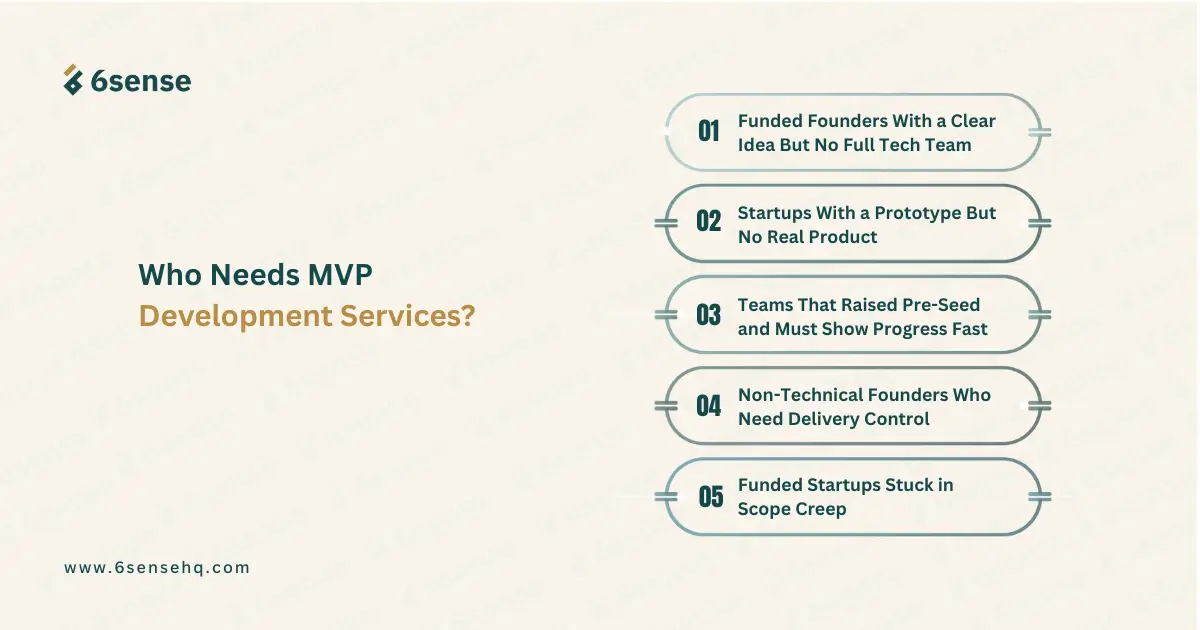
Some founders raise money before hiring engineers. They may have a strong market insight, but no internal team to ship. An MVP partner helps turn the idea into a working product, such as a SaaS dashboard, marketplace, or mobile app.
A clickable Figma file can help during early conversations, but investors and users eventually need to test real workflows. These teams need MVP development to turn mockups into login, data, payments, onboarding, and usable core features.
Pre-seed money usually comes with pressure. Founders may need to show product progress before the next investor update. A lean MVP gives them something real to demo, test, and improve instead of only sharing plans.
A non-technical founder may not know whether a developer quote is fair, whether the stack is right, or whether progress is real. A structured MVP team provides roadmap clarity, weekly progress, QA, and better technical decisions. Some founders raise funding before they have a CTO or full engineering team in place. In that case, it helps to understand how to build an MVP without a technical co-founder while still keeping control over scope, roadmap, and delivery quality.
After funding, every feature can feel important. This is where teams lose months. MVP development services help founders separate version one from version two, so the product launches before the budget gets consumed by “just one more feature.” Scope creep becomes even more dangerous after funding because every extra feature feels easier to justify. Founders who have already wasted budget once should be careful about repeating the same mistake and may need a clearer plan to restart after a failed MVP development experience.
A good MVP partner should not simply accept every idea. They should help you protect time, budget, and focus so your funded startup can launch faster and learn sooner.
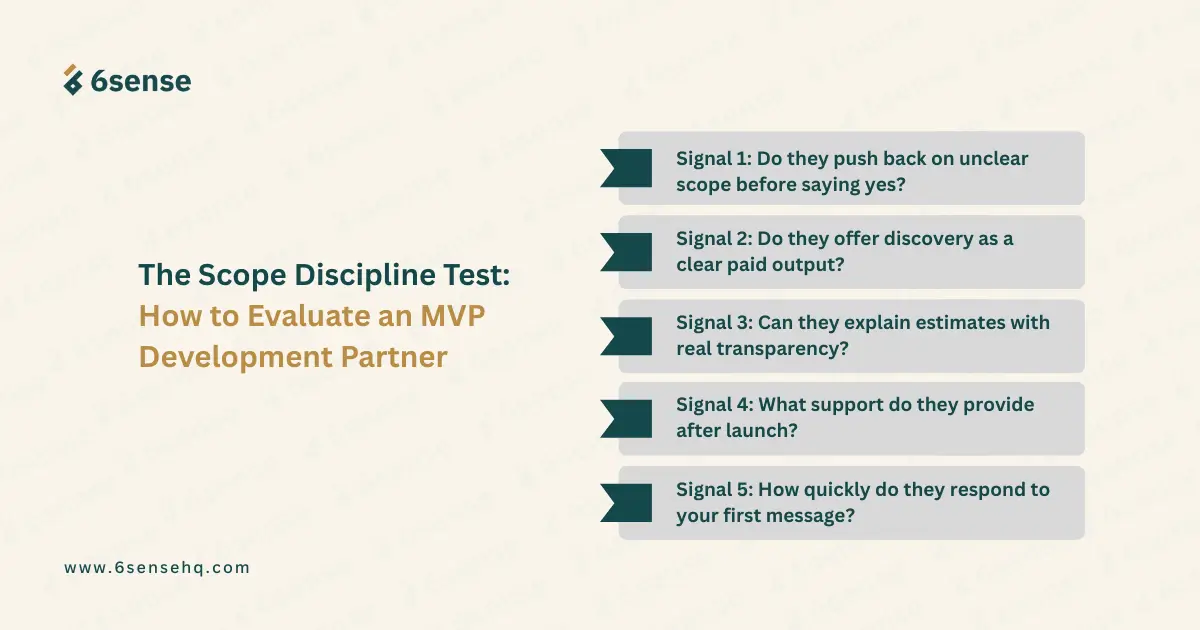
If a team accepts your full wishlist without questions, that is a warning sign. A strong MVP partner asks what must be proven first. For example, they may suggest launching with one user role before adding admin, analytics, and advanced automation.
Discovery should not be vague meetings. It should produce a scope, timeline, budget, user flows, tech plan, and risk list. This matters because funded startups need documentation they can share with investors, advisors, or internal team members before development starts.
A trustworthy partner should explain why a feature takes two weeks, not simply give a number. For example, payment integration may include user flow, backend setup, testing, error handling, and security checks. Clear estimates help founders avoid surprise costs later.
An MVP does not end on launch day. Bugs, user feedback, small improvements, and usage tracking matter immediately after release. Ask whether the team provides QA, maintenance, analytics setup, performance fixes, and a plan for the first post-launch iteration.
Response speed shows how the working relationship may feel later. If a partner is slow before the contract, they may be slower during urgent launch issues. Fast, thoughtful replies show communication discipline, especially when investors expect regular progress updates.
Funding gives a startup fuel, but the next round needs proof. A focused MVP helps founders turn investor money into progress, learning, and stronger fundraising evidence.
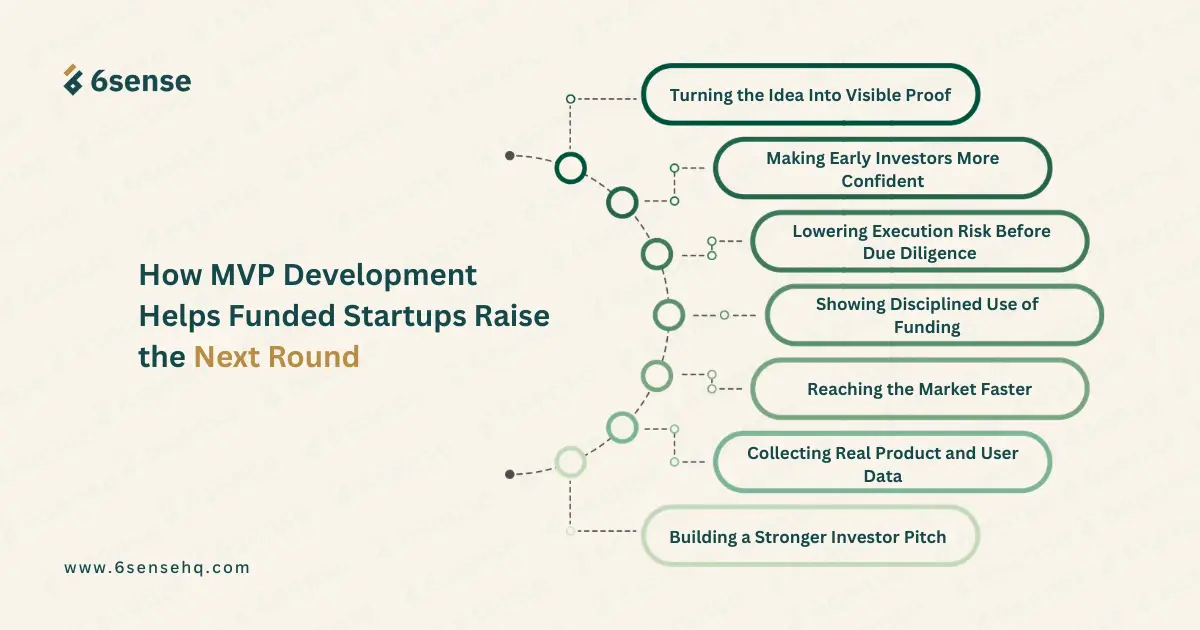
A working MVP shows that the startup can execute. Instead of only explaining the product, founders can show a real user journey. This makes investor conversations easier because the product becomes visible, testable, and more believable.
Investors want to see that their money is being used wisely. A focused MVP gives them updates they can understand: what was built, what users tested, what changed, and what the team learned from real product usage.
At 6sense HQ, we've worked with 50+ companies and delivered 80+ projects globally. Of those projects, some were for venture-funded startups and reached their planned investor milestone within the original timeline. We've consistently seen that founders who define one measurable milestone early, such as activation, pilot users, or revenue targets, make stronger investor updates and fundraising conversations later.
Example:
If your internal numbers are modest, specificity is still stronger than broad claims:
"Of the 80+ projects we've delivered, 12 were for venture-funded startups, and 75% hit their investor milestone on schedule."
A working MVP reduces one major question: “Can this team build it?” Investors can review product behavior, feedback, and early technical choices. This makes due diligence less theoretical and gives the team stronger proof than slides alone.
Funded teams can overspend quickly. A lean MVP shows discipline because it proves the founder can prioritize. Instead of building every feature, the team builds what supports traction, learning, and the next milestone.
Speed matters when competitors, users, and investors are moving fast. An MVP helps the startup launch early, test a narrow use case, and collect feedback. This is better than waiting months for a perfect full product.
Investors trust behavior more than opinions. A live MVP can show activation, retention, user feedback, waitlist conversion, pilot usage, or early revenue. These signals help the founder explain demand with real numbers, not guesses.
A pitch becomes stronger when the founder can show the product, explain what users did, and connect funding to the next milestone. MVP evidence turns the story from “we believe” into “we tested and learned.”
Many founders build products but forget that investors do not only want software updates.
They want evidence of learning.
For funded startups, investor updates should be:
Monthly → pre-seed and seed stage Weekly → active MVP build periods
A useful structure:
Wins: Reached 150 active users Metrics: Activation rate improved from 28% → 41% Challenge: Retention dropped during onboarding Ask: Need introductions to logistics founders
Pitch the MVP as proof, not as a finished product. Start with the user problem, then show the smallest product that proves people care. Explain what users did, what you learned, and what the next funding will unlock. Keep the demo short: one problem, one workflow, one outcome.
Use real numbers where possible: signups, active users, pilots, retention, revenue, or user interviews. CB Insights found that startup failure rarely has one single cause, but “no market need” was the most cited reason in its analysis of 101 startup post-mortems. That is why your MVP pitch should prove demand before you ask investors to fund scale.
End with a clear milestone: “This round helps us move from MVP to repeatable growth.”
Investors often review development decisions indirectly during check-ins. Even when they do not ask directly, founders should prepare answers.
Questions commonly include:
Many investors now also ask about source-code access and transition planning because long-term ownership risk affects due diligence later.
| MVP Type | Typical Cost Range | Best For | Notes |
| Lean no-code or prototype MVP | $5,000–$15,000 | Testing demand fast | Good for landing pages, fake-door tests, simple workflows |
| Simple custom MVP | $10,000–$30,000 | One core workflow | Often includes basic UI, login, dashboard, and limited backend |
| Moderate MVP | $30,000–$80,000 | SaaS, marketplace, or mobile app | May include payments, analytics, admin panel, and integrations |
| Complex MVP | $80,000–$150,000+ | AI, fintech, healthcare, multi-platform | Higher cost due to security, compliance, integrations, and custom logic |
Clutch's software development pricing benchmarks place development projects across a wide range, depending on complexity, team structure, and delivery model. Average software development company pricing commonly falls around $25–49/hour.
| Cost Factor | How It Affects Budget | Example |
| Feature scope | More workflows mean more planning, coding, testing, and QA | Adding chat, payments, and analytics increases cost |
| Platform choice | Web is often cheaper than separate native iOS and Android apps | A web MVP may be enough for B2B SaaS |
| Design complexity | Custom UI takes longer than basic product design | A fintech dashboard needs more polish and trust signals |
| Integrations | APIs add testing, edge cases, and security checks | Stripe, Plaid, CRM, AI APIs, or KYC tools |
| Compliance and security | Regulated industries need stronger architecture and QA | Healthcare, fintech, insurance, and legal tech |
| Team model | Freelancers, agencies, offshore teams, and in-house teams have different costs | Offshore teams can reduce cost while keeping structured delivery |
| Post-launch support | Maintenance, hosting, bug fixes, and iteration continue after launch | Budget for feedback-based improvements |
AI-assisted development is changing MVP economics for funded startups.
Tools now used frequently include:
These tools can reduce:
However:
AI accelerates building. It does not replace product requirements or decisions.
Research on AI-assisted development shows that tool impact depends heavily on context and engineering process quality.
After funding, the biggest danger is confusing money with permission to build everything. The first build should protect focus, show traction, and support the next business milestone.
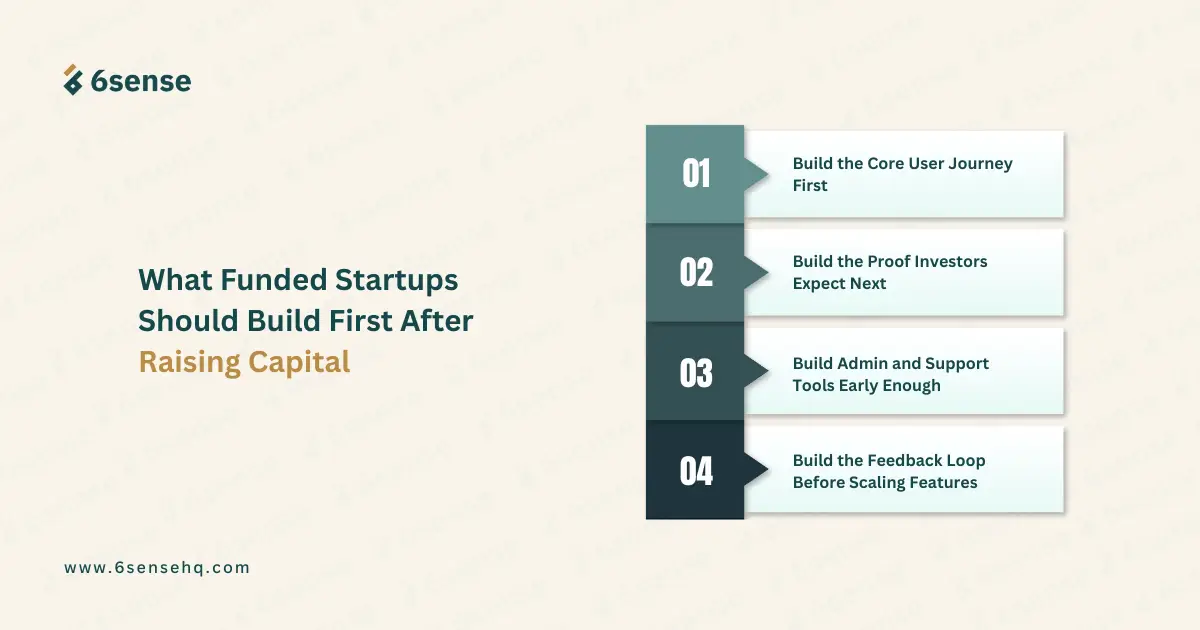
Start with the path that proves the product works. For example, a marketplace MVP should focus on matching supply and demand before adding referrals, rewards, or advanced dashboards. If users cannot complete the main journey, extra features do not matter.
Your MVP should connect to your next funding story. If investors funded you to prove demand, build activation and usage tracking. If they funded you to prove revenue, build payment, onboarding, and reporting around the first paid use case.
At this stage, founders should also decide whether the first version can be handled by one engineer or whether the MVP needs a broader team. For simpler products, it may be worth checking whether one developer can build the MVP before committing to a larger delivery setup.
A feedback loop only works when the team knows how to turn user feedback into sprint priorities. This is especially important for founders who need to manage a development team without being technical while still making product decisions quickly.
Many funded founders worry about development costs but forget about ownership costs.
Development decisions affect:
Giving equity to development vendors is uncommon because:
Development partners are usually paid through:
Common founder mistake: Giving away equity early to solve execution problems.
Instead:
Use:
Before giving away long-term ownership.
An investor milestone MVP is built around the next proof point, not the full product dream. That proof point could be 100 active users, three paid pilots, a working AI workflow, first revenue, or lower onboarding time.
This approach helps funded startups avoid vague updates like “we are still building.” Instead, the founder can say, “We launched the MVP, tested it with 25 users, fixed onboarding, and now 40% complete the core flow.” That is a better investor update because it shows learning, not just development.
The key is to choose one milestone before building. Then every feature must support that milestone. If it does not help prove progress, it belongs in version two.
A pre-seed B2B SaaS founder came to 6sense HQ after raising approximately $400K in funding. The challenge was not generating ideas. The founder had too many ideas, and only four months before the next investor milestone review. The initial roadmap included over 20 features covering reporting, dashboards, analytics, automation, permissions, and integrations.
Instead of building everything, the first step was identifying one measurable milestone: prove that users would complete the core workflow and return consistently. The scope was reduced to six critical features: onboarding, dashboard, activity tracking, notifications, user roles, and reporting.
The MVP was delivered through weekly sprint cycles across a 10-week timeline. By launch, the startup reached 180 active users and a 42% activation rate among invited customers. The founder used these metrics during investor updates and later expanded conversations around the next fundraising stage.
Founder feedback:
"The biggest shift was realizing we weren't building software anymore. We were building proof."
| Area | Pre-Seed MVP Development | Post-Funding MVP Development |
| Main goal | Prove the idea is worth pursuing | Prove the team can execute with capital |
| Budget pressure | Usually very limited | Larger, but easier to waste |
| MVP focus | Problem validation and first user interest | Traction, usage, investor milestones, and product reliability |
| Feature scope | Very narrow and experimental | Still focused, but more polished and stable |
| Team structure | Founder-led, freelancers, or small team | More structured team with PM, QA, design, and engineering |
| Investor expectation | Can be rough if learning is strong | Must show disciplined progress and measurable outcomes |
| Risk | Building before enough validation | Overbuilding because funding creates confidence |
| Best output | Learning, user proof, waitlist, prototype, early demo | Working product, user data, roadmap, and next-round evidence |
Many funded founders immediately ask:
"Now that we've raised money, what exactly should our MVP prove?"
The answer depends on business type, stage, and investor expectations. Your MVP should not attempt to prove ten things at once. It should prove one measurable business outcome.
As Y Combinator and First Round guidance repeatedly suggest, early-stage startups gain momentum by proving a small number of important assumptions before scaling.
| Startup Type | Common Milestone Type | Typical 2026 Benchmark | Time to Reach |
| B2B SaaS | Revenue validation | $10K MRR (pre-seed), $50K MRR (seed) | 3–6 months |
| Consumer/B2C | User growth | 10K WAU pre-seed / 50K WAU seed | 3–9 months |
| Marketplace | Two-sided activity | 100 active monthly transactions | 4–8 months |
| AI Product | Customer proof | 3 enterprise pilots | 2–6 months |
Common mistake: Founders select vanity metrics:
Bad examples:
Better examples:
MVP development for funded startups is not about building a small product because the team lacks money. It is about building the right product because time, focus, and investor trust matter. Once funding arrives, the founder’s job changes. The question is no longer, “Can we build this?” The better question is, “What should we prove first?”
A strongly funded MVP helps you launch faster, reduce risk, learn from users, and prepare better investor updates. Keep the scope tight, choose the right development partner, and build around your next milestone.
If you've just raised your pre-seed or seed round and need to hit a working-product milestone in 90 days, book a 30-minute scoping call. We'll review your roadmap, identify the milestone-critical features, and give you a fixed-price plan you can share with your investor. No commitment.
Learn whether one developer can build an MVP in 2026 with cost, scope, AI tools, low-code tips, risks, and launch advice.
22 min read