


6sense HQ vs DevToDollars: Best MVP Partner in 2026
Compare 6sense HQ and DevToDollars on MVP speed, team models, proof, pricing, and post-launch support to pick the right fit.
15 min read
Loading…
Learn the real cost of MVP development, key pricing factors, and budgeting tips to plan a lean, scalable startup product.
Written by: AKM Ahsan Created on: 4 Mar 202610 min to read
An MVP (Minimum Viable Product) is the very first version of your idea with just enough features to test whether real users care about it. It’s a core part of launching any software product, especially for startups that want to minimize risks and avoid building too much upfront. Founders who need a broader overview can follow this complete guide to developing an MVP, covering the process from idea validation and feature prioritization to development, testing, and launch.
When founders ask “how much does it cost to build an MVP?”, there’s no single magic number because costs vary based on features, team choice, complexity, and platform (web, iOS, Android). Every MVP project has a different budget depending on what you need and how fast you want to launch.
In this post, we’ll do a MVP cost breakdown, the real factors that drive price, differences between simple vs advanced MVPs and smart budgeting tips to help you plan your MVP wisely.
When figuring MVP development cost, there’s still no single fixed price, but active SaaS developers on Reddit suggest practical ranges based on real projects. For instance, in a detailed breakdown on r/SaasDevelopers, user u/ambryio notes that while the cost of MVP for SaaS might start around $30,000, advanced versions with AI or high-security requirements can easily exceed $150,000.
According Charles Fry on TechCrunch, early digital products typically fall into distinct budget brackets. For example, functional MVPs usually range between $50K-$100K, depending on features and timeframes.
Mobile builds (iOS + Android) are usually priced per platform ($25K-$80K+) or higher if done natively. Comments also reflect that using cross‑platform tools like React Native or Flutter can save 30-40% on development time and total cost.
Because every product, team, and scope differs, your budget ultimately depends on feature set, roles involved, and team choices.
Below is a simple comparison to help you understand how MVP cost jumps with added complexity:
| MVP Type | Typical Cost Range | Key Features |
| Simple MVP | $5,000 - $30,000 | Core single feature, minimal UI, basic workflows |
| Mid-level MVP | $30,000 - $60,000 | Multiple workflows, basic integrations (e.g., login, dashboard) |
| Advanced MVP | $60,000 - $150,000+ | Custom backend, multi-platform, analytics, payments= |
Now let’s explain this:
Here’s a snapshot of the common cost breakdown for MVP development stages based on scope:
Try our Cost calculator to get your estimated MVP cost!
Here’s a practical cost allocation across the typical MVP lifecycle:
| Stage | What It Covers | Typical % of Budget |
| Discovery & Planning | Market research + specs | 10-15% |
| UI/UX Design | Wireframes + prototypes | 15-20% |
| Core Development | Frontend + Backend + APIs | 50-60% |
| QA & Testing | Bug fixing + stability | 10-15% |
| Deployment & Launch | Server setup + release | ~5% |
Understanding real MVP development pricing breakdown examples helps founders plan budgets better. Below are typical MVP cost ranges, plus real cases from 6sense HQ to show how these translate into actual products and outcomes.
Functionality: Single-core workflow + basic UI
Estimated cost: $10K-$30K
Example: A basic to‑do list app with login and task creation.
6sense HQ Insight: ITCAN was built as a simple workflow tool tailored to a client’s approval and task management needs. It replaced costly local teams with a custom, lean solution that focused only on core features, helping manage workflows without wasting budget on redundant capabilities.
Includes: User accounts, search, product listings, cart
Estimated cost: $40K-$60K
Example: A local marketplace for buyers and sellers.
6sense HQ Insight: Jawhargy (Gold Marketplace App) was a lightweight trading platform built in 3-4 months with real‑time pricing and local payment gateway integration. The MVP design focused on essential user actions like account management and transactions, making it cost‑effective and fit for market launch.
Includes: Dashboard, analytics, user roles
Estimated cost: $40K-$80K
Example: A B2B collaboration tool MVP launched to early users.
6sense HQ Insight: Impromek is a real SaaS‑style example where a solo founder got a scalable MVP with admin, teacher, and student panels. Payments were simplified using Stripe to cut fees and complexity, resulting in an easy‑to‑use product ready for real users without overblown features.
Includes: Real‑time features, payments, API integrations
Estimated cost: $60K-$120K+
Example: On‑demand services app with payments + chat.
6sense HQ Insight: Introspection is an AI‑powered mood tracker built over 5 months by a dedicated team, including voice analysis and monthly emotional reporting.
With custom voice recognition and LLM integration, this project shows how advanced capabilities go beyond basic MVPs, and how dedicated teams enable complex builds within a set period.
When hiring a development team, startups usually choose between three common pricing models. Each model works best depending on how clear your product scope is and how much flexibility you need during development.
In a fixed-price model, the total project cost is agreed upon upfront based on a clearly defined scope, timeline, and deliverables.
Best for:
Pros
Cons
In this model, startups pay developers based on the number of hours worked. This allows the scope to evolve during development as user feedback arrives.
Best for:
Pros
Cons
In a dedicated team model, startups pay a fixed monthly cost for a team that works exclusively on their product.
Typical monthly ranges depend on team size:
| Team Size | Typical Monthly Cost |
| 1–2 developers | $5k – $10k |
| Small MVP team (3–4 people) | $10k – $25k |
| Full product team | $25k – $60k+ |
Best for:
Below are the biggest drivers behind how much you’ll end up spending. These factors shape your startup MVP budget from a minimal to a complex build.
Startups often struggle to estimate how much their MVP will cost. A simple framework can help founders get a quick idea before speaking with development teams.
MVP Cost = (Team Size × Development Weeks × Weekly Rate) + Tools + Contingency
Suppose a startup hires:
Calculation:
Development cost = 3 × 10 × $2,000 = $60,000
Additional expenses:
| Cost Type | Estimated Cost |
| Development tools | $500 – $2,000 |
| Third-party APIs | $500 – $3,000 |
| Contingency buffer (10–20%) | $6,000 – $12,000 |
Estimated total MVP cost: $67k - $77k
This simple formula helps founders estimate a realistic budget before starting development. In practice, the final cost still depends on feature scope, integrations, and team structure.
Many founders only plan for development costs, but launching an MVP also involves several operational expenses that are often overlooked.
Cloud services such as AWS, Google Cloud, or Azure are needed to run the product. Hosting typically costs $100–$1,500 per month, depending on traffic and infrastructure needs.
Startups often use analytics tools to track user behavior and product performance. These tools can cost $50–$500 per month depending on usage.
User notifications, onboarding emails, verification messages, and alerts often require services like email or SMS APIs.
Payment gateways, map services, authentication providers, and other integrations may charge usage-based fees.
If your product handles payments or personal data, you may need privacy policies, terms of service, or regulatory compliance reviews.
Mobile apps require developer accounts and publishing fees before they can be released in app stores.
After launch, regular updates, bug fixes, and performance monitoring are necessary. Maintenance typically costs $400–$1,000 per month, depending on the product complexity.
Founders often assume everything is included in the build price. In reality, some services are typically included while others are separate costs.
| Included in MVP Cost | Often NOT Included |
| Product discovery & planning | Marketing campaigns |
| Wireframing and UI/UX design | Long-term maintenance |
| Frontend development | Paid third-party services |
| Backend development | Ongoing hosting costs |
| Database setup | App store fees |
| API integrations | Customer support tools |
| QA testing and bug fixing | Future feature expansion |
| Initial deployment | Growth-stage scaling |
Before setting a budget, understand these 6 core MVP cost factors; each of these plays a big role in how much your MVP will ultimately cost.
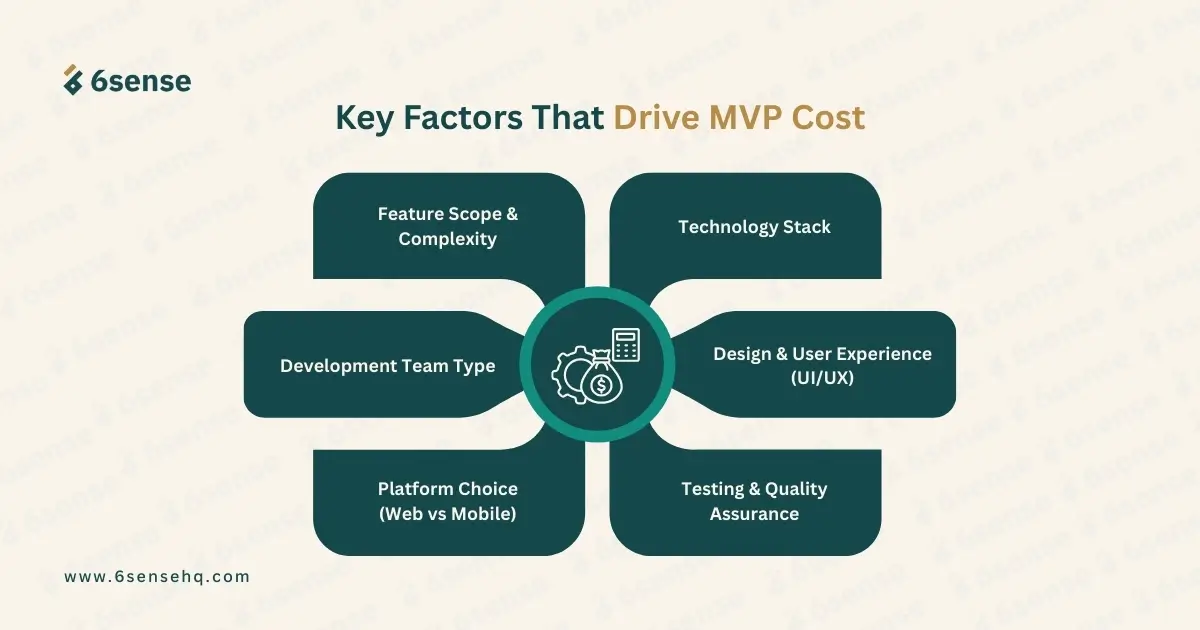
The bigger your feature list, the longer it takes to build. Simple MVP workflows take less product development time, but adding even moderate functionality (like payments or analytics) can double your timeline. Overly broad scopes are the biggest cost driver founders face, often inflating budgets by 30-50% when not prioritized properly.
Who builds your MVP matters. Hiring an in‑house team usually increases cost due to salaries and benefits. Freelancers can be cheaper but risk coordination gaps. Agencies bring structure and product expertise, which often reduces rework and overall cost despite higher hourly rates.
Building for web only? That’s usually the most cost‑efficient route. Want native mobile apps?
Costs rise because you need separate software development for iOS and Android unless you use cross‑platform tools (like React Native), which can save time and MVP budget. Platform decisions directly impact your time‑to‑market.
Choosing the right tech stack affects development speed, future maintenance, and scalability. Popular, well‑supported frameworks are typically faster and cheaper to work with.
So, choosing niche or bleeding‑edge tech can increase development time, complexity, and cost through longer debugging and fewer ready‑made components.
Good design isn’t optional; users notice. MVPs with basic, functional UI cost less, but if your goal is an investor demo or strong first impressions, you’ll need investment in professional design.
UI work often drives 10-20% of the overall development budget, depending on detail and polish.
Shipping without QA may save money initially, but it often leads to higher costs later. MVP testing ensures it is stable and reliable enough for early users. Founders who skip QA commonly spend 15-30% more on bug fixes post‑launch, so building quality early can be more cost‑effective in the long run.
Understanding MVP development cost helps you plan smartly instead of guessing numbers. While there’s a broad range, roughly $5,000 to $150,000+, depending on scope, the real trick is balancing necessary features, quality, and speed to validate your idea without overspending.
Clear goals, disciplined feature prioritization, and choosing the right MVP development team will keep your project efficient and budget‑friendly. Remember, the purpose of an MVP is to test assumptions and learn quickly, not to build the final product in one go.
Learn how to optimize your MVP budget, Talk to our experts today!
Compare 6sense HQ and DevToDollars on MVP speed, team models, proof, pricing, and post-launch support to pick the right fit.
15 min read

Compare 6sense HQ alternatives for MVP development in 2026 and find the best software team for your startup budget and goals.
17 min read

Learn whether one developer can build an MVP in 2026 with cost, scope, AI tools, low-code tips, risks, and launch advice.
22 min read