

6sense HQ vs DevToDollars: Best MVP Partner in 2026
Compare 6sense HQ and DevToDollars on MVP speed, team models, proof, pricing, and post-launch support to pick the right fit.
15 min read
Loading…
Learn how to cut MVP costs in 2026 using lean strategies, expert tech stacks, and real-world case studies to build faster for less.
Written by: AKM Ahsan Created on: 9 Mar 20267 min to read
Picture this: you have a brilliant idea, but you’re worried that development costs could stop you before you even get started. That’s where an MVP, or Minimum Viable Product, comes in: a smart way to launch fast while saving money.
MVP development cost reduction is about focusing on user validation with minimal upfront spend and smarter decisions at every step. By tuning into lean build approaches and prioritizing value over volume, founders validate their ideas faster and with less financial strain.
In this blog, you’ll get researched, practical insights into why lowering MVP costs matters, backed by real use cases, proven strategies, and tools that help you build smarter.
When you’re building a product from scratch, every dollar counts. Too many founders spend big before knowing if users even want their product, and that’s risky. Research cited in the Lean Startup ecosystem shows that about 75% of startups fail, often because their ideas or assumptions about the market were never properly validated early.
An MVP lets you test your assumptions with minimal spend by only building the most essential features first. By focusing on core functionality and early user feedback, you reduce the risk of creating something nobody wants and wasting serious development budgets.
As startup expert Eric Ries, creator of the Lean Startup methodology, explains:
This idea is the core reason founders build MVPs, launch quickly, learn from real users, and avoid spending time and money on features that may never matter.
MVP development cost breakdown early also frees up funds for marketing, growth, and pivoting if needed, so you stay agile, competitive, and better positioned for success from day one.
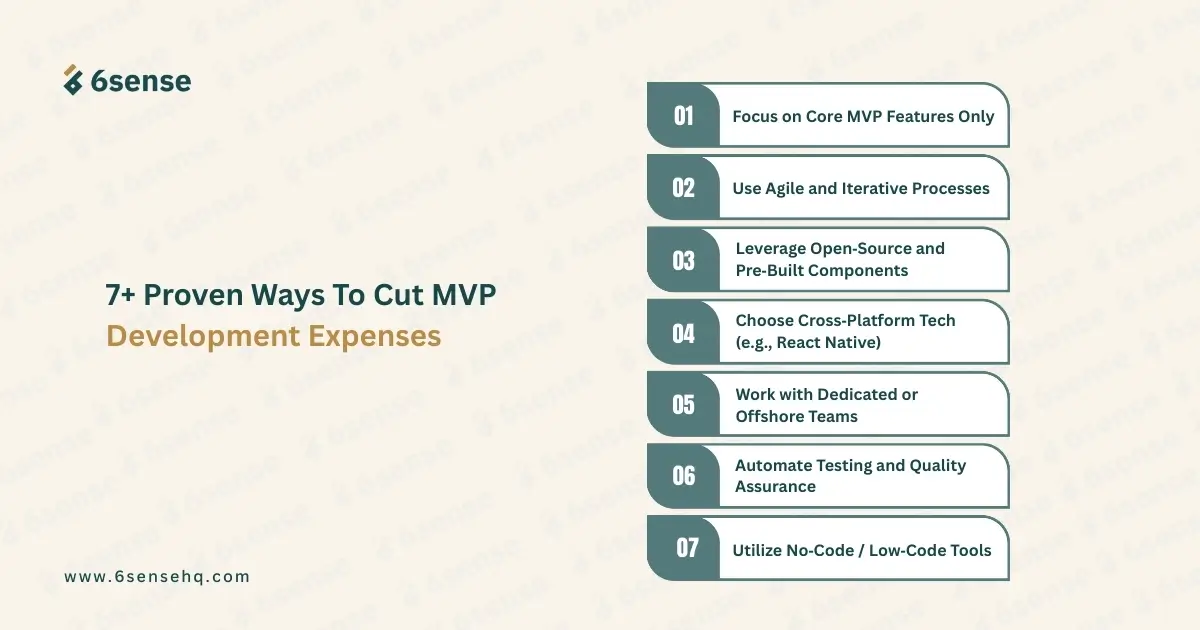
Before we dive in, here’s a quick overview of why these strategies work: Instead of guessing features or pushing for a full‑feature launch, these approaches help you build exactly what users need and nothing more.
Let’s see how to build MVP on a budget:
Pinpoint the features that directly solve your users’ problems. Avoid adding “nice‑to‑haves” that increase development time and costs without adding clear early value. Understanding which MVP features increase development costs can help you identify expensive dashboards, integrations, user roles, automation, and infrastructure requirements before they inflate your scope.
Agile development uses short development cycles and frequent feedback. This helps teams fix issues early and avoid expensive rework later.
Open‑source frameworks and libraries cut development costs and time because they eliminate licensing fees and reduce custom coding effort.
Building one codebase for both iOS and Android drastically shrinks time and resource needs versus developing two native apps independently.
Partnering with experienced, specialised development teams or hiring an experienced MVP agency lowers costs compared to in‑house hiring, especially for short‑term MVP builds. The pricing agreement can also affect your final budget, so compare fixed-price and hourly MVP development models based on scope clarity, expected changes, timeline flexibility, and how much cost predictability you need.
Automated test setups prevent expensive bug fixes later, ensuring quality without ballooning QA hours or staffing costs.
Platforms like no-code builders or low-code frameworks allow startup MVP development pricing to build basic products faster and cheaper without heavy engineering work.
A simple framework can help founders reduce MVP development costs while still building a useful product. The idea is to validate quickly, learn from users, and improve step by step.
Before writing code, test your idea with surveys, landing pages, or prototypes. This helps confirm whether users actually want the product.
Focus on the main feature that solves the user’s problem. Adding too many features early can increase MVP costs by 30–50% without improving validation.
Release a basic version of the product as soon as possible. Most MVPs take about 3–4 months to launch, depending on complexity.
Track how real users interact with your product using analytics tools and feedback surveys.
Improve the product gradually using real user insights instead of assumptions.
Different development approaches lead to very different costs. Founders who need a broader pricing baseline should first understand how much an MVP typically costs across different product types, complexity levels, team structures, and development approaches. The table below shows typical ranges based on common startup strategies.
| Approach | Cost Range | When to Use |
| No-code MVP | $3k – $10k | Idea validation and early experiments |
| Cross-platform MVP | $15k – $40k | Early SaaS products or simple apps |
| Custom MVP build | $40k – $120k+ | Complex platforms with advanced features |
Overall, MVP development costs typically range from $15,000 to $150,000, depending on complexity, features, and development team structure.
Real startup cases show how lean MVP strategies reduce development costs and validate ideas faster.
Many founders only plan for development costs, but running an MVP involves several additional expenses.
Cloud services such as AWS or Google Cloud may cost $50–$500+ per month, depending on traffic.
Tools like Mixpanel, Amplitude, or Google Analytics help track user behavior but may require paid plans as usage grows.
Payments, maps, authentication, and messaging services often charge usage-based fees.
Products handling payments or personal data may require additional security audits and compliance setup.
Publishing a mobile app requires developer accounts and platform fees.
Bug fixes, updates, and infrastructure monitoring typically require ongoing development support.
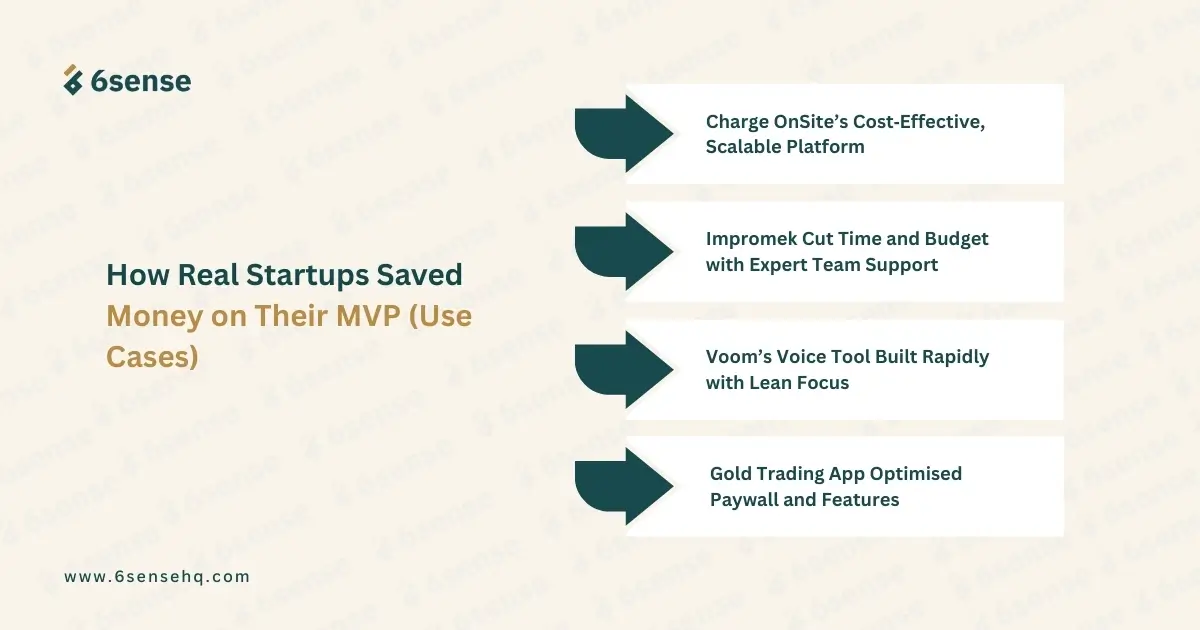
Here are 5 real examples of lean MVP success stories from 6sense HQ Case Studies, showing experience, results, and practical lessons in cost optimization.
Leveraged focused backend build strategies to reduce MVP cost by about half while still delivering scalable EV charging features.
Rather than building alone, the founder partnered with a specialised team to finish the core MVP cost‑effectively and integrate essential payment systems.
Delivered a voice‑sharing MVP in just about one month by concentrating solely on essential functionality and iterative user feedback.
Developed a lean marketplace MVP that met security and compliance needs while keeping development budgets on target.
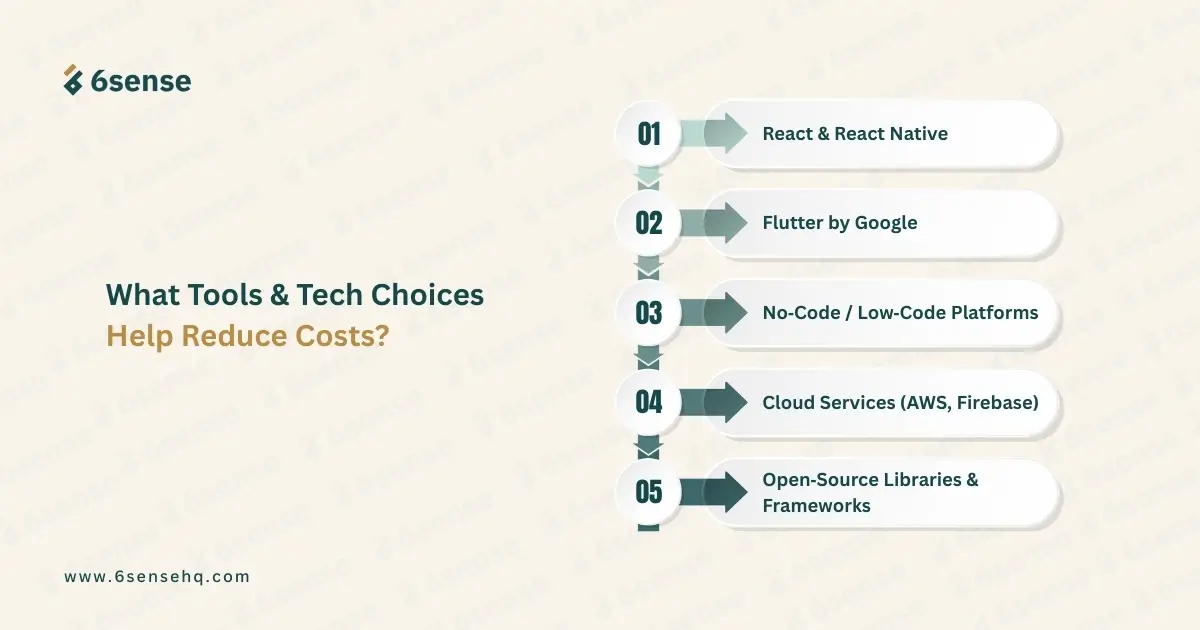
Choosing the right stack and tools impacts your budget, delivery speed, and quality. These 5 tech choices are proven to help build more affordably, without sacrificing performance or user experience.
Allows reusable code across platforms, saving time and boosting productivity compared to separate native builds.
Builds natively compiled applications from a single code base, reducing development overhead and speeding MVP delivery.
Tools like Bubble, Webflow, or low‑code stacks accelerate builds and lower spend, ideal for prototypes and early tests.
Cloud infrastructure scales with your needs, eliminating upfront server costs while offering starter credits and pay‑as‑you‑go pricing.
Pre‑built MVP frameworks like Bootstrap or Node.js modules speed builds and reduce custom coding without expensive licensing.
Reducing MVP development costs is about being strategic, thoughtful, and value‑driven. A lean MVP roadmap lets you validate ideas faster, spend smarter, and avoid unnecessary features, all while preserving capital for growth and future product enhancements.
By prioritising Saas MVP development cost efficiency and focusing on proven MVP cost-saving strategies and tools, you build confidence in your product, improve investor appeal, and set a strong foundation for scaling. Invest in what truly matters, make your own MVP development checklist and always base decisions on user feedback and iterative learning.
Book a call and talk to our expert team to build MVP at 6sense HQ.
Compare 6sense HQ and DevToDollars on MVP speed, team models, proof, pricing, and post-launch support to pick the right fit.
15 min read

Compare 6sense HQ alternatives for MVP development in 2026 and find the best software team for your startup budget and goals.
17 min read
Learn whether one developer can build an MVP in 2026 with cost, scope, AI tools, low-code tips, risks, and launch advice.
22 min read