


6sense HQ vs DevToDollars: Best MVP Partner in 2026
Compare 6sense HQ and DevToDollars on MVP speed, team models, proof, pricing, and post-launch support to pick the right fit.
15 min read
Loading…
Fixed price MVP sounds safe until week 3. Learn what it really costs, what to scope, and how to launch without surprises.
Written by: AKM Ahsan Created on: 14 May 202611 min to read
A fixed price MVP sounds safe, until you sign a $60K contract and receive a $12K change order in week 3 because the scope document left a key integration undefined. Fixed price MVP development gives you cost certainty, but only when the scope is clear, the contract is airtight, and the agency has done this before.
6sense HQ helps early-stage founders build and scale products with a dedicated PM-led engineering team onboarding in under 7 days, fixed price agreed upfront, and a working demo every Friday. We’ve helped 50+ non-technical founders build and launch MVPs with a fixed price, full team, and working demo in weeks.
Once your feature list is prioritised, the next question is how to price the build, which is what this guide covers.
Fixed price MVP development is a pricing model where a founder and development team agree on the total project cost before work begins, with scope, deliverables, timelines, and acceptance criteria locked in. The agency estimates the work and gives you one fixed price for the agreed deliverables, not hourly bills.
This model works best when the idea is well‑defined and the contract is precise.
One founder we worked with, building a marketplace MVP for the UK wedding industry on a $65K fixed price went through a 2-week discovery phase, agreed on 18 screens and 6 core flows, and launched within 10 weeks. The fixed price gave her the certainty she needed to commit her pre-seed funding to the build.
The key is scope clarity. One founder discussion showed a standard mobile MVP with 15-20 screens receiving an $80K fixed quote, while hourly estimates were around 400-500 hours at $150/hour. That means the pricing model can change the founder’s risk, not just the invoice.
| MVP Tier | Typical Fixed Price Range | Typical Timeline | Core Deliverables |
| Simple MVP | $30,000–$55,000 | 6–8 weeks | Landing page, auth, core workflow, admin |
| Standard SaaS MVP | $55,000–$100,000 | 8–12 weeks | Multi‑user dashboard, payment, CRM |
| Marketplace / Two‑Sided MVP | $80,000–$140,000 | 10–16 weeks | Buyers/sellers, escrow, reviews |
| AI or Complex MVP | $120,000–$200,000+ | 14–20 weeks | AI integrations, compliance, custom algorithms |
These figures provide a useful starting point, but SaaS products often require additional budgeting for subscriptions, user permissions, payment systems, dashboards, third-party integrations, and scalable infrastructure. Reviewing the typical cost of developing a SaaS MVP can help founders create a more accurate estimate before requesting a fixed-price proposal.
| Area | Fixed Price MVP Development | Hourly / T&M MVP Development |
| Best for | Clear scope with defined features | Evolving ideas or uncertain scope |
| Cost control | Strong upfront control | Final cost can change |
| Flexibility | Lower after scope approved | Higher flexibility |
| Founder risk | Low budget risk, high scope risk | High budget risk, lower scope risk |
| Agency risk | Agency absorbs overrun risk | Founder pays for extra time |
| Change requests | Usually billed separately | Easier to add, but adds hours |
| Timeline | Easier to plan if scope locked | Can stretch if priorities change |
Works best when:
Watch out for:
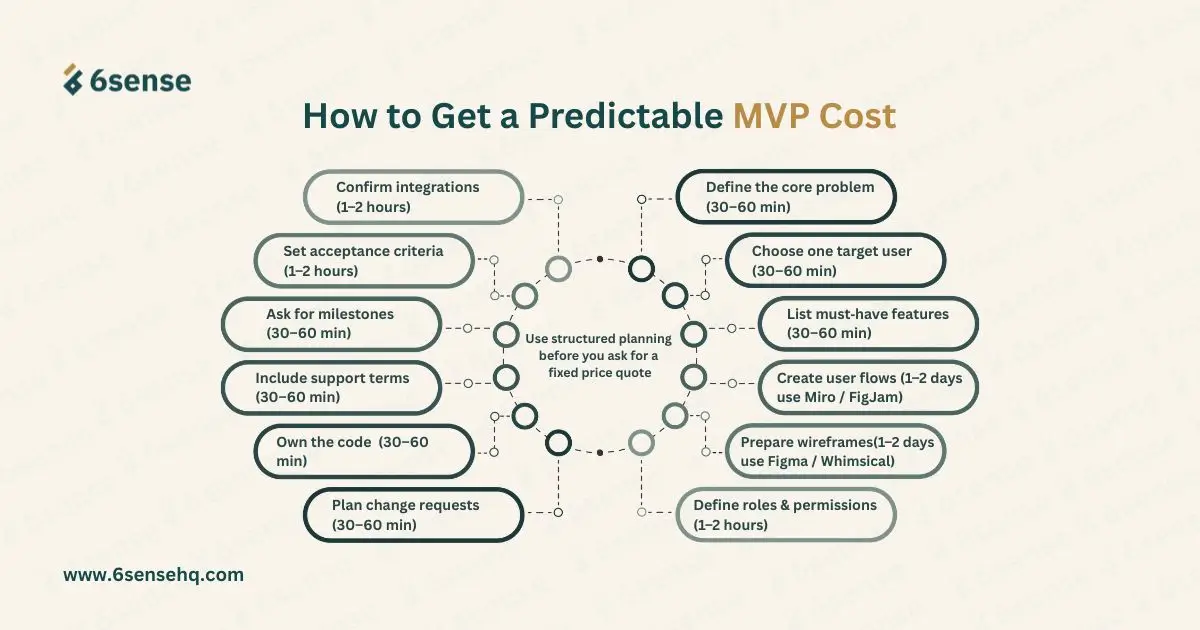
Use structured planning before you ask for a fixed price quote:
Founders usually choose a fixed price because they want clarity before they spend serious money. The model feels safer when the idea is focused, the team is small, and the launch goal is specific.
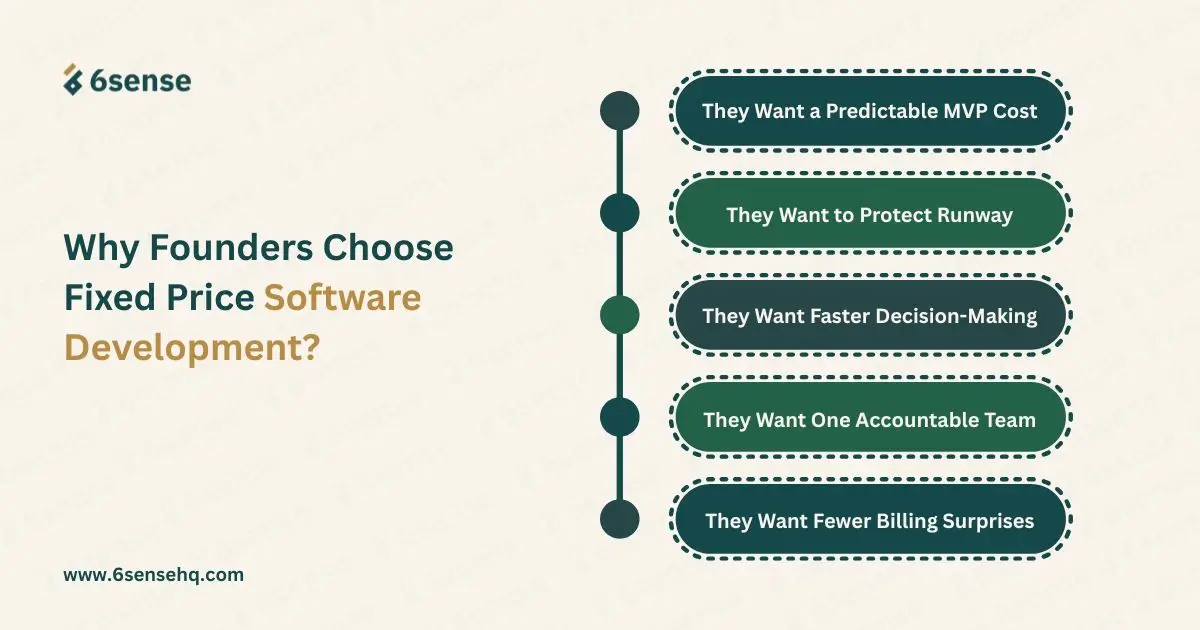
Founders do not always have the luxury of an open-ended budget. A fixed price helps them know what they will spend before the project starts. This matters because MVP development costs can vary widely depending on complexity, team structure, platform, integrations, and design depth. A fixed number makes planning easier.
Early-stage founders need to keep enough money for launch, feedback, marketing, hosting, and future improvements. If the build keeps expanding, the product may launch too late or run out of budget. Fixed pricing helps founders protect cash by forcing hard choices before development begins.
Fixed price projects usually require strong discovery, clear features, and agreed milestones. That pressure can be healthy. It pushes founders to separate must-have features from nice-to-have ideas. Instead of adding everything, they focus on the few features needed to test the product.
With hourly work, founders may feel like they are managing every small task. With a fixed price agency, the team is usually responsible for delivery. That can reduce mental load for non-technical founders, especially when the agency handles planning, design, development, QA, and launch.
Hourly pricing can feel cheaper at first because the starting estimate looks flexible. But if the scope grows, the final bill can rise. Fixed price software development gives founders a clearer ceiling, as long as the original agreement includes the right deliverables, assumptions, and change rules.
A standard fixed price MVP contract should align payments to delivery phases:
| Phase | % of Total | Deliverable Trigger |
| Discovery & Scoping | 10–15% | Requirements doc & tech plan |
| Design | 15–20% | Wireframes & UI sign‑off |
| Development Build | 40–45% | Across 2–3 sprint demos |
| QA & Testing | 10–15% | Bug‑free handoff |
| Launch | 10–15% | Live product & GitHub repo |
A fixed price scope should remove guesswork. It should tell both sides what is included, what is not included, how success is measured, and what happens after launch.
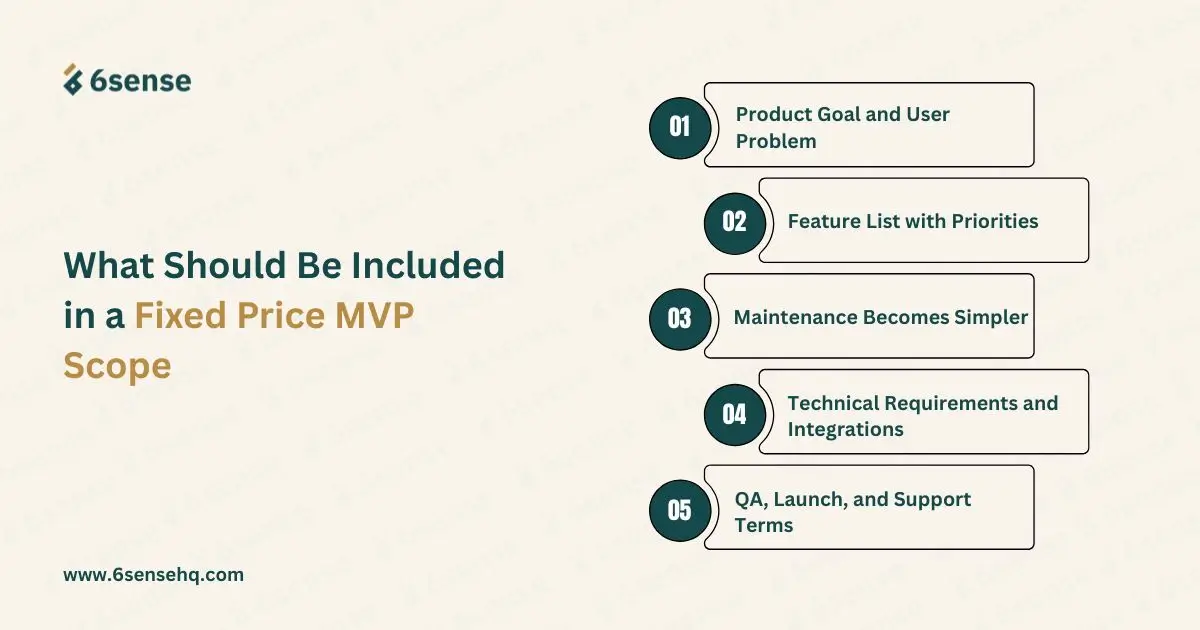
Start the scope with the business goal, not just a feature list. Explain who the MVP is for, what problem it solves, and what action users should take. It helps the agency make better product decisions instead of blindly building screens without understanding the outcome.
Every feature should be marked as must-have, should-have, or later. This keeps the MVP lean. For example, user login may be a must-have, while advanced analytics can wait. Feature priority helps protect your budget and stops the first version from becoming a full product. Understanding how individual MVP features affect development costs also helps founders identify which dashboards, integrations, permission systems, automation features, and custom workflows are likely to push the quote higher.
The scope should include screens, user journeys, and basic actions. For example, signup, profile creation, payment, dashboard, admin review, and notification flow. This gives developers a clear map and helps founders catch missing steps before the project becomes expensive to change.
Add the expected tech stack, platforms, APIs, payment gateways, hosting needs, database requirements, and security expectations. Third-party integrations and infrastructure can increase cost, so they should be discussed before pricing. Hidden technical assumptions are one of the easiest ways to lose predictability.
A fixed price MVP scope should include testing, bug fixing, deployment, handover, documentation, and post-launch support. Do not assume these are included. Write them clearly. Also, define what counts as a bug versus a new feature request, because that difference matters after launch.
A fixed price of $60K from a US‑based team typically covers 300-400 hours of senior engineering time. The same scope quoted by an Eastern European team at $50–$80/hr might indicate a lower blended cost behind the scenes, but fixed price means you pay for the outcome, not the location. Always ask your agency where the engineering team is based and what their blended hourly rate is behind the fixed quote.
Week 1 - PM‑Led Founder Workshops:
We start with mapping user flows, identifying must‑have screens, and technical dependencies. Tools: Miro / FigJam for flow visuals.
Week 2 - Technical Scoping & Wireframe Review:
We review wireframes in Figma / Whimsical, define integration points, gather acceptance criteria, and build a detailed scope document on Notion. By end of this week, you know precisely what will be built.
Output:
This discovery phase costs a small upfront fee and is applied toward the project if you proceed.
One founder we worked with, building a marketplace MVP for the UK wedding industry, agreed to a $65,000 fixed price contract following a two‑week discovery. The scope included 18 screens and 6 core flows, and the product launched in 10 weeks with payment and admin features live. The founder used the fixed price certainty to commit her pre‑seed funding confidently.
Choosing between an hourly vs fixed price agency depends on how clear your idea is today.
If you already have a clear product brief, wireframes, core features, and a launch deadline, fixed price is usually safer. Example: you want to build a simple appointment booking MVP with login, calendar, payment, admin dashboard, and email notifications. The agency can review the scope, price the work, and deliver against agreed milestones.
If your idea is still changing, hourly may be better. Example: you are testing three possible user flows, you are unsure whether the product should be mobile-first or web-first, and you need technical guidance before deciding. In that case, a fixed price may lock you in too early.
A smart middle path is discovery first, fixed price second. Pay for a short discovery phase where the agency creates user flows, wireframes, technical scope, and budget options. After that, you can choose a fixed price with more confidence.
Before signing, ask the agency: What is included? What is excluded? Who owns the code? How are changes priced? What happens if delivery is delayed? What support comes after launch? Can you show similar MVPs delivered on time and on budget?
A fixed price is best when you want certainty. Hourly is best when you want flexibility. The right choice depends less on the pricing model and more on how clearly the work is defined.
Ready to see how the 6sense HQ fixed price model works? Visit our cost calculator page!
Fixed price MVP development can be a strong choice for founders who want cost clarity, faster planning, and a focused first launch. But it only works when the scope is clear, the agency is honest, and both sides agree on what “done” means. Do not choose a fixed price just because it feels safe.
Choose it when your product is ready to be scoped properly. If your idea is still changing, start with discovery first. The best advice is simple: build less, define better, launch sooner, and keep enough budget to learn from real users.
Want a fixed price quote for your MVP? Book a free 20‑minute scope call and we’ll tell you exactly what your build would cost.
Compare 6sense HQ and DevToDollars on MVP speed, team models, proof, pricing, and post-launch support to pick the right fit.
15 min read

Compare 6sense HQ alternatives for MVP development in 2026 and find the best software team for your startup budget and goals.
17 min read

| Scope quality needed |
| Very high |
| Medium to high |
| Common problem | Hidden assumptions and change orders | Scope creep and budget overrun |
| Quality risk | Agency may rush if underpriced | Work may drag if poorly managed |
| Payment style | Milestone/project based | Weekly/monthly/time based |
| Founder control | Less day‑to‑day control | More day‑to‑day control |
| Good agency behavior | Defines scope deeply before quoting | Tracks hours clearly and reports progress |
| Bad agency behavior | Bids low, charges for changes | Vague estimates with no ceiling |
| Dispute risk | Medium; disputes when scope is vague | Low if hours tracked transparently |
| Post‑launch maintenance | Often not included; retainer needed | Easier to add without new contract |
Learn whether one developer can build an MVP in 2026 with cost, scope, AI tools, low-code tips, risks, and launch advice.
22 min read