

6sense HQ vs DevToDollars: Best MVP Partner in 2026
Compare 6sense HQ and DevToDollars on MVP speed, team models, proof, pricing, and post-launch support to pick the right fit.
15 min read
Loading…
Learn how to recover from a failed MVP, choose a reliable agency, protect ownership, and rebuild with clear scope in 2026.
Written by: AKM Ahsan Created on: 20 May 202611 min to read
A failed MVP can feel personal. You trusted a team, paid the invoices, waited for updates, and still ended up with broken features, missed deadlines, or a product users could not understand. At 6sense HQ, we regularly speak with founders who come after one bad build and need a safer way to restart.
In fact, 38% of our new founder conversations in 2025 started with some version of: “I’ve already been burned once.”
So how do you find a reliable MVP agency after a bad experience in 2026?
Start by checking proof, process, team quality, communication systems, ownership terms, and post-launch support. Do not choose the agency with the prettiest proposal. Choose the team that can explain risks clearly.
6sense HQ has delivered 50+ MVPs and 25,000+ development hours, including founder recovery projects completed in under 90 days. We help founders protect ideas with NDA, IP assignment, and security support while reducing development cost by roughly 40–60% compared with typical US agency rates.
Let’s read the blog!
Founders usually get burned because they hire for speed before they check clarity. The first calls sound exciting. The agency says they can build everything. The price looks possible. Then the work starts, and suddenly the founder realizes there is no clear scope, no product thinking, no proper QA, and no honest pushback.
Many failed MVP stories have the same pattern: too many features, weak market research, poor communication, and no real user feedback loop. Some founders also expect an agency to “figure everything out,” while the agency only acts like a coding shop. That mismatch creates frustration fast.
As Eric Ries wrote in The Lean Startup ,
“The goal of the MVP is to begin the process of learning, not end it.”
This idea matters even more after a failed project because rebuilding without learning usually creates a second mistake.
Restarting after a failed MVP is not about rushing into another contract. First, understand what went wrong, save what can be saved, and rebuild with smaller, clearer steps.
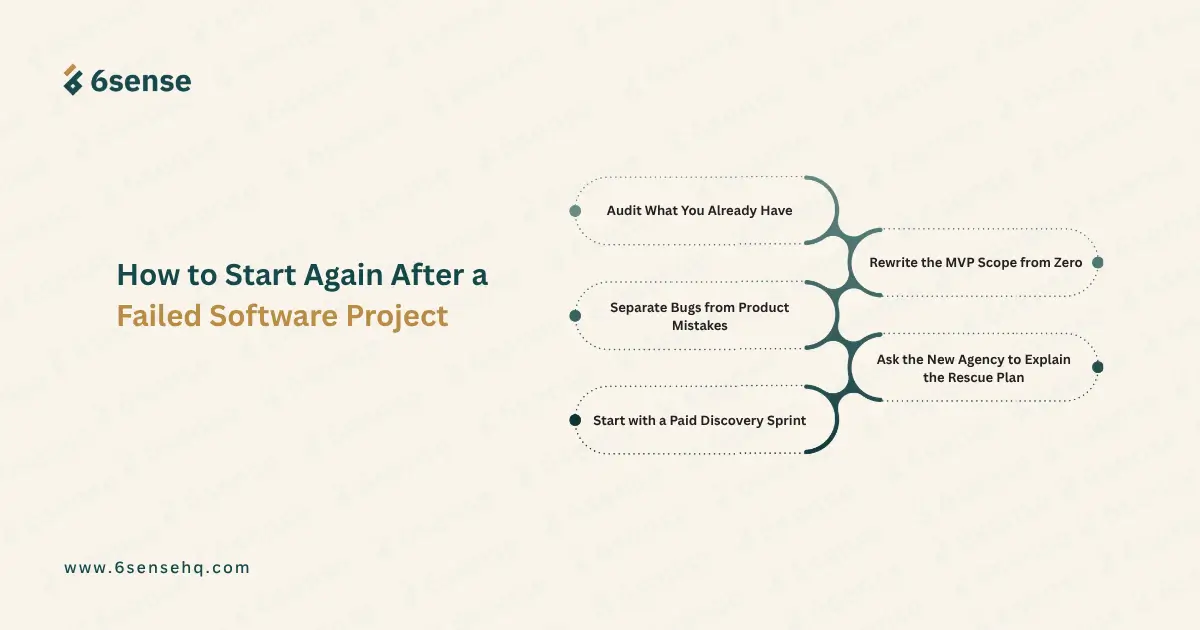
Before hiring a new developer, ask for a technical audit of the existing code, design, database, and hosting setup. Sometimes the whole product is not useless. For example, the UI may be weak, but the backend logic may still be reusable.
Do not carry every old feature into the new build. Write down the one main user problem, the core journey, and the must-have features only. If your old MVP had 25 features, the restart version may only need five.
A failed project may have two problems: bad code and bad product direction. Bugs can be fixed, but wrong assumptions need user validation. For example, if users never wanted the feature, rebuilding it cleaner will not help.
A reliable MVP agency should not just say, “We can fix it.” They should explain what they will keep, rebuild, remove, and test. Ask for a short rescue roadmap before giving them the full project.
Instead of signing a large build contract, pay for a small discovery sprint first. In one or two weeks, the agency can review the product, define the new scope, estimate the effort, and show how they think.
One founder came to us after losing approximately $42,000 to a previous development agency building a B2B operations platform. The original project had already been running for four months. The agency promised a complete AI-powered dashboard with advanced reporting, but progress updates mostly consisted of screenshots instead of working software.
The first rescue step was a technical audit. We discovered that only around 35% of the existing work was reusable. The database structure was usable, but the authentication logic, user permissions, and reporting workflows needed rebuilding.
Instead of continuing with all 23 original features, the scope was reduced to six critical workflows. A 90-day rescue roadmap was created:
The result: a live MVP launched in 84 days with 120 active users in the first month.
Founder comment:
"The biggest surprise wasn't rebuilding the product. It was realizing we should have audited the first agency much earlier."
After a bad agency experience, trust should be earned slowly. Check how the agency thinks, communicates, estimates, and handles risk before you let them touch your full product.
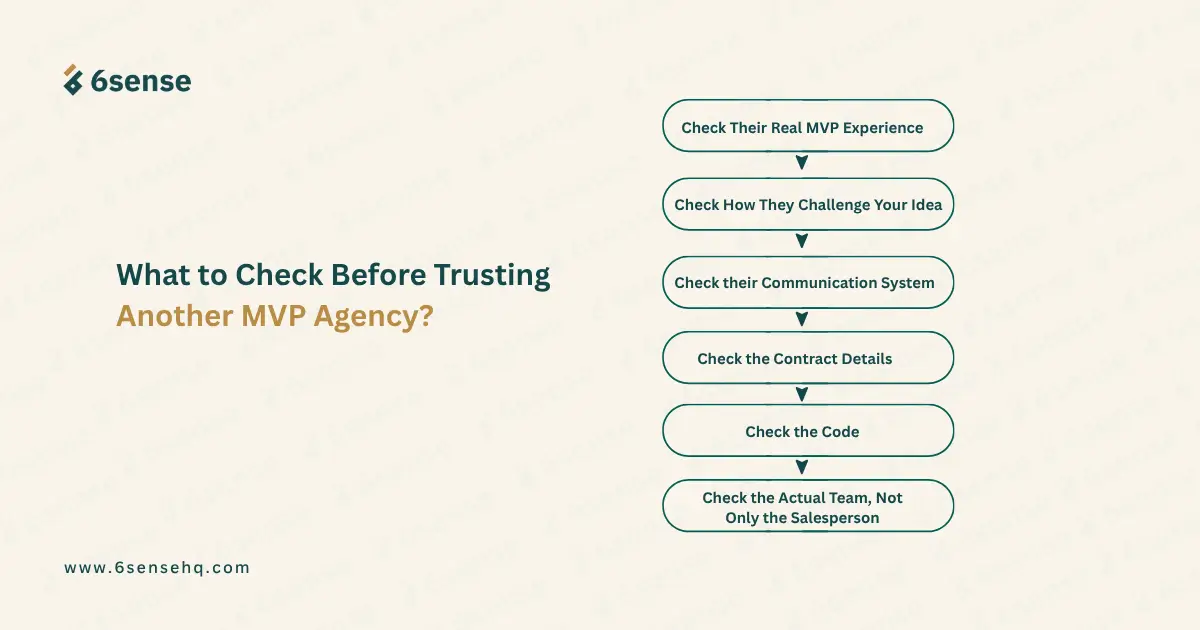
Ask for MVPs they have actually launched, not only websites or app mockups. A reliable agency should explain what the product did, who used it, what changed after launch, and what they learned from user feedback.
If an agency agrees with everything, be careful. A strong team asks hard questions like, “Why does this feature matter now?” or “Can we validate this manually first?” That pushback protects your money.
If you are not technical, it also helps to have a simple operating system for managing developers without getting lost in technical details, especially when sprint priorities, bugs, and scope changes start moving quickly.
Ask what tools they use. Strong teams usually have:
Good example:
"Every Friday we review working software, discuss blockers, and update the next sprint."
Red flag example:
"We’ll send updates when something major happens."
After a failed project, contracts matter much more than promises.
IP Assignment
Look for wording similar to:
"All work products created during the engagement become property of the client after payment completion."
Without this, ownership can become unclear.
Work-for-Hire Clause
A work-for-hire clause protects founders by confirming that code, designs, and documentation belong to the company paying for the work.
Milestone Payments
Avoid paying large amounts upfront.
Safer structure:
Bug Warranty
Minimum recommended: 30 days post-launch
Include:
GitHub Handover
Use GitHub Organizations instead of developer-owned repositories.
Founder email should own:
Escrow Protection
For larger builds:
Iron Mountain and Escrow.com can protect source code access if something happens to the agency.
In 2026, non-technical founders can also use AI-assisted code review tools during MVP recovery.
Examples:
These tools do not replace senior engineers, but they help founders identify obvious quality issues before paying for a complete rebuild.
Meet the people who will build your MVP. A polished founder call means little if junior developers do all the work without guidance. Ask who owns the architecture, QA, design, and delivery decisions.
After losing money once, most founders immediately ask:
"What should this realistically cost so I don't get burned again?"
Pricing varies by complexity, but large pricing gaps can become warning signs. Extremely low pricing sometimes means:
According to Clutch pricing benchmarks, software development firms commonly charge between $24–$49/hour, while larger US-based teams frequently exceed $100–250/hour.
| Phase | Typical 2026 Cost | Timeline | What You Should Receive | Red Flag If Lower |
| Discovery Sprint | $2K–8K | 1–2 weeks | User flows, scope, technical roadmap | "Free discovery" with no outputs |
| Code Audit | $1K–5K | 2–5 days | Quality report, architecture review | No written findings |
| Technical Due Diligence | $3K–15K | 1–2 weeks | Risk analysis, scalability review | Generic advice only |
| Full MVP Rescue Build | $25K–80K |
For founders who already raised capital, MVP planning after funding should be even more disciplined because investor money increases the pressure to show progress, control scope, and avoid another expensive rebuild.
| Risk Area | What Usually Goes Wrong | What to Do Instead |
| Scope | Too many features get added too early | Build only the core user journey first |
| Budget | Hourly work keeps expanding | Use milestone-based payments with clear deliverables |
| Timeline | Agency gives an unrealistically fast promise | Ask for a phase-by-phase delivery plan |
| Team | You only meet the salesperson | Meet the PM, tech lead, designer, and QA |
| Code | Founder cannot judge quality | Get an independent code review before continuing |
| Ownership | Agency controls accounts or code | Keep GitHub, hosting, domain, and tools under your account |
| Communication | Updates are vague or late |
"I spent two weeks on the audit before touching code again. It saved me from repeating the same mistake."
"The discovery sprint cost around $4K. It ended up being the cheapest insurance I bought."
"Owning the GitHub repository from day one became non-negotiable."
The right builder depends on your budget, product risk, technical complexity, and how much guidance you need. Do not choose by price alone. Choose by fit.
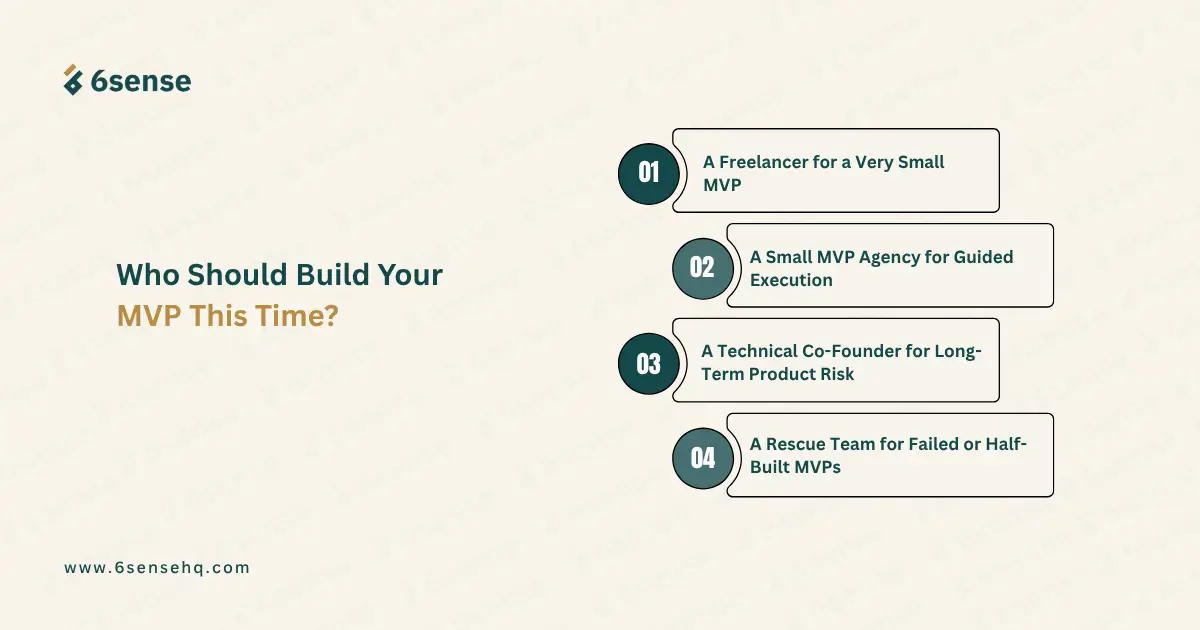
Before hiring only one freelancer, be honest about whether a single developer is enough for the first MVP or whether the product also needs design, QA, backend planning, and project management support.
A small agency works well when you need design, development, QA, and project management together. This is useful for non-technical founders who need one team to manage the full build.
If the product is not deeply technical yet, you may not need to give away equity immediately. Many founders can still build without needing a technical co-founder first, as long as the scope is clear and the delivery team can translate product goals into technical execution.
If you have already lost money, look for a team that can audit, simplify, rebuild, and stabilize. They should be comfortable fixing messy code, not only starting fresh projects.
Before choosing a partner, match the team type with your real situation. A bad fit can create the same pain again, even if the people are talented.
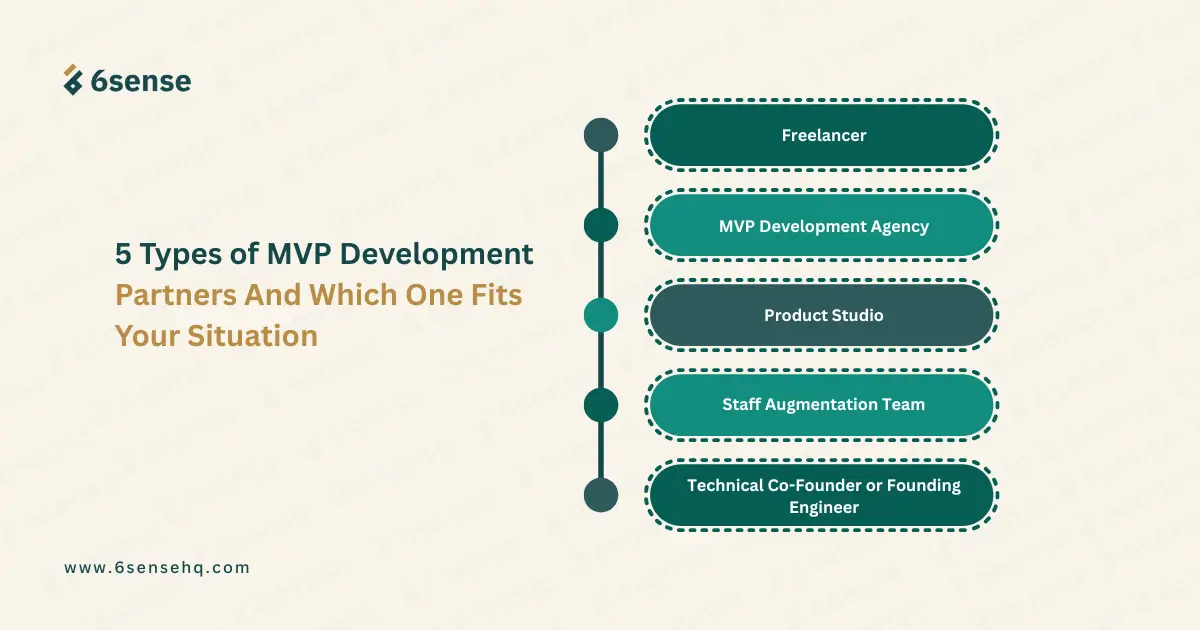
Best for very small MVPs, landing pages, simple dashboards, or prototypes with clear requirements. The cost is usually lower, but you must manage communication, QA, architecture decisions, and delivery risk more closely yourself.
Best for founders who need a complete team. A good agency gives you product planning, UI/UX, frontend, backend, QA, and delivery management. This works well when you need speed but still want structure.
Best when your idea still needs shaping. Product studios usually help with strategy, user journeys, design, and validation before development. They may cost more, but they can reduce waste if your idea is not fully clear.
Best when you already have a technical lead or internal team, but need extra developers. This is not ideal if you expect the vendor to own product decisions, roadmap, and full delivery.
Best when the product is technically complex or will need constant changes after launch. This option takes longer to find, but it gives stronger ownership than a short-term vendor.
Ask for examples from your industry or product type. If you are building SaaS, ask for SaaS examples. If you are building marketplace software, ask for marketplace examples. Similar work reduces learning time and risk.
A design portfolio can look impressive, but a real MVP must work. Ask for live links, demo access, or case studies showing actual users, features, launch results, and technical decisions.
Ask for the project manager, designer, developers, QA tester, and technical lead. You should know who is responsible for decisions. If you only meet a salesperson, the real delivery team may be weak.
This question shows whether they understand MVP thinking. A reliable team should help you cut features. For example, they may suggest manual admin approval instead of building full automation in version one.
Ask how they break down effort. Reliable agencies explain assumptions, risks, dependencies, and phases. Be careful if they give a final price after one short call without asking detailed product questions.
Every MVP changes. Ask how new ideas, feature changes, or user feedback will be handled. You need a written change process so small changes do not become surprise bills later.
Ask for weekly demos, sprint reviews, or milestone walkthroughs. Screenshots are not enough. You should see working software regularly so you can catch problems before they become expensive.
The answer should be clear: you should own the source code, designs, documentation, and product assets after payment. Also ask whether accounts will be created under your company email.
Your MVP will need bug fixes, user feedback changes, analytics, and small improvements. Ask whether they offer warranty support, maintenance, or a post-launch improvement plan after the first release.
Ask about QA, browser testing, mobile responsiveness, security checks, and acceptance testing. A good agency does not treat testing as optional. They should show how bugs are tracked and fixed.
This is one of the best questions. A trustworthy agency will tell you the hard truth. They may mention technical risk, budget risk, unclear scope, weak validation, or timeline pressure.
Before signing a large contract, ask for a discovery sprint, prototype, technical audit, or small build phase. This lets you test their communication, quality, speed, and thinking with limited risk.
Finding a reliable MVP agency after a bad experience is not about becoming more suspicious of everyone. It is about becoming more structured. Your next partner should show proof, ask hard questions, explain trade-offs, protect your ownership, and build in small, testable steps.
Do not rush because you have already lost time. A careful restart can save more money than a fast mistake. Start with an audit, narrow the scope, test the agency with a small phase, and only then move into full development. Your next MVP should not just be built. It should be built to learn.
If you've already been burned once, 6sense HQ offers a free 30-minute audit conversation. We review your existing code, scope, and technical situation and tell you honestly whether you should rebuild, refactor, or restart. No commitment required.
Compare 6sense HQ and DevToDollars on MVP speed, team models, proof, pricing, and post-launch support to pick the right fit.
15 min read
Compare 6sense HQ alternatives for MVP development in 2026 and find the best software team for your startup budget and goals.
17 min read
| Product rebuild with PM and QA |
| Instant quote after one call |
| Post-launch Support | $1K–3K/month | Ongoing | Bug fixes and monitoring | No support period |
| Testing | Product launches full of bugs | Add QA, acceptance testing, and bug-fix warranty |
| Validation | Product is built before user proof | Test with real users before adding more features |
| Support | Agency disappears after launch | Agree on post-launch support before signing |
Learn whether one developer can build an MVP in 2026 with cost, scope, AI tools, low-code tips, risks, and launch advice.
22 min read