

6sense HQ vs DevToDollars: Best MVP Partner in 2026
Compare 6sense HQ and DevToDollars on MVP speed, team models, proof, pricing, and post-launch support to pick the right fit.
15 min read
Loading…
See how Airbnb, Uber, and Dropbox turned simple ideas into billion-dollar MVPs – and how you can do it too!
Written by: AKM Ahsan Created on: 29 Apr 20268 min to read
Most billion-dollar startups didn’t start big; they started embarrassingly small.
Airbnb began with air mattresses on a living room floor, Uber started as a simple ride request for a few people, and Dropbox was just a demo video. These weren’t polished products. They were quick experiments to test one simple idea: will people actually use this?
At 6sense HQ, we’ve helped founders build MVPs across multiple industries and the pattern is always the same: real problem, smallest possible test, and feedback before scaling. The same approach used by Airbnb, Uber, and Dropbox still works today.
In this blog, we’ll explore how Airbnb, Uber, and Dropbox built their first MVPs, why those simple versions worked, startup MVP success stories, and how you can apply the same thinking to your own lean startup journey today.
A Minimum Viable Product (MVP) is the simplest version of a product that solves one core problem and helps test if people actually want it. According to Eric Ries, an MVP helps teams learn with “the least effort.”
This practical guide to MVP development uses real startup examples to show how founders can validate demand, reduce unnecessary investment, and build around genuine user feedback before scaling.
Around 90% of startups fail, often because they build something people don’t need. That’s why MVPs matter; they reduce this risk by testing ideas early.
An MVP lets you learn fast, spend less, and build something users truly care about instead of guessing.
| Company | Year | MVP Type | Core Problem | Key Outcome | Current Scale |
| Airbnb | 2008 | Concierge MVP | Expensive hotels | 3 users, $240 revenue | Global marketplace |
| Uber | 2010 | Single-feature app | Taxi inefficiency | First rides in SF | $100B+ company |
| Dropbox | 2007 | Video MVP | File syncing | 75K signups | Millions users |
| Buffer | 2010 |
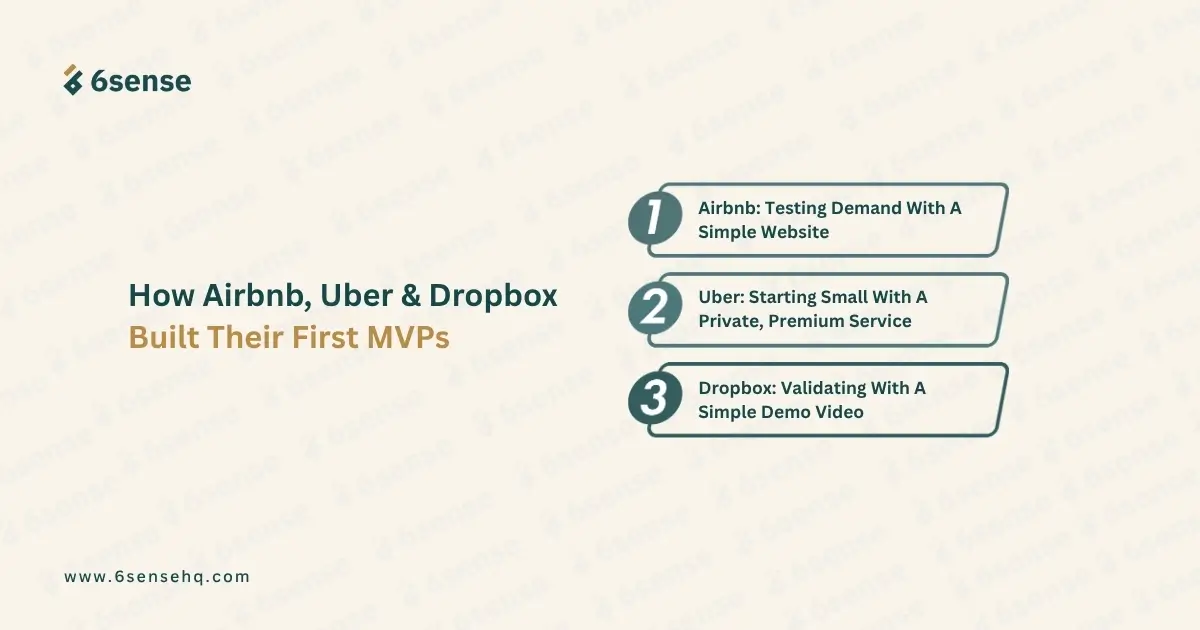
MVP Type: Concierge MVP Duration: 1 weekend Investment: ~$0 Result: 3 paying customers, $240 revenue
Airbnb’s MVP was a simple website listing air mattresses in the founders’ apartment.
They manually:
This wasn’t scalable, but it proved demand.
Key insight: They didn’t build software first—they tested behavior first.
If you want to apply the same thinking, explore our MVP development process to see how founders go from idea to working MVP step by step.
MVP Type: Single-feature app Duration: ~6 months Investment: ~$200K seed Result: First rides in San Francisco
Uber started with:
No:
Key insight: They validated convenience, not infrastructure.
MVP Type: Video MVP Duration: ~3 months Investment: ~$0 Result: 75,000 signups overnight
Dropbox built a demo video instead of a product.
The video showed:
Users immediately signed up.
This approach highlights a key shift: Video MVPs vs traditional prototypes, where prototypes try to simulate interaction, video MVPs focus on clearly demonstrating value without building functionality.
Key insight: They validated demand before solving technical complexity.
MVP Type: Landing page MVP Duration: 1–2 weeks Investment: <$1,000 Result: 100,000 users in 9 months
Buffer’s MVP had:
No product existed.
Key insight: You can validate demand without building anything.
MVP Type: Concierge MVP Duration: Few weeks Investment: Minimal Result: Validated online shoe demand
Founder:
Key insight: Manual effort > building unnecessary systems early
MVP Type: Internal MVP Result: Internal adoption → global SaaS
Slack started as:
Only later:
Key insight: Solve your own problem first
MVP Type: Closed beta MVP Result: High retention before scaling
Spotify:
Key insight: Performance mattered more than features
Today, MVPs are no longer slow or expensive. Founders validate ideas faster than ever using no-code tools, demo videos, and simple experiments, focusing on demand before development.
This is the fastest way to decide your MVP approach.
And most importantly: They tested behavior, not opinions
These MVPs worked because they focused on real problems, not perfect products. Early users didn’t care about design or scale; they cared about solving a clear pain point quickly.
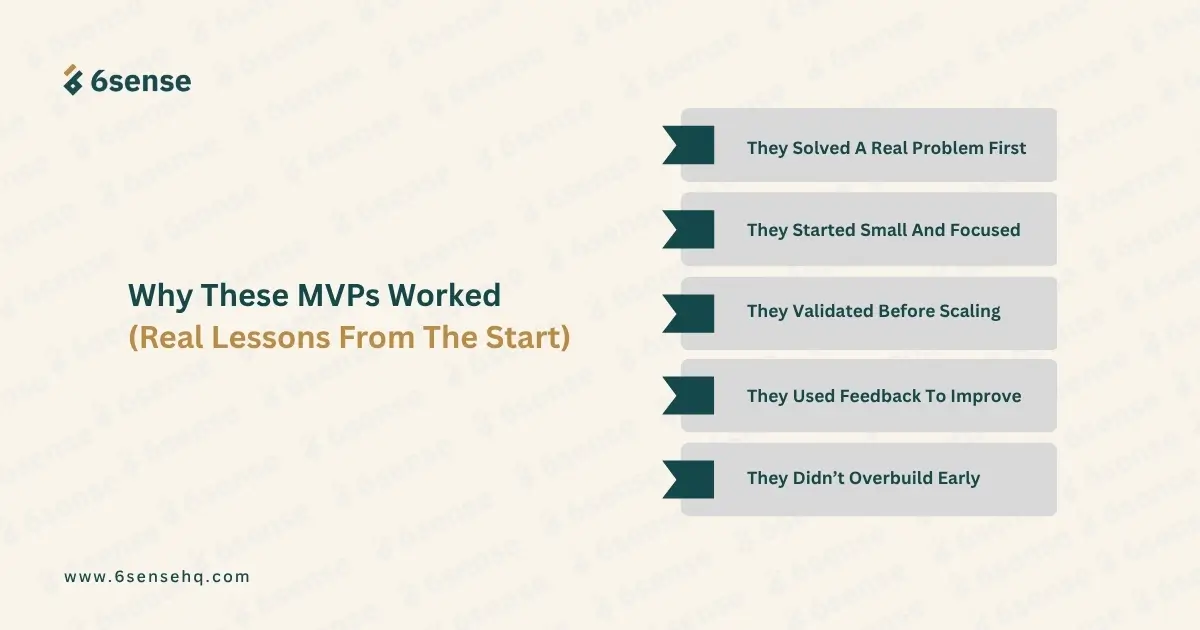
Airbnb solved the problem of expensive, unavailable hotels. Uber solved unreliable taxis. Dropbox solved file-sharing frustration. These problems were already painful. That’s why users were willing to try something new, even if it was simple and imperfect at the start.
Instead of building for everyone, they focused on a small group. Airbnb targeted conference visitors. Uber focused on premium riders in one city. Dropbox targeted early tech users. This helped them learn faster and improve quickly without getting overwhelmed.
They didn’t assume success; they tested it. Airbnb earned just $240 initially, but it proved people would pay. Dropbox validated demand through a video before coding. This reduced risk and gave them confidence to move forward step by step.
Early users shaped the product. Airbnb improved listings and photos based on feedback. Uber refined its ride experience. Dropbox improved syncing features. Instead of guessing, they listened and built product-market fit for things that users actually wanted.
None of them started with complex features. They avoided wasting time on things users didn’t need. This helped them move fast, save money, and focus only on what mattered at the beginning.
These MVP stories succeeded, but thousands of startups followed the same playbook and still failed.
The difference wasn’t the MVP. It was the problem behind it.
Research consistently shows:
An MVP doesn’t create demand; it reveals it.
Many failed startups:
but still failed because: They validated the product, not the problem.
Don’t copy the MVP format; copy the thinking behind it.
Airbnb didn’t succeed because it built a simple MVP. It succeeded because: People already needed cheaper, flexible accommodation.
The pattern across every successful MVP is simple: the smallest possible test of the most painful problem.
Airbnb, Uber, and Dropbox didn’t succeed because they built products early. They succeeded because they tested demand first, focusing on real user pain before investing in full development, something you can better plan using an MVP cost guide that maps investment to each validation stage. Research consistently shows that many startups fail not because of poor execution, but because they build something the market doesn’t actually need
Have a conversation with our experts at 6sense HQ and turn your idea into a working MVP with the right strategy and execution.
Compare 6sense HQ and DevToDollars on MVP speed, team models, proof, pricing, and post-launch support to pick the right fit.
15 min read
Compare 6sense HQ alternatives for MVP development in 2026 and find the best software team for your startup budget and goals.
17 min read
| Social scheduling |
| 100K users in 9 months |
| SaaS business |
| Zappos | 1999 | Concierge MVP | Buying shoes online | Validated demand manually | $1.2B acquisition |
| Spotify | 2008 | Beta MVP | Music streaming latency | Closed beta success | Global platform |
| Slack | 2013 | Internal MVP | Team communication | Internal adoption first | $27B+ acquisition |
Learn whether one developer can build an MVP in 2026 with cost, scope, AI tools, low-code tips, risks, and launch advice.
22 min read