

6sense HQ vs DevToDollars: Best MVP Partner in 2026
Compare 6sense HQ and DevToDollars on MVP speed, team models, proof, pricing, and post-launch support to pick the right fit.
15 min read
Loading…
Validate MVP ideas with customer discovery: 10 interview questions, frameworks, and tactics to avoid wasted $50k–$80k builds fast.
Written by: AKM Ahsan Created on: 12 May 202614 min to read
Most MVPs don’t fail after launch; they fail before they even start. The moment you assume what users need instead of asking them, you’re already building on guesswork. And for a $50,000–$80,000 MVP build, guesswork is a decision you cannot afford.
Studies from CB Insights show that 42% of startups fail because they build products with no real market need. Customer discovery is the only reliable way to find that out before you spend money on development.
Customer discovery questions for MVP help you replace assumptions with real insights. Instead of building first and hoping it works, you talk to users, understand their actual problems, and validate whether your idea is worth building at all. This work should be part of focused user research for your MVP, not treated as a one-off conversation before development.
6sense HQ has facilitated customer discovery sessions for 50+ non-technical founder MVPs across SaaS, HealthTech, and FinTech startups through structured customer discovery sessions, and the questions in this guide are drawn directly from what has consistently surfaced the most useful insights across those conversations.
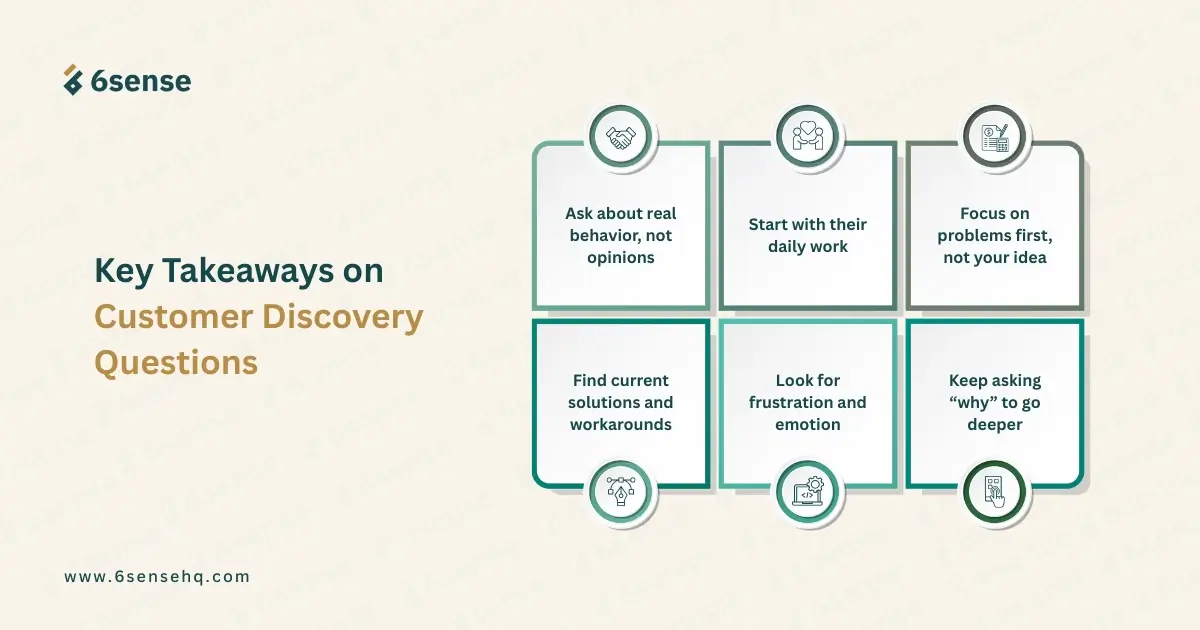
Modern customer discovery is built on three foundational startup frameworks:
Together, these frameworks shift discovery from guessing into structured hypothesis testing, the core principle behind Lean Startup methodology. For a deeper look at how discovery fits into the full product-building process, read our guide on MVP Development Framework & Methodology. You can also review the MVP development process from discovery to launch to understand how interview findings influence planning, design, development, testing, and iteration.
Use tools like Calendly (free) to schedule discovery calls and send participants a short screener form before confirming interviews. This helps filter out users who don’t actually experience the problem you’re researching.
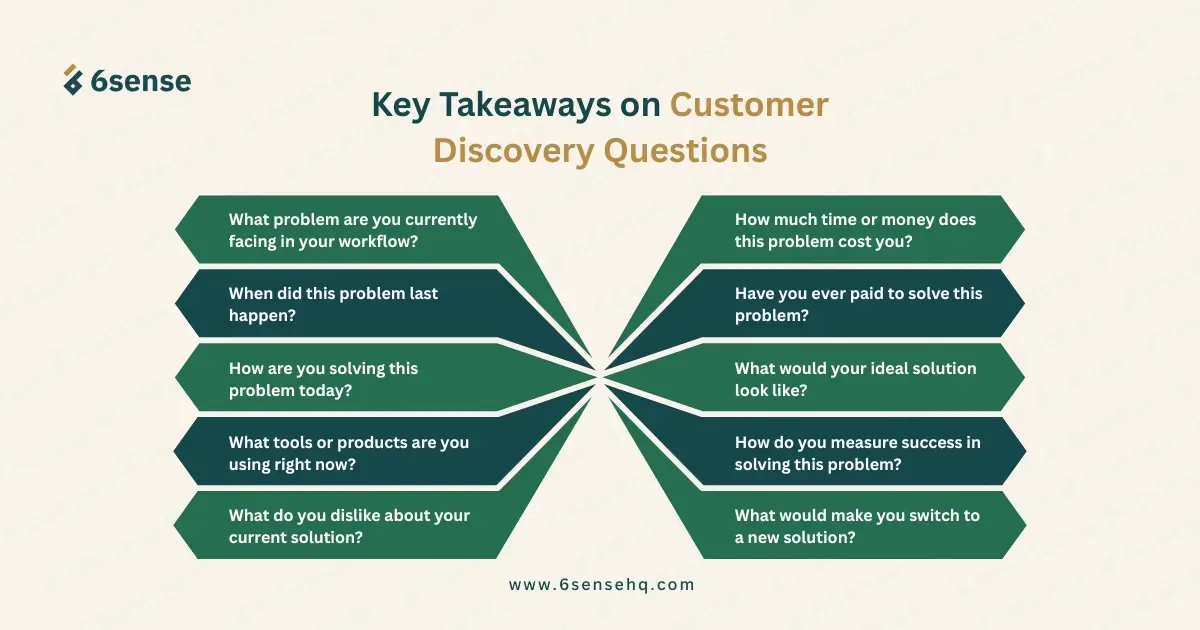
This is your starting point. You want to understand what’s actually bothering the user, not what you think is a problem. Keep it open-ended and let them explain in their own words.
Example: A founder thought reporting was the issue, but users kept talking about “manual data entry.” That became the real MVP focus.
This question shifts the conversation from opinion to reality. People often exaggerate problems, but real events show the truth.
Example: Instead of saying “this happens all the time,” a user might describe one recent stressful moment, which tells you how serious the problem actually is.
This reveals current behavior. Every problem already has a solution, even if it’s messy or manual.
Example: Many users rely on spreadsheets, WhatsApp, or manual tracking. These “hacks” are strong signals for automation opportunities in your MVP.
This helps you understand competitors and alternatives. Sometimes your real competitor isn’t another startup, it’s Excel or a simple workaround.
Example: A founder building a project tool realized teams were using Google Sheets + Slack instead of paid tools. That shaped a simpler MVP.
This is where you find your edge. Look for frustration, confusion, or inefficiency.
Example: Users might say tools are “too complex” or “take too long,” which tells you exactly what to fix in your MVP.
This helps you measure the seriousness of the problem. If it costs time, money, or stress, it’s worth solving.
Example: If a user says they spend 5 hours a week on it, that’s a strong signal for building a solution.
This is one of the strongest validation signals. If users are already paying, the problem is real.
Example: A founder discovered users were paying for multiple tools just to fix one issue, which validated demand for a better MVP.
Let users describe their “dream scenario.” This shows expectations and priorities.
Example: Instead of asking for features, users might say “I just want this to happen automatically,” pointing toward automation.
This helps you define what “value” means to the user.
Example: Some users care about saving time, others about accuracy or revenue. Your MVP should align with their definition of success.
This question uncovers buying triggers. It tells you what your MVP must do to win users.
Example: Users might say “if it’s faster” or “if it’s cheaper,” giving you clear direction for positioning your product.
Understanding customer problems is the foundation of every successful MVP. These questions help founders uncover how painful, frequent, and urgent a problem actually is. The goal is not to hear users say your idea sounds “interesting.” The goal is to understand what consistently frustrates them in real life. As frameworks like Jobs-to-be-Done explain, users adopt products to make progress in a difficult situation, not simply because a feature exists.
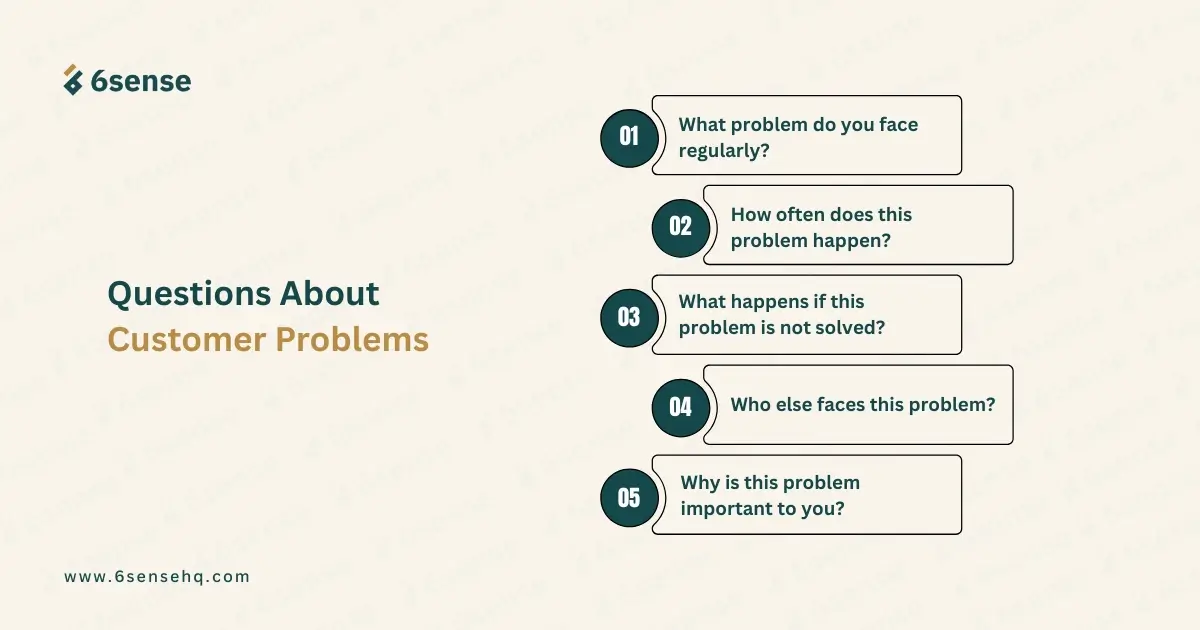
This question identifies recurring pain points instead of one-time annoyances.
Strong answer:
“Every week I lose hours manually updating spreadsheets across different tools.”
This signals a repeated operational problem worth solving.
Red-flag answer:
“Nothing major honestly, just minor inconvenience sometimes.”
This usually means the pain is not strong enough for MVP validation.
Follow-up question:
“Can you walk me through the last time this happened?”
Frequency reveals urgency. Daily or weekly problems are usually stronger MVP opportunities than occasional frustrations.
Example: Founders often discover users repeat inefficient workflows every single day.
This reveals emotional, operational, or financial impact.
Strong answer:
“We miss client deadlines and sometimes lose revenue because of it.”
Strong impact usually signals strong willingness to adopt solutions.
Red-flag answer:
“It’s annoying, but we usually just deal with it.”
Low urgency often means weak demand.
Follow-up question:
“What does that delay actually cost your team?”
This helps estimate whether the problem affects individuals, teams, or entire industries.
This uncovers emotional drivers like stress, embarrassment, lost trust, or wasted time, signals often stronger than feature requests.
Customer discovery is not only about understanding problems. It’s about understanding how users already solve them today. Current workflows, spreadsheets, manual hacks, and alternative tools are all competitors to your MVP. As The Mom Test emphasizes, founders should focus on real behavior instead of hypothetical opinions.
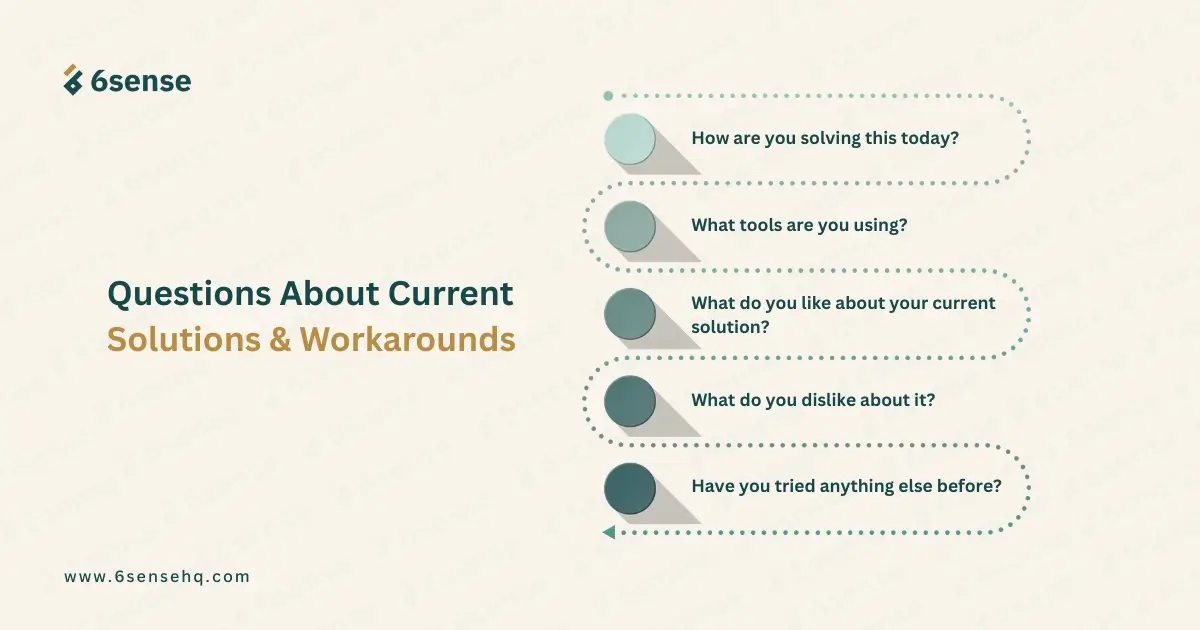
This question uncovers existing behavior and reveals whether the problem is painful enough that users already invest time or effort solving it manually.
Strong answer:
“I use three different spreadsheets and still miss things.”
This indicates strong workflow friction.
Red-flag answer:
“Oh, it’s not really a big issue.”
Weak pain usually means weak MVP demand.
Follow-up question:
“Walk me through the last time you had to deal with it.”
This identifies direct competitors, substitutes, or fragmented workflows.
Example: Users often combine Slack, spreadsheets, and Notion to solve one operational problem.
This reveals what users already value and what your MVP should preserve.
This exposes gaps your MVP can improve.
Strong answer:
“It works, but onboarding new team members takes forever.”
This reveals friction strong enough to justify switching.
Red-flag answer:
“Honestly it works pretty well.”
If users feel fully satisfied, switching becomes difficult.
Follow-up question:
“What’s the most frustrating part of using it repeatedly?”
Past failed attempts often reveal market gaps and unmet needs more clearly than direct feature requests.
Many founders underestimate competition because they only think about software competitors. In reality, spreadsheets, manual processes, agencies, and even “doing nothing” are all alternatives users compare against. These questions help uncover buying behavior, switching triggers, and pricing sensitivity.
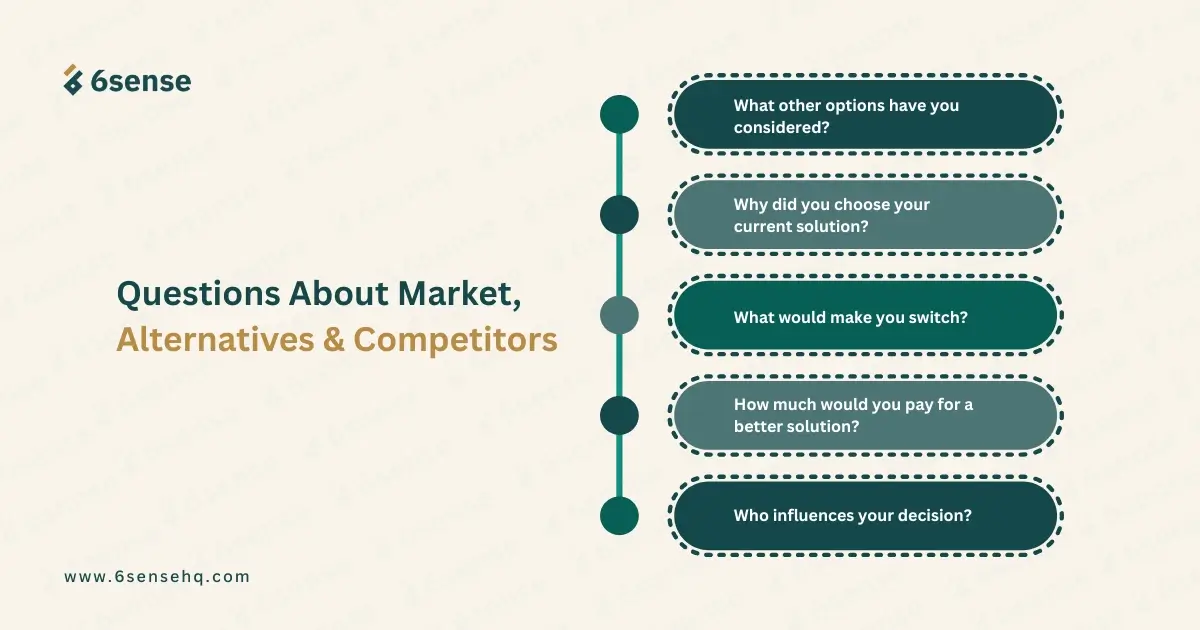
This helps identify all alternatives users compare against, including manual workflows.
Strong answer:
“We considered hiring a VA because existing tools were too complicated.”
This reveals unmet demand despite available solutions.
Red-flag answer:
“I never looked into it much.”
This can indicate weak urgency.
Follow-up question:
“What would have made you actively search for alternatives?”
This uncovers buying priorities like speed, simplicity, trust, integrations, or price.
This helps define your value proposition and positioning.
This validates willingness to pay before development begins.
Strong answer:
“If it saved our team 5-6 hours weekly, we’d pay immediately.”
This suggests measurable ROI.
Red-flag answer:
“I’d only use it if it was free.”
This often signals weak monetization potential.
Follow-up question:
“What would make paying for it feel justified?”
This reveals hidden stakeholders like managers, finance teams, founders, or procurement departments.
The end of the interview is where many founders lose momentum. A strong close helps uncover hidden insights, validate seriousness, and expand your discovery network. Great discovery interviews rarely end with “thanks for your time.” They often lead to referrals, future testers, and stronger validation signals.
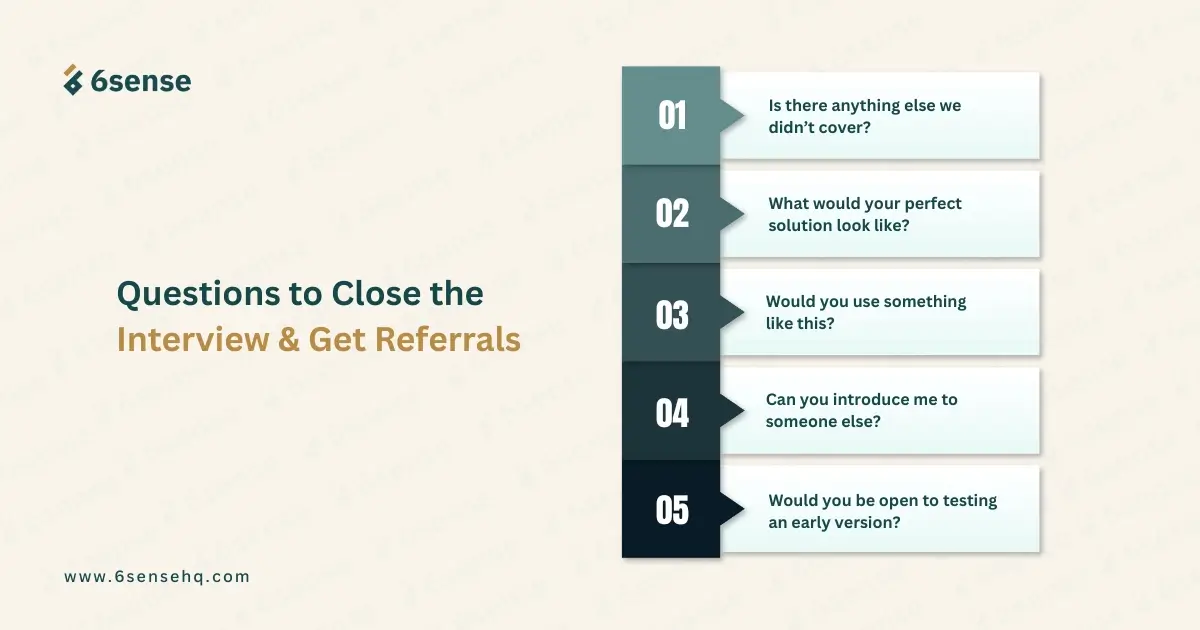
This often surfaces unexpected pain points that founders missed entirely.
This helps identify desired outcomes without directly asking users to design features.
Ask carefully. Focus on behavior instead of opinions.
Strong answer:
“If it solved the workflow issue we discussed, I’d test it immediately.”
This indicates strong relevance tied to existing pain.
Red-flag answer:
“Yeah maybe, sounds cool.”
Vague enthusiasm is not validation.
Follow-up question:
“What would need to happen before you actually tried it?”
Strong referrals usually indicate the problem is widespread within a community or team.
This is one of the strongest validation signals in discovery.
Strong answer:
“Yes, send me the beta once it’s ready.”
This suggests genuine engagement.
Red-flag answer:
“Maybe later.”
Low commitment often signals weak urgency.
Follow-up question:
“What would make testing it valuable enough for you?”
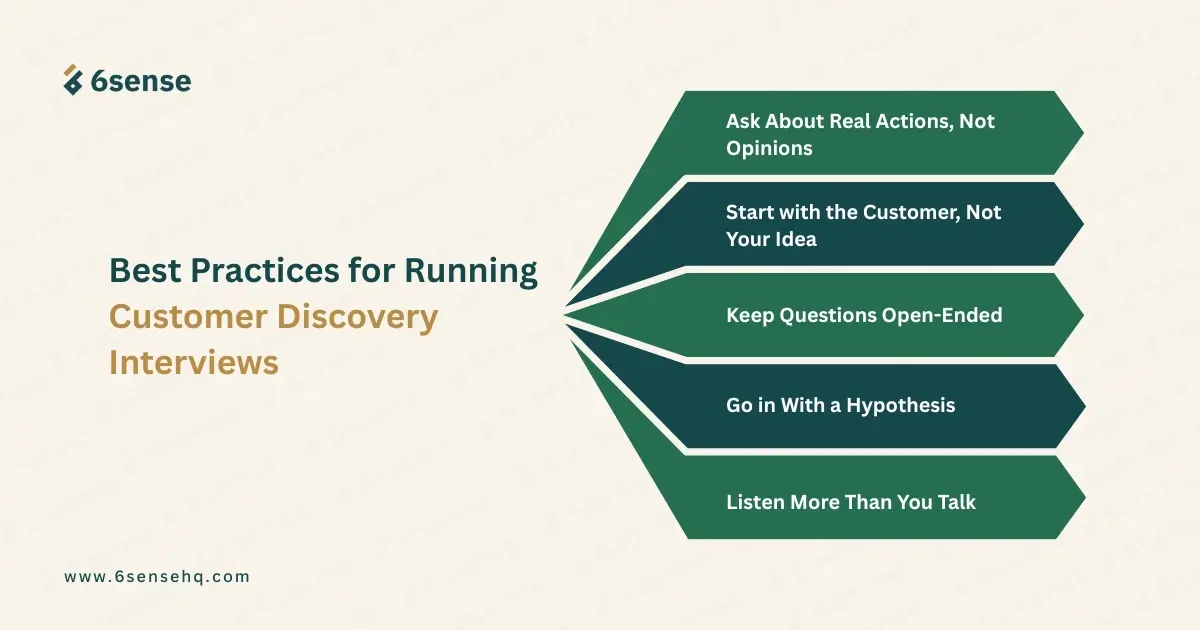
Good interviews are not about asking more questions; they’re about asking the right ones, listening deeply, and avoiding bias while focusing on real behavior and real problems.
As Rob Fitzpatrick explains in The Mom Test, founders should avoid asking users whether an idea is “good” and instead focus on understanding real experiences, workflows, and frustrations.
People often say what sounds good, not what’s true. Instead of asking “Would you use this?”, ask about what they actually did last time. This gives real insights and prevents false validation.
Use tools like Otter.ai (free transcription) or Loom (free tier) to record every session. Founders relying only on handwritten notes almost always miss important details, exact phrases, and emotional signals.
Customer discovery is structured hypothesis testing. A useful framework is:
Users in [segment] will do [action] to avoid [problem].
Example:
Freelance designers will manually manage invoices in spreadsheets to avoid expensive accounting tools.
This creates a measurable discovery goal instead of random conversations.
One founder we worked with at 6sense HQ was building a SaaS tool for freelancers with a $55K budget and no technical background. Using the framework in this guide, she ran 8 customer discovery sessions over 3 days. By interview 5, she realized her original assumption was completely wrong.
She believed invoicing was the core pain point, but users repeatedly described the real issue as tracking client approvals across scattered conversations and spreadsheets.
Well, before any development started, she pivoted the MVP feature set toward workflow tracking instead of billing automation. That discovery process prevented months of wasted development and helped the product launch to paying users within 10 weeks. Reviewing the typical MVP development phases and realistic delivery timeline helps founders understand why discovery decisions must happen before scope, design, and engineering are locked in.
Even with good questions, small mistakes can ruin your insights. Many founders repeat these errors and end up building something nobody wants or needs later.
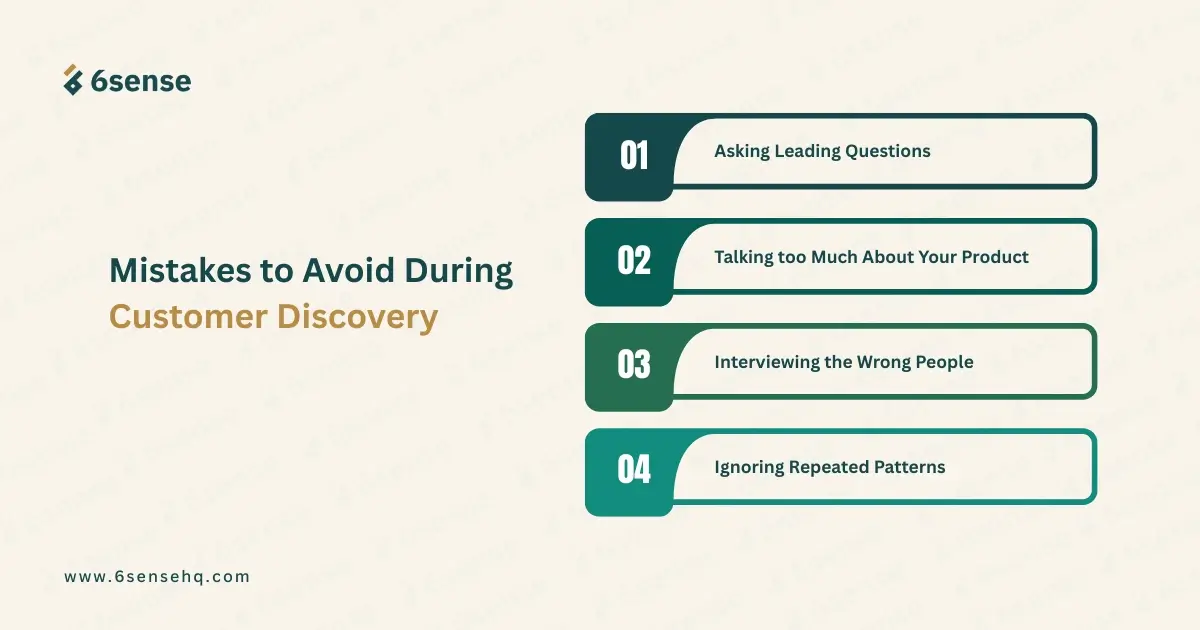
If you ask “Would you like this feature?”, most people will say yes. This gives false validation. Instead, ask about past behavior to get honest answers and avoid bias in your research.
Customer discovery is not a sales pitch. If you explain your idea too early, users may try to be polite instead of honest. Focus on their problems first.
Talking to random users won’t help. You need to find people who actually face the problem. Otherwise, your insights will not be useful for your MVP.
One opinion doesn’t matter much. Look for patterns across multiple interviews. If the same problem comes up again and again, that’s where your MVP should focus.
Read our complete MVP development checklist to avoid the most common founder mistakes before development starts. You can also explore Common MVP Development Mistakes to Avoid to understand where founders usually go wrong before and during MVP development.
Most founders fail customer discovery because they treat interviews like casual conversations instead of structured research sessions.
Here’s a practical interview structure:
| Session Stage | Time | Goal |
| Opening & Context | 5 min | Build rapport and understand the user’s role |
| Problem Discovery | 10 min | Explore frustrations and recurring issues |
| Current Solutions | 8 min | Understand workarounds and existing tools |
| Closing & Referrals | 7 min | Gather referrals and validation signals |
This structure keeps interviews focused while still leaving room for natural conversation.
Finding participants is one of the biggest challenges for first-time founders. Here are the fastest ways to recruit relevant users:
Find communities where users already complain about the problem. Ask thoughtful questions and DM engaged users.
Search by job title and send a short outreach message:
“Hey [Name], I’m researching how teams currently handle [problem]. Not selling anything, just trying to learn from people experiencing it directly. Would love 15 minutes if you’re open.”
Fastest paid option. Most founders spend $25–$75 per participant.
Strong for SaaS and startup audiences.
Avoid close friends and family. Use second-degree introductions whenever possible.
| Insight Found | What It Means | Action for MVP |
| Users repeat the same problem | Strong validation when 5+ users describe the same issue similarly | Build MVP around this core problem |
| Users already pay for a solution | High demand signal and pricing anchor | Build a simpler or better version |
| Users use manual workarounds | Opportunity for automation | Build lightweight automation MVP |
| Users don’t care much | Weak signal | Drop or rethink idea |
| Problems vary too much | No clear focus | Narrow target audience |
Not sure how to interpret your discovery findings? Book a free 20-minute validation call with our team.
Use these findings to build your first user personas and prioritize MVP features more effectively. To turn these insights into clear target users, follow our guide on How to Create User Personas for Your MVP.
Once the core problems are validated, compare MoSCoW, RICE, and Kano for MVP feature prioritization to decide which persona-backed capabilities belong in the first release and which should remain in the backlog.
Customer discovery questions for MVP are not just a step; they are the foundation of building something people actually want. If you ask the right questions, listen carefully, and focus on real problems, your chances of success increase massively.
Start simple. Talk to users. Look for patterns. Don’t rush into building. Then turn the validated findings into a practical MVP roadmap for startup teams with clear milestones, scope decisions, and learning goals. The best MVPs come from deep understanding, not assumptions.
If you want to move faster and avoid common mistakes, get expert guidance from 6sense HQ and turn your idea into a validated product.
Compare 6sense HQ and DevToDollars on MVP speed, team models, proof, pricing, and post-launch support to pick the right fit.
15 min read
Compare 6sense HQ alternatives for MVP development in 2026 and find the best software team for your startup budget and goals.
17 min read
Learn whether one developer can build an MVP in 2026 with cost, scope, AI tools, low-code tips, risks, and launch advice.
22 min read