

6sense HQ vs DevToDollars: Best MVP Partner in 2026
Compare 6sense HQ and DevToDollars on MVP speed, team models, proof, pricing, and post-launch support to pick the right fit.
15 min read
Loading…
Learn how non-technical founders can build a startup product without a CTO using validation, no-code tools, and PM-led teams.
Written by: AKM Ahsan Created on: 19 May 202616 min to read
Imagine launching a tech product without a CTO and still delivering a working MVP that attracts users and even investors. That’s exactly what many founders have done, from simple SaaS tools to early‑stage marketplaces, by planning their roadmap, validating ideas early, and scaling with the right partners. It’s not magic, it’s strategy and execution.
At 6sense HQ, we’ve helped founders build products without a CTO, delivering 47+ MVPs, 25,000+ development hours, and supporting growth with dedicated teams and staff augmentation for founders worldwide.
In this blog, you’ll learn how to build an MVP without a CTO, using smart approaches like no‑code tools, outsourcing, and structured development models that help you ship faster with less technical risk.
Let's see how to build it!
Compare 6sense HQ and DevToDollars on MVP speed, team models, proof, pricing, and post-launch support to pick the right fit.
15 min read

Compare 6sense HQ alternatives for MVP development in 2026 and find the best software team for your startup budget and goals.
17 min read
A Chief Technology Officer (CTO) is the senior executive responsible for a startup’s overall technology strategy, architecture, and technical roadmap. He shapes how the product is built and scaled. In successful startups, a CTO often wears many hats: deciding on tech choices, overseeing engineering, and aligning technology with business goals.
In larger companies, the CTO focuses more on technology vision and innovation, ensuring long‑term growth and product scalability. In early startups, this role might also include managing initial developers or building the first versions of products.
Example: At 6sense HQ, while founders sometimes lack a technical co-founder, the product strategy is still guided by technology experts who help define feature priorities, architecture, and iterative builds, effectively bridging the gap left by an absent CTO.
- Mark Zuckerberg, co‑founder and CEO of Meta (Facebook).
This highlights that in tech, execution and product delivery matter more than titles.
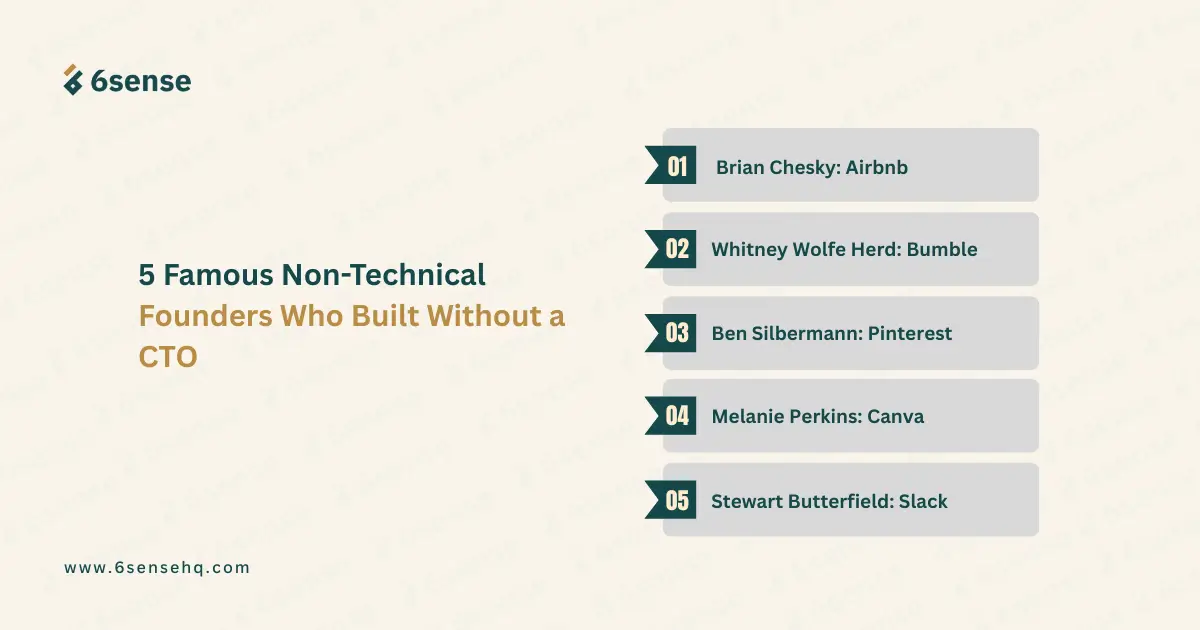
Brian Chesky came from a design background, not engineering. Before Airbnb became a global platform, the founders validated demand using a simple website that rented air mattresses during a conference. The idea was proven before the company scaled technical leadership. Airbnb later brought in deeper engineering support after traction already existed.
Whitney Wolfe Herd was not a technical founder. She focused heavily on product positioning, brand, and user psychology while building Bumble. Technical execution was handled by engineering teams hired later as the company scaled. Bumble eventually became one of the most successful female-led tech companies globally.
Pinterest’s early versions relied heavily on outsourced and contract engineering support while the founders focused on user growth and community building. The company validated demand slowly through obsessive user engagement before aggressively scaling engineering operations.
Melanie Perkins focused on simplifying design for non-designers before Canva became a billion-dollar company. Early validation happened through simple educational products and iterative experimentation before Canva evolved into a globally scalable SaaS platform.
Slack originally emerged as an internal communication tool built during the failure of a gaming startup. The founders validated the communication workflow internally before repositioning the product publicly. The success came from solving a painful operational problem first, not from building complex technology immediately.
Starting and building a tech product without a CTO or even a fractional CTO may seem risky, but it has real upsides for founders who plan well and use modern tools. Here are key benefits:
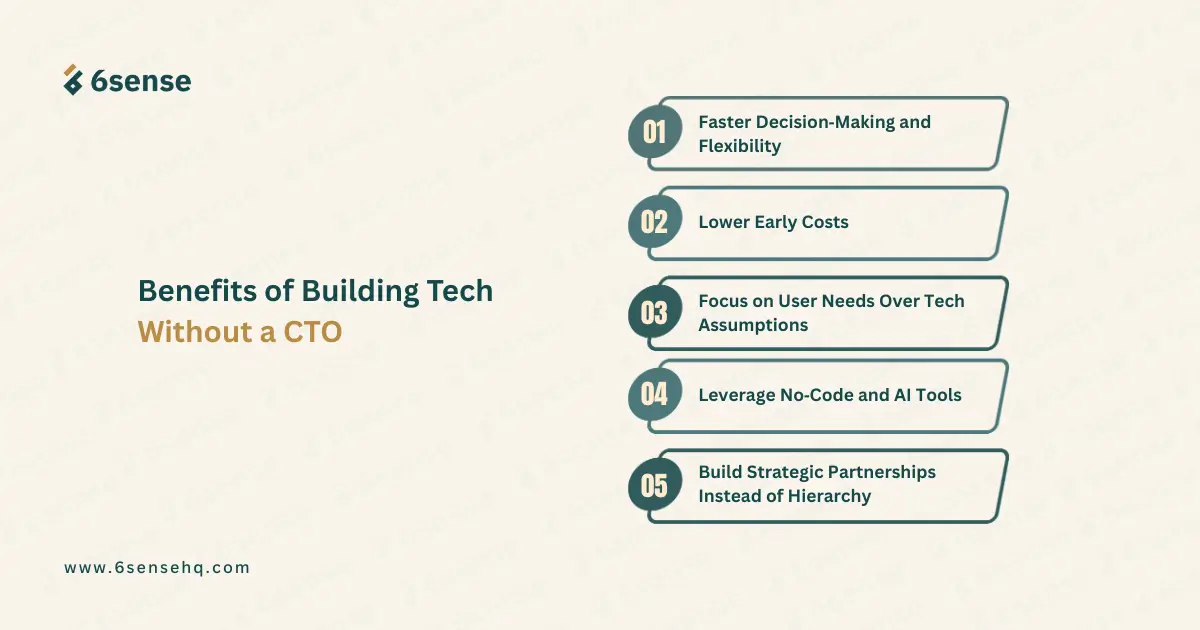
Without a full-time CTO, founders often move faster because fewer approval layers exist. Product decisions happen directly between founders, users, and delivery teams. This is especially useful during MVP stages when priorities change quickly after user feedback.
Real example: One founder working with 6sense HQ initially wanted to build 18 features for a logistics workflow platform. After the first round of user interviews, users repeatedly highlighted one issue: shipment coordination delays. Within the same week, the roadmap shifted from 18 features to 7 core features focused on coordination only. Because decisions were made directly with the PM and founder, the scope changed immediately without going through management layers.
Research consistently shows that startups with shorter feedback cycles validate assumptions faster than teams operating through long internal approval structures. Lean Startup principles are built around rapid Build-Measure-Learn loops instead of long planning cycles.
Common pitfall to avoid: Founders sometimes confuse fast decision-making with having no process at all.
Avoid:
Recovery method: Use weekly sprint reviews and keep one fixed "Must-Have" feature list.
Hiring a full-time CTO early can become expensive, especially before product-market fit exists. Salaries, benefits, equity, and recruitment costs create pressure before the product even reaches users.
Real example: A founder building a B2B operations dashboard originally planned to hire a technical co-founder. Instead, the project used a PM-led team and lightweight validation prototype. The founder avoided giving away early equity and redirected the budget toward customer interviews and beta testing.
According to Clutch pricing reports, many software development firms charge roughly $24–$49 per hour, while average software project budgets commonly range between $10K–$49K depending on scope and complexity.
Common pitfall to avoid: Trying to minimize cost by choosing only the cheapest option.
Many founders hire extremely cheap developers and later discover:
Recovery method: Optimize for value and process quality, not only price.
Founders without a CTO often naturally spend more time understanding customers because they are not immediately jumping into technical discussions.
Real example: One healthcare founder initially believed appointment automation was the biggest problem. During interviews, clinic managers repeatedly discussed billing confusion instead. The MVP shifted toward billing workflows and achieved stronger early adoption than the original idea.
When founders start with users instead of architecture discussions, they often avoid one of the most expensive startup mistakes:
Building something nobody actually needs.
Common pitfall to avoid: Talking only to friends and family.
Friends usually say:
"That sounds interesting."
Real users explain:
"This problem costs me money every week."
Recovery method: Conduct 10–15 customer interviews before finalizing features.
Tool you can use today:
Modern tools have dramatically changed how non-technical founders build products. Instead of waiting months for custom development, founders can test ideas in days or weeks.
Real example: A founder building an internal recruitment workflow tool used Bubble and Airtable to launch a prototype in under two weeks. The MVP reached pilot users before any custom engineering started.
Today founders can use:
to build:
Common pitfall to avoid: Assuming no-code tools remove the need for strategy.
Tools build products faster.
They do not automatically solve:
Recovery method: Validate demand before expanding features.
Rather than immediately hiring a CTO, founders can build flexible support systems through advisors, PM-led teams, or technical partners.
Real example: One founder with no technical background worked with a PM-led development team and a part-time technical advisor instead of hiring a full-time CTO. The founder maintained ownership while still getting technical guidance when needed.
This approach creates flexibility because founders can increase or reduce support based on product stage.
Common pitfall to avoid: Giving away large equity percentages too early.
Many founders assume:
"I need a technical co-founder immediately."
In reality, technical leadership can come through:
Recovery method: Validate first, then bring long-term technical leadership after traction appears.
Building your product without a CTO works best when you follow clear steps rather than guessing what to do next.
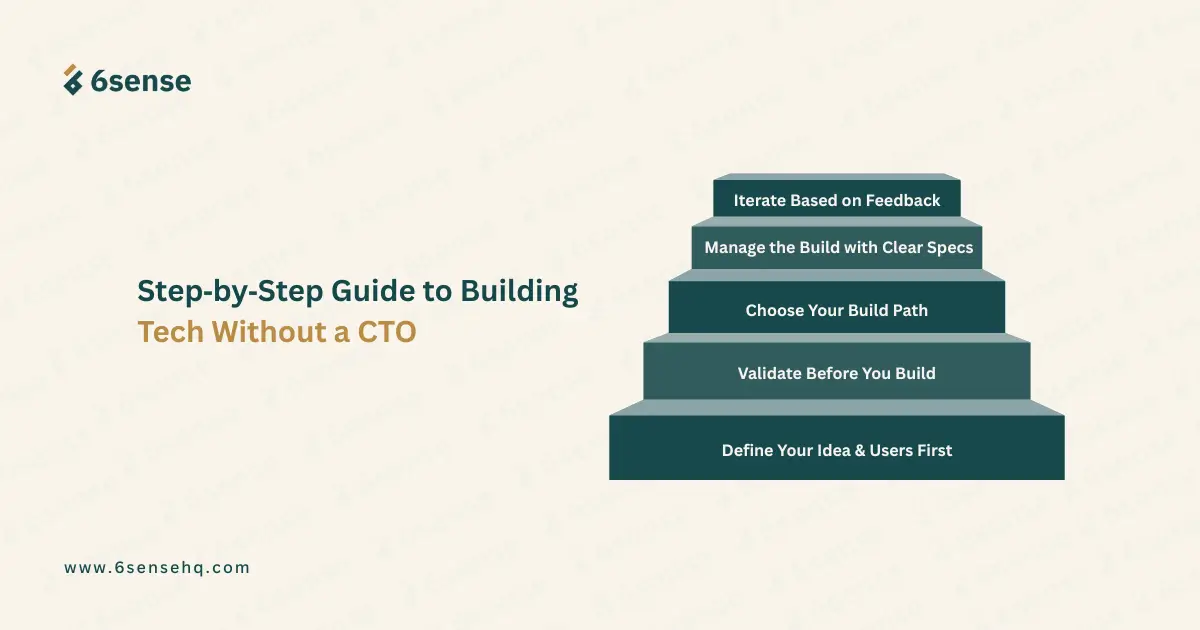
Start by clearly explaining what problem your product solves and who it serves. Writing detailed user stories and outcomes helps everyone you hire or partner with understand your vision. Founders who validate early avoid building unnecessary features later.
Before spending on development, test the demand with a landing page or simple prototype. If people sign up, you prove real interest. This reduces risk and saves money on tools or teams you don’t need.
Decide if you’ll use no‑code tools, hire freelancers, or work with an agency. No‑code tools let you launch quickly, while agencies handle complex builds. Many non‑technical founders use a mix depending on budget and timelines.
A detailed project brief for developers, with mockups, flow diagrams, and acceptance criteria, reduces confusion, speeds progress, and aligns expectations. You don’t need to code; you need clarity.
Collect user feedback from early testers and improve the product in cycles. This learn-build-measure approach improves product-market fit and avoids overbuilding features no one uses.
One non-technical founder came to 6sense HQ with a $55K budget and an idea for a B2B logistics coordination platform. There was no CTO, no engineering background, and no technical co-founder, only a rough workflow document and customer pain points gathered from industry contacts.
Instead of immediately hiring developers, the project started with user interviews, feature prioritization, and a lightweight validation prototype. After validating demand, the MVP was built through PM-led sprints with weekly demos every Friday.
Within 14 weeks, the founder had a working platform used by 3 pilot customers. The startup later expanded the product after validating the operational workflow with real users instead of assumptions.
One of the biggest questions non-technical founders ask is not
The answer depends on the path you choose. Building in-house gives maximum control but is usually the most expensive option. No-code and AI tools reduce upfront costs but may require rebuilding later if the product grows. Agencies and PM-led teams cost more initially, but they often reduce delays, communication issues, and technical mistakes.
According to Clutch software development pricing reports, most development firms globally charge around $24–$49 per hour, with project budgets commonly ranging between $10K–$50K+, depending on scope and complexity.
The ranges below combine public market pricing benchmarks with delivery patterns observed across 47+ startup projects handled by 6sense HQ.
| Path | Typical Cost | Timeline | Best For | Key Risk |
| No-Code / AI Tools | $0–$5K | 1–6 weeks | Early validation, landing pages, simple SaaS workflows | May require rebuilding later |
| Freelancers / Contractors | $5K–$30K | 4–12 weeks | Small products with clear requirements | Communication gaps or inconsistent delivery |
| Agency / PM-Led Team | $40K–$80K | 8–16 weeks | Structured MVP builds and non-technical founders | Choosing the wrong partner |
| In-House Team | $80K–$300K+ yearly | 6–18 months | Long-term products with ongoing development | Hiring cost and management complexity |
| Fractional CTO + Small Team | $10K–$50K+ | 6–14 weeks | Founders needing technical oversight without a full CTO | Can become expensive if scope expands |
This is where MVP Development for Non-Technical Founders becomes less about writing code and more about building with clear scope, product guidance, QA, and steady feedback loops.
At 6sense HQ, most founders building structured MVPs fall into the $40K–$80K range because the scope includes product management, sprint planning, development, QA, and weekly founder demos, not only engineering hours.
AI tools make creating basic tech easier than ever, but many startups still fail to get traction without the right execution.
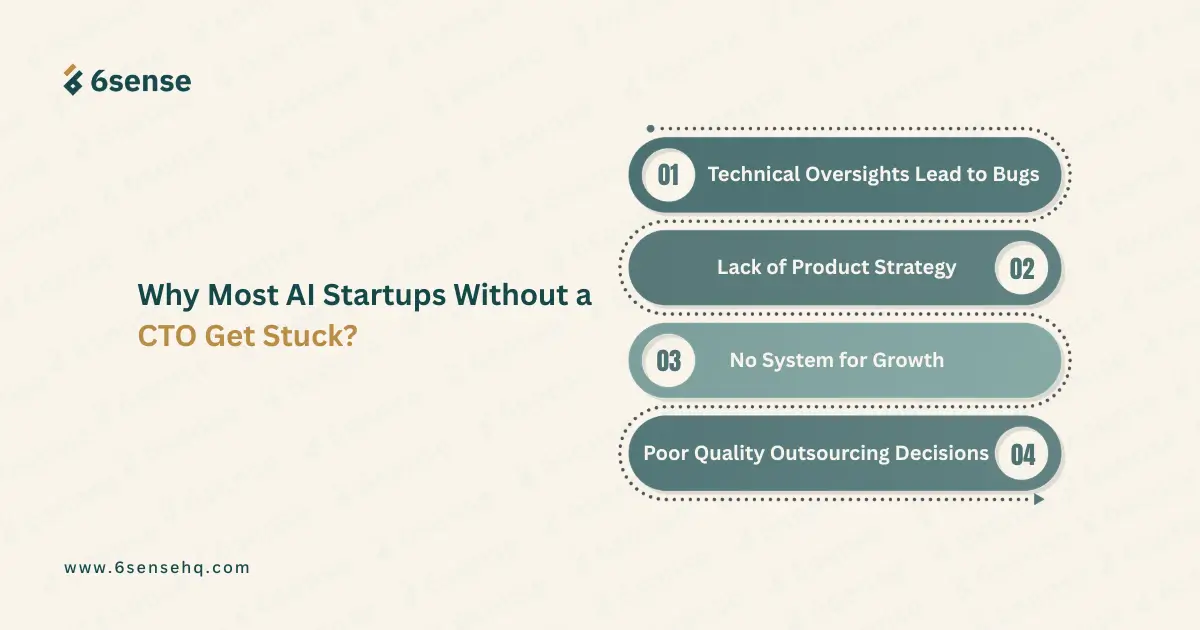
Even if you build quickly with AI or no‑code tools, you might not know how to fix deeper tech problems. This makes it hard to maintain or scale products as they grow beyond the prototype phase.
Without a CTO or technical lead guiding architecture and long‑term scalability, early decisions may create technical debt, which can slow down future development and increase costs.
AI tools help make a working demo, but turning that prototype into a scalable business with stable infrastructure usually requires technical planning that many non‑technical founders overlook.
Outsourcing development without technical oversight can result in poor code, missed milestones, or misunderstandings about scope. This slows down or derails progress.
AI-assisted development has dramatically changed what non-technical founders can build without hiring a full engineering team immediately.
Today, tools like:
allow founders to generate working applications, landing pages, backend workflows, and UI systems using natural language prompts.
For example:
This means many founders can now validate products in days instead of months.
However, AI tools do not replace:
At 6sense HQ, AI-assisted development is used to accelerate MVP timelines, but experienced PMs and engineers still guide architecture, sprint planning, and scalability decisions.
| Decision Factor | Build In-House | No-Code / AI Tools | Outsource to Agency / Team |
| Typical Cost (2026) | $80K–$300K+ yearly | $20–$500/month tools | $30K–$80K MVP range |
| Timeline | 6–18 months | Days to 6 weeks | 8–16 weeks |
| Technical Skill Required | Very High | Low | Very Low |
| Best For | Long-term scaling | Fast validation | Structured MVP builds |
| Equity Required | Often High | None | None |
| Scalability | High | Medium | High |
| Product Ownership | Full | Full | Full IP transfer possible |
| Main Risk | Hiring mistakes | Rebuild later | Wrong partner selection |
| Investor Perception | Strong long-term | Fine for validation | Strong if roadmap is clear |
| Management Complexity | Very High | Low | Medium (PM-led) |
At 6sense HQ, most non-technical founders initially choose either a no-code validation path or a PM-led dedicated team, depending on timeline, complexity, and fundraising goals.
If you don’t have a CTO, you still have several real ways to create your startup product, each with its own strengths.
DIY with No‑Code/Low‑Code Tools: You can build functional MVPs using platforms like Bubble, Webflow, Glide, or Airtable. These let you put together core features without writing code yourself.
Hire Freelancers or Contractors: Working with independent developers lets you bring technical skill into your project without needing a full‑time CTO. Clear project specs are crucial here.
Work with an Agency or Development Studio: Outsourcing to a professional team gives structured delivery and quality oversight, good when product complexity increases.
A fractional CTO is a part-time technical leader who helps founders make technical decisions without joining full-time.
Instead of paying a full CTO salary plus equity, founders work with a fractional CTO on:
The cost depends on:
Fractional CTOs work best when:
For many startups under $1M ARR, a fractional CTO provides enough technical leadership without the cost and equity expectations of a full-time CTO.
Choosing tools and approaches wisely makes building your startup product easier and more effective.
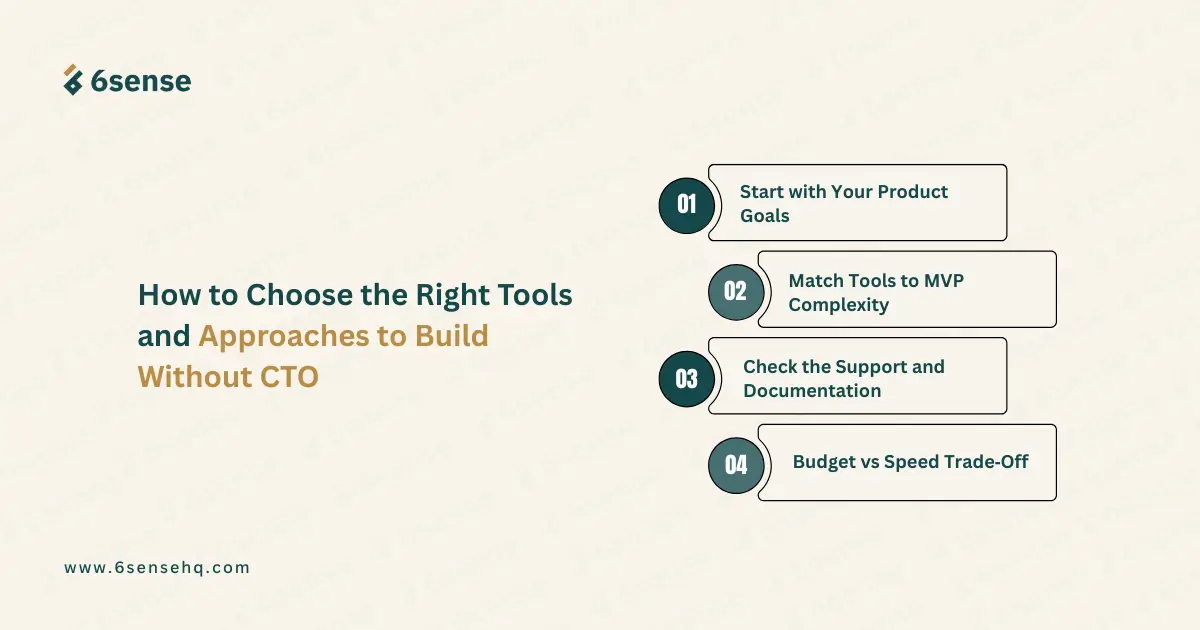
Pick tools that match what your product needs. Simple landing pages and basic workflows might only need no‑code platforms, while complex logic may need freelance developers alongside tools.
If you’re building a simple prototype to test demand, no‑code tools are often enough. For larger products, choose builders who have experience with scalable tech.
A strong community, tutorials, and documentation make it easier to learn and fix problems fast, especially when you don’t have a technical lead.
Some tools cost more but save time (e.g., premium no‑code tools), while others require more effort but cost less. Choose based on how quickly you need results.
Avoid these common pitfalls to keep your product on track and avoid unnecessary costs or delays.
Many non-technical founders assume they must immediately give away large equity percentages to secure technical help. In reality, startup equity structures are much more flexible.
| Role | Typical Equity Range |
| Technical Co-Founder | 15%–45% |
| Fractional CTO | 0.25%–1% |
| Technical Advisor | 0.1%–0.5% |
| Agency / Development Partner | Usually 0% |
Technical advisors are experienced engineers or operators who guide founders a few hours per month instead of joining full-time.
They usually help with:
This creates a middle path between:
Most early-stage investors care less about titles and more about:
A non-technical founder with:
often looks stronger than a startup with a CTO but no market validation.
When to add technical help matters. Bringing in developers too early, before you know your customers and demand, can dilute equity and slow focus on market fit.
According to research, many successful non‑technical founders choose to validate their product with no‑code or early tools and only bring technical talent once they have paying users or clear traction.
This lets you negotiate from strength, preserve more ownership, and hire the right expertise when your product needs scalable architecture or complex features.
Building a tech product without a CTO is absolutely possible in today’s startup environment. With thoughtful planning, validating ideas early, selecting the right tools, and partnering wisely with technical talent, you can get an MVP live, gather real user feedback, and iterate toward product‑market fit without giving away too much too soon.
Start simple, stay focused, and avoid common pitfalls. Over time, as you grow users and revenue, you can bring in tech talent or advisors from a position of strength.
Book a free 30-minute roadmap call to understand your product scope, timeline, and technical options
Learn whether one developer can build an MVP in 2026 with cost, scope, AI tools, low-code tips, risks, and launch advice.
22 min read