

6sense HQ vs DevToDollars: Best MVP Partner in 2026
Compare 6sense HQ and DevToDollars on MVP speed, team models, proof, pricing, and post-launch support to pick the right fit.
15 min read
Loading…
Learn how non-technical founders can build an MVP without a CTO, validate ideas, choose the right build path, and avoid costly startup mistakes.
Written by: AKM Ahsan Created on: 18 May 202615 min to read
You do not need a technical co-founder to test a serious startup idea. You need a sharp problem, a simple first version, and discipline to learn fast.
To build an MVP without a technical co-founder, start with one painful problem, define the smallest useful version, validate demand, choose no-code, freelancers, agency, or a dedicated team, then test with real users before scaling.
6sense HQ has helped 50+ non-technical founders build and launch their MVPs without a technical co-founder, using a dedicated PM-led engineering team, fixed-price delivery, and working demos every Friday. Many founders assume they need a CTO before they can start building. In reality, most successful MVPs begin with a clear problem, a focused scope, and a structured team that handles the technical execution in plain English.
This blog will guide you through key takeaways, what your MVP should include, how to build without a CTO, who can help, and how to validate before overspending.
An MVP, or Minimum Viable Product, is the simplest working version of your product that solves one real problem for users. It is not a half-finished product. It should be useful enough for people to try, understand, and give feedback on. Founders often describe it as the smallest feature set you can test or sell before adding more.
You should spend money on an MVP because it helps you avoid spending much more on the wrong product. Instead of building every feature, you test the main idea first. This helps you learn if users care, what they need, what confuses them, and whether they are willing to use or pay for the solution.
The goal is not to make the cheapest product possible. The goal is to make something simple, focused, and good enough to test the real promise. If the MVP looks too weak or feels too confusing, users may leave before you learn anything useful.
According to CB Insights research, one of the top reasons startups fail is building something nobody actually wants. That is why validation matters before full-scale development begins.
As Eric Ries explained in The Lean Startup, the goal of an MVP is not perfection, it is validated learning through the Build-Measure-Learn loop. Founders launch a simplified version, measure real user behavior, then improve based on evidence instead of assumptions.
A strong MVP is not about having more features. It will be a mostly failed MVP if you think like that. It is about proving that users care enough to try, use, or pay for the product. For non-technical founders, the goal is to build the simplest version that delivers real value, collects feedback, and helps the startup decide what to build next.
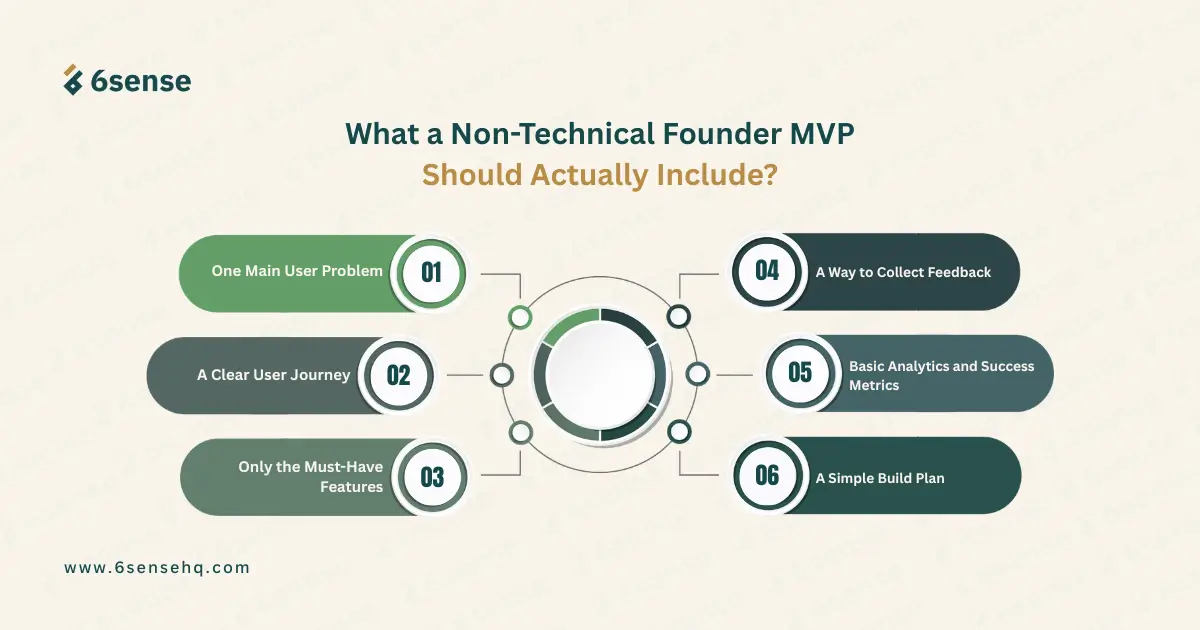
Your MVP should start with one painful problem, not a big dream product. Many founders fail because they try to build the final version first. Pick the most urgent problem your users already complain about. If that problem is strong enough, even simple MVPs can create interest and useful feedback.
Before building anything, map how a user moves from problem to result. Write the steps in plain language: sign up, add information, complete one action, get one result.
It helps developers, designers, tech founders, and testers understand the product without guessing. A clear journey also reduces confusion and saves development time.
A non-technical founder MVP should include the smallest set of features needed to deliver value. Avoid dashboards, advanced settings, complex automation, and “nice to have” ideas unless they prove the core promise.
Remember, the goal is not to impress everyone. The goal is to test whether the main solution works. This is where code tools can help you move faster, but they should not push you into building extra features too early.
Your MVP should make it easy to learn from users. Add a feedback form, short survey, onboarding call, or in-app question. You need to know where users get stuck, what they expect, and what they would pay for.
For tech founders, this feedback is useful for product decisions. For a non-technical founder, it is also useful when explaining priorities to a development partner or replacing guesswork with real user insight.
Do not launch blindly. Track simple numbers like signups, activation, feature usage, drop-offs, demo requests, and paid interest. These numbers show whether people only like the idea or actually use the product.
Well, good metrics also help you talk to investors, developers, and future team members with confidence. In MVP development, metrics help your startup decide whether to improve, pivot, or stop before spending too much.
A non-technical founder does not need to act like a technical cofounder, but they do need a simple build plan. This means knowing what to build first, what to delay, and who is responsible for each part.
Your plan can include no-code or code tools, design screens, weekly milestones, testing steps, and launch tasks. Good MVP development keeps the work focused, so your team can build, test, and improve MVPs without wasting time.
You can learn basic tech and simple software logic if your startup has time. It helps you understand developers better, but it is slow. This guide is best when the MVP is simple and you want more control.
A technical cofounder can lead the product, architecture, and software decisions. This is useful when the idea is complex or long-term. But many founders struggle to find the right person, especially before traction or strong market research.
No-code and code tools can help you test ideas faster without deep technical skills. For founders asking how to build MVP without a CTO, this is often the easiest first step. It works best for simple workflows and early validation.
Different tools fit different MVP types:
A development partner can help plan, design, build, and test your MVP when you do not have an internal tech team. For a serious startup, this guide works well when speed, quality, and structured delivery matter.
For smaller products, you may also need to decide whether one developer can realistically build your MVP or whether the project needs design, QA, PM, and backend support from the beginning.
In 2026, a fifth option emerged between no-code and hiring developers: AI-assisted build tools. Platforms like Cursor, Lovable, Bolt.new, and v0 allow founders to describe features in plain English and generate working code automatically.
For simple SaaS tools, internal dashboards, prototypes, and proof-of-concept products, these tools can dramatically reduce development costs. In some cases, founders who previously needed a $30K freelancer build can now validate an idea using $2K-5K worth of tools and advisor support.
However, AI-generated code still requires review. Security, scalability, architecture quality, and long-term maintainability remain important. For serious MVPs, founders should still validate technical decisions with an experienced PM or technical advisor before scaling.
For founders who already have investor backing, MVP development for funded startups usually needs tighter sprint planning, clearer reporting, and stronger delivery accountability.
| Option | Cost Range | Typical Timeline | Technical Skill Required | Control Level | Best For |
| Learn to Code | $0–2K | 3–6 months | High | Full | Solo founders with time |
| No-Code Tools | $0–5K | 2–8 weeks | Low | Medium | Simple MVPs and fast validation |
| Freelancer | $5K–30K | 4–12 weeks | Low | Medium | Small feature builds or prototypes |
| Agency / Dedicated Team | $30K–120K |
Cost ranges are based on scoping experience across 200+ founder MVP projects at 6sense HQ.
As a rough guide:
Before choosing a build path, it also helps to understand how to prioritize which features should exist in version one. Learn more about MVP feature prioritization frameworks before development begins.
If you want detailed pricing examples, explore fixed-price MVP development models and MVP feature cost breakdowns before requesting quotes from builders.
Real Founder Example:
One founder we worked with at 6sense HQ, a marketing consultant building a B2B workflow tool for agencies, came to us with a Google Doc brief, no technical background, and a $60K budget. Within 12 weeks, she had a working MVP, 15 beta users, and an investor interested in funding the next stage. She never hired a technical co-founder. Instead, the project was managed through a PM-led sprint process where product decisions, technical communication, and weekly demos were handled by the delivery team in plain English.
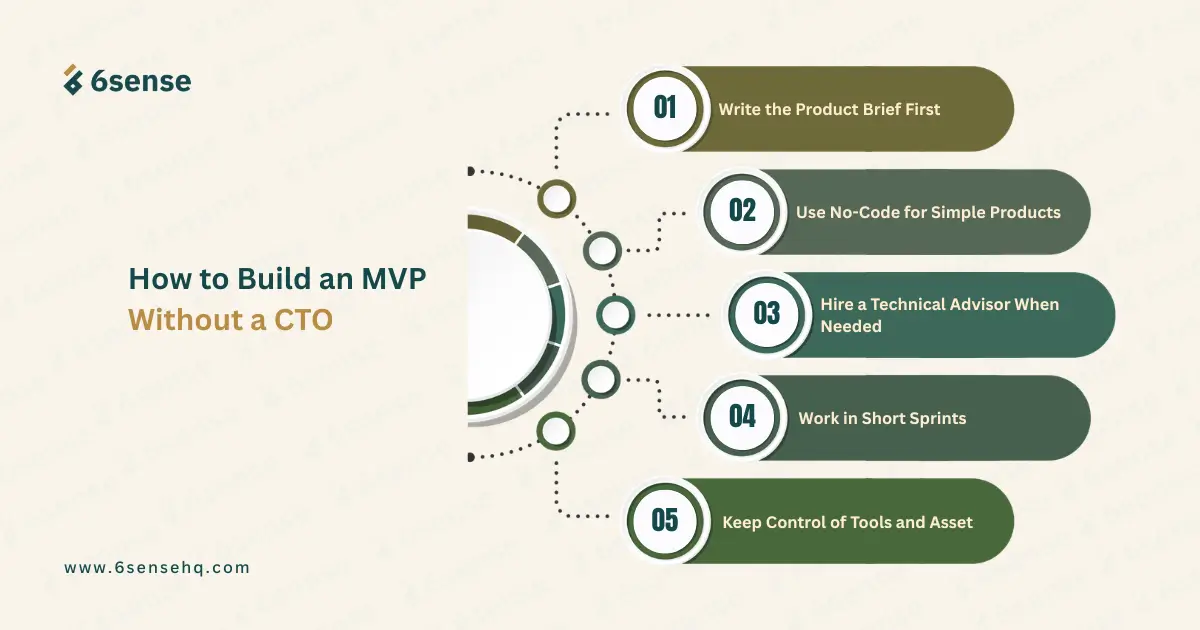
Start with a short product brief before hiring anyone. Include the problem, target user, core feature list, user journey, examples, timeline, and budget range. This brief becomes your control document.
Without it, developers may build what they think you mean, not what your users actually need.
If your MVP is a marketplace, internal tool, booking platform, directory, simple SaaS, or workflow app, no-code can help you launch faster. Tools like Bubble, Webflow, Airtable, Glide and Zapier are often enough for testing demand.
The key is knowing when no-code is enough and when custom development is needed.
You may not need a full-time CTO, but a part-time technical advisor can save you from bad architecture, weak security, poor database choices, and messy code ownership.
Even a few paid review sessions can help you check estimates, review the stack, and avoid expensive rebuilds later.
Do not give a team a huge project and disappear for two months. Break work into weekly or two-week sprints. Review progress, test features, ask questions, and document decisions.
This is also where founders need a simple system to manage developers as a non-technical founder, especially when priorities, scope, and timelines start changing during the MVP build.
Make sure your GitHub, Figma, domain, hosting, analytics, database, and documentation belong to you or your company. This is important when working with freelancers or agencies.
If the relationship ends, you should still have access to everything needed to continue building.
One of the biggest fears non-technical founders have is:
“Who will handle the technical decisions if I do not have a CTO?”
At 6sense HQ, that responsibility is handled through a PM-led delivery model.
The PM becomes the bridge between the founder and the engineering team by managing:
Instead of founders translating ideas into technical language themselves, the PM converts business goals into clear execution tasks the engineering team can build against.
Every Friday, founders review progress through working demos instead of waiting silently for months. Product decisions stay transparent, sprint priorities remain focused, and founders can guide the vision without needing deep technical knowledge.
This model solves one of the biggest problems non-technical founders face:
They get structured technical leadership without immediately giving away co-founder equity.
| Validation Step | What to Do | Why It Matters | Simple Example | Best For |
| Problem interviews | Talk to 10-20 target users. Ask about pain, workflow, cost, and current solutions. | Confirms if the problem is real. | Ask clinic owners about patient follow-ups. | Early idea stage |
| Landing page test | Create a simple page with a waitlist, demo form, or pricing interest button. | Shows real interest before building. | Add “Join the beta” form. | Testing demand |
| Manual MVP | Deliver the result manually before building full automation. | Tests value with low cost. | Manually match buyers and sellers. | Marketplace or AI ideas |
| Clickable prototype | Build a Figma or no-code demo users can click through. |
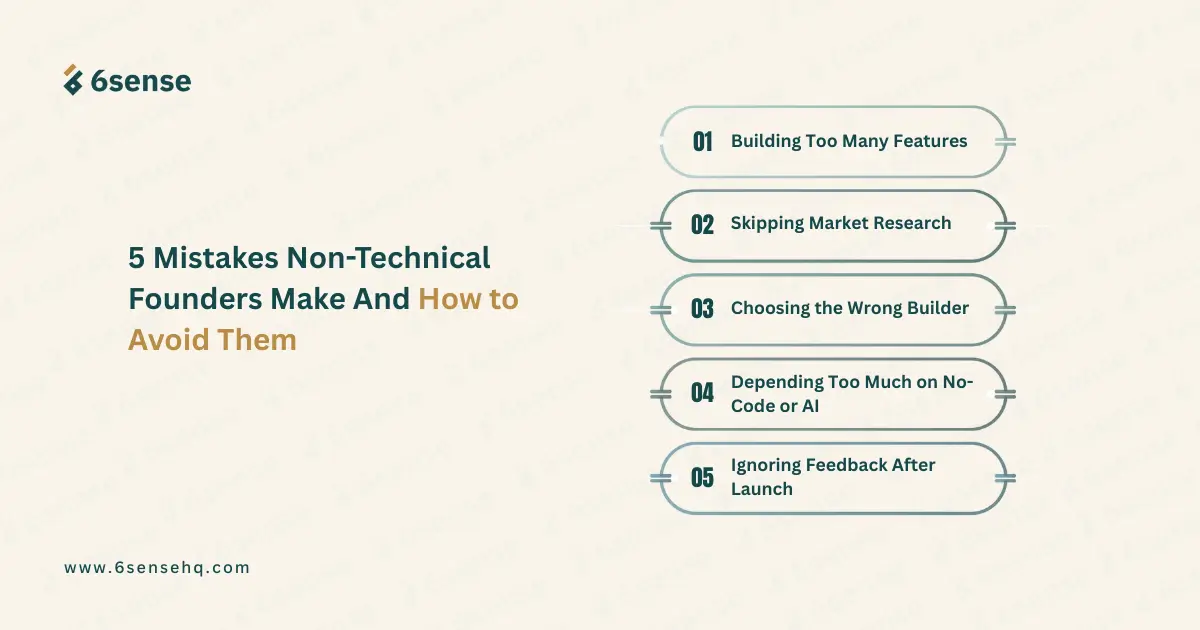
Many founders try to build the full product in version one. This makes the mvp development process slower, more expensive, and harder to test. Use a focused approach: build only the core feature that proves users want the solution.
One founder came to us with 47 planned features in the first product brief. After a 60-minute prioritization session, the list became 7 Must-Have features. The estimated build cost dropped from $130K to $58K.
Some founders start building before talking to users. That is risky because the business may solve a problem people do not care about. Before writing requirements, do interviews, study competitors, and check real complaints. Good market research helps your business avoid expensive guesses.
A cheap freelancer, weak agency, or wrong development company can create delays, poor communication, and messy handover. For a tech startup, choose people who understand MVPs, not just coding. Ask for process, milestones, ownership terms, and past startup work before you begin.
A founder hired a cheap freelancer through Upwork for $12K. Three months later, the project was only partially complete and the freelancer disappeared. Rebuilding the MVP properly later cost more than $65K.
If you are already dealing with delays, messy code, or a failed handover, it is worth learning how to start again after a failed MVP development experience before hiring the next team.
No-code and AI can help you build fast, but they are not always enough for secure or complex software. Many founders try to code MVPs without knowing limits, then rebuild later. Use this approach for testing, but review technical risks early.
An MVP is not finished after launch. It is a learning tool. If users get confused, leave, or ignore a feature, listen quickly. Track behavior, run short calls, and improve the software based on evidence, not personal opinion.
Many non-technical founders give away equity too early because they assume every technical person needs to become a co-founder. In reality, most early MVP support should be paid work, not equity partnerships.
These are service relationships, not long-term co-founder roles.
For most MVPs, paying a structured team is safer because:
A true technical co-founder usually:
If someone is only building what you already specified, that is usually a paid role, not a co-founder relationship.
A strong answer includes real founder examples, launch timelines, and product screenshots.
A strong answer explains:
A strong team explains discovery, scoping, architecture planning, and design alignment clearly.
The founder should always own:
Strong teams define:
A strong answer includes bug fixing, stabilization, analytics review, and next-step planning after MVP release.
Building an MVP without a technical co-founder is not only possible, but it is also practical when you keep the process simple. Start with one real problem, validate it before development, choose the right build path, and work with people who communicate clearly.
You do not need to know how to code, but you do need to lead the product with focus. Avoid feature overload, protect your ownership, and test with real users early. The best advice is simple: do not wait for the perfect technical partner. Build the smallest useful version, learn from the market, and improve from there.
Get expert guidance from 6sense HQ to build your MVP faster, smarter, and with a structured team behind you.
Compare 6sense HQ and DevToDollars on MVP speed, team models, proof, pricing, and post-launch support to pick the right fit.
15 min read
Compare 6sense HQ alternatives for MVP development in 2026 and find the best software team for your startup budget and goals.
17 min read
| None |
| High |
| Full MVPs with structured delivery |
| Show onboarding and dashboard screens. |
| SaaS or mobile apps |
| Pre-sale or pilot | Ask users to pay, join a pilot, or sign an LOI. | Proves stronger buying intent. | Offer a beta plan to 5 users. | B2B products |
| Competitor gap research | Study reviews, complaints, pricing, and missing features. | Finds a sharper product angle. | Spot complaints about slow onboarding. | Crowded markets |
| Usability testing | Watch users complete one core task without help. | Reveals confusion and friction. | Ask users to finish setup. | Post-prototype stage |
| Analytics review | Track signups, activation, usage, retention, and drop-offs. | Turns behavior into decisions. | Fix onboarding if setup drops. | Live MVP stage |
Learn whether one developer can build an MVP in 2026 with cost, scope, AI tools, low-code tips, risks, and launch advice.
22 min read