

6sense HQ vs DevToDollars: Best MVP Partner in 2026
Compare 6sense HQ and DevToDollars on MVP speed, team models, proof, pricing, and post-launch support to pick the right fit.
15 min read
Loading…
Learn how to build a no-code MVP, choose the right tools, reduce costs, and validate your startup idea with real users faster.
Written by: AKM Ahsan Created on: 5 May 20267 min to read
Have you ever had a great idea but didn’t know how to build it? You’re not alone. Many founders struggle with the technical steps in product creation and end up delaying or abandoning their plans.
At 6sense HQ, we’ve worked with 50+ non-technical founders who faced exactly this problem. In most cases, the issue wasn’t the idea; it was not knowing how to test it without hiring developers. That’s where no-code MVPs come in.
A modern no-code development platform allows founders to create real products quickly without needing engineering teams. Today, no-code is no longer a niche approach; by 2026, up to 70% of applications are expected to be built using no-code or low-code platforms.
In this blog, you’ll learn exactly what a No Code MVP is, how to build one, why many founders choose this path, the best no-code tools available, and how to validate your MVP with real users.
A No Code MVP is the simplest working version of a product built without writing traditional code. Instead of coding function by function, it uses visual platforms with drag‑and‑drop interfaces, templates, and integrations to create real, usable products quickly.
Most founders today rely on a visual app builder to design interfaces and workflows without touching code.
The main goal is to test your idea with real users fast and cheaply. Rather than spending months and a lot of money hiring developers, you build a product with only the essential features your users need.
This approach has exploded in adoption, surveys show that about 72% of startups now use no‑code or low‑code tools to launch apps and MVPs, showing how mainstream this method has become.
No Code MVPs are especially useful for early‑stage ideas, helping founders learn whether their concept has real demand before investing in full development. In many cases, teams also combine no-code with low-code tools when they need slight customization without full development.
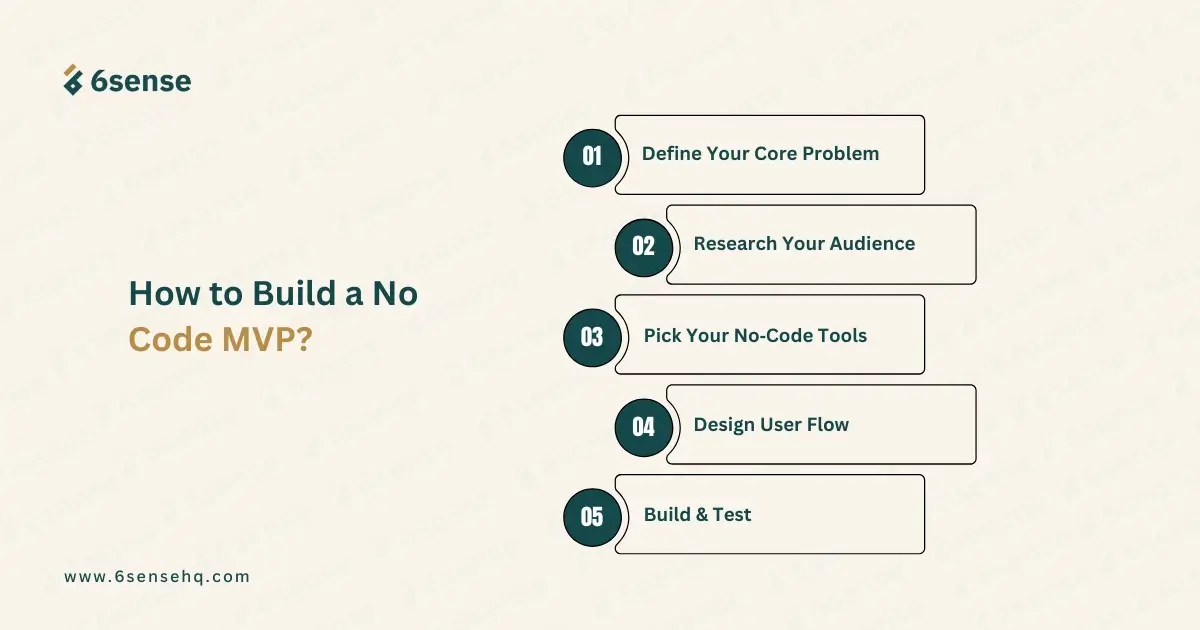
Focus on one clear problem.
Example: Instead of “fitness app,” define: → “Busy professionals struggling to track workouts.”
Before choosing a no-code platform, take time to validate your startup idea before developing the MVP.
Practical tip: Interview 10–15 potential users, examine how they currently solve the problem, and look for repeated pain points that indicate genuine demand.
Pick based on product type:
Map the simplest path: → Landing → Action → Outcome
Use visual tools → test quickly → fix issues
This approach allows founders to build without coding, reducing both time and cost significantly. In 2026, founders can build MVPs in days instead of months using no-code + AI tools.
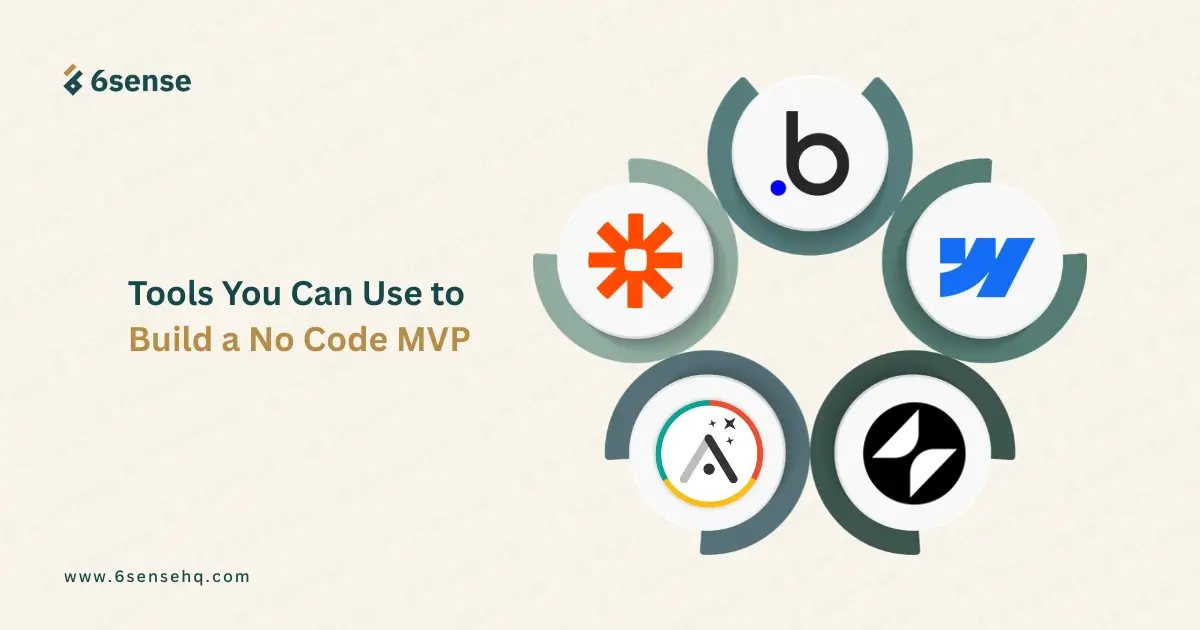
Best for: Full web apps, dashboards, marketplaces
Bubble is one of the most powerful drag-and-drop platforms, enabling complex workflows without traditional programming. Pricing: Starts ~$29/month Pros:
Cons:
Example: Many SaaS tools and marketplaces are built entirely on Bubble.
Who should NOT use it: If you only need a landing page
Best for: Marketing sites, landing pages Pricing: Starts ~$14/month
Pros:
Cons:
Insight: Webflow is ideal for validating ideas via landing pages before building products
Best for: Internal tools, simple apps Pricing: Free tier available
Pros:
Cons:
Best for: Mobile apps Pricing: Starts ~$36/month
Pros:
Cons:
Best for: Connecting tools Pricing: Free tier available
Pros:
Cons:
| Tool | Best For | Free Tier | Starting Price | Learning Curve |
| Bubble | SaaS apps | ❌ | ~$29/mo | High |
| Webflow | Websites | ✅ | ~$14/mo | Medium |
| Glide | Simple apps | ✅ | Free | Low |
| Adalo | Mobile apps | ❌ | ~$36/mo | Medium |
| Zapier | Automation |
Some of the best-known startup MVP stories show that validation does not require a complete product. Looking at how Airbnb, Uber, and Dropbox tested their earliest product ideas can help founders understand why starting small is often more effective than building every feature at once.
No-code is powerful, but not always the right choice.
Avoid no-code when:
At this stage, the founders we work with usually transition from no-code to custom builds with our engineering team, without losing the validation already done.
Below is a simple comparison based on common startup concerns for MVP when choosing whether or not to use no‑code tools. Many early-stage products today are launched as a no-code SaaS before transitioning into full custom builds.
Factual insights based on community discussions and industry guides.
| Concern | No‑Code MVP Advantage | Typical Challenge |
| Time to Market | Very fast build speed | Traditional dev takes longer |
| Cost | Low startup cost | Developer hiring is expensive |
| Skill Needed | Can be used by non‑technical founders | Requires coding expertise |
| Validation Speed | Quick feedback loop | Slow iteration with code |
| Scalability | Moderate (good first step) | Better long‑term scaling |
You should switch when:
This is where 6sense HQ typically steps in, taking a validated MVP and rebuilding it for scale with full product context.
Compare this to traditional MVP builds ($10K–$50K+), and the advantage is clear.
The biggest shift in MVP building is AI.
Tools like:
This AI-assisted approach is often described as vibe coding for MVP development, where founders use platforms such as Cursor, Bolt, and Lovable to turn natural-language instructions into testable product features. It offers more flexibility than traditional no-code tools, although generated code still requires testing, security checks, and technical review.
You need to test your MVP development with real people before spending too much time or money. These methods come from discussions makers share when building and launching early MVPs.
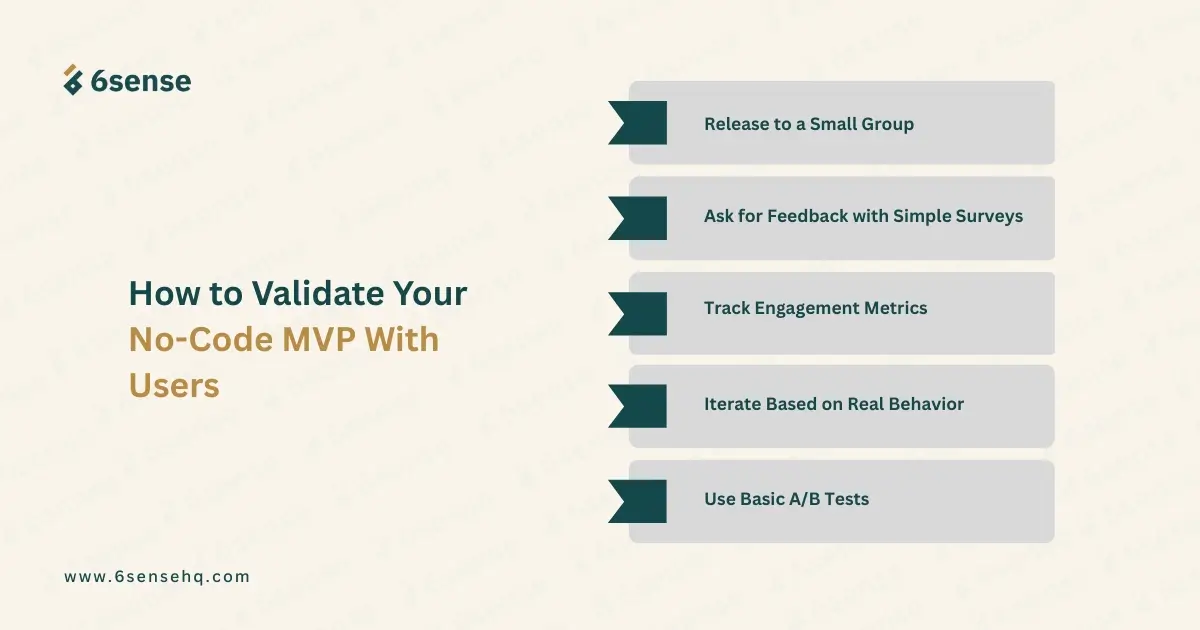
Share your MVP with a small, real group of early users. Watch how they interact with it. Don’t just listen to what they say, focus on what they actually do inside the product, like clicking buttons or making purchases.
After people use your MVP even once, ask a few clear questions about what they liked, what confused them, and what they wished were better. Short surveys give actionable feedback quickly.
Measure real usage data like sign‑ups, repeat visits, and feature use. If users keep returning or completing key steps, it shows your idea has real value and demand.
Don’t stop at feedback, change your MVP based on what users actually do, not just what they say they want. Refining based on behavior speeds up learning and makes your product more useful.
Try two versions of a feature to see which one performs better. Even small interface changes can make big differences in user behavior and help you decide which direction is stronger.
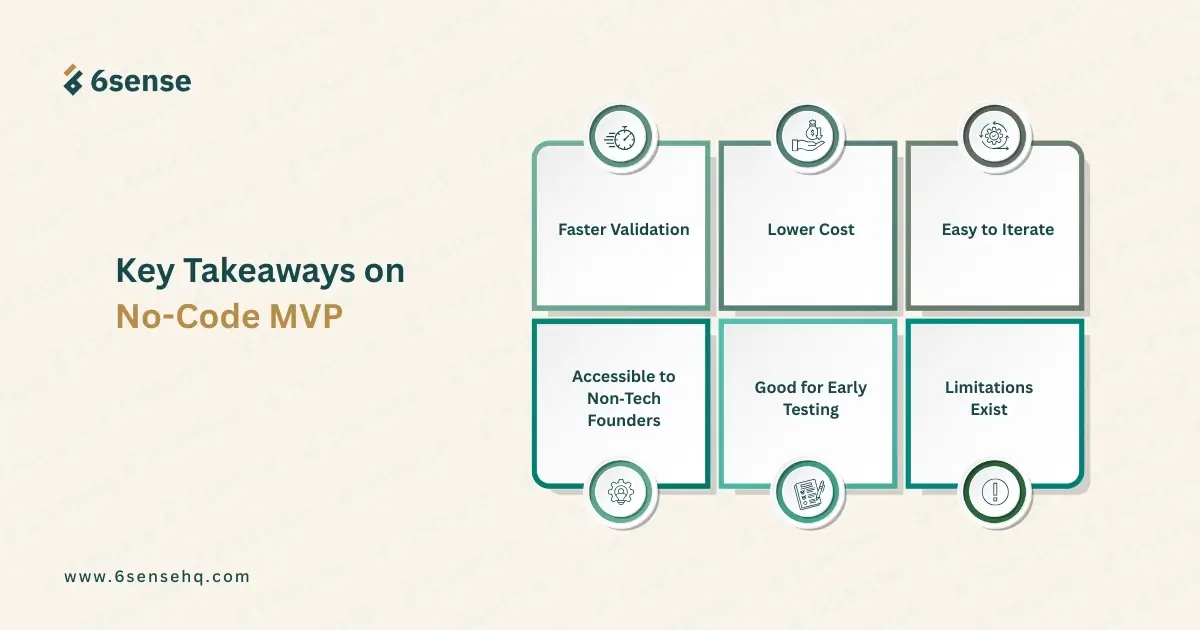
A No Code MVP is one of the smartest ways for founders to move from idea to market quickly and cost‑effectively. Instead of spending weeks building code, you can launch a working product in days and get real user feedback. Focus on core problems, pick the right tools, and follow a clear validation plan to learn fast and improve.
Don’t wait to build the perfect product, test first, learn fast, and adjust smartly.
Get professional guidance from 6sense HQ: Visit 6sense HQ for personalized support and no‑code strategies.
Compare 6sense HQ and DevToDollars on MVP speed, team models, proof, pricing, and post-launch support to pick the right fit.
15 min read
Compare 6sense HQ alternatives for MVP development in 2026 and find the best software team for your startup budget and goals.
17 min read
| Free |
| Low |
Learn whether one developer can build an MVP in 2026 with cost, scope, AI tools, low-code tips, risks, and launch advice.
22 min read