

6sense HQ vs DevToDollars: Best MVP Partner in 2026
Compare 6sense HQ and DevToDollars on MVP speed, team models, proof, pricing, and post-launch support to pick the right fit.
15 min read
Loading…
Learn how MVP development helps startups launch faster, reduce costs, and validate ideas with real user feedback. Build smarter today.
Written by: AKM Ahsan Created on: 8 Apr 20268 min to read
Many startup ideas begin with excitement, big plans, and a long list of features. But building a full product right away can be risky. That’s where MVP development comes in.
At 6sense HQ, we have guided more than 40 startups through MVP development across SaaS, fintech, and healthtech. The benefits described in this guide are not theoretical; they come from real founder journeys we’ve supported while building and launching MVP products.
Instead of spending months building something complex, startups launch a basic version first. This helps them test ideas, collect feedback, and improve the product step by step. It saves time, reduces risk, and helps founders understand what customers truly want.
In this blog, we’ll explore the real benefits of MVP development, how it validates product ideas early, how it reduces cost and risk, and why startups use it to launch faster and grow smarter.
A Minimum Viable Product (MVP) is the simplest working version of a product built with only the core features. Understanding what an MVP means in software development starts with recognizing that it is not an incomplete product. It is a focused, functional version designed to test whether people actually need or want the solution before the startup invests heavily in development. Instead of guessing what customers want, startups release a smaller version first and learn directly from real users.
Marty Cagan, founder of Silicon Valley Product Group and author of Inspired, describes an MVP as the smallest possible product that is still valuable, usable, and feasible for customers.
It is also helpful to understand the key differences between an MVP, a proof of concept, and a prototype. A proof of concept determines whether an idea is technically feasible, while a prototype demonstrates its potential design or user experience. An MVP goes further by delivering a functional product to real users so the business can evaluate actual market demand.
This perspective highlights the real purpose of an MVP: to launch something simple but functional so teams can learn from real user behaviour and improve the product through iteration.
Before diving into the specific benefits, it’s important to understand why startups prefer MVP development. Instead of building everything at once, founders focus on learning quickly and improving gradually.
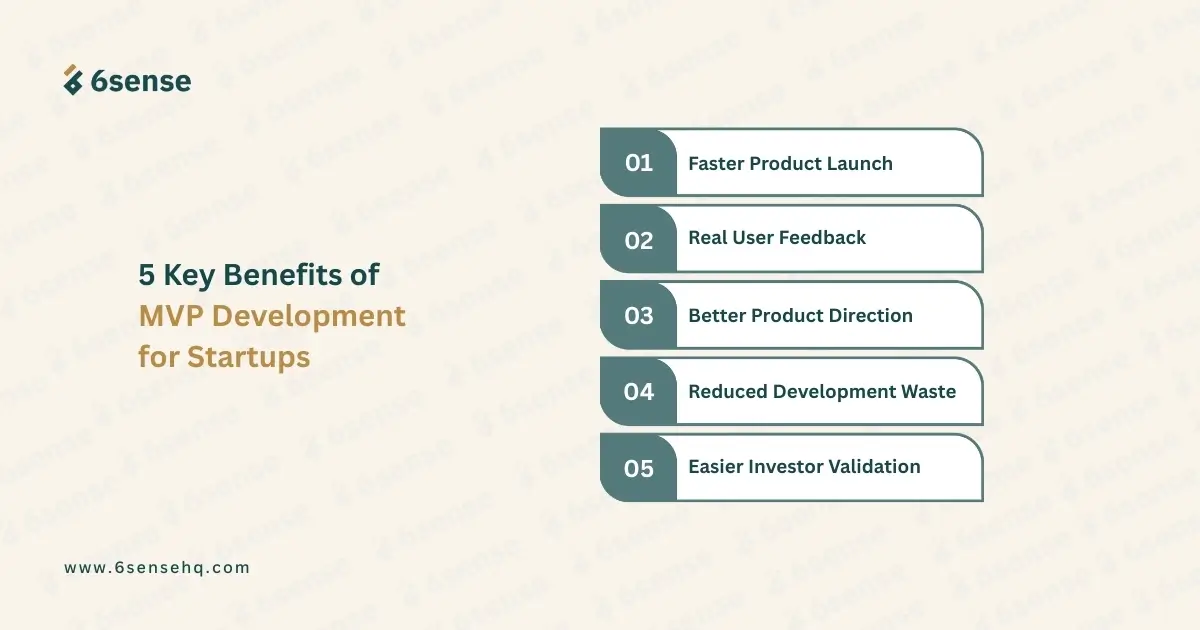
One major benefit of MVP development is speed. Instead of spending months building a complex product, startups launch a simple version quickly.
Launching early helps startups capture a first-mover advantage, entering the market before competitors and building brand recognition among early adopters.
Many MVP projects can launch in as little as 8-16 weeks, depending on complexity.
This faster launch gives startups a competitive advantage, allowing them to:
An MVP allows tech startups to gather real feedback from early adopters.
The core idea behind MVP development is “validated learning,” where teams learn from actual user behaviour instead of guesswork.
Early adopters provide insights such as:
This feedback helps founders refine their product and move closer to product-market fit.
Many startups discover that their first idea needs changes. MVP development makes this easier. Because the product starts small, teams can quickly adapt features based on user feedback.
This iterative development process allows founders to:
Instead of building large systems around untested ideas, MVP development ensures that every improvement is guided by real user behaviour.
Startups often waste time building features that users never use.
MVP development prevents this by focusing only on the core functionality that solves the primary user problem.
By eliminating unnecessary features, MVP development significantly reduces wasted development effort and lowers financial risk during the early stages of product development.
This lean approach keeps teams focused on the product’s core value.
Investors rarely fund ideas based on concepts alone. They want evidence that the product works.
An MVP gives founders something real to show investors, including:
Having a working MVP signals that the founder has validated the idea and understands the market.
Instead of presenting only a pitch deck, founders can demonstrate a real product, which significantly improves investor confidence.
One of the biggest advantages of MVP development is cost savings.
The average cost of building an MVP ranges from about $20,000 to $120,000, depending on complexity.
By comparison, building a fully developed software product can cost hundreds of thousands of dollars.
Other studies suggest that MVP development can cost 60–70% less than building a complete product from the start.
This makes MVP development particularly valuable for:
An often overlooked benefit of MVP development is the ability to start generating revenue early.
If the core problem is solved effectively, startups can:
Early customers can also become brand advocates, helping drive product-led growth through word-of-mouth and organic adoption.
Many of today’s largest technology companies began with simple MVPs.
Airbnb’s first MVP was a simple website where the founders rented out air mattresses in their apartment to conference visitors. This basic concept validated the idea of peer-to-peer accommodation before the platform expanded globally.
Key Benefit Illustrated: Faster launch and investor validation.
Dropbox famously validated its product using a simple demo video showing how the product would work. The video attracted thousands of interested users before any full product was built.
Key Benefit Illustrated: User validation and demand testing.
Spotify initially launched with a limited feature set focused purely on music streaming. Through user feedback and iteration, the company refined its recommendation systems, playlists, and subscription model.
Key Benefit Illustrated: Product direction through continuous iteration.
Building a full product without testing the idea can be extremely risky for startups. MVP development helps reduce both financial risk and wasted product development effort. However, founders must still manage the common challenges that arise during MVP development, including feature creep, unclear priorities, limited resources, technical shortcuts, and insufficient user research. Identifying these problems early helps teams maintain a focused scope and avoid delays that could reduce the advantages of the MVP approach.
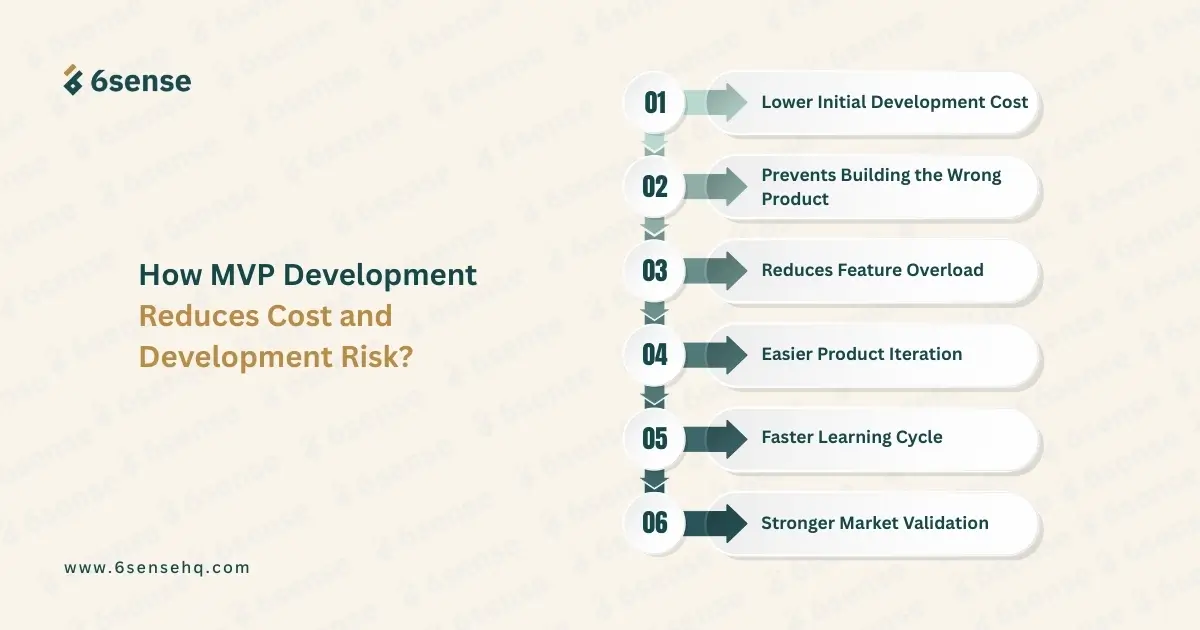
One of the biggest advantages of MVP development is cost savings. Since only the core features are built, software development requires fewer resources. Startups can test their idea without investing heavily in a full product build.
Many startups fail because they build products that nobody actually needs. MVP development helps teams validate the problem first. If users show little interest, the startup can adjust the idea early instead of losing months of work.
Many founders try to add too many features early. MVP development forces teams to focus only on essential functionality. This keeps the product simple and helps users clearly understand the value it provides.
When the product is small and simple, making changes becomes easier. Startups can quickly update features, improve usability, and adjust the product based on customer feedback without rebuilding large systems.
An MVP creates a quick learning loop. Build → launch → learn → improve. This cycle helps teams move faster and make better product decisions based on real data rather than assumptions.
When users start using an MVP, it proves that the product solves a real problem. Early adoption shows that the idea has potential. This validation gives founders confidence before scaling the product further.
| Benefit | What It Means | Key Outcome |
| Faster Launch | Build only core features first | Faster time-to-market |
| Real User Feedback | Early adopters provide insights | Better product decisions |
| Better Product Direction | Iterative development | Clear product roadmap |
| Reduced Waste | Focus only on essential features | Lower development risk |
| Investor Validation | Show real traction | Easier fundraising |
| Lower Costs | Build small before scaling | Reduced financial risk |
| Early Monetization | Start charging users earlier | Validate business model |
Speed is one of the biggest advantages of MVP development. Instead of spending a year building a full product, startups release a smaller version much earlier. This allows them to start learning from users immediately.
This ability to launch, learn, and adjust quickly explains why developing an MVP is so important for startups. It allows founders to replace assumptions with real usage data, identify weaknesses before they become expensive, and make better product decisions while the business is still flexible.
Launching early helps founders understand what users like, what features they actually use, and what needs improvement. Instead of guessing customer needs, teams rely on real data and feedback.
This approach also creates early relationships with users. Early adopters often provide valuable suggestions that help shape the future product. Over time, this feedback helps startups build a stronger product that truly solves customer problems.
MVP development has become one of the smartest strategies for startups building new products. Instead of investing significant time and money in a full product, founders can test their ideas quickly with a simpler version. This approach helps validate ideas, reduce development risk, save costs, and collect real user feedback. Companies like Airbnb, Dropbox, and Spotify all started with simple MVP versions before scaling into global platforms.
At 6sense HQ, we’ve helped founders launch MVPs that validated ideas within weeks and created the foundation for scalable products. If you are exploring an idea, starting with an MVP may be the fastest and smartest way to move forward.
Book a meeting with 6sense HQ team and discover how we can help you build and validate your MVP quickly.
Compare 6sense HQ and DevToDollars on MVP speed, team models, proof, pricing, and post-launch support to pick the right fit.
15 min read

Compare 6sense HQ alternatives for MVP development in 2026 and find the best software team for your startup budget and goals.
17 min read
Learn whether one developer can build an MVP in 2026 with cost, scope, AI tools, low-code tips, risks, and launch advice.
22 min read