

6sense HQ vs DevToDollars: Best MVP Partner in 2026
Compare 6sense HQ and DevToDollars on MVP speed, team models, proof, pricing, and post-launch support to pick the right fit.
15 min read
Loading…
Learn how AI MVP development helps startups validate faster, cut costs, choose tools, and build smarter products with user data.
Written by: AKM Ahsan Created on: 6 May 20266 min to read
Imagine launching a product so fast and smart that users love it from day one, without months of coding. That’s the power startups are chasing today with AI in MVP development.
AI in MVP development means using artificial intelligence to design, build, test, and refine minimum viable products faster and smarter than traditional methods.
At 6sense HQ, we’ve partnered with founders across SaaS, fintech, and marketplaces to integrate AI into MVPs, including recommendation engines and conversational interfaces. Our engineering team has delivered AI features for 50+ founders, such as predictive analytics; one recommendation engine prototype increased early user retention by 30%. If you want a clear persona plan, download our free 6sense HQ Non‑Technical Founder Persona Template.
In this blog, you’ll learn what AI‑powered MVPs are, why startups use them, how to build one step by step, and how to choose the right AI tools to bring your concept to life.
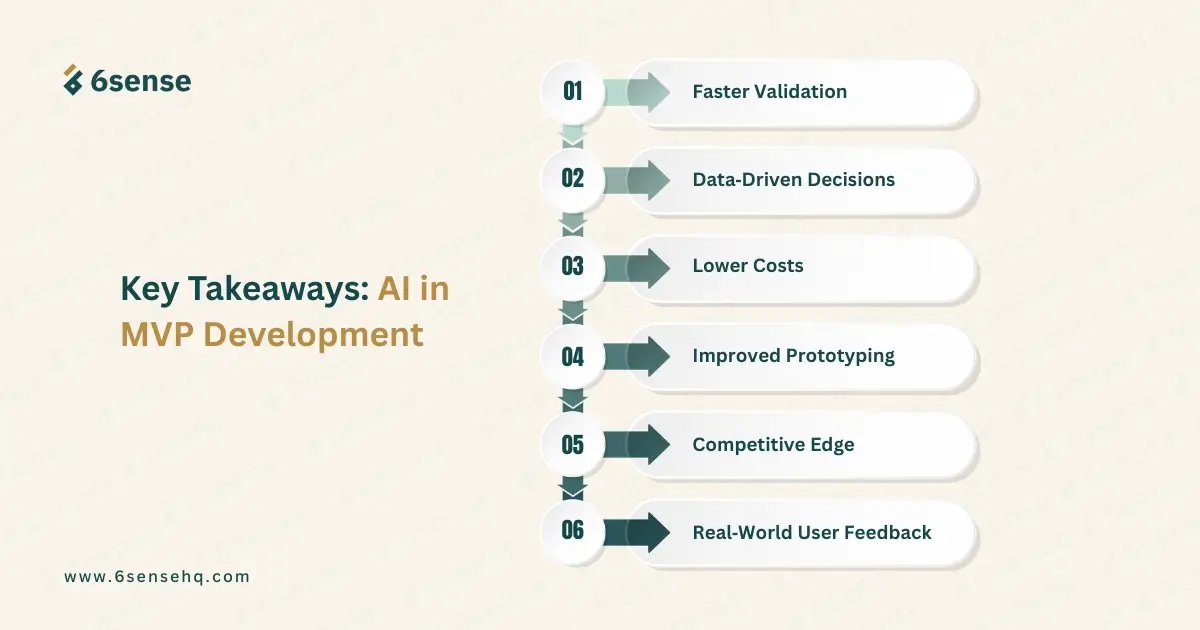
An AI‑powered MVP is an early version of a product that includes artificial intelligence as part of its core features, not just basic functionality but AI that adds value from the start. Unlike traditional MVPs that simply validate a concept, AI MVPs test whether intelligent features like recommendations, automation, or predictive analytics actually solve real user problems.
For example, startups using AI tools report that 80% of early‑stage software teams integrate AI to boost productivity, and 61% of those teams report higher profitability than teams without AI.
Examples:
Unlike traditional MVPs, AI MVPs test whether intelligence itself creates value, not just whether the product works.
| Area | Traditional MVP | AI MVP |
| Focus | Core functionality | Intelligence + functionality |
| Build speed | Weeks–months | Days–weeks |
| Decision making | Founder intuition | Data-driven insights |
| Complexity | Lower | Medium–high |
| Risk | Product risk | Data + product risk |
Here’s a practical roadmap founders follow to quickly test their AI product ideas without overspending time or resources:
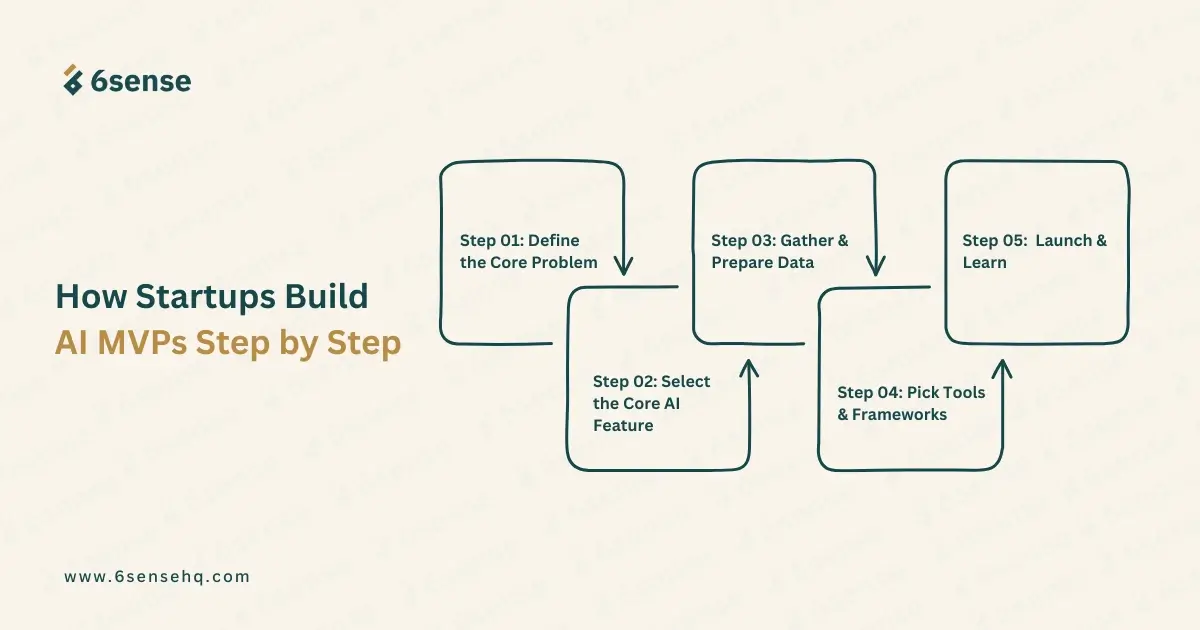
Start with a problem that AI can meaningfully improve, not just decorate.
Example: Instead of “task manager” → “AI that prioritizes tasks based on urgency and behavior”
Common mistake: Adding AI where it doesn’t add value
Focus on ONE AI feature:
Common mistake: Trying to build multiple AI features before validation for startups
You don’t need massive datasets early.
Best approach:
Tools:
Use pre-trained APIs instead of building from scratch:
Common mistake: Trying to build custom models too early
Release early → track behavior → iterate fast
What to track:
Common mistake: Waiting for perfection instead of testing early
If you’re looking for Famous MVP examples, these AI-powered startup stories show how simple early versions can validate demand before companies invest in full-scale product development.
Started as a small experimental feature inside Notion’s product. Validated demand before full rollout → now core product feature.
Launched using the OpenAI API as an MVP → Validated AI search demand before building custom models
A founder added an AI recommendation engine to their MVP in 3 weeks → Increased user engagement by 42% within the first month
Here’s a quick comparison of common challenges when integrating AI into MVPs:
| Challenge | Why It Matters |
| Data Quality | Poor data leads to weak or biased AI predictions. Good data is expensive and hard to get. |
| Complex Integration | AI must fit existing systems smoothly; integration can be technical and costly. |
| Ethical Risks | AI models can show bias or harmful behavior if not properly monitored. |
| User Trust | Users may distrust AI decisions without transparency, lowering adoption. |
| Performance Costs | AI services may increase costs with scale if not optimized early |
A major shift is happening: “vibe coding.”
Tools like:
Now allow founders to describe features in plain English and generate working code instantly.
This means:
Easy to build (API-based):
Requires technical support:
Key insight: Start simple, scale complexity only after validation
This is why most founders should start with APIs, not custom AI.
| Challenge | Why It Matters | How to Solve It |
| Data Quality | Poor results | Start with 1,000 clean samples |
| Integration | Complex systems | Use APIs instead of custom builds |
| Ethical Risks | Bias issues | Monitor outputs + filters |
| User Trust | Low adoption | Explain AI decisions clearly |
| Costs | Scaling issues | Use GPT-4o-mini before upgrading |
AI is not always the answer.
Avoid AI if:
Example: Adding AI to a simple booking tool → unnecessary complexity
AI in MVP development is not hype; it’s a practical way to build smarter, faster, and more user‑focused products. By integrating intelligence early, startups reduce risk, sharpen insight, and reach real users sooner.
The key is to stay lean: focus on meaningful AI features, validate with data, and iterate quickly based on real feedback. That’s how winning products are built today.
Reach out to the 6sense HQ team for tailored guidance on AI MVP development and launch success.
Compare 6sense HQ and DevToDollars on MVP speed, team models, proof, pricing, and post-launch support to pick the right fit.
15 min read
Compare 6sense HQ alternatives for MVP development in 2026 and find the best software team for your startup budget and goals.
17 min read
| UI generation |
| Free |
| Rapid design |
Learn whether one developer can build an MVP in 2026 with cost, scope, AI tools, low-code tips, risks, and launch advice.
22 min read