


Real Benefits of Staff Augmentation for Startups
Need to scale without long-term risk? Staff augmentation lets you add proven talent fast, control costs, and keep full ownership of delivery.
6 min read
Loading…
Not all staffing solutions are the same. Explore the types of staff augmentation models to find the right fit for your project’s speed, flexibility, and expertise needs.
Written by: Nasif Sid Created on: 22 Dec 20256 min to read
The main types of staff augmentation models are: traditional (onsite), remote, onshore, offshore, nearshore, project-based, dedicated teams, and skill-based (commodity, skilled, highly skilled). Each of these models helps businesses plug talent gaps, either temporarily or for the long haul.
Well, staff augmentation simply means bringing in external experts to work alongside your internal team without the hassle of permanent hiring. Whether you need one data analyst for a short project or a full development team for a year, there’s a model that fits.
In this blog, we’ll break down the core types of staff augmentation models, help you decide which one works best for your business needs, and highlight potential risks (plus how to avoid them).
Let’s start!
The actual models used in modern staff augmentation are: Onsite, Remote, Nearshore/Offshore, Skill-based, Project-based, Dedicated, Freelance Networks, Shadow Resourcing, and BOT (Build-Operate-Transfer). These reflect how companies really scale teams today beyond textbook definitions.
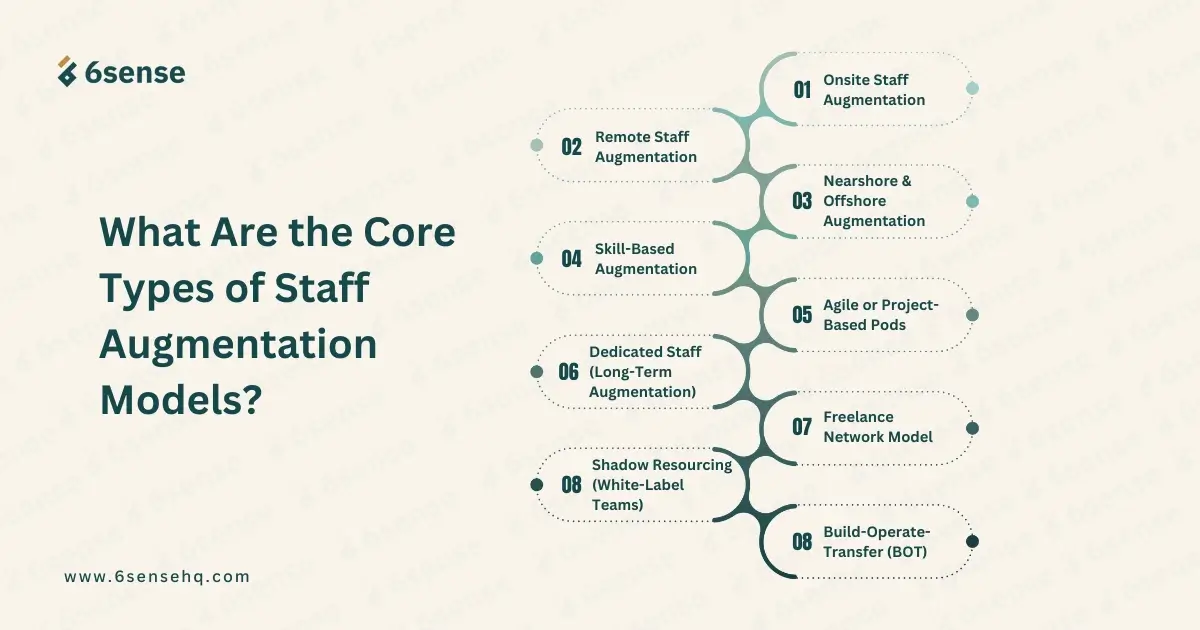
This model puts external professionals in your physical office. It’s common in industries like finance, defense, or hardware where in-person coordination or system access is key. It also helps when sensitive data can’t be shared online, or when tight collaboration is needed daily.
Remote augmentation gives you access to global talent without adding desks. It’s ideal for roles like developers, designers, or marketers. Popular among startups and bootstrapped teams, this model saves costs and taps into time-zone flexibility, though strong communication habits are a must.
Hiring talent in other countries, either nearby (nearshore) or far (offshore), is widely used for budget efficiency and 24/7 coverage. Reddit users suggest nearshore works better when you want real-time sync, while offshore is best for large-scale development with cost control.
This model focuses on hiring based on the level of skill required:
The value? You avoid overpaying for what you don’t need, and get sharp talent for what you do.
Here, you hire a mini-team, often cross-functional (PM + Dev + QA), just for a specific project. Once it's done, the team disbands. This model is common in product sprints, MVP launches, or re-platforming projects. Redditors say it reduces onboarding friction and accelerates timelines.
Dedicated staff are like full-time teammates just employed by someone else. You get consistency and cultural alignment over months or years. It’s a smart option for growing tech companies that need continuity but can’t commit to in-house hiring yet.
Think Toptal, Upwork, or Turing. You tap into a vetted freelance talent pool for short gigs. Great for filling quick gaps or testing roles before investing further. Quora users love the flexibility, but warn that quality can vary and retention is harder.
This is when an agency supplies staff who appear as part of your company. The client often doesn’t even know they’re external. It’s common in B2B SaaS and agency work. It keeps your brand experience intact, but only works if trust in the vendor is solid.
In this model, a provider builds a remote team for you, operates it under their brand, then transfers it to you when it’s mature. Often used by enterprises setting up offshore R&D centers. It blends control, cost savings, and long-term ownership.
To pick the right staff augmentation model, you need to match it with your project needs, budget, skill gaps, and timeline. It’s not one-size-fits-all. Here are the 6 real-world factors to help you decide smartly:
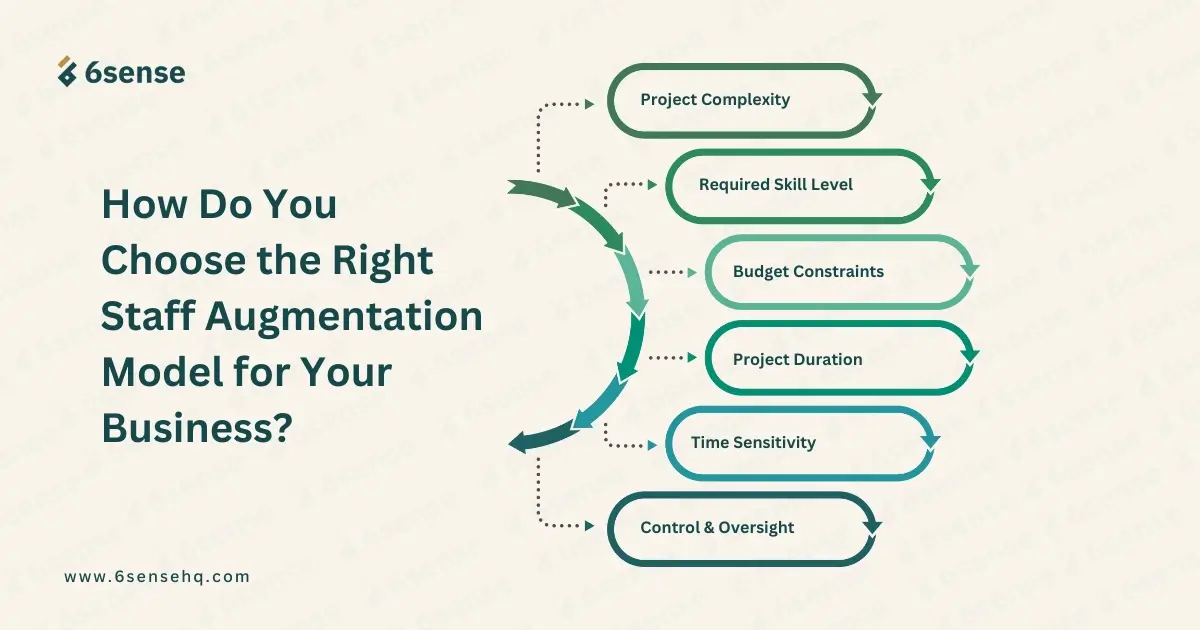
For simple or repetitive tasks like data entry or customer support, a commodity or mid-level skill-based model works fine. But if you’re working on a product launch or system migration, go for agile pods or dedicated teams.
Also, complex projects often require people who can collaborate closely and think long-term.
If your project needs rare tech expertise like AI, cybersecurity, or DevOps, you’ll need highly skilled professionals. Specialized staff augmentation helps you skip the long hiring cycle. A study shows it takes 42 days on average to hire a skilled IT pro, so tapping into ready-to-go talent saves time.
Offshore and freelance models can cut costs by 30-50%, making them perfect for startups or lean teams. But with lower costs, you may face language barriers or time zone issues. Onshore and nearshore options may cost more but give better communication and cultural alignment, especially important for client-facing projects.
Short-term needs like bug fixes or seasonal campaigns? Use project-based or temporary staffing. For longer work like platform upgrades or continuous product development, dedicated teams or hybrid models are better. They offer more consistency and let external staff blend with your in-house team workflows over time.
You need to choose providers with pre-vetted talent pools who can onboard within 48-72 hours. Platforms like Turing or Toptal focus on speed. According to LinkedIn data, top candidates are hired within 10 days, so fast access is key if you're on a tight delivery schedule.
If you want to stay hands-on, interviewing, assigning tasks, and managing daily work go with traditional or dedicated augmentation. But if you’d rather focus on outcomes and let someone else manage the existing team, hybrid or managed service models are better. They let you delegate without losing visibility on results.
Understanding when to use different models is just as important as understanding what they are.
Think of it like renting vs. leasing: project-based is short and sharp; long-term is strategic and stable.
Augmented staff is flexible and fast, but like any strategy, it comes with a few risks. The key is knowing what those risks are and planning ahead.
Here’s a quick table showing the most common challenges and how to deal with them effectively:
| Risk | Solution |
| Misalignment with internal teams | Conduct proper onboarding and regular sync-ups |
| Time zone and communication issues | Choose nearshore partners or set clear communication protocols |
| Data security concerns | Sign NDAs, use secure access tools, and work with trusted vendors |
| Hidden costs | Clarify billing terms, including overtime, tools, and licensing |
| Overdependence on external talent | Use augmentation as a bridge while building internal capability |
| Cultural mismatch | Pre-screen for soft skills and cultural fit during interviews |
Staff augmentation isn’t just a backup plan anymore; it’s a smart, scalable strategy for growing teams and getting work done faster. Whether you're building a new product, facing a hiring freeze, or need expert skills for a short-term task, choosing the right approach matters.
The types of staff augmentation models available today give you the flexibility to match talent with specific needs, timelines, and budgets. Just make sure you have a clear plan and a trusted partner. That’s how you stay competitive in today’s market.
Ready to make smarter hiring moves? Discover growth tools that actually deliver at 6sense HQ.
Need to scale without long-term risk? Staff augmentation lets you add proven talent fast, control costs, and keep full ownership of delivery.
6 min read
Staff augmentation can supercharge your team, but it’s not a one-size-fits-all solution.
7 min read
Understanding the right pricing model for staff augmentation can save costs and maximize the value of your external team.
6 min read