


Types of Staff Augmentation Models for Startups
Not all staffing solutions are the same. Explore the types of staff augmentation models to find the right fit for your project’s speed, flexibility, and expertise needs.
6 min read
Loading…
Both staff augmentation and outsourcing promise flexibility and speed, but the right choice depends on how you want to build and scale your team.
Written by: Nasif Sid Created on: 29 Sept 20258 min to read
When you need extra hands for a project, the first question is often: Should you add people to your team or hand the whole job to someone else? While both are forms of outsourcing, staff augmentation is actually a more flexible subset of outsourcing, one where you retain control of the work while scaling your team with external talent.
That’s the main difference in staff augmentation vs outsourcing, control stays with you in one, shifts in the other.
Staff augmentation means you hire skilled professionals to join your team temporarily. Outsourcing, on the other hand, gives full responsibility to an external team that manages everything from start to finish.
Choosing between the two depends on your goals, timeline, and how involved you want to be. In this blog, I’ll explore their key differences, pros, cons, types, and which one fits your business best.
Let’s start, then!
While both fall under the umbrella of outsourcing, staff augmentation is a more flexible, controlled subset. It’s like renting talent to work under your direction, whereas traditional outsourcing is like handing over the keys to an external team to run the show.
Let’s find out the differences between staff augmentation vs outsourcing:
| Feature | Staff Augmentation | Outsourcing |
| Team Composition | External hires are integrated into your in-house team | Entirely external team, working independently |
| Control & Management | You maintain full control over tasks and workflow | Vendor manages project execution and deliverables |
| Cost Model | Paid hourly or monthly, depending on resource usage | Often fixed project cost or milestone-based payments |
| Use Case | Filling temporary skill gaps or scaling the team temporarily | Delegating entire projects or non-core functions |
| Flexibility | Highly scalable resources up or down as needed | Moderate, changes often require contract adjustments |
| Onboarding Time |
Staff augmentation comes with several great benefits that can help your business grow without the stress of traditional hiring. From saving costs to having more control, here’s why many companies are choosing this model over others:
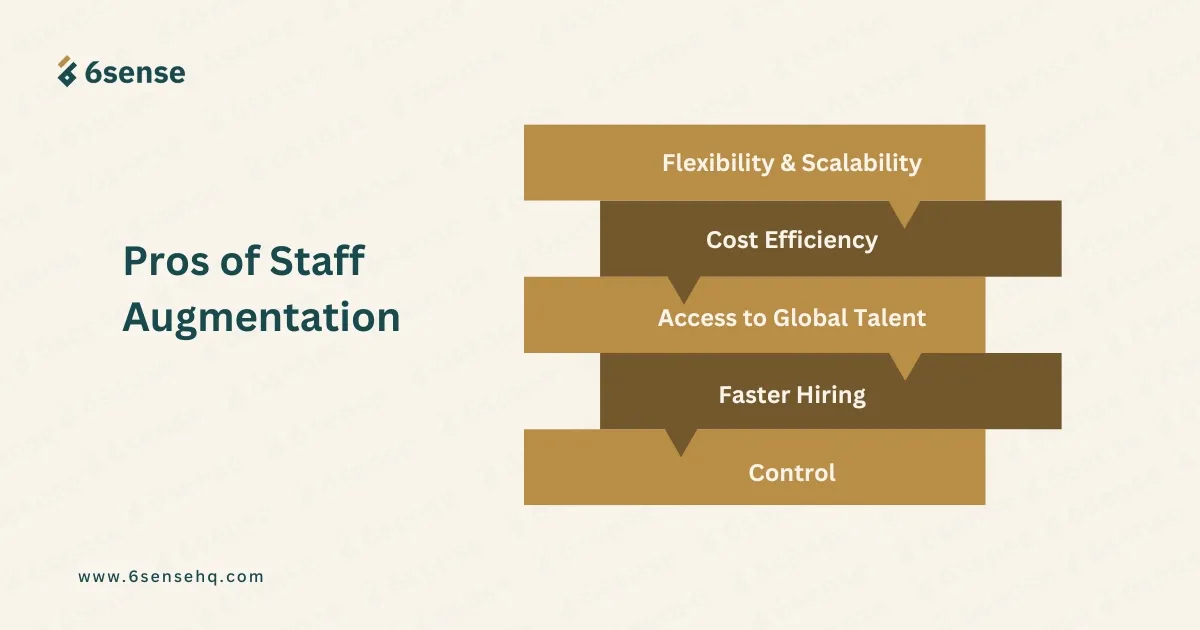
One of the biggest perks is the ability to quickly adjust your team size. If your project suddenly grows or slows down, you can scale your workforce up or down without hassle. This flexibility means you only hire the help you need, exactly when you need it, no long-term commitments required.
You save money because you're not hiring full-time employees. That means no paying for benefits, office space, or long onboarding processes. You just bring in skilled professionals for the time you need them, which keeps your project budget in check.
With staff augmentation, you’re not limited to local talent. You can hire top experts from anywhere in the world. It opens doors to highly skilled professionals who may not be available nearby, helping you get the exact expertise your project needs.
Finding the right talent can take months with traditional hiring. Staff augmentation lets you skip the long recruitment process. The professionals are already trained and experienced, so you can get them on board fast and start working right away.
Even with outside help, you stay in charge. Augmented staff work under your direction and within your systems. You manage tasks, timelines, and goals just like you would with your in-house team, giving you full control over the outcome.
While staff augmentation offers many advantages, it also has some downsides you should be aware of. These challenges can affect team dynamics, communication, and long-term goals if not managed carefully.
Here are a few common issues companies face:
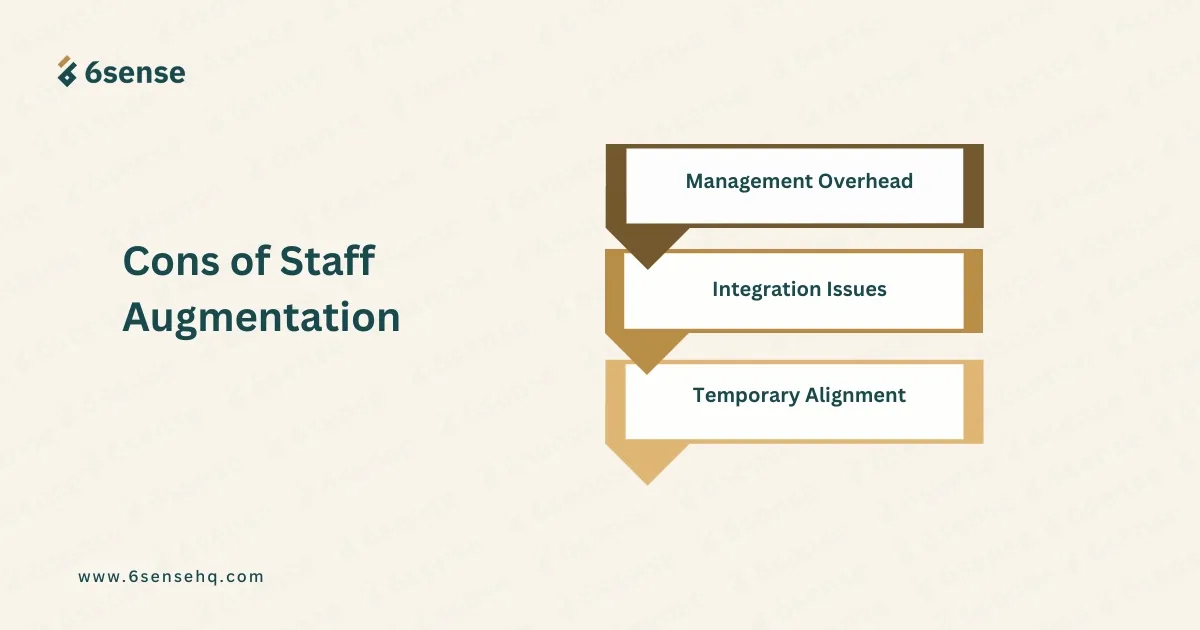
Bringing in more people means your internal team, especially managers, has to supervise and coordinate more tasks. This can increase pressure on team leads who now have to align in-house and external staff. If your project managers are already stretched thin, this extra load can slow down progress and cause confusion.
Augmented staff often come from different countries, which can lead to time zone gaps, language barriers, or cultural differences. These things can make communication tricky and delay collaboration. Without proper onboarding or tools in place, your team might struggle to stay connected and work smoothly as one unit.
Since augmented staff are brought in for short-term work, they may not feel truly connected to your company’s bigger mission or long-term plans. They’re focused on finishing their tasks, not growing with your team. This limited commitment can sometimes affect motivation and consistency in quality over time.
Outsourcing can be a game-changer for companies that want to get things done faster and smarter. It’s a great way to reduce workload, tap into expert help, and stay focused on what matters most for your business.
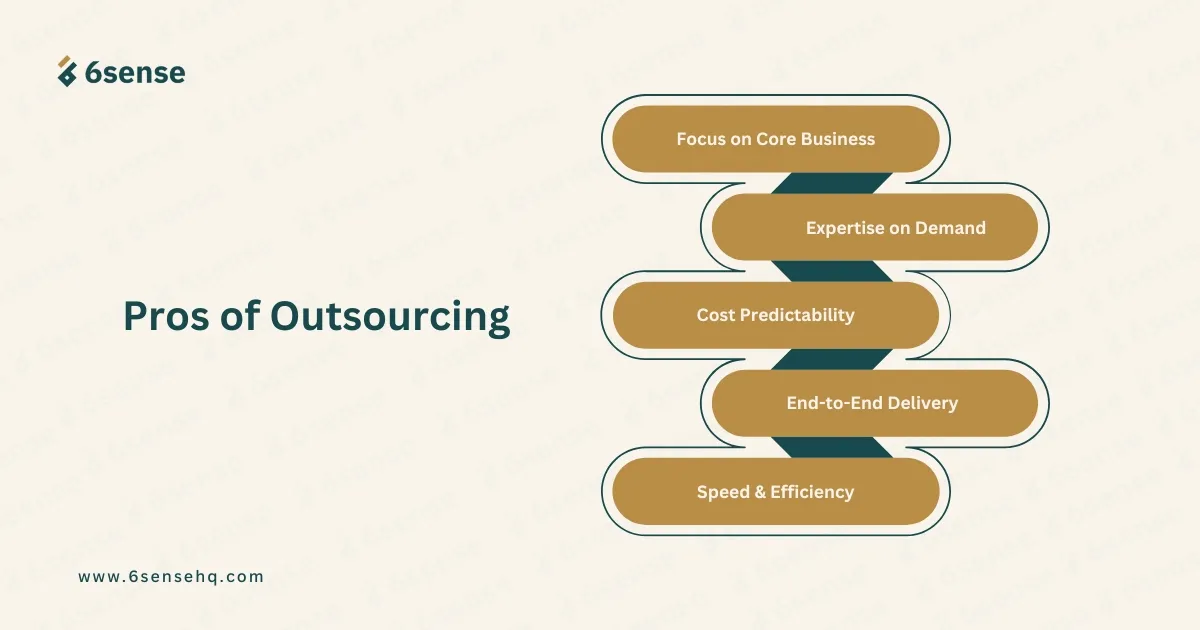
Outsourcing lets your team focus on what they do best. Instead of spreading your staff thin with extra tasks, you can hand off non-core work to external partners. This means your internal resources can stay focused on strategy, growth, and high-priority projects that truly move the needle.
Need experts in a specific tech stack or industry? Outsourcing gives you access to full teams with the skills you don’t have in-house. Whether it’s software development or data analytics, vendors already have specialists ready to jump in and deliver quality results fast; no training required.
With software outsourcing, you usually agree on a fixed price and timeline before the work begins. This helps you plan your budget with fewer surprises. You don’t have to worry about hourly billing, long hiring cycles, or extra expenses; everything is clearly defined in advance with service-level agreements.
When you outsource, the vendor takes care of everything from design to development to testing. You don’t have to micromanage each step. Instead, you get regular updates and finished deliverables. This saves your team time while still ensuring the job gets done professionally and on schedule.
Outsourcing companies usually have tried-and-tested workflows, tools, and teams already in place. That means they can start your project quickly and work faster without waiting for setup. This built-in efficiency helps you meet deadlines and launch products or services sooner than if you built everything from scratch.
Outsourcing can save time and money, but it’s not without its downsides. If not managed carefully, it can lead to miscommunication, security issues, or unexpected expenses. Like other pros and cons, here are some common challenges businesses face when outsourcing work.
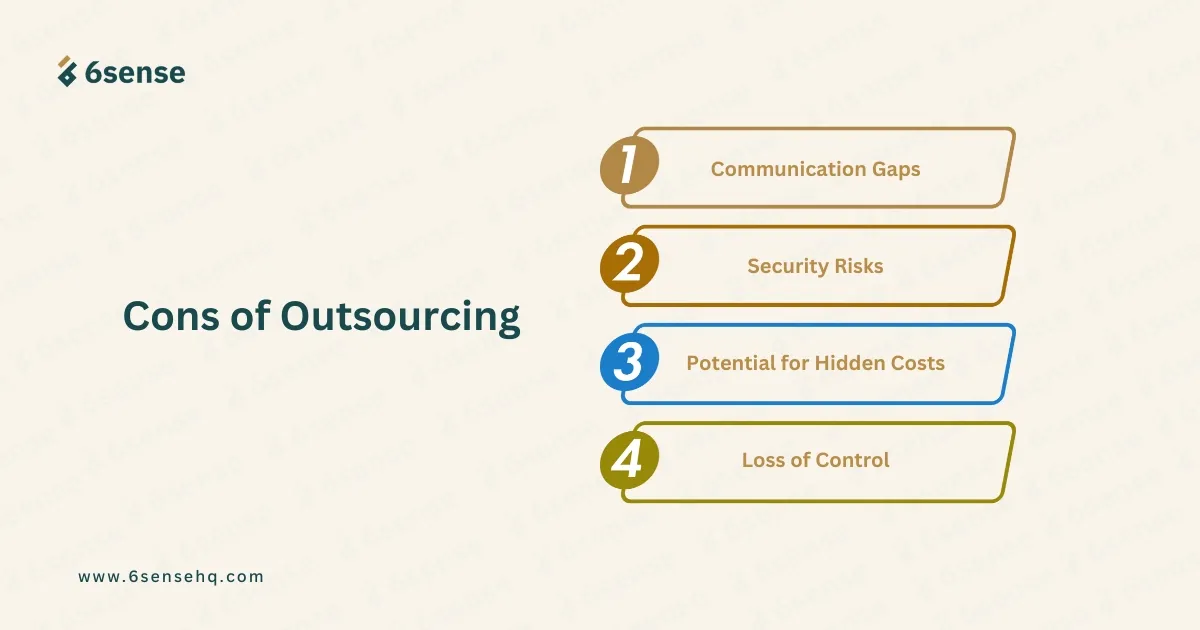
When you outsource a project, you’re trusting another team to manage it their way. Their methods might not match how your company usually works. It can lead to differences in quality, missed expectations, or delays, especially if the vendor doesn’t fully understand your goals or brand.
Working with a team in another country can create challenges. Time zone differences, language barriers, and cultural misunderstandings can make communication harder. This might slow down the project, cause confusion, or lead to mistakes if everyone isn’t on the same page.
Sharing sensitive business information with an outside vendor always carries some risk. If the vendor doesn’t have strong security practices, your data or intellectual property could be exposed. Without clear contracts and trust, there’s a chance of privacy breaches or non-compliance issues.
Outsourcing might seem cost-effective at first, but unexpected expenses can pop up. If the project scope changes or you need extra revisions, those often come with added charges. Without clear terms upfront, your budget can grow quickly and catch you off guard.
Which model is right for you, staff augmentation or outsourcing, depends on what your business needs right now. If you already have an internal team and just need to add specialized skills for a short period, staff augmentation is the smarter choice.
It gives you control over the team, lets you scale quickly, and keeps your processes in-house. This model works best when you want external help but still want to manage the work yourself.
On the flip side, outsourcing is better when you don’t have the internal team to build something from scratch or you want minimal involvement in day-to-day execution. It allows you to delegate an entire project to a vendor who handles everything from start to finish. This is a great option when you're prioritizing cost, speed, and end-to-end delivery.
Companies like 6sense HQ often use a mix of both approaches depending on project complexity, urgency, and available resources.
When it comes to choosing between staff augmentation and outsourcing, there’s no perfect answer for everyone. It really depends on your project goals, timeline, team capacity, and budget. If you want more control and just need to fill short-term skill gaps, staff augmentation is a good fit.
But if you're looking for a complete solution with less involvement on your end, outsourcing may be the better option. In the staff augmentation vs outsourcing debate, the best choice is the one that fits your needs right now. Sometimes, using both models together works best.
Looking to scale fast or outsource smart? 6sense Technologies is your go-to partner. Reach out to us and let’s build something great.
Not all staffing solutions are the same. Explore the types of staff augmentation models to find the right fit for your project’s speed, flexibility, and expertise needs.
6 min read

Need to scale without long-term risk? Staff augmentation lets you add proven talent fast, control costs, and keep full ownership of delivery.
6 min read
| Quickly, individuals are added directly into your current systems |
| Slower, requires full project scoping before execution begins |
| Cultural Alignment | Easier, team members blend with your existing culture and tools | Harder, vendor teams may have different practices and values |
| Responsibility | Client is accountable for outcomes | Vendor is accountable for outcomes |
| In-House vs Remote | Usually remote, but works closely with your internal team as if in-house | Fully remote, operates independently outside your team and systems |
Staff augmentation can supercharge your team, but it’s not a one-size-fits-all solution.
7 min read