

SaaS Development Process: Step-by-Step Guide for Success
Master the SaaS development process with our step-by-step guide on planning, building, and scaling a successful cloud product.
8 min read
Loading…
Choosing the right SaaS development methodology is key to growth. Learn how Agile, Lean, and DevOps can help scale your startup.
Written by: AKM Ahsan Created on: 23 Apr 20266 min to read
Building a successful SaaS product sounds exciting, but most founders hit the same wall, how do you actually build it the right way? That’s where development methodologies come in.
SaaS development methodologies are structured frameworks used to plan, build, and scale cloud-based software products. The four core approaches are Agile (iterative sprints), Lean (fast validation), DevOps (continuous deployment), and Waterfall (sequential execution). Most modern SaaS startups rely on Agile or hybrid Agile-DevOps models to balance speed and scalability.
In this blog, we’ll break down SaaS development methodologies in simple terms. You’ll learn what they are, the most common types, how to choose one, and when to use each in real situations.
SaaS development methodology is simply the structured way a team plans, builds, tests, and launches a SaaS product. It defines how work is organized and how teams move from idea to a working product.In software engineering, working without a defined process is often referred to as “cowboy coding”, a style where developers operate with little coordination or structure, often leading to poor collaboration and unstable outcomes.”
Statistically, over 70% of modern software teams use Agile-based approaches today, showing how important structured methods are in SaaS development.
Without a defined methodology, SaaS projects often suffer from scope creep, delays, and wasted development effort. This makes methodology choice a critical business decision, not just a technical one.
Most SaaS teams today follow a few proven methods that help them manage speed, quality, and changes effectively while building scalable products.
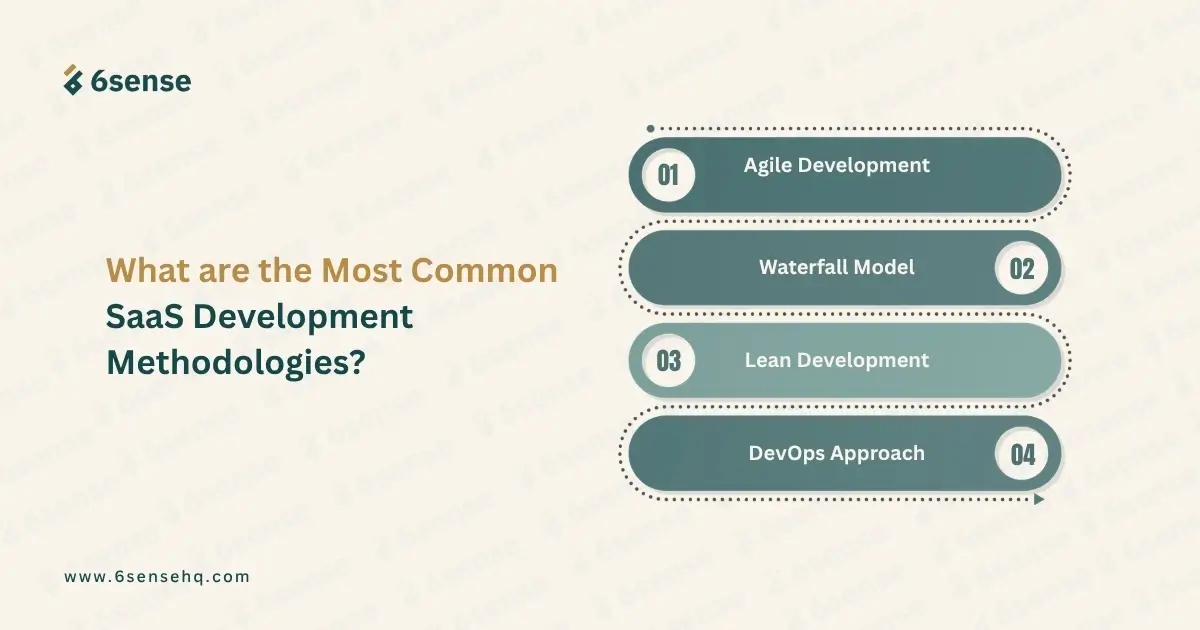
Agile is the most widely used method in SaaS applications.
Spotify uses Agile through its “squad model,” allowing small teams to iterate independently and release features quickly.
Agile teams deliver software up to 30–40% faster compared to traditional models. Also, At 6sense HQ, Agile is typically used for MVP builds where rapid iteration and feedback are critical.
Waterfall follows a step-by-step process where each stage is completed before moving forward.
SAP uses Waterfall for large-scale ERP systems where requirements are clearly defined and changes are limited.
Lean focuses on reducing waste and building only what users truly need.
Slack started as a Lean product, testing early with small teams before scaling into a full platform.
Lean approaches can reduce time-to-market by up to 50% by avoiding unnecessary features.
DevOps connects development and operations teams to improve speed and reliability.
Amazon AWS uses DevOps with “two-pizza teams” to enable continuous deployment and rapid scaling.
High-performing DevOps teams deploy up to 200x more frequently.
Choosing the right methodology can decide whether your SaaS product grows or struggles.
A mismatch between methodology and product needs can lead to:
For example:
Choosing the right methodology is not about trends. It’s about understanding your product, team, and goals before making a decision that will guide your entire software development process.
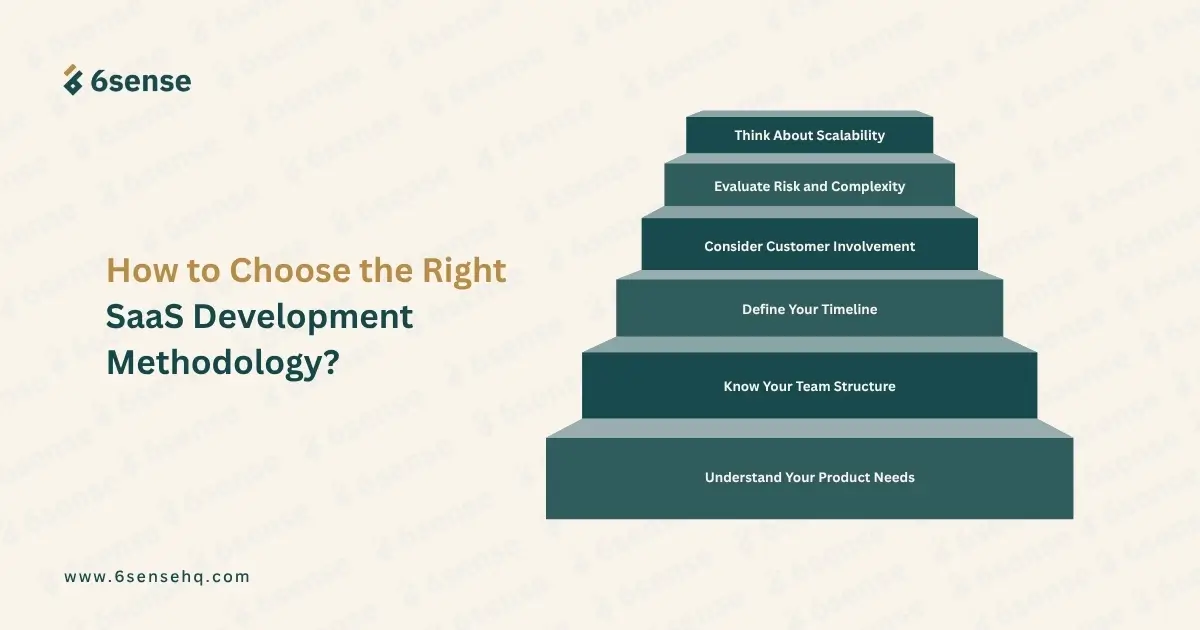
Start by identifying whether your modern SaaS product development will change frequently or stay stable. If your idea evolves often, Agile is a better fit. If everything is clearly defined from the start, a structured approach like Waterfall may work better.
Your team’s size and experience matter a lot. Smaller, flexible teams usually perform better with Agile or Lean. Larger teams with strict roles may benefit from structured methods that clearly define responsibilities and workflows.
If you need to launch quickly, methods like Agile or Lean are ideal because they support faster iterations. For long-term projects with fixed deadlines, a planned approach like Waterfall may be more suitable.
If your users need to give feedback during software development, choose Agile. It allows continuous feedback and improvements. If user input is limited, a linear approach can work without constant changes.
Complex software as a service products with high risks often benefit from iterative methods. These allow teams to test and adjust early. Simple projects with low uncertainty can follow a more structured development path.
Choose a methodology that supports future growth. SaaS products often scale quickly, so flexible methods like Agile or DevOps help teams adapt without rebuilding SaaS development processes later.
Most successful SaaS companies do not follow a single methodology.
Common combinations:
Hybrid approaches work best when teams need both speed and stability. However, mixing methods without clarity can create confusion, so alignment is critical.
Choosing between methodologies depends on your project type, team structure, and how often your requirements are expected to change during software development and growth.
| Situation | Agile | Lean | Waterfall | DevOps (NEW) |
| Requirement changes | Frequent | Moderate | Fixed | Continuous |
| Speed | Fast | Very fast | Slow | Very fast |
| Flexibility | High | High | Low | High |
| Best for | Startups | MVPs | Enterprise | Scaling SaaS |
| Feedback | Continuous |
At 6sense HQ, methodology is chosen based on product stage and complexity.
This approach ensures:
Most SaaS products evolve through different methodologies:
SaaS development methodologies are not just technical choices; they shape how your product grows. The right method helps your team stay aligned, move faster, and deliver better results.
Agile, Lean, and Waterfall each have their place. What matters is choosing based on your product needs, not trends. Many successful SaaS companies even mix methods to fit their workflow.
If you’re building or scaling a SaaS app, take time to understand your SaaS development process. A clear methodology can save time, reduce risk, and improve outcomes.
Talk to our expert team at 6sense HQ today to build smarter SaaS products faster with the right development methodology and guidance.
Master the SaaS development process with our step-by-step guide on planning, building, and scaling a successful cloud product.
8 min read
Learn why SaaS development is faster and more scalable than traditional software. Compare deployment, cost, and cloud agility.
9 min read

| Limited |
| Automated loops |
| Risk handling | Adaptive | Reduces waste | Hard to adjust | Automated mitigation |
| Team size (NEW) | Small–medium | Small | Large | Medium–large |
Master the SaaS development process in 2026. Learn about costs, tech stacks, and best practices to build and scale your cloud software.
11 min read